If you have ever paused mid-sentence wondering whether to write “a hour” or “an hour,” you already know why articles in English grammar cause so much confusion. These three tiny words, a, an, and the, are some of the most overused, underused, and misused words in the language. However, once you understand the logic behind them, the guesswork disappears completely.
If you want to learn more about direct and indirect speech rules tips and expert advice.
In this guide, we will break down every rule in plain language, share real examples, and give you a few tables you can bookmark for quick reference. So, let’s get started.
If you want to learn more about modal verbs in english tips and expert advice.
What Are Articles in English Grammar?
Articles are small words placed before nouns to show whether the speaker is talking about something specific or something general. English has only two kinds of articles: the indefinite articles (a, an) and the definite article (the). That’s it. No hidden categories, no exceptions hiding around every corner. Articles are technically classified as a type of determiner within the broader parts of speech system, so if you’re brushing up on the basics, that’s a natural place to start.
If you want to learn more articles in english grammar tips and expert advice.
For instance, when you say “I saw a cat,” you mean any cat, not a particular one. But when you say “I saw the cat that scared us yesterday,” you’re referring to one specific cat that both you and the listener already know about. This distinction is the entire foundation of the topic, and once it clicks, everything else becomes much easier.
If you want to learn more conditional sentences rules tips and expert advice.
Definite Article vs Indefinite Articles
The word “the” is called the definite article because it points to something definite, meaning specific and already identified. Meanwhile, “a” and “an” are indefinite articles because they refer to something non-specific, or something being mentioned for the first time.
If you want to learn more gerunds and infinitives rules tips and expert advice.
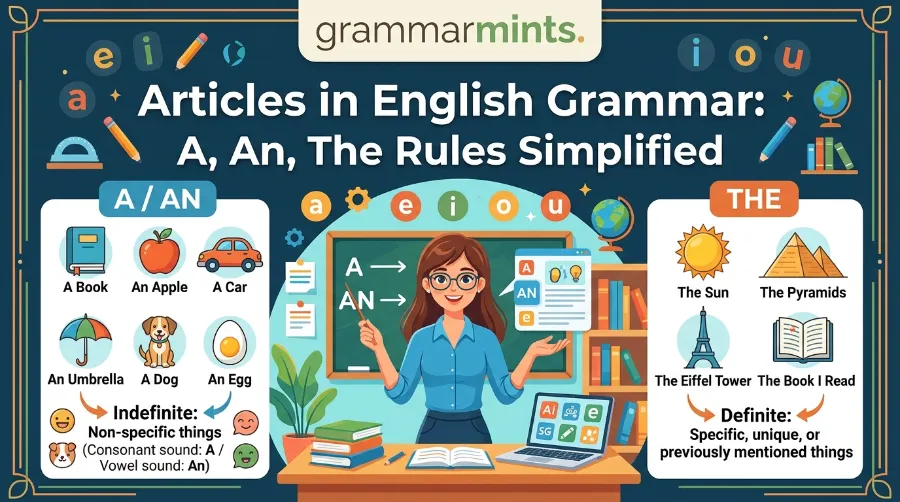
Here’s a simple way to remember it: definite means “we both know exactly what I mean,” while indefinite means “I’m just introducing something new.” Once you start thinking this way, choosing the right article becomes almost automatic.
Rules for Using “A” and “An”
Many learners assume the choice between “a” and “an” depends on whether a word starts with a vowel or a consonant letter. That assumption is close, but not quite correct, and it’s actually where most mistakes happen.
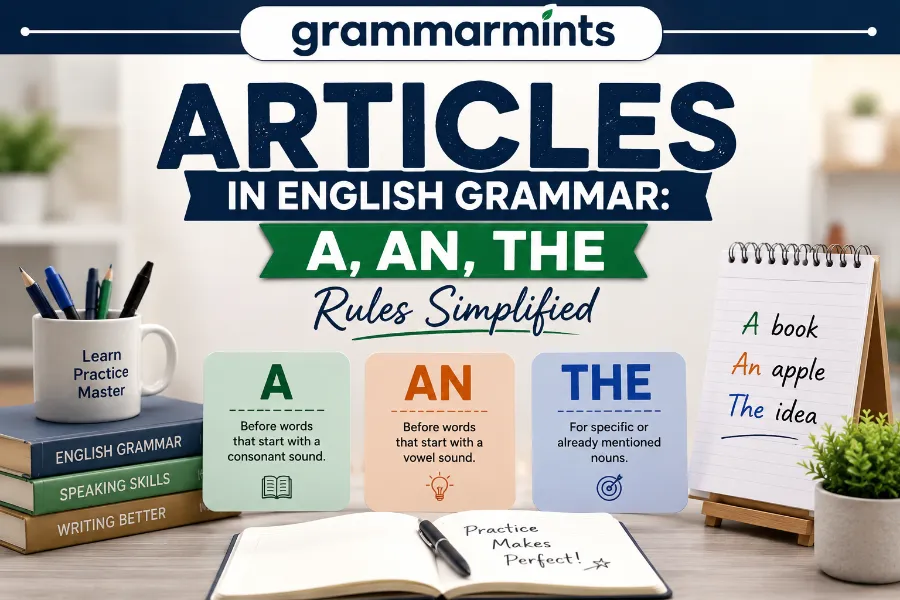
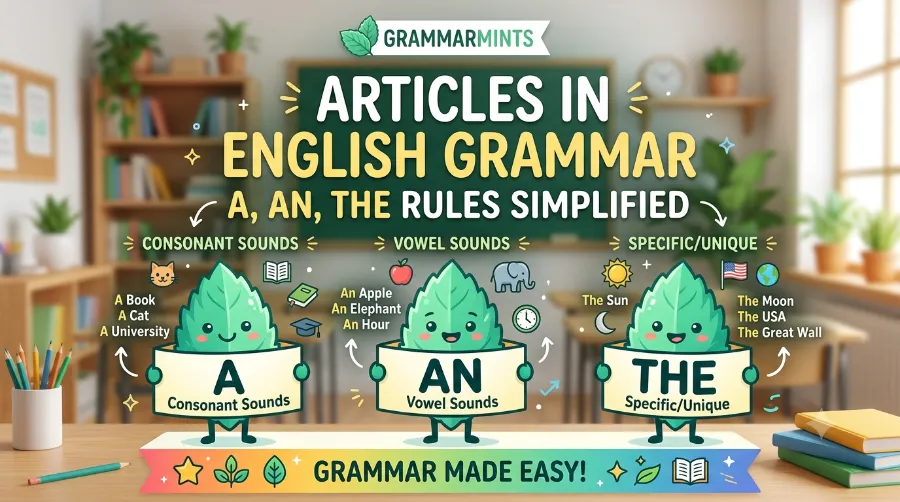
The real rule is based on sound, not spelling. Use “an” before words that begin with a vowel sound, and use “a” before words that begin with a consonant sound. This is why we say “an honest man” (the h is silent) but “a university” (the u sounds like “yoo,” a consonant sound).
Here’s a quick reference table:
| Example Phrase | Correct Article | Why |
|---|---|---|
| a book | a | Starts with consonant sound /b/ |
| an apple | an | Starts with vowel sound /æ/ |
| an hour | an | Silent “h,” starts with vowel sound |
| a university | a | Starts with consonant sound /yoo/ |
| a European trip | a | Starts with consonant sound /yoo/ |
| an MBA degree | an | “M” is pronounced “em,” a vowel sound |
Sound-Based Rule Explained
This sound-based logic explains why abbreviations can be tricky. For example, “an FBI agent” is correct because “F” is pronounced “ef,” which begins with a vowel sound, even though F is technically a consonant letter.
This is one of the reasons articles trip up even confident writers, especially second-language learners, since it connects closely with pronunciation. It’s worth pairing this with how tenses in English grammar are formed, since verb sounds follow similar spoken-English logic.
Rules for Using “The”
The definite article “the” is used when both the speaker and listener know exactly which person, place, or thing is being discussed. This happens in several common situations, and once you learn them, “the” becomes far less mysterious.
Use “the” when:
- The noun has already been mentioned once before in the conversation.
- There is only one of something in existence, such as “the sun” or “the internet.”
- The noun is made specific by a phrase that follows it, like “the book on the table.”
- You are talking about superlatives, such as “the best,” “the tallest,” or “the first.”
Teachers consistently report that “the” is one of the hardest concepts for adult learners to internalize, particularly for speakers of languages that don’t use articles at all, such as Russian, Japanese, or Hindi.
When to Use “The” with Specific Nouns
Consider this pair of sentences: “I bought a laptop” versus “I bought the laptop we discussed last week.” The first sentence introduces new information. The second sentence refers to something already known, which is exactly why “the” appears there.
This same logic applies when nouns are followed by identifying details, such as “the woman in the red coat” or “the article on VOA’s grammar page.” Once a noun is narrowed down this way, “the” is almost always required.
When to Omit Articles
Not every noun needs an article, and knowing when to skip one is just as important as knowing when to use one. Articles are usually dropped before plural or uncountable nouns used in a general sense, such as “Dogs are loyal” or “Water is essential for life.”
Articles are also skipped before most proper nouns, like names of people or countries. For example, “Sarah traveled to Japan” is correct, not “Sarah traveled to the Japan.” However, there are exceptions, such as “the United States” or “the Philippines,” which is exactly the kind of inconsistency that keeps this topic interesting for grammar teachers and confusing for students.
Common Mistakes Non-Native Speakers Make
Article errors rank among the most frequent grammar mistakes ESL writers make, often appearing right alongside verb agreement and pluralization issues.
This pattern shows up in classrooms every single semester. A student might write “I have a homework” instead of the correct “I have homework,” simply because their native language treats the noun differently. Similarly, forgetting articles altogether, as in “I went to store to buy bread” instead of “I went to the store to buy bread,” is one of the most frequently documented ESL mistakes.
A few other patterns worth watching for:
- Adding “the” before general plural nouns (“the dogs are loyal animals” instead of “dogs are loyal animals”)
- Skipping “an” before silent-h words (“a hour” instead of “an hour”)
- Using “a” before uncountable nouns (“a advice” instead of “some advice” or just “advice”)
If subject-verb pairing also feels shaky, it tends to trip up learners around the same stage of fluency as articles. Our breakdown of subject-verb agreement rules pairs naturally with this topic.
Quick Practice Table: A, An, The at a Glance
| Rule | Use When | Example |
|---|---|---|
| A | Before consonant sounds, general/first mention | a car, a European |
| An | Before vowel sounds | an idea, an hour |
| The | Specific, known, unique, or superlative nouns | the moon, the best day |
| No article | General plural or uncountable nouns | Cats are curious. Milk is healthy. |
Step-by-Step Method to Master Articles
If you want to stop second-guessing yourself, follow this simple process every time you’re unsure which article to use:
- Say the noun out loud. Listen to the first sound, not the first letter.
- Ask if it’s specific or general. If both you and your reader already know exactly what you mean, lean toward “the.”
- Check if it’s countable. Uncountable nouns like “information” or “advice” usually skip the article entirely.
- Reread the sentence. If it sounds unnatural, try swapping the article and compare which version flows better.
- Practice with real sentences daily. Reading news written in simplified English is a simple way to see correct article use in context.
This method works especially well alongside related topics like how to correctly report someone’s words using direct and indirect speech rules, since articles often shift depending on whether a sentence is quoted directly or reported indirectly.
Related English Grammar Topics You Should Explore
Mastering articles is just one piece of a much bigger picture. If you’re building a strong grammar foundation, it helps to also understand how modal verbs in English function, since modals and articles often appear in the same sentence structures, especially in formal writing and academic English.
For a broader overview of everything covered on the blog, the English grammar rules hub page is a good starting point, and you can always return to the GrammarMints homepage for the latest grammar guides and updates.
A few external resources are worth bookmarking too: the ESL Base articles guide offers extra practice exercises, UsingEnglish.com has a searchable grammar glossary that’s handy for quick lookups, and VOA Learning English publishes short news articles written in simplified English: genuinely one of the easiest ways to see correct article usage in real, current sentences.
Frequently Asked Questions
1. What is the easiest way to remember when to use “an”? Say the word out loud. If it starts with a vowel sound, not just a vowel letter, use “an.”
2. Why do we say “a university” instead of “an university”? Because “university” starts with a consonant sound, “yoo,” even though the letter U is a vowel.
3. Do all languages have articles like English does? No. Languages such as Russian, Japanese, and Hindi don’t use articles at all, which is why native speakers of these languages often find English articles especially challenging.
4. Is it ever correct to skip an article completely? Yes. Plural general nouns, uncountable nouns, and most proper nouns typically don’t need an article at all.
5. Can “the” be used with plural nouns? Yes, when referring to a specific group. For example, “the students in my class” refers to a specific set of students, not students in general.
Conclusion
Articles in English grammar might seem like small, forgettable words, but they carry a surprising amount of meaning. Once you understand that the choice comes down to sound, specificity, and countability, the rules stop feeling random and start feeling logical. Keep practicing with real sentences, revisit the tables above whenever you’re unsure, and over time, choosing between a, an, and the will become second nature rather than a guessing game.
References
- ESL Base. “Articles in English Grammar.” https://www.eslbase.com/grammar/articles/
- UsingEnglish.com. Grammar Glossary and Resources. https://www.usingenglish.com/
- VOA Learning English. “Grammar and Vocabulary.” https://learningenglish.voanews.com/z/4456
- Comparative study on grammatical error analysis among intermediate ESL learners (error ranking: verb agreement, pluralization, article usage).
- Text Inspector. “Top 10 Common ESL Mistakes and How to Correct Them.”