Every sentence you have ever written is built from just eight building blocks. Once you understand the parts of speech, English grammar stops feeling like a maze and starts feeling like a set of Lego bricks you already know how to snap together. In this guide, you will learn what each part of speech does, see real examples with numbers and dates, and pick up quick tips you can use today.
If you want to learn more conditional sentences rules tips and expert advice.
Whether you are a student in the United States, a professional in Germany brushing up on business English, or simply someone who wants fewer red squiggly lines in Word, this guide keeps things simple. No jargon overload, no boring textbook tone — just clear explanations you can actually use.
What Are the Parts of Speech in English Grammar?
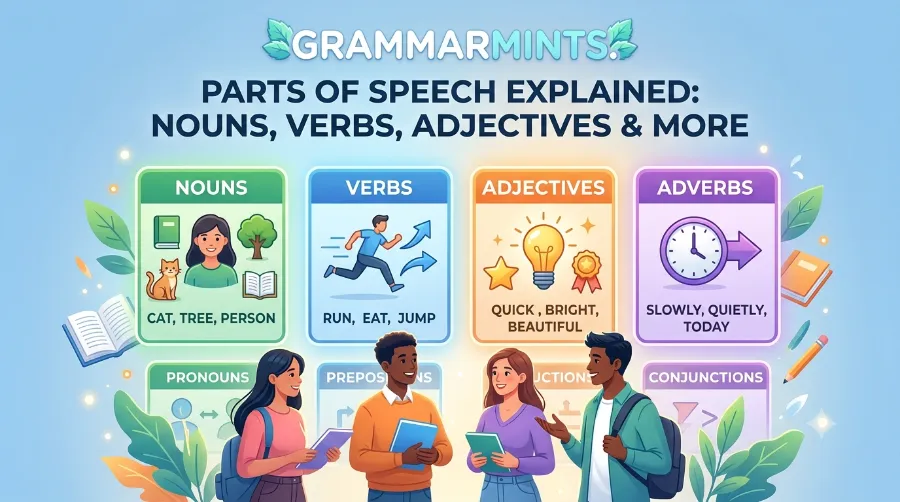
The parts of speech are the eight categories that every word in the English language falls into, based on the job that word does in a sentence. A word’s part of speech is not fixed forever, either. For example, “run” is a verb in “I run every morning,” but it becomes a noun in “I went for a run.”
Understanding this system matters because grammar rules, sentence structure, and even punctuation all depend on knowing which part of speech you are working with. Once this clicks, editing your own writing becomes much faster. It also makes it easier to learn additional languages later, since most languages organize words in a similar way.
If you want to learn more gerunds and infinitives rules tips and expert advice.
If you want a deeper dive into related grammar topics, <a href=”https://grammarmints.com/english-grammar-rules/”>GrammarMints’ English grammar rules hub</a> is a solid next stop after this guide.
The 8 Parts of Speech Explained (With Examples)
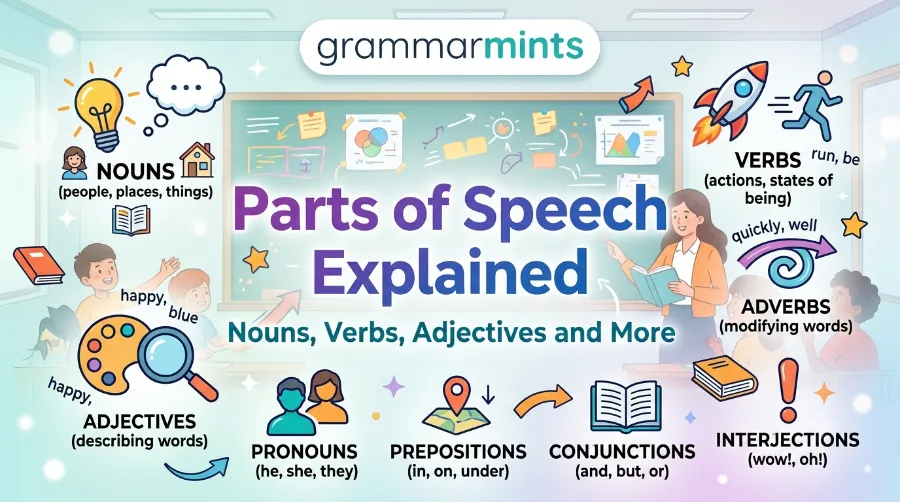
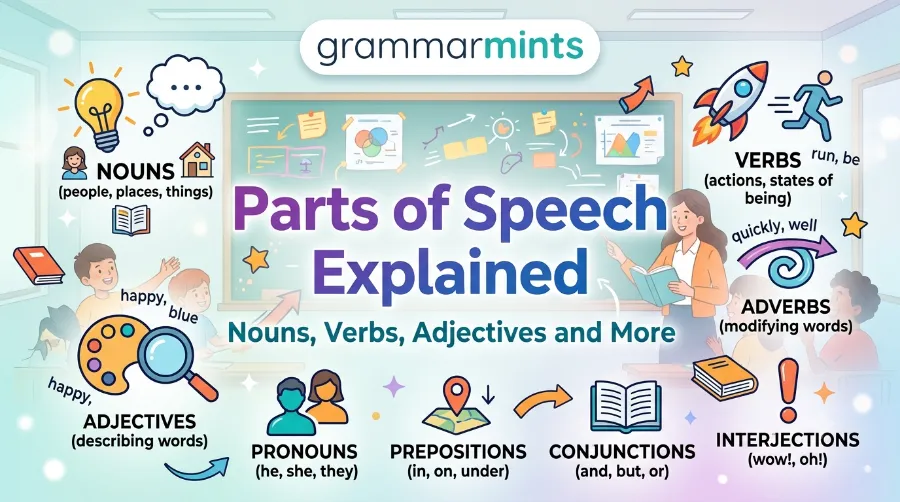
Here is the full breakdown. Each one plays a specific role, and most sentences use several of these at once.
1. Nouns
A noun names a person, place, thing, or idea. “Teacher,” “Chicago,” “laptop,” and “freedom” are all nouns. Nouns can be singular or plural, and they can be common (generic, like “city”) or proper (specific, like “Paris”).
Example: “The teacher graded 32 essays before Friday.”
2. Pronouns
Pronouns replace nouns so that sentences do not sound repetitive. Words like “she,” “they,” “it,” and “who” all fall into this category.
Example: “Maria finished her report, then she emailed it to them.”
3. Verbs
Verbs show action or a state of being. Every complete sentence needs at least one verb, which is why this part of speech is often called the engine of the sentence.
Example: “The team launched the product in March 2025 and sold 12,000 units in the first week.”
4. Adjectives
Adjectives describe or modify nouns and pronouns. They answer questions like “what kind,” “how many,” or “which one.”
Example: “The bright, spacious office had three large windows.”
5. Adverbs
Adverbs modify verbs, adjectives, or other adverbs. Many, though not all, end in “-ly.”
Example: “She quickly finished the extremely difficult exam.”
6. Prepositions
Prepositions show the relationship between a noun (or pronoun) and other words in a sentence, often relating to time, place, or direction. Words like “under,” “before,” “with,” and “since” are prepositions.
Example: “The meeting starts at 9 a.m. on Monday, in Conference Room B.”
7. Conjunctions
Conjunctions connect words, phrases, or clauses. “And,” “but,” “because,” and “although” are common examples.
Example: “I wanted to attend the conference, but I had a scheduling conflict, so I sent a colleague instead.”
8. Interjections
Interjections express sudden emotion or reaction. They often stand alone and are followed by an exclamation point.
Example: “Wow! That deadline came up fast.”
Parts of Speech Table: Quick Reference
Here is a simple table you can bookmark or screenshot for quick review.
| Part of Speech | Job in a Sentence | Example Word | Example Sentence |
|---|---|---|---|
| Noun | Names a person, place, thing, or idea | teacher | The teacher arrived early. |
| Pronoun | Replaces a noun | she | She arrived early. |
| Verb | Shows action or state of being | arrived | She arrived early. |
| Adjective | Describes a noun or pronoun | early | She arrived early, an unusually punctual start. |
| Adverb | Modifies a verb, adjective, or adverb | quickly | She quickly greeted the class. |
| Preposition | Links a noun to the rest of the sentence | before | She arrived before 8 a.m. |
| Conjunction | Connects words or clauses | and | She greeted the class and began the lesson. |
| Interjection | Expresses sudden emotion | Wow! | Wow! The room was already full. |
Why Learning Parts of Speech Matters
Grammar knowledge is not just for English teachers. It shapes how clearly you communicate at work, in school, and even in casual writing like emails and social posts. Here is why this topic deserves your attention:
- Clearer writing. Knowing whether a word is a noun or a verb helps you avoid confusing sentence structures.
- Better editing. You can spot and fix common errors, like using an adjective where an adverb belongs, in seconds instead of minutes.
- Stronger test scores. Standardized tests such as the SAT, TOEFL, and IELTS frequently test grammar knowledge directly or indirectly through reading comprehension.
- Faster language learning. Once you understand English word classes, learning grammar in French, Spanish, or German becomes noticeably easier, since many languages share the same core categories.
For a broader look at foundational grammar concepts, the <a href=”https://www.englishclub.com/grammar/parts-of-speech.php”>EnglishClub parts of speech guide</a> is a widely used reference among ESL learners and teachers alike.
Real-World Examples: Parts of Speech in Everyday English
Grammar rules can feel abstract until you see them in real situations. Here are a few grounded, numbers-based examples.
- News headlines: A 2025 headline like “Fed raises rates by 0.25% in March meeting” uses a proper noun (Fed), a verb (raises), a number acting as a noun phrase (0.25%), and a preposition (in) — all in nine words.
- Workplace emails: A typical business email sent on a Monday morning might read, “Please review the attached proposal by Thursday,” combining a verb (review), an adjective (attached), a noun (proposal), and a preposition (by).
- Product reviews: Online reviews often lean heavily on adjectives and adverbs. A five-star review such as “This laptop charges incredibly fast and rarely overheats” uses two adverbs (incredibly, rarely) to strengthen the claim.
Recognizing these patterns in real text, rather than only in textbook sentences, is what makes the parts of speech genuinely useful day to day.
How English Proficiency Data Shows Why Grammar Basics Matter
According to the EF English Proficiency Index (EF EPI) 2025 edition, which analyzed test data from 2.2 million test takers across 123 countries and regions, English proficiency continues to vary widely around the world. Notably, the Netherlands ranked first overall, followed by Croatia and Austria, both of which improved their standing compared to previous years.
Even more relevant for grammar learners: the 2025 report found that speaking was the weakest English skill in more than half of the countries measured, which strongly suggests that foundational grammar work, including mastering parts of speech, is often the missing piece between reading comprehension and confident spoken communication.
| Rank (2025 EF EPI) | Country | Trend |
|---|---|---|
| 1 | Netherlands | Held #1 position |
| 2 | Croatia | Improved ranking |
| 3 | Austria | Improved ranking |
| 4 | Germany | One of the biggest gains in Europe |
This data matters for European and American learners alike, since it shows that even in high-ranking regions, structural skills like grammar and sentence-building still separate strong communicators from average ones. For more grammar fundamentals that build on this topic, check out <a href=”https://grammarmints.com/”>GrammarMints</a> directly.
Common Mistakes Learners Make with Parts of Speech
Even confident English speakers slip up here. These are the errors that show up most often in student essays and workplace writing:
- Confusing adjectives and adverbs, such as writing “she did good” instead of “she did well.”
- Misusing pronouns, particularly mixing up “who” and “whom,” or “its” and “it’s.”
- Overusing prepositions at the end of formal writing, which is not technically wrong but can weaken tone in professional documents.
- Treating gerunds as verbs, forgetting that a word like “running” can act as a noun, such as in “Running is great exercise.”
If you want a more detailed breakdown of these specific traps, the <a href=”https://www.english-grammar-revolution.com/parts-of-speech.html”>English Grammar Revolution parts of speech page</a> covers several of them in more depth, and this overview of grammar fundamentals from <a href=”https://usadultliteracy.com/2024/07/29/parts-of-speech-in-grammar/”>USAdultLiteracy</a> is also a helpful supplementary read for adult learners specifically.
Quick Tips to Master Parts of Speech Fast
Follow these steps in order for the fastest results, especially if you are prepping for a test or trying to clean up your writing habits.
- Label a paragraph. Take any paragraph you have written and label every word’s part of speech. This alone reveals most of your habitual mistakes.
- Read your writing aloud. Awkward adjective-adverb swaps are easier to hear than to see.
- Study one part of speech per week. Trying to master all eight at once usually backfires; focused practice sticks better.
- Use a grammar checker as a teacher, not a crutch. Look at why it flagged something, not just the fix it suggests.
- Revisit GrammarMints’ <a href=”https://grammarmints.com/english-grammar-rules/”>pillar grammar guide</a> every few weeks to reinforce what you have learned.
Frequently Asked Questions
What are the 8 parts of speech in English? The eight parts of speech are nouns, pronouns, verbs, adjectives, adverbs, prepositions, conjunctions, and interjections.
Can one word belong to more than one part of speech? Yes. Many English words shift categories depending on context. “Light,” for instance, can be a noun (“turn on the light”), a verb (“light the candle”), or an adjective (“a light backpack”).
Why do parts of speech matter for ESL learners specifically? Understanding word classes helps ESL learners build sentences correctly, avoid common translation errors, and understand grammar explanations that assume this vocabulary as a starting point.
Is it necessary to memorize grammar terms to write well? Not entirely, but knowing the terms makes it much faster to understand feedback from teachers, editors, or grammar tools, and to fix recurring mistakes on your own.
Conclusion
Grammar does not have to feel intimidating once you break it down into its core parts. The eight parts of speech — nouns, pronouns, verbs, adjectives, adverbs, prepositions, conjunctions, and interjections — form the foundation of every sentence you read or write in English. With consistent, small-step practice, this knowledge becomes second nature, and your writing, speaking, and even test scores tend to improve as a result. Start small, label a paragraph today, and build from there.
References
- EF Education First, “EF English Proficiency Index 2025,” ef.com
- EnglishClub, “Parts of Speech,” englishclub.com
- English Grammar Revolution, “Parts of Speech,” english-grammar-revolution.com
- USAdultLiteracy, “Parts of Speech in Grammar,” usadultliteracy.com
- GrammarMints, “English Grammar Rules,” grammarmints.com