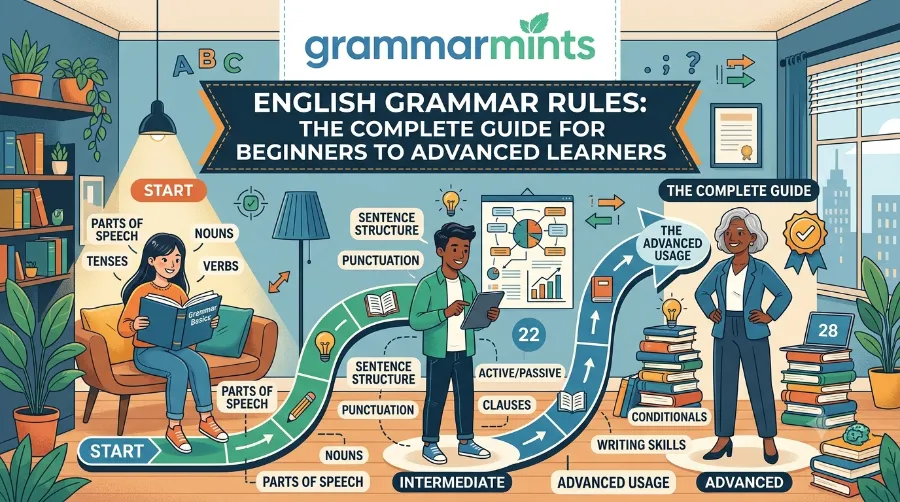
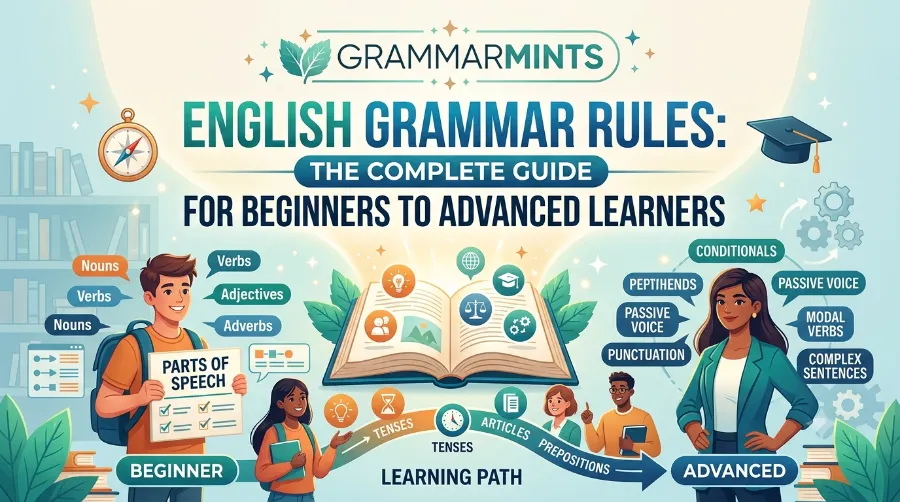
Learning solid English grammar rules is the fastest way to sound clear, confident, and credible, whether you are writing an email, a college essay, or a business proposal. In fact, over 1.5 billion people around the world are currently learning English in some form, and grammar remains the single biggest hurdle for most of them. This guide walks you through everything from the basic building blocks of a sentence to the finer points that trip up even native speakers. By the end, you will have a practical roadmap you can actually use, not just a list of rules to memorize.
If you want to learn more about parts of speech explained tips and expert advice.
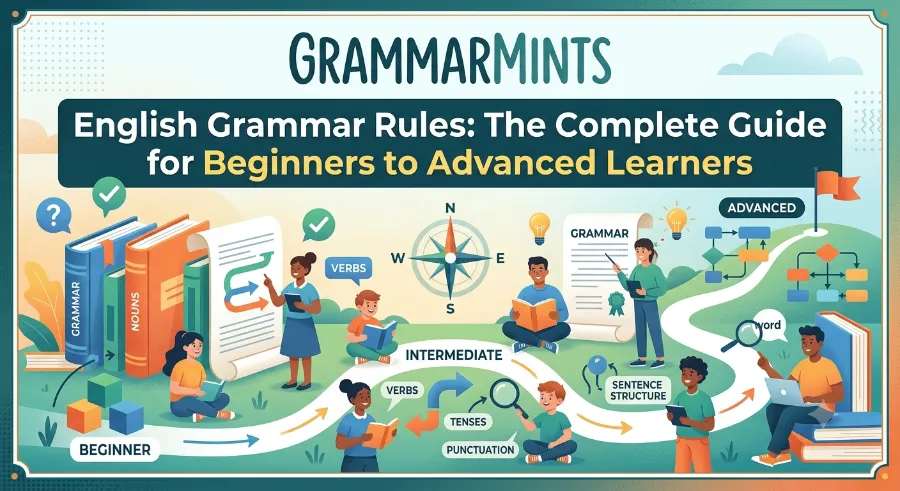
Whether you are just starting out or polishing an already strong command of English, this guide breaks grammar down into manageable, real-world steps. We will cover parts of speech, sentence structure, tenses, punctuation, and the mistakes that quietly damage your credibility at work and in school.
If you want to learn more conditional sentences rules tips and expert advice.
Why English Grammar Rules Still Matter in 2026
Some learners assume that spell-checkers and AI writing tools have made grammar less important. The data says otherwise. A 2025 industry survey found that 74% of hiring managers reported that grammar errors on a resume or cover letter significantly reduced a candidate’s chances of getting hired. Separately, research covering error-laden resumes found roughly an 18.5 percentage point drop in interview callbacks compared to clean, well-written applications.
If you want to learn more about tenses in English grammar tips and expert advice.
Grammar also shapes how professional you sound in everyday communication. According to workplace communication research, 65% of survey respondents said spelling and grammar mistakes in emails and reports were simply unacceptable. Meanwhile, English continues to dominate globally: the EF English Proficiency Index 2025, which tested 2.2 million adults across 123 countries, ranked the Netherlands first for the sixth year running with a score of 647. None of that happens by accident. Strong grammar habits are built, one rule at a time.
If you want to learn more gerunds and infinitives rules tips and expert advice.
Consider a simple, real-world example. In 2024, a hiring manager at a mid-sized marketing firm rejected two otherwise similar résumés purely because one contained three subject-verb agreement errors in the first paragraph. The candidate with cleaner grammar was invited to interview within a week. Stories like this are common, not rare, which is exactly why grammar deserves ongoing attention rather than a one-time review before a big deadline.
If you want a deeper foundation before moving forward, our beginner’s guide to parts of speech is a good next stop after this article.
The 8 Parts of Speech: Your Grammar Foundation
Every rule in English grammar traces back to eight core word categories. Once you recognize these, sentence structure and punctuation start to make a lot more sense.
| Part of Speech | Job in a Sentence | Example |
|---|---|---|
| Noun | Names a person, place, thing, or idea | teacher, Paris, freedom |
| Pronoun | Replaces a noun | she, they, it |
| Verb | Shows action or state of being | run, is, believe |
| Adjective | Describes a noun | quiet, seven, curious |
| Adverb | Describes a verb, adjective, or another adverb | quickly, very, often |
| Preposition | Shows relationship (place, time, direction) | under, since, toward |
| Conjunction | Joins words, phrases, or clauses | and, but, although |
| Interjection | Expresses sudden emotion | Wow!, Oh no! |
According to EnglishClub’s breakdown of the parts of speech, most English words can actually function as more than one part of speech depending on context, which is exactly why memorizing definitions alone rarely works. For instance, “light” can be a noun (turn on the light), a verb (light the candle), or an adjective (a light backpack). Practicing with real sentences, not flashcards, is what makes this stick.
Articles and Determiners: A Quick Reference
Articles are small words, yet they cause outsized confusion, especially for learners whose native language does not use them at all. English has three articles: a, an, and the. Getting these right depends less on memorization and more on understanding whether a noun is specific or general.
| Article | When to Use | Example |
|---|---|---|
| a | Before a singular, countable noun starting with a consonant sound, first mention | She bought a laptop. |
| an | Before a singular, countable noun starting with a vowel sound | He is an honest man. |
| the | Before a noun already known to speaker and listener, or unique | The sun rises in the east. |
| (no article) | Before plural or uncountable nouns used generally | Dogs make loyal companions. |
A frequent mistake among non-native writers is dropping articles entirely, producing sentences like “She conducted research on climate change project” instead of “She conducted research on a climate change project.” Meanwhile, native speakers occasionally overuse “the,” adding it where a general statement needs no article at all. Practicing with real paragraphs, rather than isolated sentences, helps this rule become automatic over time.
Beyond articles, determiners like this, that, some, many, and each also modify nouns and clarify quantity or specificity. For example, “each student submitted a report” signals individual submissions, while “many students submitted reports” signals a group action. Distinguishing between these small words often matters more for clarity than learners initially expect.
English Sentence Structure Basics
A complete English sentence needs, at minimum, a subject and a verb. From there, sentences grow in four recognized patterns:
- Simple sentence – one independent clause (She studies every evening.)
- Compound sentence – two independent clauses joined by a conjunction (She studies every evening, and she reviews her notes on weekends.)
- Complex sentence – an independent clause plus a dependent clause (Because she studies every evening, her grades improved by 2025.)
- Compound-complex sentence – a mix of the above (Because she studies every evening, her grades improved, and her teacher noticed the change.)
Most beginner mistakes happen in step two or three, usually because writers forget a comma before the conjunction or attach a dependent clause incorrectly. As a result, sentences either run together or get chopped into fragments. If sentence structure still feels shaky, our guide to building stronger sentences walks through each pattern with more practice examples.
English Tenses Made Simple
English has twelve main tenses, though learners rarely need all of them fluently at once. Here is a simplified roadmap:
- Present simple – habits and facts (I write every morning.)
- Present continuous – actions happening now (I am writing this guide.)
- Past simple – finished actions (I wrote three drafts in June 2025.)
- Past continuous – ongoing past action (I was writing when the call came in.)
- Present perfect – past action with present relevance (I have written over 200 articles.)
- Future simple – predictions and plans (I will publish this next week.)
Beginners should master present simple, past simple, and future simple first. Advanced learners, however, benefit most from practicing present perfect and past perfect, since these two tenses cause the most confusion for non-native speakers, according to classroom research from the British Council.
For a fuller picture, here is how all twelve tenses map out across time:
| Time | Simple | Continuous | Perfect | Perfect Continuous |
|---|---|---|---|---|
| Present | I write | I am writing | I have written | I have been writing |
| Past | I wrote | I was writing | I had written | I had been writing |
| Future | I will write | I will be writing | I will have written | I will have been writing |
Notice a pattern: the “perfect” forms always connect two points in time, while the “continuous” forms emphasize an action still in progress. Once a learner sees this grid laid out visually, tense selection tends to feel far less random. For example, “By 2027, she will have completed her degree” uses future perfect to connect a future action to an even later reference point, a structure that rarely appears in casual conversation but shows up often in formal writing and academic reports.
One subtlety worth noting for a US and European audience: British English tends to favor present perfect more heavily (“I have just eaten”), while American English often defaults to past simple in the same situation (“I just ate”). Neither version is wrong; the difference simply reflects regional convention rather than a grammar error.
Common English Grammar Mistakes (and How to Fix Them)
Even confident writers repeat the same handful of errors. Reviewing these patterns is often more useful than reading a full textbook, because these mistakes appear in real writing constantly.
| Mistake | Incorrect Example | Corrected Example |
|---|---|---|
| Subject-verb agreement | The list of items are ready. | The list of items is ready. |
| Its vs. it’s | The dog wagged it’s tail. | The dog wagged its tail. |
| Comma splice | The meeting ran late, we left anyway. | The meeting ran late, so we left anyway. |
| Dangling modifier | Walking to the store, the rain started. | Walking to the store, I got caught in the rain. |
| Tense shift | She walked in and is sitting down. | She walked in and sat down. |
| Misplaced modifier | She almost drove her kids to school every day. | She drove her kids to school almost every day. |
| Confusing that/which | The report which was late caused problems. | The report that was late caused problems. |
A 2025 analysis of adult literacy and grammar patterns highlighted subject-verb agreement and homophone confusion (their/there/they’re, its/it’s) as two of the most persistent issues among adult English learners, a pattern also confirmed by research from usadultliteracy.com on parts of speech and grammar in everyday writing. Consequently, these two categories deserve extra practice time before moving to advanced grammar work.
Chart: Why Grammar Accuracy Matters at Work
| Metric | Impact |
|---|---|
| Hiring managers penalizing grammar errors | ██████████████ 74% |
| Employees who find grammar mistakes unacceptable | ████████████ 65% |
| Drop in interview callbacks for error-laden resumes | ███ 18.5 pts |
This simple chart makes one point clear: grammar accuracy is not academic trivia. It has a direct, measurable effect on how you are perceived professionally.
Punctuation Rules That Trip Up Even Native Speakers
Punctuation quietly carries a lot of meaning. A misplaced comma can genuinely change what a sentence says. Consider these three rules that cause the most confusion:
- The Oxford comma – “I invited my parents, the mayor, and the band” avoids confusion with “I invited my parents, the mayor and the band,” which could imply the parents are the mayor and the band.
- Apostrophes for possession – Singular nouns take ‘s (the writer’s desk), while plural nouns ending in s take just an apostrophe (the writers’ conference).
- Semicolons – Used to join two closely related independent clauses without a conjunction (The deadline was Friday; nobody finished early.)
Purdue’s Online Writing Lab, one of the most cited grammar resources in academic settings, notes that punctuation errors are among the most common issues flagged in both student and professional writing, largely because these rules are rarely taught explicitly after primary school.
Colons also deserve a mention, since they are frequently confused with semicolons. A colon introduces a list, explanation, or elaboration after a complete sentence, as in: “The recipe needed three things: flour, sugar, and patience.” A semicolon, by contrast, only connects two complete, related thoughts without introducing anything new. Mixing the two up rarely creates a serious misunderstanding, but it does signal to careful readers, including hiring managers and professors, that punctuation was not double-checked before submission.
Prepositions of Time and Place: Common Confusions
Prepositions are short, but they rarely translate directly between languages, which is why they remain one of the trickiest areas even for advanced learners. Three prepositions cause most of the trouble: in, on, and at.
- in – used for months, years, and longer periods (in July, in 2025, in the morning)
- on – used for specific days and dates (on Monday, on July 4th)
- at – used for precise times and specific points (at 6 p.m., at the corner)
A 2017 study analyzing compositions from 112 English learners found that prepositions, alongside articles, ranked among the most frequently misused word categories, ahead of even verb tense errors. This finding lines up with what most tutors observe firsthand: learners often translate prepositions word-for-word from their native language, which rarely works because English preposition rules are largely idiomatic rather than logical.
A practical fix is to learn prepositions inside common phrases rather than in isolation. For instance, memorizing “interested in,” “good at,” and “afraid of” as fixed chunks is far more effective than trying to derive the correct preposition from a general rule.
Advanced Grammar Rules for Confident, Fluent Writing
Once the basics feel automatic, advanced learners should focus on these four areas:
- Parallel structure – keep list items and comparisons grammatically consistent (She likes reading, writing, and cooking, not She likes reading, writing, and to cook.)
- Active over passive voice – “The team finished the report” reads stronger than “The report was finished by the team.”
- Conditional sentences – mastering all four conditional types (zero, first, second, third) unlocks nuanced, hypothetical, and reflective statements.
- Subjunctive mood – used in formal or hypothetical contexts (If she were here, she would explain it.)
Advanced grammar rarely gets easier through memorization alone. Instead, it improves through consistent reading, careful editing, and feedback, particularly from a tutor, teacher, or reliable grammar checker.
Conditional Sentences
Take conditional sentences as an example, since they trip up even confident intermediate speakers. The zero conditional describes general truths (“If you heat water to 100°C, it boils”). The first conditional describes realistic future outcomes (“If it rains tomorrow, we will cancel the picnic”). The second conditional describes hypothetical or unlikely present situations (“If I won the lottery, I would travel for a year”). Finally, the third conditional describes an unreal past (“If she had studied earlier, she would have passed the exam in 2024”). Each type shifts both the verb tense and the intended meaning, so mixing them up often changes what a sentence actually communicates.
Parallel Structure
Parallel structure deserves equal attention because it affects how polished a sentence sounds, even when the grammar is technically not “wrong.” Consider a résumé bullet point: “Managed the budget, trained new hires, and was responsible for scheduling” breaks parallel form midway through. Rewriting it as “Managed the budget, trained new hires, and scheduled shifts” restores balance and reads noticeably more professional, a small fix that recruiters notice quickly.
Formal vs. Informal Grammar: Knowing When to Switch
Grammar rules don’t change between formal and informal writing, but which rules get relaxed absolutely does. Understanding this distinction matters for anyone writing across different contexts, from a casual text message to a client-facing report.
Formal writing (reports, cover letters, academic papers) typically expects:
- Full sentences with no contractions (do not instead of don’t)
- Third-person perspective rather than “I” or “you,” except in direct correspondence
- Active voice with precise word choice
- Consistent, complete punctuation, including the Oxford comma
Informal writing (texts, social posts, casual emails) generally allows:
- Contractions and sentence fragments for rhythm
- Starting sentences with “And” or “But”
- Ending sentences with a preposition (Who did you go with?)
A 2025 workplace communication study found that professionals who successfully code-switch between these two registers were rated as more competent communicators by colleagues than those who wrote every message in the same register regardless of audience. In other words, knowing when to bend a rule is itself a grammar skill worth developing, not a sign of carelessness.
How to Practice Grammar Every Day
Consistency beats intensity when building grammar skills. Try this simple weekly routine:
- Read 10 minutes daily from a reputable news source or novel, noting unfamiliar sentence patterns.
- Write one paragraph daily and review it 24 hours later with fresh eyes.
- Study one grammar rule per week instead of trying to absorb everything at once.
- Keep an error log of your own recurring mistakes, since research consistently shows that personalized error tracking speeds up correction far more than generic exercises.
- Read your work aloud before submitting it, since awkward phrasing is often easier to hear than to see.
For a structured approach with example sentences, English Grammar Revolution offers a straightforward breakdown of parts of speech and sentence patterns that pairs well with this practice routine.
Tools and Resources Worth Bookmarking
A few resources consistently show up in classrooms and professional writing programs worldwide:
- EnglishClub’s parts of speech guide for a clear, example-driven overview of word categories.
- Purdue OWL for citation, punctuation, and formal writing standards trusted by universities across the United States and Europe.
- usadultliteracy.com for accessible explanations aimed at adult learners rebuilding their grammar foundation.
Pairing outside resources with structured practice on a site like GrammarMints gives learners both the explanation and the repetition needed to make grammar rules stick long-term.
Frequently Asked Questions
What are the basic grammar rules every beginner should know? Beginners should start with the eight parts of speech, simple sentence structure, and the three core tenses: present, past, and future simple.
How long does it take to master English grammar? Most learners reach a comfortable, functional level within 600 to 1,000 hours of focused study, according to Cambridge Assessment English research, though daily practice can speed this up considerably.
What is the most common English grammar mistake? Subject-verb agreement and homophone confusion (its/it’s, their/there/they’re) rank among the most frequent errors across both native and non-native writers.
Do native English speakers make grammar mistakes too? Yes. Studies on writing errors consistently show that native speakers regularly misuse commas, apostrophes, and passive voice, proving that grammar is a skill everyone continues refining.
Is it better to learn grammar rules or just practice speaking? Both matter. Grammar rules give you a map, while speaking and writing practice build the muscle memory to apply that map naturally.
Does British English grammar differ from American English grammar? Mostly in vocabulary, spelling, and preposition choices rather than core grammar rules. For example, British English favors “at the weekend” while American English uses “on the weekend,” but sentence structure and tense rules remain the same across both.
Can grammar checkers replace learning the rules? Grammar checkers catch obvious errors and are genuinely useful for a quick review, but they frequently miss context-dependent issues like tone, ambiguous pronoun references, and stylistic parallel structure. Understanding the underlying rule still produces stronger, more consistent writing.
Conclusion
Mastering this side of the language is not about memorizing an endless list of exceptions. It is about building a few strong habits: recognizing parts of speech, structuring sentences with intention, choosing the right tense, and catching the small errors that quietly undercut good writing. Whether you are a beginner working through your first paragraphs or an advanced writer polishing a professional report, the path forward is the same: read often, write daily, and review honestly. Grammar improves through repetition, not perfection, so treat every mistake as useful data rather than a setback.
References
- British Council, English Language Learning Statistics
- EF Education First, EF English Proficiency Index 2025
- Cambridge Assessment English, Learner Proficiency Research
- EnglishClub, Parts of Speech Overview
- Purdue Online Writing Lab (OWL), Grammar and Punctuation Guidelines
- usadultliteracy.com, Parts of Speech in Grammar
- English Grammar Revolution, Parts of Speech Guide
- Plagly and BestWriting, Workplace Grammar Impact Studies (2025)