Conditional sentences confuse even confident English speakers, and that’s completely normal. Every time you say “if this happens, then that happens,” you are building a conditional sentence, whether you realize it or not. These small “if” sentences carry a lot of grammatical weight, and getting them wrong can quietly change the meaning of what you say.
If you want to learn more conditional sentences rules tips and expert advice.
The good news is that once you see the pattern, conditional sentences stop feeling like a puzzle. In this guide, you will learn the four core conditional types, see real examples with real dates and numbers, and pick up a few tricks that even experienced learners often miss. By the end, you should be able to use if-clauses with the same ease as a native speaker.
If you want to learn more gerunds and infinitives rules tips and expert advice.
What Are Conditional Sentences?
A conditional sentence is a sentence built from two parts: a condition and a result. The condition usually starts with “if” (sometimes “unless” or “when”), and it sets up a situation. The result tells you what happens because of that situation. For example, “If you save $50 every month, you will have $600 in a year” links a clear condition to a clear outcome.
This structure sits at the heart of everyday English. You use it to make promises, give warnings, offer advice, and even talk about regrets. Grammarly’s own style guide describes conditional sentences the same way: two linked clauses, one setting up a possibility and the other showing what follows from it. That single idea, condition plus result, is the key that unlocks all four types below.
If you’re still shaky on basic sentence patterns, it helps to review the core English grammar rules first, since conditional sentences build directly on those foundations. It also helps to understand how tenses work in English grammar, because every conditional type depends on a specific tense pairing between the two clauses.
Why Conditional Sentences Matter in Everyday English
You might think conditional sentences only show up in grammar textbooks, but that’s far from true. Job offers, weather forecasts, medical advice, and even text messages to friends rely on this structure constantly. “If the flight is delayed, we will miss the connection” is a conditional sentence you might text a travel partner in 2026 without thinking twice about the grammar behind it.
Because conditionals shift meaning based on tense, small mistakes can create real confusion. Saying “If I will see him, I will tell him” instead of “If I see him, I will tell him” is a common error that immediately signals non-native speech to a listener. Meanwhile, business emails often rely on the first conditional to set expectations, such as “If you confirm by Friday, we will lock in the current rate.”
According to Kaplan International’s language guide, conditionals matter because they let speakers talk about things that might happen now or later, and they cover everything from giving advice to expressing regret to stating plain facts. That range spans advice, regret, and fact. It’s exactly why English has four different conditional forms instead of just one.
The Zero Conditional: Facts and General Truths
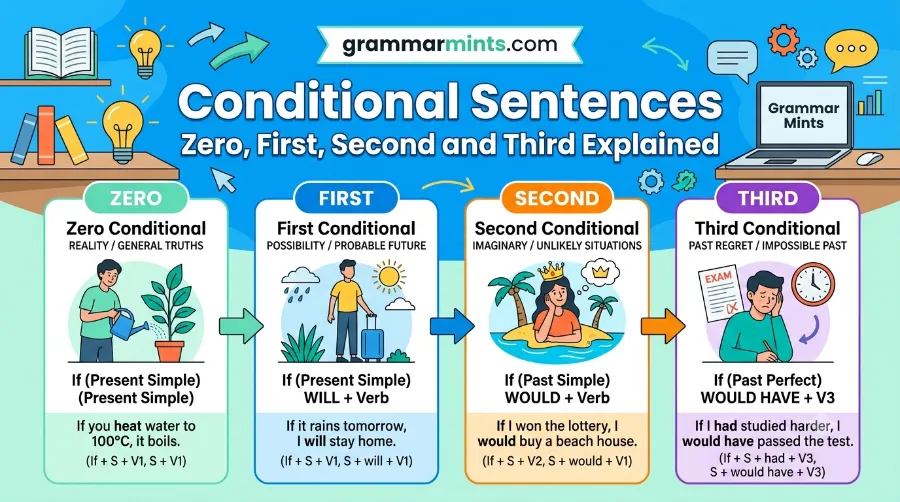
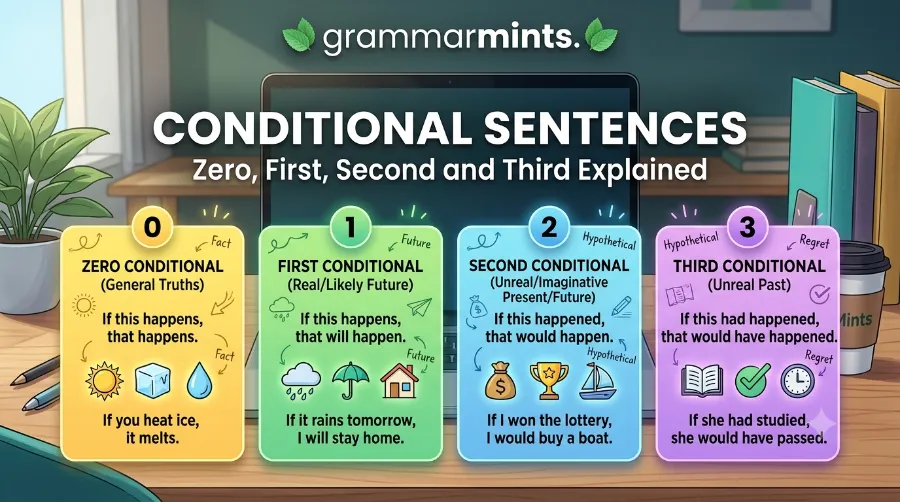
The zero conditional describes things that are always true. It uses the simple present tense in both clauses, and it does not talk about the future at all. Instead, it talks about facts, habits, and cause-and-effect relationships that never change.
Formula: If + simple present, … simple present.
Example: If water reaches 100°C at sea level, it boils.
Here are a few more everyday examples:
- If the temperature drops below 0°C, water freezes.
- If you mix red and blue paint, you get purple.
- If the store opens at 9 a.m., customers start lining up by 8:45 a.m.
Notice that none of these sentences describe a one-time event. They describe patterns that repeat every single time the condition is met. This is why the zero conditional is sometimes called the “always true” conditional. It’s also the simplest conditional to master, which makes it a good starting point before moving into the more flexible first conditional.
The First Conditional: Real Future Possibilities
The first conditional talks about situations that are likely to happen in the real future. It combines the simple present in the if-clause with “will” plus the base verb in the result clause.
Formula: If + simple present, … will + base verb.
Example: If Maria finishes her project by Friday, June 26, 2026, she will present it at Monday’s team meeting.
The first conditional is the workhorse of planning language. Here’s how it usually plays out in real situations:
- You identify a realistic condition: something that could actually happen (e.g., “If it rains tomorrow”).
- You attach a specific, likely outcome: not a fantasy, but a real plan (“we will move the picnic indoors”).
- You keep the tense consistent: simple present in the if-clause, “will” in the result clause.
More examples:
- If sales grow by 12% this quarter, the company will hire three new employees.
- If you register before August 1, 2026, you will save $40 on the course fee.
- If he doesn’t leave by 6:30 p.m., he will miss his train.
Unlike the zero conditional, the first conditional is about one specific, plausible future event, not a repeating pattern.
The Second Conditional: Unreal Present or Future Situations
The second conditional describes situations that are unlikely, imaginary, or simply not true right now. It uses the simple past in the if-clause (even though the meaning is not really past tense) and “would” plus the base verb in the result clause.
Formula: If + simple past, … would + base verb.
Example: If I had an extra $10,000 today, I would invest it in a small business.
This conditional is often called the “dream” or “advice” conditional because people use it to imagine alternate realities or to gently suggest what someone else should do. A few more examples:
- If she were the manager, she would change the vacation policy.
- If they lived closer to the office, they would walk to work every day.
- If I won the contest, I would donate half the prize money.
One quirky but important rule: in formal English, you use “were” instead of “was” for every subject in second conditional sentences (“If I were,” “If he were,” “If it were”). This connects closely to subject-verb agreement rules, since it’s technically the subjunctive mood overriding the usual agreement pattern.
The Third Conditional: Unreal Past Situations
The third conditional talks about things that did not happen in the past, along with the imagined result if they had happened differently. It’s the conditional of regret, hindsight, and “what if” thinking about events that are already finished.
Formula: If + past perfect, … would have + past participle.
Example: If the team had submitted the proposal by March 15, 2026, they would have won the contract.
Because this conditional deals with a past that cannot be changed, it relies heavily on modal structures. If you’re unsure how “would have,” “could have,” and “might have” differ in meaning, it’s worth reviewing modal verbs in English grammar before practicing this conditional further.
A few more real-world style examples:
- If he had studied for three extra hours, he would have passed the certification exam.
- If we had left the house at 7 a.m. instead of 7:30 a.m., we would have avoided the traffic.
- If she hadn’t missed the 2025 deadline, she would have received the scholarship.
Academic writing centers, including Madonna University’s writing resources, treat this pattern as the clearest example of a fully hypothetical structure in English: an unreal past connected to an imagined (but impossible) outcome.
Mixed and Inverted Conditionals
Once you’re comfortable with the four main types, you’ll start noticing sentences that blend two timeframes. These are called mixed conditionals, and they combine a past condition with a present result, or the other way around.
Example: If she had taken that job in 2023 (past), she would be running her own department now (present).
You’ll also encounter inverted conditionals, which drop “if” entirely and flip the subject and auxiliary verb instead. This style shows up often in formal writing, contracts, and news reports.
Example: Had the airline announced the delay earlier, passengers would not have missed their connections.
This inverted structure works a bit like reported or formal speech patterns, so if you enjoy this kind of sentence-level nuance, you’ll likely also enjoy learning about direct and indirect speech rules, since both concepts deal with restructuring a sentence while keeping its original meaning intact.
Conditional Sentences vs. Similar Structures
Learners sometimes confuse conditional sentences with other time-based clauses, especially “when” clauses. The two look alike, but they carry different levels of certainty. “When I get home, I will cook dinner” assumes you are definitely going home. “If I get home before 8 p.m., I will cook dinner” leaves the outcome open, because arriving before 8 p.m. isn’t guaranteed.
This distinction matters more than it seems. Swapping “if” for “when” in a sentence about an uncertain event can accidentally make a promise sound like a certainty, which can create real misunderstandings in emails, contracts, or instructions. A useful habit is to ask yourself, “Is this outcome guaranteed, or just possible?” before choosing between “if” and “when.”
A similar mix-up happens with “unless,” which functions as a negative condition. “Unless you finish by 6 p.m., we will leave without you” is grammatically identical in meaning to “If you don’t finish by 6 p.m., we will leave without you.” Both sentences follow first-conditional rules; only the wording changes.
Conditional Sentences in Real Life: Business, Travel, and Everyday Conversation
Conditional sentences do more than fill grammar workbooks; they shape how people negotiate, plan trips, and manage relationships. In business writing, the first conditional often sets terms and expectations. A vendor might write, “If the shipment arrives after September 1, 2026, the client will receive a 10% discount,” turning a grammar pattern into a contractual promise.
Travel planning leans on conditionals just as heavily. A traveler booking a flight to Europe might say, “If the layover in Frankfurt is under two hours, we will keep the ticket; if it’s longer, we will look for a direct flight instead.” Notice how naturally two conditional clauses can sit side by side in ordinary speech, each doing a slightly different job.
Everyday conversation relies on the second and third conditionals for something a little more personal: imagination and reflection. Friends chatting about career choices might say, “If I hadn’t taken that internship in 2021, I probably wouldn’t be working in this industry now.” This is a mixed conditional that blends regret about the past with a comment on the present. These aren’t textbook exercises; they’re the ordinary sentences people say to each other every day, in offices, airports, and living rooms across the United States and Europe.
Even casual digital communication is full of conditionals. A quick text like “If you’re free tonight, we should grab dinner” is a first conditional doing the work of an invitation, while “If I were you, I’d wait until the sale” is a second conditional doing the work of advice. Recognizing these patterns in daily life is often the fastest way to internalize the grammar, faster than memorizing formulas alone.
How to Practice Conditional Sentences Effectively
Grammar rules stick best when they’re tied to action, not just memorization. Try this short practice routine to build real fluency with conditional sentences over the next week:
- Pick one conditional type per day. Spend Monday only on zero conditionals, Tuesday only on first conditionals, and so on. Focusing narrows your attention and prevents the four types from blending together in your memory.
- Write three sentences from your own life. Instead of copying textbook examples, write about your actual schedule, goals, or plans. “If I finish this report by 3 p.m., I will leave early” sticks better than a sentence about a stranger.
- Say the sentences out loud. Speaking activates a different kind of memory than reading silently, and it helps you catch awkward phrasing before it becomes a habit.
- Ask a native speaker or tutor to check your tense pairing. Even one correction from a real person tends to fix a mistake faster than ten rounds of self-study.
- Revisit the table above once a week. A quick glance at the tense-pairing chart refreshes the pattern without forcing you to reread the whole explanation every time.
Consistency beats intensity here. Ten focused minutes a day for a week will likely teach you more than one long study session, mainly because conditional sentences are a pattern-recognition skill, and patterns need repetition to settle into long-term memory.
Conditional Sentences Rules at a Glance
Sometimes a simple table communicates a rule faster than three paragraphs can. Here’s a quick-reference chart for all four conditional types.
| Type | Tense in If-Clause | Tense in Result Clause | Meaning | Certainty Level |
|---|---|---|---|---|
| Zero Conditional | Simple present | Simple present | General truths, facts, habits | Always true |
| First Conditional | Simple present | Will + base verb | Real, likely future event | High probability |
| Second Conditional | Simple past | Would + base verb | Unreal or unlikely present/future | Low probability |
| Third Conditional | Past perfect | Would have + past participle | Unreal past, regret, hindsight | Impossible (past is fixed) |
Think of this table as a certainty scale. Zero conditional sits at 100% certainty because it describes unchanging facts. First conditional sits somewhere in the “realistic and possible” range. Second conditional drops into “unlikely, but imaginable.” Third conditional sits outside the realm of possibility entirely, because the past event it describes already happened (or didn’t) and cannot be undone.
Conditional Sentences: US English vs. European English Usage
Readers across the United States and Europe generally follow the same core rules for conditional sentences, but a few small habits differ by region. American English tends to favor the simpler “If I was” in casual speech, even in the second conditional, while British and broader European English instruction usually holds firmer to “If I were” as the grammatically preferred form in both speech and writing.
Punctuation habits shift slightly too. American style guides commonly place a comma after the if-clause regardless of sentence length, while some European English textbooks are a bit more flexible with shorter clauses. Neither approach is “wrong,” but consistency within a single document matters more than picking one regional style over another.
European learners studying English as a second language often encounter conditional sentences earlier and more formally in school curricula, particularly in countries where grammar-focused instruction is standard. American learners, by contrast, often pick up conditional patterns more informally through reading and conversation before ever seeing the formal tense-pairing rules. Neither path is better; they simply lead to different strengths. European learners often nail the formal structure quickly, while American learners often have strong instincts for natural rhythm and phrasing.
If your goal is professional or academic writing intended for both American and European readers, sticking to the standard forms shown in the table earlier in this guide is the safest choice. It reads as correct and polished no matter which side of the Atlantic your reader is on.
Common Mistakes People Make With Conditional Sentences
Even advanced learners slip up on conditional sentences, usually in one of these predictable ways:
- Using “will” in the if-clause: “If it will rain, I will bring an umbrella” should be “If it rains, I will bring an umbrella.” The if-clause never takes “will” in a standard first conditional.
- Mixing up second and third conditional forms: Writing “If I would have known, I would have called” instead of the correct “If I had known, I would have called.”
- Forgetting “were” in formal second conditionals: Saying “If I was rich” instead of “If I were rich” in formal writing.
- Dropping articles incorrectly around conditional nouns: For example, forgetting “a” or “the” in phrases like “If you get a promotion.” This is a topic covered in more depth in this guide to articles in English grammar.
- Overusing conditionals in a single paragraph: Stacking four or five if-clauses in a row can make writing feel cluttered and hard to follow. Breaking long conditional chains into two shorter sentences almost always reads more clearly.
- Confusing “would” with simple future intent: Writing “If I would go to the party, I would see her” instead of the correct “If I go to the party, I will see her.” The word “would” belongs in the result clause of a second conditional, not inside a first-conditional if-clause.
Most of these errors happen because speakers translate directly from their native language, where conditional tense patterns often work differently. Slowing down and matching the correct tense pair, as shown in the table above, solves the majority of these issues almost immediately. Reading your sentence back out loud is also a surprisingly effective way to catch a mismatched tense before it ends up in a final draft.
Real-Life Practice: Conditional Sentences With Dates and Numbers
Seeing conditionals used with real numbers makes the pattern much easier to remember. Try following this short practice sequence:
- Zero conditional practice: If the thermostat is set below 18°C, the heater turns on automatically.
- First conditional practice: If the report is submitted before 5 p.m. on Friday, July 24, 2026, the client will review it over the weekend.
- Second conditional practice: If the company had a bigger marketing budget this year, it would launch a national ad campaign.
- Third conditional practice: If the store had restocked before the July 4, 2026 holiday weekend, it would have sold out completely.
Notice how each sentence anchors itself to a specific number, date, or measurable detail. This is a great habit to build into your own writing practice, because vague conditionals (“if things go well”) are harder to learn from than specific ones (“if revenue crosses $50,000 this month”).
FAQ: Conditional Sentences
What is the easiest way to remember the four conditional types? Think of them as a ladder moving away from reality: zero conditional is 100% real (facts), first conditional is realistic future, second conditional is imaginary present or future, and third conditional is an impossible past.
Can I use “unless” instead of “if” in conditional sentences? Yes. “Unless” means “if not,” so “Unless you hurry, you will be late” means the same as “If you don’t hurry, you will be late.”
Is it wrong to start a sentence with “if”? No, it’s completely correct. “If it rains, we’ll stay in” and “We’ll stay in if it rains” mean exactly the same thing; only the emphasis and rhythm change.
Do conditional sentences always need a comma? Only when the if-clause comes first. “If you call me, I will answer” needs a comma, but “I will answer if you call me” does not.
Are mixed conditionals considered “correct” grammar? Yes, mixed conditionals are standard English. They simply combine two different timeframes to express more complex real-life situations, such as a past cause with a present effect.
Which conditional type is hardest for most learners? Most learners struggle with the third conditional, mainly because past perfect (“had studied”) and “would have” both feel unfamiliar compared to simpler present or future tenses. Slowing down and practicing this type in isolation, rather than mixing it with the others, usually helps the most.
Do native speakers ever break these rules in casual speech? Yes, especially in relaxed conversation. You’ll sometimes hear “If I would have known” instead of the technically correct “If I had known.” It’s common in informal speech, but formal writing, academic papers, and professional emails still expect the standard structure explained in this guide.
Conclusion
Conditional sentences might look intimidating at first glance, but they follow four clear, learnable patterns. Zero conditional sentences state facts. First conditional sentences describe realistic future plans. Second conditional sentences imagine unlikely scenarios. Third conditional sentences reflect on a past that cannot be changed. Once you memorize the tense pairing for each type, the rest becomes a matter of practice.
It also helps to remember that grammar rules exist to support clear communication, not to make writing feel stiff or robotic. Native speakers occasionally bend these rules in casual conversation, and that’s fine in relaxed settings. In professional emails, academic essays, and client-facing writing, though, sticking to the standard patterns covered in this guide will always read as confident and polished.
Try writing three sentences of each type this week, using real dates, numbers, or situations from your own life, and the pattern will start to feel natural far faster than you expect. Keep the tense-pairing table nearby while you practice, and don’t worry about getting every sentence perfect on the first try. Fluency with conditional sentences, like most parts of grammar, builds gradually through repeated, low-pressure practice rather than a single study session.
References
- Grammarly, “The 4 Types of Conditional Sentences” (linked in the “What Are Conditional Sentences?” section above)
- Kaplan International, “Conditionals and If Clauses Lesson” (linked in the “Why Conditional Sentences Matter” section above)
- Madonna University Writing Center, Conditionals Guide (linked in the “Third Conditional” section above)