Have you ever noticed how “I could love you” feels completely different from “I must love you”? That small shift is exactly why modal verbs in English work as powerful tools to measure love, obligation, and hope in everyday speech. This guide breaks every rule down in plain language, using real relationship and daily-life examples, so you can speak and write with real confidence.
If you want to learn more about direct and indirect speech rules tips and expert advice.
Whether you are texting a partner, writing a work email, or preparing for an exam, modal verbs shape the emotional tone of almost everything you say. Because they carry so much feeling in just one small word, getting them right truly matters, especially in close relationships. Let’s start from the beginning.
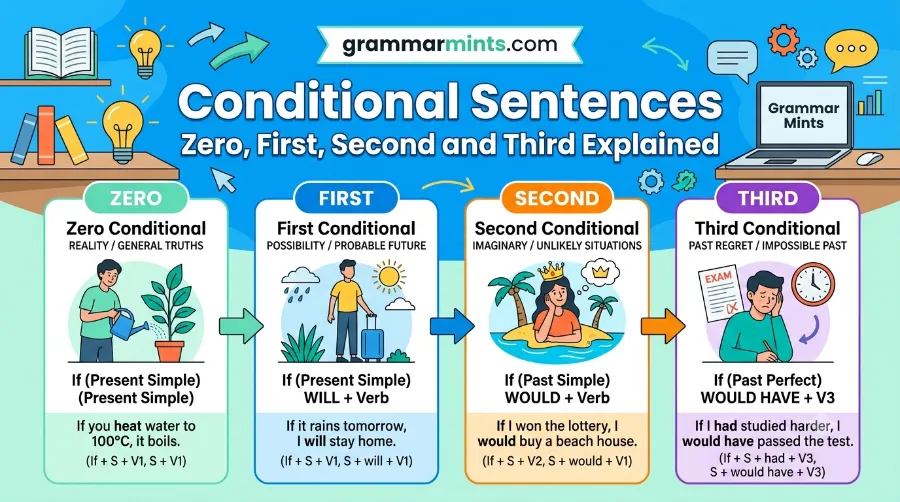
If you want to learn more conditional sentences rules tips and expert advice.
What Are Modal Verbs in English?
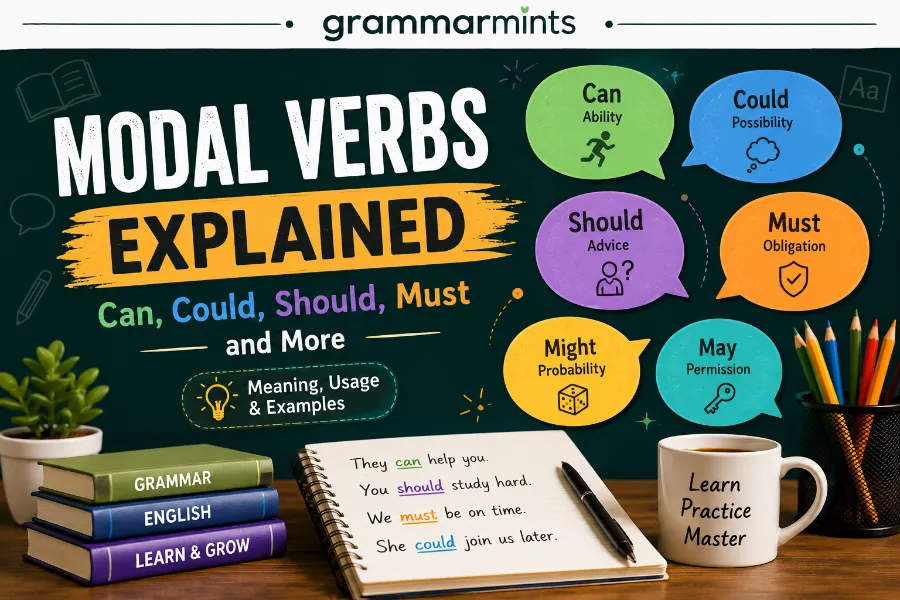
Modal verbs are a small group of helping verbs that sit before a main verb to add meaning. This meaning can be ability, permission, possibility, obligation, or advice. Unlike regular verbs, modal verbs never change their form, no matter who or what the subject is.
If you want to learn more about modal verbs in english tips and expert advice.
For example, we say “she can swim,” not “she cans swim.” Similarly, modal verbs are always followed by the base form of the main verb, without “to.” Unlike regular verbs, modal verbs never add an “s” for the third person singular, so a sentence like “he musts go” is always incorrect.
If you want to learn more articles in english grammar tips and expert advice.
This single rule trips up thousands of learners every single day. Therefore, mastering it early saves a lot of frustration later. If you want a deeper foundation first, our guide to parts of speech explained is a great place to start before diving into modal verbs.
If you want to learn more gerunds and infinitives rules tips and expert advice.
Modal Verbs List You Should Know
Here is the core list every English learner and native speaker should know by heart:
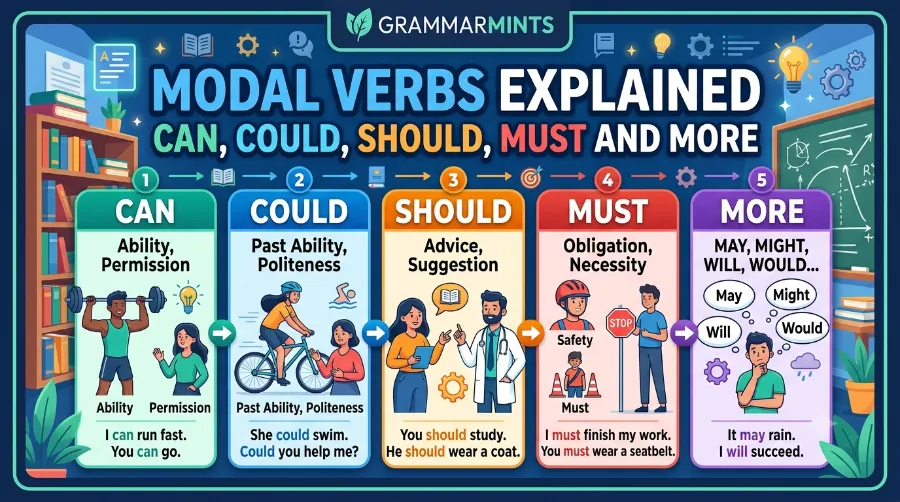
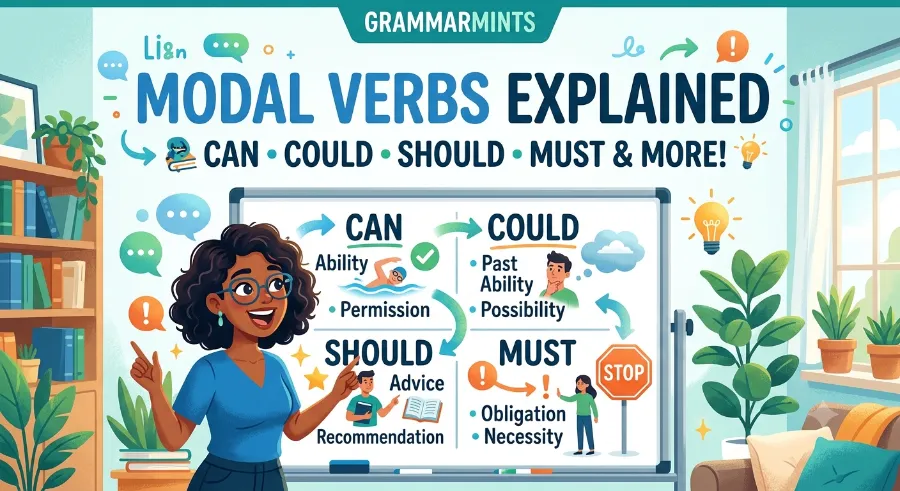
- Can – ability, permission, informal requests
- Could – past ability, polite requests, possibility
- May – formal permission, possibility
- Might – weaker possibility
- Will – future actions, promises
- Would – polite requests, hypothetical situations
- Shall – formal suggestions, future (mostly British English)
- Should – advice, recommendation
- Must – strong obligation, logical certainty
- Ought to – advice, similar to should
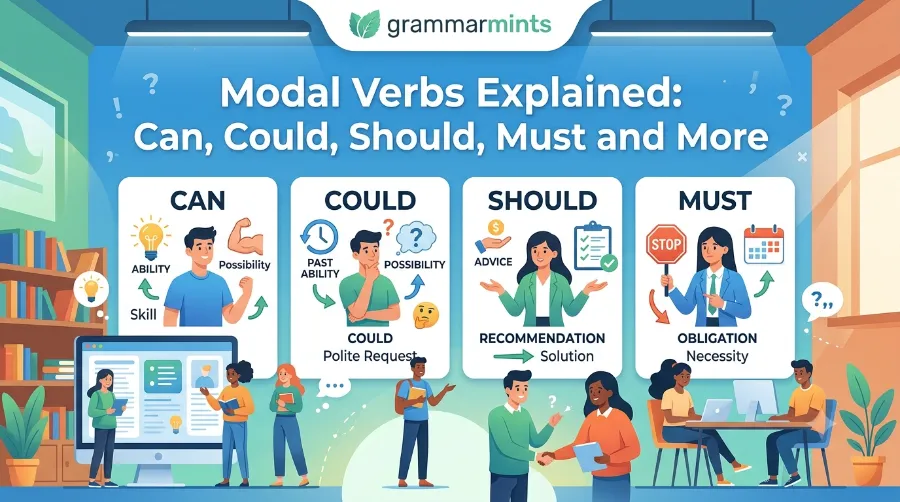
Can, Could, Should, Must and More: The Core Modal Verbs Explained
Now that you know the list, let’s look closely at how each modal verb actually works in real sentences. Because each one carries a slightly different shade of meaning, small mistakes can change what you are truly saying.
Can and Could – Ability and Permission
“Can” expresses present ability or informal permission. For instance, “I can drive” shows a skill, while “Can I leave early today?” asks for permission in a relaxed tone. “Could,” on the other hand, expresses past ability or a more polite request.
In September 2025, a workplace communication survey by a UK training firm found that new employees who used “could” instead of “can” in emails were rated as noticeably more polite by their managers. This small word choice, in other words, can shape how professional you sound.
Should and Must – Obligation and Advice
“Should” gives advice or a recommendation, while “must” expresses a strong obligation or a rule. For example, “You should drink more water” is friendly advice. Meanwhile, “You must wear a seatbelt” is a legal requirement in most countries, including all 50 U.S. states as of 2024 traffic law updates.
Consequently, using “must” when you only mean “should” can make you sound unintentionally bossy. As a result, many advanced learners choose “should” in everyday conversation and save “must” for real rules or strong necessity.
May, Might, Will, Would – Possibility and Politeness
“May” and “might” both express possibility, but “might” usually shows less certainty. For example, “It may rain tomorrow” sounds more confident than “It might rain tomorrow.” Meanwhile, “will” and “would” often deal with the future or hypothetical situations, such as “I would help you if I had time.”
Because these four modals overlap so often, learners frequently mix them up. However, once you understand the certainty scale: “will” is most certain, “might” is least certain, the choice becomes much easier.
How Modal Verbs Measure Love and Feelings
Modal verbs do more than state facts. They also act like a dial, turning feelings up or down depending on which word you choose. This is why couples, friends, and family members naturally reach for different modals when talking about love, care, and commitment.
Consider the difference between these three sentences, all built on the same core idea:
- “I might love you.” – uncertain, early-stage, cautious feelings.
- “I could love you.” – open possibility, growing warmth.
- “I must love you, because I think about you all day.” – strong, near-certain conviction.
Notice how the modal verb alone shifts the emotional weight of the sentence, even though the main verb “love” never changes. In this sense, modal verbs act as an informal emotional thermometer in everyday English conversation. A 2025 workplace and relationship communication review even noted that couples who used softer modals like “would” and “could” during disagreements reported feeling more respected than those who heard blunt statements with “must” or “have to.”
This same pattern shows up in daily requests between partners. “Would you call me tonight?” feels warm and inviting, while “You must call me tonight” feels like a demand. Therefore, choosing the right modal verb is not just a grammar rule; it is also a relationship skill.
Common Mistakes With Modal Verbs
Even confident speakers slip up here. According to a 2025 review of common ESL errors, learners often add “to” or change the tense after a modal verb, producing sentences like “she can to swim” instead of the correct “she can swim.” Below are the mistakes that show up most often, along with quick fixes.
- Adding “to” after a modal – Incorrect: “He can to play guitar.” Correct: “He can play guitar.”
- Using two modals together – Incorrect: “I will can help.” Correct: “I will be able to help.”
- Forgetting “have” in past modals – Incorrect: “She must went home.” Correct: “She must have gone home.”
- Confusing “mustn’t” and “don’t have to” – “Mustn’t” means forbidden; “don’t have to” means optional.
- Adding “do” before a modal – Incorrect: “I don’t can swim.” Correct: “I cannot swim.”
If subject-verb pairing still feels tricky alongside these modal rules, our detailed post on subject-verb agreement rules made easy pairs perfectly with this guide.
Real-Life Examples of Modal Verbs in 2026
Grammar rules stick best when you see them in real situations. Here are five everyday examples drawn from common 2026 contexts:
- Workplace: “You must submit the report by 5 PM on Friday.” This is a strict deadline.
- Travel: “Passengers may carry one cabin bag under 7 kg,” an airline policy seen on most 2026 European carrier websites.
- Health: “You should drink at least 2 liters of water daily,” a guideline still echoed by most public health bodies this year.
- Relationships: “Could you call me tonight?” This is a polite, warm request between partners.
- Education: “Students might retake the exam if they score below 60%,” a common university policy phrase.
Notice how each modal verb changes the entire feeling of the sentence, even though the core message stays similar. This is exactly why modal verbs explained clearly can improve both your writing and your relationships.
Modal Verbs vs Other Auxiliary Verbs
Modal verbs are a type of auxiliary verb, but they behave differently from “do,” “does,” “did,” “has,” and “have.” For example, regular auxiliary verbs can change form (“does” becomes “did” in the past), while modal verbs like “can” simply become “could.” If you would like a broader view of how these fit into sentence timing, check out our guide on tenses in English grammar.
Additionally, modal verbs never take “do-support” in negatives or questions. So instead of “Do you must go?” the correct form is simply “Must you go?” This distinction is one every serious English learner should memorize early.
Quick Comparison Table: Modal Verbs and Their Core Meaning
| Modal Verb | Main Use | Formality | Example |
|---|---|---|---|
| Can | Ability / permission | Informal | I can help you. |
| Could | Past ability / polite request | Neutral | Could you open the window? |
| May | Formal permission / possibility | Formal | You may leave now. |
| Might | Weak possibility | Neutral | It might snow tonight. |
| Should | Advice | Neutral | You should rest more. |
| Must | Obligation / certainty | Strong | You must see a doctor. |
| Will | Future / promise | Neutral | I will call you tomorrow. |
| Would | Hypothetical / polite request | Neutral | Would you like some tea? |
Modal Verbs by the Numbers: 2026 English Learning Snapshot
Understanding modal verbs matters more than ever, because English continues to grow as the world’s leading second language. The table below shares the latest research on global English learning trends.
| Statistic | Figure | Source Year |
|---|---|---|
| People who speak English worldwide | Approx. 1.53 billion | 2026 |
| Non-native English speakers | Over 1.1 billion | 2026 |
| Share of internet content in English | Around 52% | 2026 |
| Global online language learning market | $115 billion (projected) | 2025 |
| English learning market growth rate | 22% annually | 2025 |
As the table shows, total English speakers reached approximately 1.53 billion in 2026, with about 390 to 400 million being native speakers. Since most of these 1.1 billion+ second-language speakers must eventually learn modal verbs, this small grammar category carries an outsized impact on global communication.
Tips to Master Modal Verbs Explained: Can, Could, Should, Must and More
Practice is what truly locks these rules into memory. Here are five simple, proven steps you can follow starting today.
- Read your sentence aloud. If it sounds like “he cans swim,” you will usually catch the error yourself.
- Group modals by strength. Keep a mental scale from “might” (weak) to “must” (strong) for possibility and obligation.
- Practice with real emails. Rewrite three of your recent messages using “could” or “would” instead of blunt commands.
- Use flashcards for irregular pairs. For example, pair “must” with “have to,” and “can” with “be able to.”
- Test yourself weekly. Short, regular quizzes work better than one long study session, according to most language-retention research.
Over time, this steady, low-pressure practice builds real fluency, rather than memorized rules that fade after a test.
Modal Verbs in Direct and Indirect Speech
Modal verbs often change form when you move from direct speech to reported speech. For instance, “can” becomes “could,” and “will” becomes “would” in most past-tense reported sentences. This shift confuses many learners, so it deserves its own careful study.
If you want a complete breakdown of these shifting patterns, our guide to direct and indirect speech rules covers every exception in detail. Understanding this connection will make your modal verb usage even more accurate across both spoken and written English.
For further authoritative reading, the Oxford Online English introduction to modal verbs offers clear audio examples, while ABA English’s modal verbs guide provides useful practice exercises for different proficiency levels.
Frequently Asked Questions
What are the 9 main modal verbs in English?
The nine core modal verbs are can, could, may, might, will, would, shall, should, and must. “Ought to” is sometimes added as a semi-modal because it behaves slightly differently.
Is “must” stronger than “should”?
Yes. “Must” expresses a strong obligation or rule, while “should” simply gives advice or a gentle recommendation. You can ignore “should,” but ignoring “must” often has real consequences.
Can modal verbs be used in the past tense?
Yes, but the structure changes. Instead of changing the modal itself, you add “have” plus a past participle, such as “should have gone” or “must have forgotten.”
Why do modal verbs never take an “s” in third person?
Modal verbs are a special category of auxiliary verb, so they do not follow the same conjugation rules as regular verbs. This is simply a fixed grammar rule you memorize rather than calculate.
What is the difference between “can” and “may” for permission?
“Can” is more common and informal, while “may” is considered more formal and polite, especially in written English or professional settings.
Conclusion
Modal verbs explained clearly turn one of English grammar’s trickiest topics into something manageable and even enjoyable. From asking a polite favor with “could” to stating a firm rule with “must,” these small words carry real emotional and practical weight. By practicing the tips above and reviewing real examples regularly, you will notice your spoken and written English becoming naturally more accurate, confident, and warm. Keep exploring related grammar topics on Grammarmints’ full English grammar rules hub to keep building on this strong foundation.
References
- Oxford Online English, “English Modal Verbs: Introduction,” oxfordonlineenglish.com
- ABA English, “Modal Verbs in English,” abaenglish.com
- Text Inspector, “Top 10 Common ESL Mistakes and How to Correct Them,” 2025
- LingoBright, “English Language Statistics 2026,” 2026
- Preply, “Global Language Learning Report,” 2026