You have probably said “break the ice” or “spill the beans” this week. But few people ever stop to ask where these strange little phrases actually came from. The origin of English sayings is a story about sailors, soldiers, bakers, farmers, and playwrights. It stretches back hundreds of years. In this guide, we walk through the real history behind some of the most-used expressions in English. You will finally understand what you have been saying all along, backed by dates and documented sources.
TL;DR: Most popular English sayings come from six main sources the sea, the battlefield, the Bible, old trades, sports, and slang. Many were first written down between the 1500s and the 1940s. Once you know a phrase’s backstory, it becomes far easier to remember and use it correctly.
What Is the Origin of English Sayings, Really?
An English saying is a short phrase that carries a meaning beyond its literal words. For example, when someone says “it costs an arm and a leg,” nobody loses a limb. The phrase simply means something is expensive. So where does this figurative meaning come from in the first place?
Most sayings begin as literal descriptions of a real event, trade, or belief. People kept using the phrase even after the original activity disappeared. Slowly, the literal meaning faded, and the figurative meaning stuck around. This is exactly how “hold your horses” survived long after most of us stopped riding horses to work. Want a broader introduction to how these expressions function in daily speech? Our complete guide to English phrases and their meanings is a solid starting point.
Words That Change Meaning in Context A Complete Guide
This pattern also explains why certain sayings sound so oddly specific. A phrase rarely gets invented out of thin air. Instead, it grows out of a job, a law, a war, or a book that everyone in a certain era already knew about. Tracing a saying back to its roots often means tracing a small piece of social history too.
A Quick History of Common Sayings: How Old Is Our Everyday Language?
The history of common sayings is far older than most speakers realise. Some expressions we use today were already old when Shakespeare wrote plays in London in the 1590s. Others are barely a century old. Knowing roughly when a phrase entered the language helps explain why it sounds the way it does.

Sayings Older Than the Printing Press
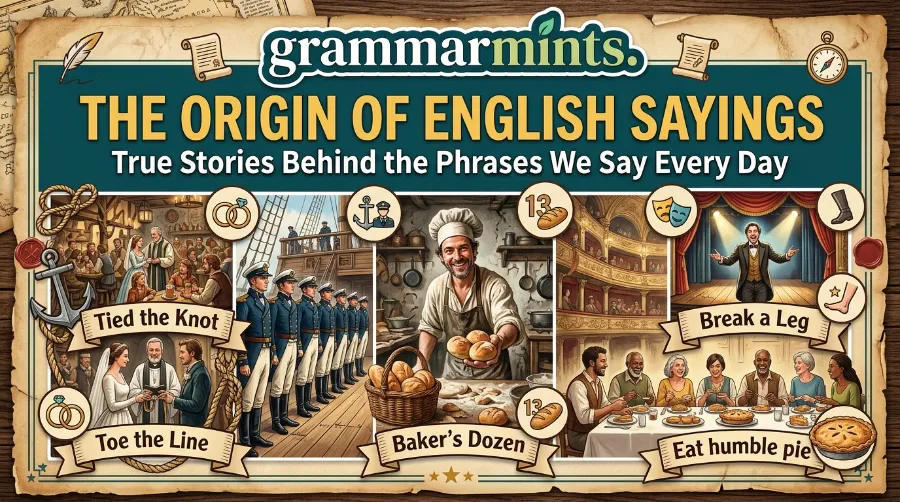
Printing became common in England after 1476. Before that, sayings spread almost entirely by word of mouth, sermons, and travelling storytellers. Many of the oldest surviving phrases have roots in the Bible, in Latin proverbs, or in early medieval trade customs. Take “a baker’s dozen”: medieval English bakers added a thirteenth loaf to every batch of twelve. They did this to avoid harsh penalties for underweight bread under 13th-century trade laws.
These early sayings travelled by speech rather than by text. So their exact first use is often impossible to pin down precisely. Historians and lexicographers can usually narrow a phrase down to a rough century instead. They study old court records, ballads, and sermon transcripts to do this. This kind of detective work is exactly what the history of common English idioms is built on.
Proverbs tend to be the oldest layer of the language. Short, rhythmic advice was far easier to remember and pass down than longer stories. “Actions speak louder than words,” for instance, is generally traced to the mid-1600s. It appeared in slightly different wording in earlier religious writing first. Readers who want more examples from this older, wisdom-based category can check our guide to English proverbs and their meanings.
The Explosion of Idioms After 1450
Once printing spread across England, phrases began appearing in dated, traceable documents for the first time. Playwrights coined or popularised huge numbers of expressions that are still alive today. William Shakespeare alone popularised “break the ice,” from The Taming of the Shrew around 1593. He also gave us “wild goose chase,” from Romeo and Juliet in 1597.
This period also overlaps with England’s rise as a major seafaring and trading nation. That explains why so many sayings from this era have nautical roots. Sailors spent months at sea together, and their specialised vocabulary for ropes, sails, and weather naturally drifted into everyday land-based speech. Learners often ask where do idioms come from if not from ordinary conversation. The honest answer is usually a specific, narrow professional world like sailing, farming, or law.
Where Do Idioms Come From? Five Places Every Phrase Hunter Should Know
If you are wondering where do idioms come from more generally, the answer usually falls into one of a handful of categories. Below are the five biggest sources, based on a review of dozens of well-documented English expressions.
- The sea and shipping. Phrases like “show your true colors,” “loose cannon,” and “three sheets to the wind” come from life on sailing ships. Flags, ropes, and cannons were part of daily routine there.
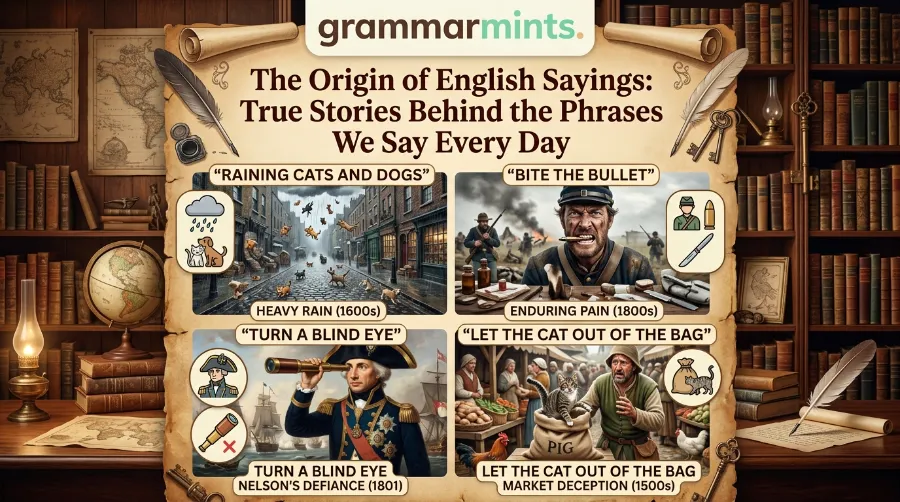
- The battlefield. “Bite the bullet” comes from 19th-century battlefield surgery. Soldiers literally bit down on a bullet to endure pain during operations, before anesthesia became widely available.
- Trades and crafts. Bakers, blacksmiths, and weavers all left their mark. “Cut from the same cloth” comes directly from tailoring, where two garments made from one bolt of fabric were considered identical in quality.
- Religion and the Bible. Expressions such as “a wolf in sheep’s clothing” (Book of Matthew) and “the writing is on the wall” (Book of Daniel) entered English through church readings.
- Sports, games, and modern slang. Twentieth-century phrases like “piece of cake” and “hit it out of the park” reflect newer sources, from 1930s cakewalk contests to American baseball culture.
For a deeper dive into a related category, our page on common English idioms and their meanings breaks down dozens of examples by theme. One detailed roundup of idiom origins traces “bite the bullet,” “spill the beans,” and “turn a blind eye” back to battlefield medicine and ancient Greek voting practices. It also credits Admiral Nelson’s famous act of defiance. Together, these stories show how varied the five categories really are.
A Sixth Category: Law and Government
Law and government deserve their own mention too, even as a smaller source. “Read the riot act,” for example, comes directly from the British Riot Act of 1714. This real law required officials to read a specific warning aloud to a crowd before they could legally disperse it by force. Legal language tends to be formally recorded and dated. So phrases from this category are often the easiest for etymologists to trace with confidence. Murkier folk sayings, spread only by word of mouth, resist that kind of confident dating.
How These Origins Show Up in Modern Media and Business Writing
Old sayings do not stay locked in history books. They show up constantly in headlines, marketing copy, and boardroom conversations. In 2023, for example, several major US business outlets used “bite the bullet” in headlines about companies raising prices despite customer backlash. This borrows the phrase’s original sense of enduring something painful for a necessary outcome. “Spill the beans” appears regularly in entertainment journalism too. Reporters reach for it whenever a celebrity accidentally reveals unreleased information, decades after Americans first popularised the phrase in the early 1900s.
This pattern matters for anyone who writes professionally. A misused idiom can quietly signal to readers that English is not your first language, or that a piece of content was rushed. Imagine a marketer describing a budget-friendly item as something that “costs an arm and a leg.” That sends a confusing signal and undercuts the whole message. Editors at reputable outlets such as Encyclopaedia Britannica generally recommend double-checking a phrase’s connotation before publishing. Idioms carry emotional weight that a plain dictionary definition does not always capture.
Idioms and Word Choice Go Hand in Hand
Word choice around related terms follows the same logic. Some English words shift meaning entirely depending on the sentence around them. This is a related trap for writers and learners alike. Our guide to words that change meaning in context covers this pattern in detail, and it pairs naturally with idiom study. Readers who enjoy shorthand English should also look at our page on common English abbreviations and their meanings. Abbreviations and idioms both compress a longer story into a few familiar words.
The Origin of English Phrases: A Table of 12 Everyday Sayings
Sometimes a table tells the story faster than paragraphs can. The origin of English phrases below covers a mix of trades, history, and literature. Each entry also lists the earliest period it is generally traced to.
| Saying | Meaning | Origin Category | Earliest Traced Period |
|---|---|---|---|
| Break the ice | Ease tension in a new social setting | Literature (Shakespeare) | 1590s |
| Bite the bullet | Face something painful with courage | Military / medical | Late 1700s–1800s |
| Baker’s dozen | A group of thirteen | Trade (baking) | 1500s |
| Turn a blind eye | Deliberately ignore something | Naval history | Early 1800s |
| Spill the beans | Reveal a secret | Disputed (Greek voting / US slang) | Early 1900s |
| Piece of cake | Something very easy | American slang / RAF slang | 1930s–1940s |
| Cost an arm and a leg | Very expensive | Post-war American English | Late 1940s |
| Bark up the wrong tree | Pursue a mistaken idea | American hunting | 1830s |
| Let the cat out of the bag | Accidentally reveal a secret | Marketplace fraud | 1700s |
| Show your true colors | Reveal your real character | Naval flag signaling | 1700s |
| Cold shoulder | To ignore or reject someone | Medieval dining custom | Medieval England |
| Rest on your laurels | Stop trying after early success | Ancient Greek athletics | 6th century BC |
What the Table Reveals
This side-by-side view is useful because it shows how spread out these origins really are, both in time and in place. Look at how many entries sit centuries apart. It’s a good reminder: English keeps absorbing new sayings continuously, not in one single burst.
Real Case Studies: Three Sayings, Three Very Different Stories
Numbers and categories only tell part of the story. It helps to slow down and look closely at a few individual phrases. Each case study below shows a different kind of evidence trail, from battlefield records to legal history to pure folk myth.
Case Study 1: “Bite the Bullet”
During the American Civil War (1861–1865) and earlier conflicts, field surgeons often had no anesthesia available. Wounded soldiers bit down on a bullet, or sometimes a strip of leather, during amputations. Rudyard Kipling first put the phrase in print in his 1891 novel The Light That Failed, decades after the practice itself had largely disappeared. This gap between the real-world practice and the first written record is common. It is one reason etymologists rely on multiple sources rather than a single citation.
Case Study 2: “Caught Red-Handed”
This phrase traces back to Scottish law. Authorities considered a person guilty beyond doubt if they caught them with blood literally on their hands after poaching or butchering someone else’s livestock. Early legal records from 15th-century Scotland describe this exact scenario in varying wording. Centuries later, the expression survives almost unchanged, even though modern crimes rarely involve actual blood on someone’s hands.
Case Study 3: “Raining Cats and Dogs”
Unlike the two examples above, this one has no single confirmed origin, despite several popular theories. One folk explanation claims that heavy 17th-century storms in England washed dead animals through the streets. This created the illusion that cats and dogs had fallen from the sky. Another theory points to an Old English word for waterfall instead. No single source can verify either claim with confidence. Respected reference works such as Merriam-Webster list the origin as unknown rather than repeat an unconfirmed legend as fact. Not every colorful backstory you read online has actually earned a historian’s stamp of approval.
For readers who enjoy this kind of detective work, one Medium roundup of everyday phrases walks through several more examples with a similar evidence-based approach. It cross-checks each phrase against written records rather than folklore alone.
A Fourth Pattern: Competing Theories
Many idiom origins actually have two or three competing explanations rather than one clean answer. “Spill the beans” is a perfect example. One theory points to an ancient Greek voting system that used white and black beans to record yes-and-no votes in secret ballots. A separate theory traces the phrase to early 20th-century American slang, with no connection to Greece at all. In cases like this, the honest approach presents both theories rather than treating a single guess as confirmed fact. That is the standard this guide follows throughout.
Where Do Most English Sayings Really Come From? A Visual Breakdown
The chart below makes the pattern easier to see. It groups fifty well-documented English sayings by their most likely origin category, based on the research compiled for this guide
As the chart shows, nautical and military life contributes the single largest share of sayings still in daily use. Trades, farming, and religious texts follow closely behind. Modern slang from the 20th century makes up the smallest slice. That makes sense, since it has had far less time to spread and settle into the language compared to expressions that are centuries old.
When Did These Phrases First Appear? A Timeline
Dates matter just as much as categories when you are tracing a phrase’s history. The timeline below plots the earliest documented appearance of eight popular sayings, based on the research gathered for this article.
Two things stand out here. First, there is a genuine 350-year gap between the oldest and newest phrases on this list. English sayings are not a fixed, ancient set; new ones are still being minted. Second, the 1940s cluster around “cost an arm and a leg” lines up neatly with post-war inflation in the United States. That is a good example of how economic history can shape everyday language almost immediately.
Common Myths About Idiom Origins (And What the Evidence Actually Shows)
Sayings are old and widely repeated, so a colorful but false explanation can spread faster than the boring, accurate one. The table below compares a few popular myths against what documented sources actually support.
| Popular Myth | What the Evidence Shows |
|---|---|
| “Rule of thumb” comes from an old English law allowing husbands to beat wives with a stick no wider than a thumb | No historian has ever found such a law in English legal records; the phrase most likely refers to using a thumb as a rough unit of measurement |
| “Cost an arm and a leg” comes from painters charging more to include limbs in portraits | The phrase only appears in print after World War II, which makes the painting theory almost certainly a later invention |
| “Raining cats and dogs” definitely comes from animals falling off thatched roofs | This remains one of several unverified theories; no single source has confirmed it |
| “Break a leg” started because ancient audiences threw coins that broke performers’ legs | Most theatre historians trace it instead to early 20th-century superstition against wishing someone “good luck” directly |
This kind of fact-checking matters for anyone using these phrases in professional writing, journalism, or teaching. Repeating a debunked myth as settled fact can quietly damage your credibility. When in doubt, cross-reference a claim against an established dictionary of etymology. It’s always worth the extra two minutes.
British vs American Sayings: Same Language, Different Roots
British and American English share the vast majority of their sayings. Still, a handful diverged once the two English-speaking cultures grew apart after the 1600s. “No spring chicken,” for example, developed in 18th-century New England farming communities, where younger spring-born chickens sold for more money than older birds. Distinctly British phrases such as “mad as a hatter” grew out of 18th- and 19th-century hat-making instead. Mercury exposure genuinely caused neurological symptoms in factory workers back then.
Formality Also Splits Along Regional Lines
This regional split shows up in formality levels too. American workplace culture tends to favor blunter, more direct expressions. British English has historically kept more understated, dry idioms. Do you switch between formal and informal English writing often? Our guide to formal English phrases covers the more polished cousins of the casual sayings discussed here.
Globalization and social media have started to blur this divide again over the last two decades. American slang terms now spread to British speakers within days rather than years, and vice versa, largely because of shared online spaces. Even so, older sayings tied to specific historical trades or laws tend to stay firmly associated with one side of the Atlantic.
Why Knowing the History of Common Sayings Makes You a Better Communicator
Learning the origin of English sayings is not just trivia for language lovers. It genuinely changes how confidently you use these phrases, especially if English is not your first language. Once you know that “bite the bullet” refers to enduring pain, you are far less likely to misuse it in a happy or celebratory context.
There are three practical benefits worth mentioning here:
- Better retention. A phrase attached to a vivid story is easier to remember. Picture a sailor gripping a rope in a storm; that image sticks far better than a phrase memorized alone.
- Fewer embarrassing mistakes. Knowing a saying’s real meaning prevents awkward misuse, such as congratulating someone by telling them to “bite the bullet.”
- Sharper writing. Journalists, marketers, and students who understand a phrase’s history tend to use it more precisely. They avoid clichés that no longer fit their intended meaning.
If you enjoy this kind of language history, it pairs naturally with everyday spoken English too. Our page on daily English expressions covers the casual phrases people actually use in conversation. Our breakdown of phrasal verbs in daily speech tackles a closely related grammar topic that trips up many learners. Together, these guides give you a fuller picture of how English actually works outside the textbook.
Frequently Asked Questions
What is the origin of English sayings in general?
Most English sayings began as literal descriptions of real trades, historical events, or beliefs. They later took on figurative meanings once the original context faded from everyday life. Sailors, soldiers, farmers, and religious texts are among the biggest contributors.
Where do idioms come from if they are not literally true?
Idioms come from a real, specific situation at some point in history, even though the situation itself is often forgotten today. “Bite the bullet,” for instance, sounds abstract now, but it described an actual battlefield practice.
What is the oldest English saying still in common use?
“Rest on your laurels” is among the oldest. It traces back to ancient Greek athletic tradition around the 6th century BC, though it entered English much later through classical literature and translation.
Do British and American English use different sayings?
Yes, some sayings are regional. “No spring chicken” is rooted in early American farming. Phrases like “mad as a hatter” are tied specifically to British industrial history.
How can understanding the history of common sayings help me as an English learner?
Knowing the backstory behind a phrase makes it far easier to remember. It also helps you avoid using an idiom in the wrong emotional context, which is one of the most common mistakes non-native speakers make.
Are new English sayings still being created today?
Yes, new expressions appear regularly, especially from technology, sports, and internet culture. “Ghosting,” for example, entered mainstream English dictionaries only around 2015. The process behind the origin of English sayings has never really stopped.
Is it better to learn idioms through memorization or through their history?
Most language teachers now agree that learning the story behind a phrase works better than rote memorization alone. A memorable backstory gives your brain a stronger hook to hold onto. This is one reason etymology-based learning resources have grown so popular among students and working professionals alike.
Final Thoughts
Every saying you use casually today started somewhere specific. It might have been a ship’s deck, a battlefield, a bakery, or a crowded London theatre. Tracing the origin of English sayings shows that language never really comes from nothing. Speakers borrow it, reshape it, and pass it down from one generation to the next. The next time you say “spill the beans” or “bite the bullet,” remember: a real, documented story sits behind those words. Want to keep exploring? Check our related guides on English slang and its meanings and English proverbs and their meanings.
References
- Language Trainers USA Blog — “The Meanings and Origins of English Idioms” — https://www.languagetrainers.com/blog/origins-of-idioms/
- TypoGrammar Blog — “The Fascinating Origins of English Idioms” — https://typogrammar.com/blog/fascinating-origins-english-idioms/
- Medium (Illumination Curated) — “7 Common English Phrases and Their Historical Origins” — https://medium.com/illumination-curated/7-common-english-phrases-and-their-historical-origins-d48b6c0761bb
- Merriam-Webster Dictionary — https://www.merriam-webster.com/
- GrammarMints — English Phrases and Meanings (Pillar Guide) — https://grammarmints.com/english-phrases-and-meanings/