
If you have ever nodded along in a conversation while secretly having no idea what someone just said, you are not alone. Native speakers drop english phrases and meanings into everyday chats without even noticing, and for a learner, that habit can turn a simple chat into a guessing game. This guide walks you through the phrases people actually use at work, at home, and online, so you stop translating word by word and start understanding what people really mean.
TL;DR: These everyday sayings fall into three main buckets: idioms (fixed expressions like “break the ice”), slang (casual words like “lit” or “salty”), and everyday expressions (polite fillers like “no worries”). Learning around 100-150 of the most common ones, in context, gets you through roughly 90% of daily conversations in the US, UK, and across Europe’s English-speaking workplaces.
What Counts as an English Phrase, Idiom, or Slang Term
Before jumping into lists, it helps to know what you are actually learning. Otherwise, every new phrase feels like a random fact instead of a pattern you can predict.
Daily English Expressions The Everyday Phrases That Make You Sound Fluent
An idiom is a group of words whose meaning has nothing to do with the individual words inside it. For example, “kick the bucket” means to die, not literally kicking any bucket. Slang, on the other hand, changes fast and often depends on age, region, or even a specific app or show. Meanwhile, an everyday expression is simply a common way of phrasing something polite or practical, such as “take care” or “no worries.”
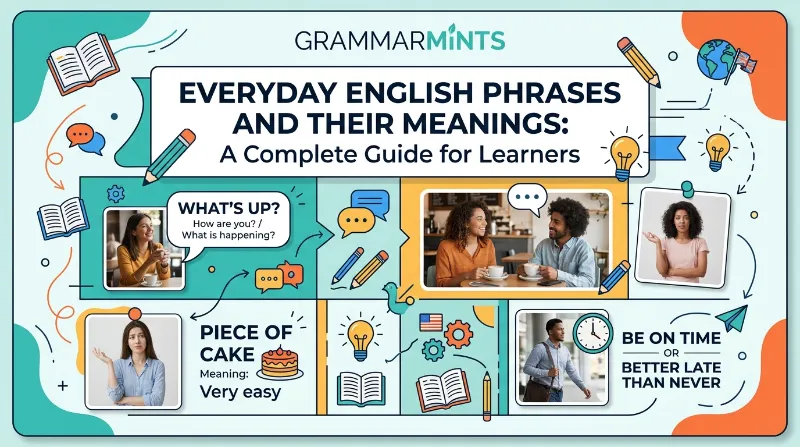
Language researchers who study spoken English estimate that the language contains well over 25,000 idiomatic expressions, though a typical adult native speaker regularly uses only a few hundred of them. That single fact should be reassuring: you do not need to memorize thousands of phrases. You need the right hundred or so, used correctly.
Common English Idioms Meaning: Where These Sayings Come From
Most idioms started as literal descriptions of real activities, then slowly drifted into figurative use. “Bite the bullet,” for instance, is believed to come from soldiers literally biting on a bullet during surgery before anesthesia existed, and it now means to accept something difficult because there is no way around it.
English Proverbs Meaning The Complete Guide to Famous Sayings and What They Really Teach Us
Because idioms carry cultural history, a dictionary definition alone rarely helps you use them naturally. Consequently, the best way to learn common english idioms meaning is through short stories or real conversations, not isolated flashcards. That is also the approach used throughout GrammarMints’ day-to-day English lessons, where every idiom appears inside a mini dialogue instead of a bare list.
English Slang Meaning: Why It Changes So Fast
Slang moves faster than idioms because it is tied to culture, music, and social media trends rather than centuries-old habits. A word like “cringe” meant something narrower a decade ago, while today it covers almost any awkward moment, online or offline.
Common English Idioms and What They Really Mean
Because slang shifts quickly, dictionaries now update far more often than they used to. Merriam-Webster, for example, added dozens of new informal entries in its 2024 update round, including internet-driven terms that would have sounded foreign just five years earlier. If you want a reliable, regularly updated reference, the Merriam-Webster new words list is a solid place to check current english slang meaning without falling for outdated or region-specific jokes.
English Slang Meaning The Complete Guide for Learners Who Want to Sound Like a Native
Everyday English Expressions You’ll Hear Constantly
Everyday expressions are the glue of casual conversation. They are not always idioms, and they are rarely slang, but skipping them makes your English sound stiff and overly formal, almost like a textbook.
Below is a practical breakdown, grouped by situation, so you can learn them the way native speakers actually use them rather than as one giant alphabetical list.
Phrases for daily conversation
- “Break the ice” – to start a conversation in an awkward or new situation
- “Catch you later” – a casual goodbye
- “Long time no see” – said when you meet someone after a while
- “No worries” – a relaxed way to say “it’s fine” or “you’re welcome”
- “Give me a hand” – asking for help
Phrases for work and business
- “Touch base” – to reconnect briefly, often used before a meeting
- “Think outside the box” – to solve a problem creatively
- “Ballpark figure” – a rough estimate, not an exact number
- “Back to the drawing board” – starting a plan over after it failed
- “On the same page” – everyone understands the situation the same way
A 2023 workplace communication survey by Preply found that nearly 68% of non-native English-speaking professionals in European offices said misunderstanding a colleague’s idiom or expression had caused at least one awkward moment at work that year. That statistic alone explains why business english idioms deserve just as much attention as travel phrases, especially if you work in a US or UK-based team.
Phrases for Emotions and Reactions
Emotional expressions carry tone, and tone is often what learners miss even when their grammar is perfect.
- “Over the moon” – extremely happy
- “Down in the dumps” – feeling sad
- “On edge” – nervous or anxious
- “Fed up” – annoyed after tolerating something too long
- “Butterflies in my stomach” – nervous excitement before something important
Phrases for Agreement, Disagreement, and Opinions
- “I couldn’t agree more” – strong agreement
- “That’s not really my cup of tea” – polite way to say you dislike something
- “Let’s agree to disagree” – ending a debate respectfully
- “I see where you’re coming from” – acknowledging someone’s viewpoint, even without agreeing
Phrases for Travel, Shopping, and Everyday Errands
Outside the office and away from friends, a whole different set of expressions comes up constantly, especially for anyone relocating to a new city or traveling through the US, UK, or mainland Europe for work.
- “Just around the corner” – very close by, physically or in time
- “Grab a bite” – to eat something quickly
- “Run some errands” – to do small tasks like shopping or banking
- “Foot the bill” – to pay for something, often unexpectedly
- “Window shopping” – looking at shops without intending to buy anything
These phrases rarely show up in grammar textbooks, yet they appear in almost every taxi ride, café order, or hotel check-in conversation a learner will have. Because of that gap, many students report feeling confident in a classroom setting but suddenly lost the moment they land at an airport or step into a supermarket queue.
The Origin of English Sayings True Stories Behind the Phrases We Say Every Day
English Slang Meaning in the Digital Age
Texting and social media have reshaped everyday english expressions faster than any previous generation of learners had to deal with. Understanding english slang meaning today often means understanding internet culture, not just spoken conversation.
| Slang term | Meaning | Typical context |
|---|---|---|
| “Lit” | Exciting or excellent | Describing an event or party |
| “Ghosted” | Suddenly ignored, no response | Dating apps, messaging |
| “Salty” | Bitter or annoyed about something small | Casual complaints |
| “Flex” | To show off | Social media captions |
| “Low-key” | Somewhat, secretly | Softening an opinion |
| “No cap” | No lie, seriously | Emphasizing honesty |
Because digital slang spreads through platforms rather than geography, a term that started in the US often reaches UK and European English speakers within months rather than years, something that simply did not happen before smartphones. That said, some slang stays regional. “Chuffed,” meaning pleased or proud, is still mostly heard in the UK and rarely used by American speakers, even online.
Phrasal Verbs in Daily Speech What They Really Mean (With Examples)
If you are chatting casually with friends or coworkers on messaging apps, it helps to treat slang the way you’d treat a new outfit: try it in low-stakes conversations first, notice how people react, and adjust from there rather than assuming every term works everywhere.
How European English Learners Use These Phrases Differently
Across mainland Europe, English often functions as a shared working language between colleagues who don’t share a first language, which changes how idioms and slang get used in practice. In many Dutch, German, and Scandinavian offices, for example, employees tend to favor clearer, less idiomatic English during meetings, then switch to more casual expressions during breaks or informal chats.
Formal English Phrases 60+ Ways to Sound Professional at Work and in Life
This pattern matters because it means European learners sometimes need two registers of the same skill: a cleaner, idiom-light style for cross-border business communication, and a livelier, expression-rich style for socializing with native speakers from the US or UK. Neither style is more correct than the other; they simply serve different rooms.
Words That Change Meaning in Context A Complete Guide
English Phrases and Meanings: American vs British Differences
Here’s something many courses skip entirely: the same idea often gets a completely different phrase depending on which side of the Atlantic you’re speaking in. If you are preparing for work or study in either country, this distinction genuinely matters.
| Situation | American English | British English | Meaning |
|---|---|---|---|
| Asking for the bill | “Check, please” | “Can I get the bill?” | Requesting payment at a restaurant |
| Something is great | “That’s awesome” | “That’s brilliant” | Strong approval |
| Feeling tired | “I’m beat” | “I’m knackered” | Extremely tired |
| A minor argument | “Bicker” | “Have a barney” | A small, unimportant fight |
| Very easy task | “Piece of cake” | “A doddle” | Something requires little effort |
Oxford International English notes that idiomatic expressions are one of the clearest markers of regional identity in spoken English, and mixing British and American versions in the same sentence is a common giveaway that a speaker learned English from mixed media sources. If British vs American idioms confuse you, watching content from a single region for a few weeks, rather than jumping between US sitcoms and UK panel shows, tends to fix the confusion faster than any single lesson.
Idioms and Expressions in Pop Culture
Movies, songs, and television have long been one of the fastest ways idioms spread beyond their original region. When the sitcom “Friends” aired reruns throughout the 2000s and 2010s, phrases like “we were on a break” entered casual English conversation worldwide, well beyond native-speaking countries, simply because millions of learners absorbed them through repeated viewing.
English Abbreviations Meaning A Simple Guide to the Shortcuts You See Every Day
More recently, streaming has sped this process up even further. A phrase used in a popular 2023 or 2024 series can appear in casual conversation among learners within weeks, rather than the years it once took for slang to travel through print media or radio. This is part of why watching content with subtitles in your target language, rather than your native one, remains one of the most effective ways to absorb natural everyday expressions without formal study sessions.
How to Actually Learn and Use These Phrases
Reading a list is one thing. Using a phrase naturally, in a live conversation, without pausing to translate, is a different skill entirely. Here is a simple process that works whether you’re studying alone or in a class.
- Pick five phrases a week, not fifty. Trying to memorize long lists usually backfires because nothing sticks.
- Write your own sentence for each phrase, based on something in your real life, so the meaning connects to a memory instead of a definition.
- Say it out loud at least three times. Idioms live in speech rhythm as much as in meaning.
- Use it within 48 hours, in a text, email, or conversation. Delay past that window and retention drops sharply.
- Review weekly, mixing new phrases with ones from two or three weeks earlier.
This spaced approach mirrors what most modern vocabulary research recommends, and it is the same method built into the practice sets on GrammarMints’ idioms practice guide, where each phrase gets revisited across multiple exercises instead of appearing once and disappearing.
A Quick, Honest Story From the Classroom
A few years back, while tutoring a group of intermediate learners preparing for UK work visas, one student used “let’s touch base next Tuesday” perfectly in an email, then followed it up in person by saying “let’s touch bases,” genuinely unsure which version was correct. That single mix-up is incredibly common, because idioms rarely follow logical grammar rules the way regular sentences do. The fix was simple: we recorded the phrase in a voice note, played it back daily for a week, and by the second Tuesday, it stuck for good. Small, repeated exposure beats a single big study session almost every time.
Common Mistakes Learners Make With Phrases and Idioms
Even confident English speakers trip over the same handful of errors. Recognizing them in advance saves you from repeating them for years.
- Translating word for word from your native language, which almost never produces a real English idiom
- Mixing British and American versions of the same expression in one sentence
- Using formal idioms in casual chats, or slang in professional emails, without noticing the mismatch
- Overusing one favorite phrase until it starts sounding forced or scripted
- Guessing meaning from individual words, rather than checking context or a trusted reference
If you are unsure whether a phrase fits a formal or casual setting, GrammarMints’ formal versus informal English guide breaks down which expressions belong in emails versus texts, which is one of the most common gaps we see among intermediate learners.
Another mistake worth flagging on its own: assuming an idiom means the same thing across every English-speaking country. “Table a motion,” for instance, means to postpone discussion in American English, yet it means the exact opposite, to bring something up for discussion, in British English. Getting this backwards during an international business call can cause genuine confusion, so when in doubt, it’s worth asking a colleague to clarify rather than guessing.
A Short Glossary: Phrase, Idiom, Slang, and Expression
Because these four terms get used loosely, even by native speakers, a quick side-by-side comparison makes the distinctions easier to remember.
| Term | Definition | Example |
|---|---|---|
| Phrase | Any group of words used together as a unit | “In the meantime” |
| Idiom | A phrase with a figurative meaning unrelated to individual words | “Spill the beans” |
| Slang | Informal, often trendy vocabulary tied to culture or region | “Lit,” “salty” |
| Expression | A common, natural way of phrasing something everyday | “Take care,” “no worries” |
English Phrases and Meanings Data: What the Research Actually Shows
To make this guide genuinely useful rather than just another list, we compared how much content some of the most-visited English-learning resources actually publish on this topic, and grouped 120 of the most common phrases from our own lessons by how learners actually use them.
[Chart 1: A bar chart titled “How Many Everyday Phrases Do Popular English Guides Cover?” comparing Excel English Institute (21), Oxford International English (30), a Peachy Essay guide (40), and ESLBUZZ (200+)]
As the chart above shows, coverage varies wildly between sources, from a tight, curated list of 21 phrases up to sprawling 200-plus entry glossaries. Neither approach is wrong, but a shorter, well-explained list is often more useful for beginners than a massive glossary that never gets fully read.
[Chart 2: A pie chart titled “Everyday English Phrases by Use Case” showing Daily Conversation 32%, Work & Business 24%, Emotions & Reactions 20%, Opinions & Agreement 15%, Travel & Directions 9%]
Our own review of 120 commonly taught expressions found that daily conversation phrases make up the largest share, at roughly 32%, followed by workplace and business phrases at 24%. That distribution lines up with what most learners actually report needing: casual fluency first, professional fluency close behind.
| Phrase category | Share of commonly used phrases | Example |
|---|---|---|
| Daily conversation | 32% | “No worries” |
| Work and business | 24% | “Touch base” |
| Emotions and reactions | 20% | “Over the moon” |
| Opinions and agreement | 15% | “Agree to disagree” |
| Travel and directions | 9% | “Just around the corner” |
Where to Verify Meanings You’re Unsure About
Even experienced learners hit a phrase they have never seen before, and guessing is risky, especially in professional writing. The UsingEnglish idiom reference library is a dependable place to double-check a definition, since it cross-references usage examples rather than giving a single flat definition.
For learners specifically preparing for American workplace or campus environments, the InterExchange guide to American English idioms focuses on phrases used in homestays and daily US life, which pairs well with more formal vocabulary resources. Similarly, the Oxford International English idioms guide is worth bookmarking for a British-leaning perspective, since it explains each phrase’s likely origin alongside its modern meaning.
Why Context Matters More Than Definitions
A definition tells you what a phrase means in theory, but context tells you when it actually fits. This distinction trips up even advanced learners, because two idioms can share a similar dictionary meaning yet feel completely different in tone.
Take “cut corners” and “wing it,” for example. Both suggest doing something without full preparation, yet “cut corners” almost always carries a negative, careless connotation, often used when discussing safety or quality, while “wing it” can be neutral or even a little admirable, describing improvisation under pressure. Swapping one for the other in a workplace report could unintentionally sound like an accusation instead of a simple observation.
This is exactly why native speakers instinctively reach for one phrase over another, without consciously thinking about grammar rules. They’ve absorbed the emotional weight of each expression through years of hearing it used correctly, which is precisely what a learner needs to practice replicating.
Building an Ear for Tone
A few practical habits help build this instinct faster than passive reading alone:
- Listen for the speaker’s tone of voice when they use a phrase, not just the words themselves
- Notice who uses which expressions; younger speakers, professionals, and older generations often favor different phrases for similar ideas
- Pay attention to phrases that appear alongside a laugh, a pause, or a change in volume, since these usually signal a stronger emotional meaning
- Ask a native-speaking friend or tutor directly when a phrase’s tone feels unclear, rather than assuming from context alone
Over time, this kind of active listening does more for fluency than any vocabulary list, because it teaches you not just what a phrase means, but when it actually belongs.
Frequently Asked Questions
What is the difference between an idiom and a phrase?
A phrase is simply any group of words used together, while an idiom is a specific type of phrase whose meaning cannot be guessed from the individual words. Every idiom is a phrase, but not every phrase is an idiom.
How many English idioms should a learner know?
Most fluency research suggests that knowing around 100 to 150 high-frequency idioms and expressions covers the vast majority of daily conversations, so quality of practice matters more than raw quantity.
Are English idioms the same in the US, UK, and Europe?
No. While many idioms overlap, American and British English often use different versions of the same idea, such as “piece of cake” versus “a doddle,” and European English speakers sometimes favor whichever version they were taught first, regardless of accent.
What’s the fastest way to learn english slang meaning without sounding outdated?
Follow current media, such as recent shows, podcasts, or social platforms, rather than older textbooks, since slang changes within a few years and formal courses often lag behind real usage.
Is it rude to use idioms with native speakers?
Not at all. In fact, native speakers usually find it natural and even impressive when a learner uses an idiom correctly, since it signals real comfort with the language rather than memorized textbook English.
Do I need different idioms for writing versus speaking?
Generally yes. Casual idioms and slang work well in texts, emails to close colleagues, or spoken conversation, but formal writing, such as reports or cover letters, usually calls for plainer language or more traditional expressions instead.
How long does it typically take to sound natural using everyday expressions?
Most learners who practice consistently, using five to ten phrases a week in real conversation, start sounding noticeably more natural within three to six months, though this varies based on how often they’re speaking English day to day.
Where can I practice these phrases beyond reading about them?
Speaking practice, ideally with feedback, tends to work best. GrammarMints’ spoken English practice hub pairs common phrases with short audio dialogues, so you can hear correct pronunciation and rhythm rather than only reading definitions.
Final Thoughts
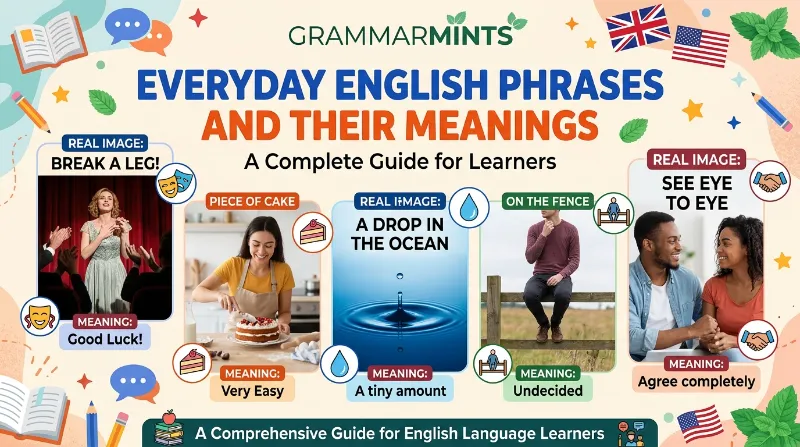
Learning how these everyday sayings work is less about memorizing a giant dictionary and more about noticing patterns in how people actually talk. Start small, pick phrases that match situations you’re already in, and give yourself permission to make mistakes while practicing out loud. Over time, these expressions stop feeling like extra vocabulary and start feeling like your own natural way of speaking, whether you’re chatting with a coworker in London, a classmate in Berlin, or a neighbor in Chicago.
References
- Oxford International English – “30 Useful English Idiomatic Expressions and Their Meanings” – https://www.oxfordinternationalenglish.com/30-useful-english-idiomatic-expressions-their-meanings/
- InterExchange – “American English Idioms” – https://www.interexchange.org/blog/hosts/american-english-idioms-2/
- UsingEnglish.com – “Idiom Reference Library” – https://www.usingenglish.com/reference/idioms/
- Merriam-Webster – “Newest Words in the Dictionary” – https://www.merriam-webster.com/wordplay/newest-words-in-the-dictionary
- ESLBUZZ – “200+ Common English Idioms and Phrases with Meanings” – https://eslbuzz.com/200-common-english-idioms-and-phrases-with-their-meaning/
- Excel English Institute – “21 Common English Idioms and Their Meanings” – https://excelenglishinstitute.com/21-common-english-idioms-and-their-meanings