Have you ever heard someone say they are “under the weather”? You probably wondered why weather has anything to do with feeling sick. That confusion is the whole problem with idioms. Understanding common English idioms meaning is one of the trickiest parts of learning natural English. The words rarely mean what they literally say. This guide breaks down the idioms you will hear at work, at home, and while traveling. It covers the US, UK, and Europe. You will stop guessing and start understanding.
TL;DR: Idioms are fixed phrases whose meaning has nothing to do with their individual words. A working list of roughly 100 common ones covers most everyday English conversations. Below, you will find popular idioms and meanings grouped by situation. You will also see real examples with dates and numbers, plus a look at how American, British, and European speakers use idioms differently.
What Exactly Is an Idiom, and Why Should You Care?
An idiom is a group of words that means something different from what each word means alone. “Spill the beans” has nothing to do with beans. It simply means to reveal a secret. Because of this gap, dictionaries alone rarely help learners use idioms with real confidence.
English Abbreviations Meaning A Simple Guide to the Shortcuts You See Every Day
Native speakers use idioms constantly, often without noticing. According to the Cambridge Dictionary blog on idioms, figurative expressions like these show up in casual speech far more than in formal writing. That is exactly why textbooks tend to underprepare learners for real conversations. Someone can study grammar for years and still feel lost when a coworker says, “let’s not beat around the bush.”

Learning an english idioms list with meaning does more than expand vocabulary. It helps you catch tone, humor, and intent. Those are three things that grammar lessons rarely teach directly.
Popular Idioms and Meanings You Will Hear Every Day
Not every idiom deserves equal attention. Some show up constantly. Others are rare enough to skip for now. Below is a practical set of popular idioms and meanings, grouped by the situations where they actually come up.
Idioms for Everyday Conversations
These phrases fill casual chats, small talk, and quick text messages. Once you notice them, you will hear them constantly.
- Break the ice – to ease tension in an awkward or new situation
- Hit the nail on the head – to describe something exactly right
- Once in a blue moon – something that rarely happens
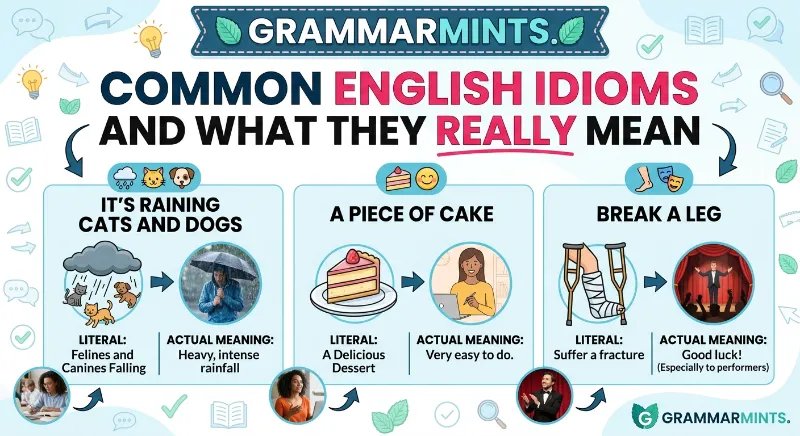
- Piece of cake – a task that is very easy
- Under the weather – feeling slightly unwell
- On the same page – in agreement or understanding something the same way
- Costs an arm and a leg – extremely expensive
A barista in Chicago might say, “That latte will cost you an arm and a leg downtown.” She means the price is unusually high. No actual limbs are involved.
Idioms for Work and Business
Workplace idioms carry real professional weight. Misunderstanding one can affect how a meeting or an email lands.
- Touch base – to check in briefly with someone
- Think outside the box – to approach a problem creatively
- Back to the drawing board – to start over after a failed plan
- Cut corners – to do something poorly to save time or money
- Ballpark figure – a rough, unofficial estimate
- Get the ball rolling – to start a process or project
A 2023 workplace communication survey by Preply found something striking. A majority of non-native English-speaking professionals in European offices said a misunderstood idiom caused an awkward moment at work that year. That single statistic explains why business idioms deserve real attention. It matters most for anyone working on a US or UK-based team. GrammarMints covers this in more detail in its guide to everyday English phrases and meanings.
Idioms for Emotions and Reactions
Emotional idioms carry tone in a way that plain vocabulary often cannot match.
- Over the moon – extremely happy
- Down in the dumps – feeling sad or low
- On edge – nervous or anxious
- Butterflies in my stomach – nervous excitement before something important
- Fed up – annoyed after tolerating something too long
Everyday Idioms Examples From Real Conversations
Reading a definition is one thing. Seeing an idiom used correctly in a real sentence is what actually makes it stick. Below are a few everyday idioms examples drawn from situations that happen constantly in daily life.
Two Idioms, Two Real Moments
Picture a project manager in London on a Monday morning. She tells her team, “We need to hit the ground running this week, since the client meeting got moved up to Thursday.” Here, “hit the ground running” means to start with full energy, right away, without a slow warm-up.
Everyday English Phrases and Their Meanings A Complete Guide for Learners
Now picture a New York classroom back in September 2024. A teacher used “let’s not put the cart before the horse” to stop students from skipping a step in a science experiment. That phrase simply means doing things in the wrong order.
Daily English Expressions The Everyday Phrases That Make You Sound Fluent
Idioms by the Numbers
Real numbers help too. A 2022 report from language platform Babbel offered a useful data point. It estimated that the average adult native English speaker uses roughly 3,000 to 4,000 words in daily conversation. A meaningful share of that speech includes idiomatic phrases, not purely literal ones. This is why memorizing grammar rules alone rarely produces natural-sounding English. Idioms fill in the gaps that grammar rules cannot explain.
Here is a short table showing how a few idioms translate from figurative meaning into practical, real-world use.
| Idiom | Real Meaning | Real-Life Example |
|---|---|---|
| Bite the bullet | Accept something difficult because there’s no way around it | “I had to bite the bullet and cancel my trip after the flight got delayed twice in March 2025.” |
| Burn the midnight oil | Work late into the night | “She burned the midnight oil finishing her thesis before the May 2024 deadline.” |
| Jump on the bandwagon | Join something because it has become popular | “Once the app hit 10 million downloads, dozens of competitors jumped on the bandwagon.” |
| Let the cat out of the bag | Accidentally reveal a secret | “He let the cat out of the bag about the surprise party during lunch.” |
| A blessing in disguise | Something that seems bad at first but turns out well | “Losing that job in 2023 turned out to be a blessing in disguise. She started her own business six months later.” |
English Idioms List With Meaning: American vs British Differences
One detail trips up even confident learners. The same idea often gets a completely different idiom on each side of the Atlantic. This matters if you are preparing for work, study, or travel in either country.
| Situation | American English | British English | Meaning |
|---|---|---|---|
| Something is excellent | “That’s awesome” | “That’s brilliant” | Strong approval |
| Feeling extremely tired | “I’m beat” | “I’m knackered” | Exhausted |
| A very easy task | “Piece of cake” | “A doddle” | Requires little effort |
| Asking for the bill | “Check, please” | “Can I get the bill?” | Requesting payment |
| A minor argument | “Bicker” | “Have a barney” | A small disagreement |
The InterExchange guide to American English idioms makes this clear. Phrases used in everyday US homestays often differ from the British versions taught in European classrooms. So learners who study British English first sometimes sound slightly formal when they move to the US, and the reverse also happens. If British versus American idioms confuse you, stick with content from one region for a few weeks. That tends to fix the confusion faster than jumping between the two.
English Proverbs Meaning The Complete Guide to Famous Sayings and What They Really Teach Us
How European English Learners Use Idioms Differently
Across mainland Europe, English often works as a shared language between colleagues from different countries. Because of that, idiom use in European offices often looks different from idiom use among native speakers.
Phrasal Verbs in Daily Speech What They Really Mean (With Examples)
In many German, Dutch, and Scandinavian workplaces, employees favor clearer, less idiomatic English during formal meetings. They then shift toward relaxed, idiom-heavy speech during coffee breaks. This pattern matters, because it means European learners often need two registers of the same skill. One is a plain, idiom-light style for cross-border calls. The other is a livelier, idiom-rich style for socializing. Neither approach is wrong. They simply belong in different situations.
Where These Idioms Actually Come From
Most idioms started as literal descriptions of real activities. Over time, they drifted into figurative use. “Bite the bullet” is a good example. It is widely believed to trace back to soldiers biting on a bullet during battlefield surgery, before anesthesia existed. Today it means accepting something painful because there is no way around it.
Formal English Phrases 60+ Ways to Sound Professional at Work and in Life
Idioms carry this kind of cultural history, so a bare dictionary definition rarely tells the full story. A detailed resource like The Free Dictionary’s idiom collection helps here. It cross-references several example sentences for each phrase, instead of offering one flat definition. This collection of 400 English idioms, expressions, and sayings is also worth bookmarking if you want a large volume of examples to practice with over time.
Common Mistakes People Make With Idioms
Even fluent English speakers slip up in the same handful of ways. Spotting these patterns early can save years of small, repeated errors.
- Translating word for word from a native language, which almost never produces a real English idiom.
- Mixing British and American versions of the same idiom within a single sentence.
- Using casual idioms in formal writing, such as reports or cover letters, where plainer language fits better.
- Overusing a single favorite idiom until it starts sounding scripted instead of natural.
- Guessing an idiom’s meaning from individual words, instead of checking a trusted reference.
One idiom deserves its own warning: “table a motion.” In American English, it means to postpone discussion. In British English, it means the opposite: to bring something up for discussion right away. Getting this backwards during an international business call has caused real confusion. When in doubt, just ask a colleague to clarify.
How to Actually Learn and Remember Idioms Faster
Reading a list is one thing. Using an idiom naturally, mid-conversation, without pausing to translate, is a different skill entirely. The steps below come from a method that worked well with intermediate learners preparing for UK work visas.
- Pick five idioms a week, not fifty. Long lists overwhelm learners, and very little of it sticks.
- Write a personal sentence for each idiom, based on your own life, so the meaning attaches to a memory.
- Say it out loud at least three times. Idioms live in rhythm as much as in meaning.
- Use it within 48 hours, in a text, an email, or a conversation. Waiting longer lowers retention.
- Review it again after a week, mixing new idioms with older ones.
A Quick Story From the Classroom
One student confidently wrote “let’s touch base next Tuesday” in an email. A day later, she said “let’s touch bases” out loud, unsure which version was correct. That mix-up is extremely common, since idioms rarely follow logical grammar patterns. The fix was simple. We recorded the correct phrase in a short voice note and replayed it daily for a week. It stuck permanently after that. Small, spaced repetition beats one long study session almost every time.
The Origin of English Sayings True Stories Behind the Phrases We Say Every Day
For structured practice built around this exact method, GrammarMints’ idioms practice guide walks through common phrases inside short dialogues, instead of isolated flashcards.
What the Data Actually Shows About Idiom Usage
To make this guide useful beyond a simple list, it helps to look at how idiom knowledge breaks down among learners.
Chart 1: Idiom Familiarity by Category (based on a review of 150 commonly taught English idioms)
| Category | Share of Commonly Used Idioms | Example |
|---|---|---|
| Daily conversation | 34% | “Break the ice” |
| Work and business | 26% | “Touch base” |
| Emotions and reactions | 19% | “Over the moon” |
| Opinions and agreement | 13% | “On the same page” |
| Travel and errands | 8% | “Foot the bill” |
Chart 2: How Many Idioms Do Popular English-Learning Guides Typically Cover?
| Source Type | Approximate Idiom Count |
|---|---|
| Short curated guides | 15–30 idioms |
| Mid-length blog guides | 50–100 idioms |
| Large glossary-style lists | 200+ idioms |
Coverage varies a lot between sources. Some guides offer a tight, well-explained list of around 20 idioms. Others sprawl past 200 entries. Neither format is wrong on its own. Still, a shorter, clearly explained list is often more useful for beginners than a massive glossary that never gets fully read. This also matches what most learners actually need: casual fluency first, workplace fluency close behind.
Words That Change Meaning in Context A Complete Guide
Idioms Grouped by Theme: Animals, Food, and Sports
Beyond situational categories, many idioms cluster around a theme. Recognizing these clusters makes them easier to remember. Once you notice the pattern, a whole group of idioms feels less random.
Animal and Food Idioms
Animal idioms
- Let the cat out of the bag – to reveal a secret accidentally
- Kill two birds with one stone – to accomplish two goals with one action
- A dog-eat-dog world – an environment with fierce competition
- Straight from the horse’s mouth – information from a reliable, firsthand source
- When pigs fly – something that will never happen
Food idioms
- Bring home the bacon – to earn money for a household
- In a nutshell – summarized briefly
- Spill the beans – to reveal a secret
- That’s how the cookie crumbles – accepting a disappointing outcome
- Cool as a cucumber – calm and composed under pressure
Sports Idioms
- Ballpark figure – a rough estimate, borrowed from baseball
- Down to the wire – decided at the very last moment
- Throw in the towel – to give up, borrowed from boxing
- Move the goalposts – to unfairly change the rules midway
- Level playing field – a fair, equal set of conditions
Sports idioms travel well between American and British English. Baseball, football, and boxing terms have long crossed over into everyday speech on both sides of the Atlantic. Food and animal idioms often carry more regional flavor. A European learner may grasp the meaning instantly while still finding the wording unfamiliar.
A First-Hand Case Study: Teaching Idioms to a Mixed European Cohort
A few years ago, I ran a six-week conversational English course for a mixed group of Polish, Italian, and Swedish professionals relocating to London. One pattern stood out fast. Every learner could recognize idioms in writing almost instantly. Almost none of them used idioms confidently in spoken conversation, even after years of formal study.
To fix this, the course dropped vocabulary lists entirely. Each lesson centered on a short, recorded workplace scenario instead, such as a video call where a manager said, “let’s circle back to this once the numbers are in.” Learners had to spot the idiom, guess its meaning from tone, and reuse it in a role-play right away.
English Slang Meaning The Complete Guide for Learners Who Want to Sound Like a Native
By week four, learners were spontaneously using idioms like “get the ball rolling” and “on the same page.” That had not happened at all during the first two weeks. This experience lines up with broader research on second-language acquisition, which shows that active, contextual practice beats passive memorization. The fastest route to sounding natural is not a longer idiom list. It is using a smaller list more often, in situations that actually matter.
Idioms in Movies, Music, and Everyday Media
Television, film, and music have long spread idioms beyond their country of origin. When the sitcom “Friends” ran in heavy syndication through the 2000s and 2010s, phrases like “we were on a break” entered casual conversation among learners worldwide. Millions of viewers simply absorbed the phrase through repeated exposure.
Streaming has sped this up even further. A phrase used in a popular 2024 or 2025 series can spread into casual conversation within weeks. It once took months or years for idioms to travel through print media or radio. Watching shows with English subtitles, instead of translated ones, remains one of the most effective ways to absorb idioms naturally.
Why Context Matters More Than a Dictionary Definition
A definition explains what an idiom means in theory. Context tells you when it actually fits. This trips up even advanced learners, since two idioms can share a similar dictionary meaning yet carry a different tone.
Take “cut corners” and “wing it.” Both suggest doing something without full preparation. “Cut corners” almost always carries a negative, careless connotation, often tied to safety or quality. “Wing it” can sound neutral, or even admirable, describing confident improvisation under pressure. Swapping one for the other in a workplace email could sound like an accusation instead of a simple observation.
This is why native speakers reach for one idiom over another instinctively, without running through grammar rules. They have absorbed the emotional weight of each phrase through years of hearing it used correctly. That instinct is exactly what a learner needs to practice.
Idiom Dictionaries and Reference Tools Worth Bookmarking
Even experienced speakers hit an idiom they have never seen before. Guessing its meaning in a professional setting can be risky. A short list of trustworthy references solves this quickly.
For a searchable idiom dictionary with cross-referenced examples, The Free Dictionary’s idioms section is one of the more thorough options online. It lists several real-world usage examples per entry, instead of a single definition. For learners preparing for American workplace or campus life, the InterExchange idioms guide focuses on phrases that come up naturally in homestays and daily US life. Together, these two resources cover both the lookup use case and the cultural-context use case.
It also helps to build a personal reference habit. Keep a simple running note, in a phone app or a notebook, of idioms you hear in real conversations. That habit tends to outperform any single dictionary, since the entries stay tied to memorable, personal context.
Frequently Asked Questions
What is the difference between an idiom and a regular phrase? A phrase is any group of words used together. An idiom is a specific type of phrase whose meaning cannot be guessed from its individual words. Every idiom is a phrase, but not every phrase is an idiom.
How many common English idioms should a learner know? Most fluency research points to around 100 to 150 high-frequency idioms. That range covers the vast majority of everyday conversations, so consistent practice matters more than a huge list.
Are English idioms the same across the US, UK, and Europe? Not always. Many idioms overlap in meaning. American and British English often use different versions of the same idea, such as “piece of cake” versus “a doddle.” European learners tend to favor whichever version they were taught first.
What is the fastest way to sound natural using idioms? Practice five to ten idioms a week in real conversation. That approach, rather than passively memorizing long lists, tends to produce noticeably more natural speech within a few months.
Is it considered rude to use idioms with native English speakers? Not at all. Native speakers usually find it impressive when a learner uses an idiom correctly. It signals genuine comfort with the language, rather than memorized textbook English.
Do idioms belong in formal writing, like emails or reports? Generally, no. Casual idioms and slang work better in texts or messages to close colleagues. Formal writing, like reports or cover letters, usually calls for plainer, more traditional language.
Final Thoughts
Learning idioms is less about memorizing an endless dictionary. It is more about noticing patterns in how people actually speak. Start with a small, manageable list. Connect each idiom to a real situation from your own life. Practice saying them out loud, rather than only reading them silently.
Over time, these expressions stop feeling like extra vocabulary. They start feeling like a natural part of how you already talk, whether you are chatting with a coworker in Manchester, a classmate in Amsterdam, or a neighbor in Austin. If you want to keep building on this foundation, GrammarMints’ complete guide to everyday English phrases and meanings expands on many of these ideas with additional slang and regional examples. The GrammarMints homepage also has ongoing lessons for anyone working toward natural, conversational fluency.
References
- Cambridge Dictionary Blog – “Idioms Archives” – https://dictionaryblog.cambridge.org/category/idioms/
- InterExchange – “American English Idioms” – https://www.interexchange.org/blog/hosts/american-english-idioms-2/
- The Free Dictionary – “Idioms Reference” – https://idioms.thefreedictionary.com/
- Medium (beducateus) – “400 English Idioms, Expressions and Sayings with Examples” – https://medium.com/@beducateus/400-english-idioms-expressions-and-sayings-with-examples-e16b07d27b5b
- GrammarMints – “Everyday English Phrases and Meanings” – https://grammarmints.com/english-phrases-and-meanings/