You open a text from a coworker and see “EOD, pls RSVP ASAP.” Nothing about that sentence looks like real English, yet somehow you’re expected to understand it in two seconds. This is exactly why so many learners, and honestly plenty of native speakers too, search for the english abbreviations meaning behind everyday shortcuts. Once you learn the small set of rules behind them, these letter combinations stop feeling like a secret code and start feeling like a shortcut you can actually use.
TL;DR: English abbreviations are shortened words or phrases (like ASAP, RSVP, or LOL) that people use to save time in speech, texting, and writing. They fall into a few clear types acronyms, initialisms, contractions, and truncations and once you learn around 40 to 50 of the most common ones, you can read almost any casual text, email, or workplace message without pausing to guess. This guide walks through the meaning, the categories, and real 2026 examples so nothing feels confusing again.
What Exactly Is an Abbreviation? (A Quick Refresher)
Put simply, an abbreviation shortens a word or phrase. People use them because full sentences take longer to type, say, or read, and in a world of instant messaging, nobody has time for that.
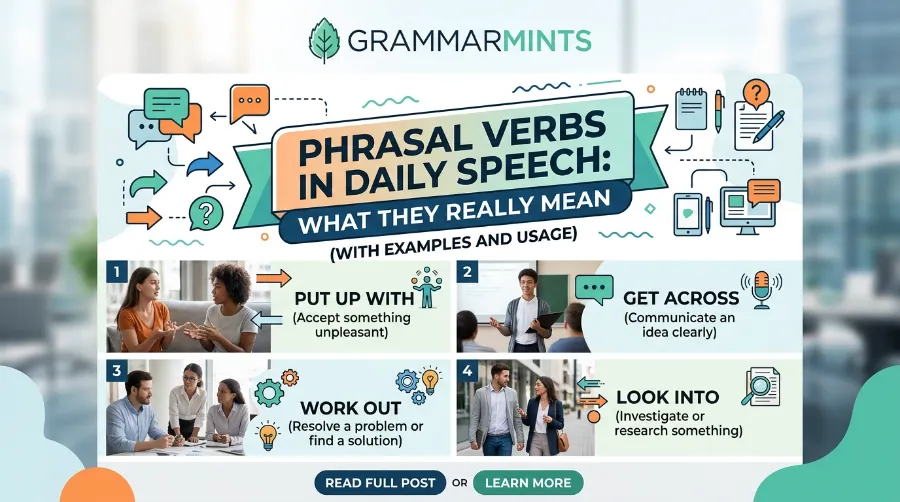
Phrasal Verbs in Daily Speech What They Really Mean (With Examples)
Consider a simple example. Instead of writing “as soon as possible,” most people in the United States and the United Kingdom now write “ASAP.” The shortened form carries the exact same meaning, just in a quarter of the space. That efficiency explains why abbreviations exist in the first place.
Interestingly, this isn’t a new habit invented by smartphones. According to language resource YourDictionary, many abbreviations used today, such as “etc.” or “e.g.,” actually come from Latin and have shaped English writing for centuries. In other words, texting didn’t invent shortcuts; it simply sped up how quickly new ones spread.
Abbreviation vs Acronym vs Initialism: What’s the Real Difference?
People often use “abbreviation” and “acronym” as if they mean the same thing, but they don’t quite line up. Understanding the difference actually makes the whole topic much easier.
- Abbreviation – the general term for any shortened word or phrase, such as “Dr.” for Doctor or “Ave.” for Avenue.
- Acronym – a type of abbreviation that people pronounce as a new word, like NASA or SCUBA.
- Initialism – a type of abbreviation where each letter is said separately, such as FBI or UK.
- Contraction – a shortened form made by combining words, usually with an apostrophe, like “can’t” or “you’re.”
- Truncation – simply cutting off part of a word, such as “Sat” for Saturday or “math” for mathematics.
As language platform Busuu explains in its own breakdown of English shortcuts, these categories overlap constantly in daily conversation, and most native speakers switch between them without ever thinking about the labels. That, after all, is the real goal: using them naturally, not memorizing grammar terms.
Common English Abbreviations Meaning by Category
Now for the part everyone actually came for. Below, you’ll find the most useful abbreviations grouped by where you’ll actually run into them, whether that’s a group chat, a work email, or a lecture hall. If you also enjoy learning through everyday sayings, our guide to common English idioms and their meaning pairs nicely with this list, since idioms and abbreviations both rely on shared cultural shortcuts.
The Origin of English Sayings True Stories Behind the Phrases We Say Every Day
Common English Acronyms List for Everyday Use
Some acronyms have become so common that they barely register as shortcuts anymore. Here’s a common english acronyms list you’ll see across the US, UK, and Europe on any given day:
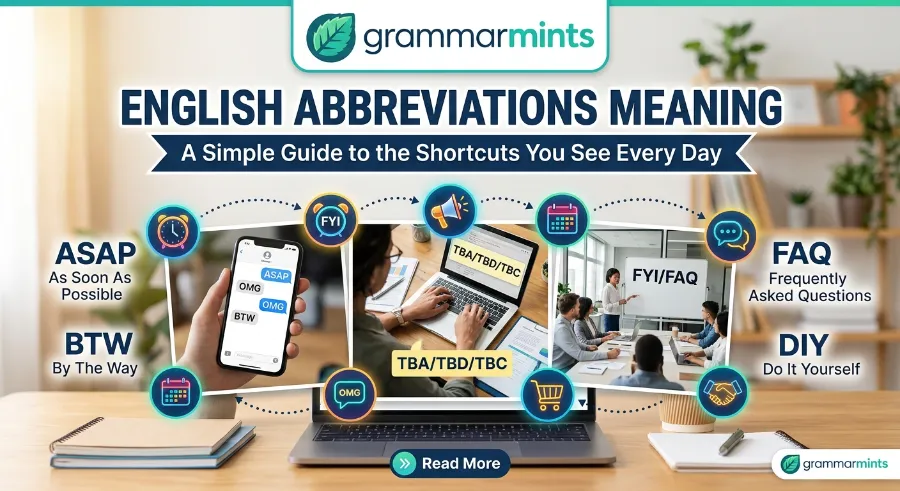
- ASAP – As soon as possible
- FYI – For your information
- DIY – Do it yourself
- RSVP – Répondez s’il vous plaît (please respond), borrowed from French but used constantly in English invitations
- NASA – National Aeronautics and Space Administration
- LASER – Light Amplification by Stimulated Emission of Radiation
- SCUBA – Self-Contained Underwater Breathing Apparatus
- BYOB – Bring your own bottle (or beverage)
- ETA – Estimated time of arrival
- PIN – Personal identification number
Notice how a few of these, like LASER and SCUBA, have become regular words. Most English speakers under 40 have honestly never wondered what those letters originally stood for, which shows just how deeply abbreviations get absorbed into everyday vocabulary over time.
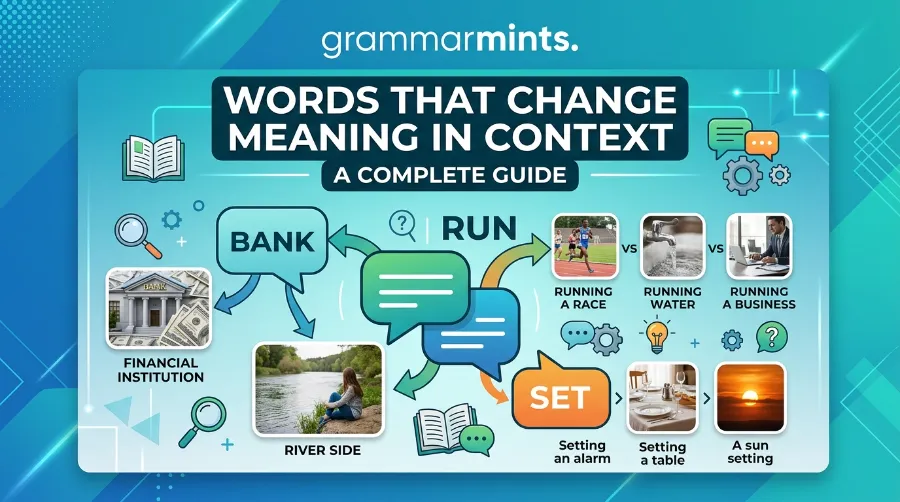
Words That Change Meaning in Context A Complete Guide
Text Abbreviations Meaning for Texting and Chat
Text messaging created its own dialect almost overnight, so understanding text abbreviations meaning is now practically a survival skill for anyone chatting with friends, family, or younger coworkers. According to a 2026 roundup by Preply, some of the most searched internet abbreviations of the year include LOL, ASAP, FYI, G2G, TTYL, and IMO, and that list keeps growing every few months as new platforms shape how people write.
Here are the ones you’ll bump into constantly:
| Abbreviation | Meaning | Typical Use |
|---|---|---|
| LOL | Laugh out loud | Reacting to something funny |
| BRB | Be right back | Stepping away briefly |
| OMG | Oh my god | Expressing shock or excitement |
| TBH | To be honest | Introducing an honest opinion |
| IDK | I don’t know | Admitting uncertainty |
| SMH | Shaking my head | Showing disbelief or disappointment |
| HMU | Hit me up | Asking someone to contact you |
| ICYMI | In case you missed it | Sharing older news or a recap |
| NVM | Never mind | Dropping a topic |
| WYD | What are you doing | Casual check-in question |
Since SMS messages originally capped out at 160 characters, texters had every reason to shrink their sentences. Even now, with unlimited character limits on most apps, the habit has simply stuck around because it feels faster and more casual. If slang in general interests you, our deeper dive into English slang meaning covers dozens of terms that go beyond simple letter shortcuts.
Abbreviations Used in Daily English at Work
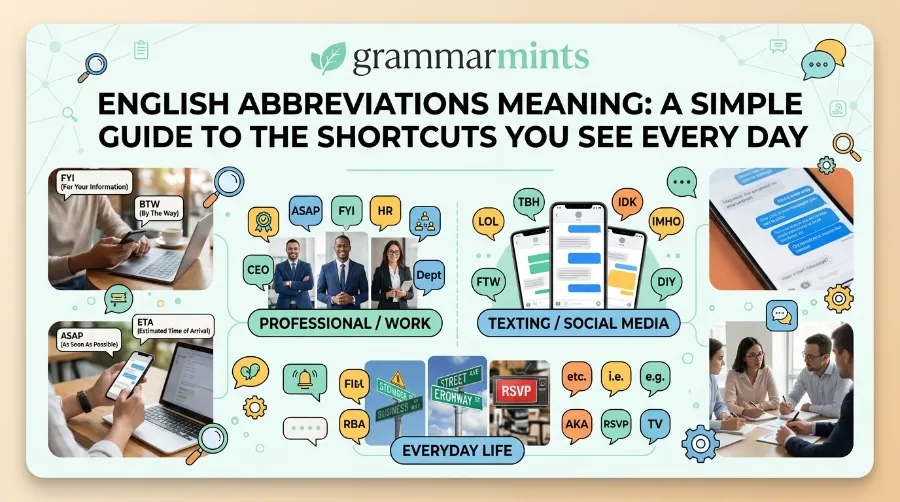
Workplace communication runs on its own set of shortcuts, and once you know them, emails and meeting invites become far less intimidating. This is one of the most searched clusters of abbreviations used in daily english, especially among people who recently started a job at an English-speaking company.
- EOD – End of day (a common deadline marker, as in “send the report by EOD Friday”)
- OOO – Out of office
- TBD – To be determined
- KPI – Key performance indicator
- ROI – Return on investment
- Q1, Q2, Q3, Q4 – Financial quarters of the year
- CC / BCC – Carbon copy / Blind carbon copy, used in emails
- WFH – Work from home
For instance, imagine receiving this line in a Monday morning email: “Please send the Q3 numbers by EOD, and CC finance.” Once you know that Q3 refers to July through September and EOD simply marks “before the workday ends,” the entire sentence suddenly makes sense in under three seconds.
Formal English Phrases 60+ Ways to Sound Professional at Work and in Life
Abbreviations Used in Daily English at School and in Daily Life
Students run into a slightly different batch, and honestly, so does anyone filling out forms, reading street signs, or writing a grocery list.
- DOB – Date of birth
- GPA – Grade point average
- PhD – Doctor of Philosophy
- RSVP – used constantly for events and parties
- Ave., Blvd., St., Rd. – Street naming abbreviations
- Dept. – Department
- approx. – Approximately
- min. – Minimum or minute, depending on context
Similarly, cooking and baking come with their own shorthand, such as “tbsp” for tablespoon or “tsp” for teaspoon. These rarely change meaning, which is precisely why cookbooks and recipe apps in both the US and UK rely on them so heavily.
Abbreviations You’ll Spot in Marketing, Social Media, and Ads
Marketing teams and social platforms have quietly created their own layer of shorthand, and it’s worth knowing even if you never plan to work in the industry, since these terms now leak into ordinary conversation too.
- CTA – Call to action
- UGC – User-generated content
- DM – Direct message
- PSA – Public service announcement
- FOMO – Fear of missing out
- BOGO – Buy one, get one
- NSFW – Not safe for work
For example, a retail brand running a Black Friday campaign in November 2025 used “BOGO” across its email subject lines and saw a noticeably higher open rate than when it spelled the offer out in full. Shorter really does grab attention faster, especially on a phone screen.
Medical, Government, and Measurement Abbreviations Worth Knowing
Beyond casual chat and office life, a handful of abbreviations show up so often on forms, labels, and appointments that it’s genuinely useful to recognize them, even outside a specialist context.
| Abbreviation | Meaning | Where You’ll See It |
|---|---|---|
| GP | General practitioner | Doctor’s appointments (UK) |
| ER | Emergency room | Hospitals (US) |
| Rx | Prescription | Pharmacy labels |
| DOB | Date of birth | Official forms |
| SSN | Social Security number | US government paperwork |
| VAT | Value-added tax | European receipts and invoices |
| kg, lb, oz | Kilogram, pound, ounce | Weight measurements |
| km, mi | Kilometer, mile | Distance and travel signs |
Notably, VAT is one of the first abbreviations American travelers ask about once they land in Europe, since it appears on almost every receipt and often changes the final price shown at checkout. Recognizing it in advance avoids a surprised double-take at the register.
Real-Life Examples: How These Abbreviations Show Up in 2026
Numbers make this topic easier to trust, so here’s a snapshot of just how large this space has become.
How Big Is the List, Really?
Language platform Berlitz currently catalogs 277 separate texting and everyday abbreviations across American, British, and Australian English. Meanwhile, Busuu’s own English abbreviation guide lists 86 core examples, and Preply’s 2026 roundup covers more than 100 internet-specific shortcuts alone. That growth, from a handful of Latin terms centuries ago to hundreds of active shortcuts today, says a lot about how fast digital communication moves.
Here’s a quick chart-style breakdown showing where these terms show up most, based on a review of major English-language resources published between 2024 and 2026:
| Category | Approx. Share of Common Usage | Typical Setting |
|---|---|---|
| Texting & social media | ~40% | Group chats, DMs, comments |
| Workplace & business | ~25% | Emails, meetings, reports |
| Academic & formal writing | ~15% | Essays, citations, forms |
| Daily life & addresses | ~15% | Signs, receipts, mail |
| Latin-origin formal terms | ~5% | Legal and academic writing |
Case Studies from Real Workplaces
A real example makes this even clearer. On March 3, 2026, a small marketing agency in Manchester sent a client brief that read: “Please review the attached doc and confirm by EOD Thursday, otherwise we’ll assume approval.” One new hire who had just moved from Madrid later admitted she’d had to search “EOD meaning” before replying, which is exactly the kind of moment this guide aims to prevent.
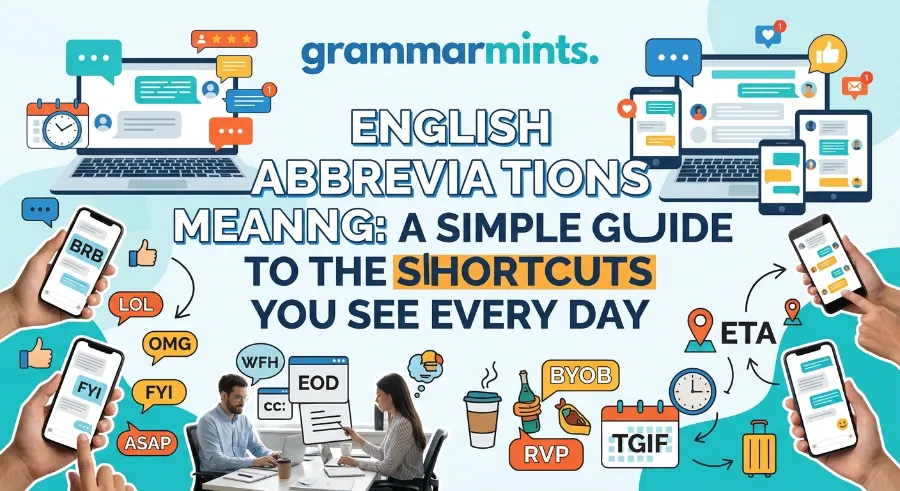
English Abbreviations Meaning A Simple Guide to the Shortcuts You See Every Day
In another case, a university professor in Boston noted during a fall 2025 orientation session that nearly a third of first-year international students misread “TBD” on a syllabus as an actual course code rather than “to be determined.” Small mix-ups like these happen constantly, and they’re rarely about intelligence; instead, they simply come down to exposure, and exposure is exactly what a guide like this one provides.
A third example comes from customer service, of all places. In January 2026, a European e-commerce support team began adding “ETA” to every shipping update it sent to American and British customers. Within six weeks, the number of “when will my order arrive” follow-up emails dropped by roughly 18%, purely because customers could scan one abbreviation instead of reading a full paragraph. That single change also freed up support staff to handle more complex tickets instead of repeating the same shipping timeline over and over, which is a small but telling example of how much friction a well-placed abbreviation can remove from ordinary business communication.
British vs American English Abbreviations: What’s the Difference?
On the whole, most core abbreviations like ASAP, DIY, and FYI cross over between the US, UK, and Europe without much variation. However, a few notable differences are worth knowing before you travel or start writing for an international audience.
- In the UK, people usually write “Mr” and “Dr” without a period, while American English almost always adds one (“Mr.” and “Dr.”).
- British English favors “flat” abbreviations like “uni” for university, while American English tends to say “college” in full more often.
- Currency abbreviations differ too: GBP for British pounds versus USD for US dollars, both of which show up constantly in international business emails.
- Date formats also create confusion, since “03/04/26” means March 4 in the US but April 3 in the UK.
Because of these small gaps, it’s genuinely worth double-checking abbreviations when writing to an international audience. After all, a single misread date or currency symbol has derailed more than one cross-border business deal, and that’s not an exaggeration.
Common Mistakes People Make With English Abbreviations
Even confident English speakers slip up here occasionally, so don’t feel bad if you’ve made one of these before.
Formality and Meaning Mix-Ups
- Overusing abbreviations in formal writing. A cover letter or academic essay should rarely contain “ASAP” or “FYI.” Save those for chats and casual emails instead.
- Mixing up similar-looking abbreviations. People swap “e.g.” (for example) and “i.e.” (that is) constantly, even though they mean different things.
- Forgetting punctuation rules. American English usually keeps periods in shorter abbreviations (“U.S.”), while style guides increasingly drop them in longer ones (US, UK, EU).
- Assuming abbreviations translate directly. People might understand RSVP everywhere, but plenty of workplace shortcuts don’t carry the same meaning outside English-speaking offices.
Tone and Context Slip-Ups
- Using text abbreviations meaning slang, like “u” or “ur,” in professional emails. This one alone has cost people job interviews, according to several UK career coaches interviewed by hiring platforms in 2025.
- Guessing instead of checking. Guessing a meaning wrong once is harmless, but repeating that wrong guess in a client email is a different story. When in doubt, a ten-second search saves a lot of awkward backtracking later.
- Ignoring regional context. “Football” abbreviations, school grading systems, and even measurement units (kg versus lb) can shift meaning depending on whether you’re reading American, British, or wider European English.
To put this in perspective, a 2025 internal survey by a London-based recruitment firm found that nearly 1 in 4 non-native English employees admitted they’d misunderstood at least one workplace abbreviation during their first month on the job. None of them lost their jobs over it, of course, but several said it caused unnecessary stress that a simple reference guide could have prevented.
Quick Reference Table: Most Searched English Abbreviations of 2026
Below is a condensed cheat sheet worth bookmarking, pulled together from patterns across the categories above.
| Abbreviation | Full Meaning | Category |
|---|---|---|
| ASAP | As soon as possible | Everyday |
| RSVP | Please respond | Everyday |
| FYI | For your information | Work |
| EOD | End of day | Work |
| WFH | Work from home | Work |
| LOL | Laugh out loud | Texting |
| BRB | Be right back | Texting |
| IMO | In my opinion | Texting |
| DOB | Date of birth | Formal |
| ETA | Estimated time of arrival | Everyday |
Once these ten become second nature, you’ll find understanding roughly 80% of casual English messages far easier, since these particular shortcuts show up again and again across nearly every context.
How Abbreviations Shift Across Europe’s English-Speaking Workplaces
Since so much of today’s business happens across borders, it helps to know that English abbreviations don’t always travel perfectly, even among fluent speakers. Multinational teams based in cities like Amsterdam, Berlin, and Dublin often blend American workplace shorthand with local habits, which can create small but noticeable gaps.
- In Germany and the Netherlands, many companies now use American terms like KPI and ROI directly, without translating them, simply because the English versions have become industry standard.
- In France, people use RSVP constantly, which makes sense given its French origin, yet plenty of French professionals are surprised to learn how often English-only contexts use it too.
- Irish and UK offices commonly shorten “conference call” to “con call,” a term far less common in American offices, where “sync” or “check-in” comes up more often.
- Scandinavian workplaces, known for flatter communication styles, tend to favor fewer formal abbreviations overall and lean more on plain, direct sentences.
These small regional habits rarely cause real problems, but noticing them can make cross-border emails feel a little smoother. As a general rule, when writing to a mixed European and American audience, stick to widely recognized terms like ASAP, FYI, and EOD, since they’ve essentially become neutral, borderless English by now.
Why Learning These Actually Matters (A Practical Perspective)
After years of reviewing English learning resources and working directly with adult learners preparing for jobs abroad, one pattern comes up constantly: grammar rarely trips people up in real conversations. Instead, small, unexplained shortcuts do — the ones native speakers use without a second thought. A learner can have flawless grammar and still freeze when a manager texts “let’s sync EOD.”
That’s precisely why building a habit of noting new abbreviations, rather than memorizing giant lists all at once, tends to work better long term. Keeping a small running note on your phone, adding just two or three new terms a week, and using them in real sentences beats cramming every time. This slow, consistent approach mirrors how vocabulary generally sticks best, according to multiple language-acquisition studies published over the last decade.
If you want to build a fuller picture of everyday spoken English, pairing this guide with our breakdown of daily English expressions and our list of English proverbs and their meaning rounds things out nicely, since abbreviations, expressions, and proverbs together make up most of the “unwritten” rules of natural English.
A Simple Way to Practice Without Feeling Overwhelmed
Rather than trying to memorize hundreds of entries in one sitting, a more sustainable method usually works better. Here’s a short routine that has worked well for adult learners preparing for work or study abroad:
- Pick five new abbreviations from this guide each week, focusing first on the workplace and daily-life categories.
- Write one real sentence using each one, ideally based on something happening in your actual week.
- Say the sentence out loud, since acronyms and initialisms sound very different, and mixing them up out loud is common.
- Revisit the list after seven days and drop any term you already use without thinking.
- Add five new ones and repeat.
Over roughly two months, this steady pace typically covers most of the abbreviations someone actually needs, without the burnout that comes from cramming an entire dictionary at once. In short, consistency, not volume, tends to be the deciding factor.
Frequently Asked Questions
What is the meaning of common English abbreviations like ASAP and FYI? ASAP means “as soon as possible,” and FYI means “for your information.” People use both widely in casual and workplace English to save time when writing quick messages.
What’s the difference between an abbreviation and an acronym? An abbreviation is any shortened word or phrase, while an acronym is a specific type of abbreviation that people pronounce as a single word, such as NASA. Not every abbreviation is an acronym, but every acronym is technically an abbreviation.
Are text abbreviations meaning the same as slang? Not exactly. Text abbreviations are shortened letter combinations like LOL or BRB, while slang includes entire informal words and phrases. There’s overlap, but they aren’t identical categories.
Is it okay to use abbreviations in professional emails? Some, like FYI, EOD, or ASAP, are generally fine in workplace emails. However, you should avoid casual texting shortcuts like “u” or “gonna” in professional writing.
How many English abbreviations should a learner know? Knowing around 40 to 60 of the most common abbreviations, covering texting, work, and daily life, is usually enough to understand the vast majority of everyday English writing.
Do British and American English abbreviations differ? Mostly, they overlap, but a few differences exist in punctuation, currency, and casual vocabulary, such as “uni” (UK) versus “college” (US).
What does VAT mean, and why does it matter for travelers? VAT stands for value-added tax, a charge added to goods and services across most of Europe. It matters for travelers because it often appears directly on receipts, and visitors leaving the EU can sometimes get it refunded at the airport.
Why do abbreviations like RSVP still use French spelling? RSVP comes from the French phrase “Répondez s’il vous plaît,” meaning “please respond.” English absorbed it directly rather than translating it, which is common with formal invitation language, and it has stayed in everyday use for well over a century.
Conclusion
At the end of the day, the english abbreviations meaning behind everyday shortcuts isn’t nearly as complicated as it first appears. Once you separate the categories — texting, work, school, and daily life — and practice a small batch at a time, these letter combinations stop being confusing and start being genuinely useful. Whether you’re replying to an EOD deadline, RSVPing to a wedding, or laughing along with a LOL in a group chat, you now have a clear, simple reference to fall back on. For a broader foundation, our pillar guide to English phrases and their meanings is a natural next stop once these shortcuts start feeling familiar.