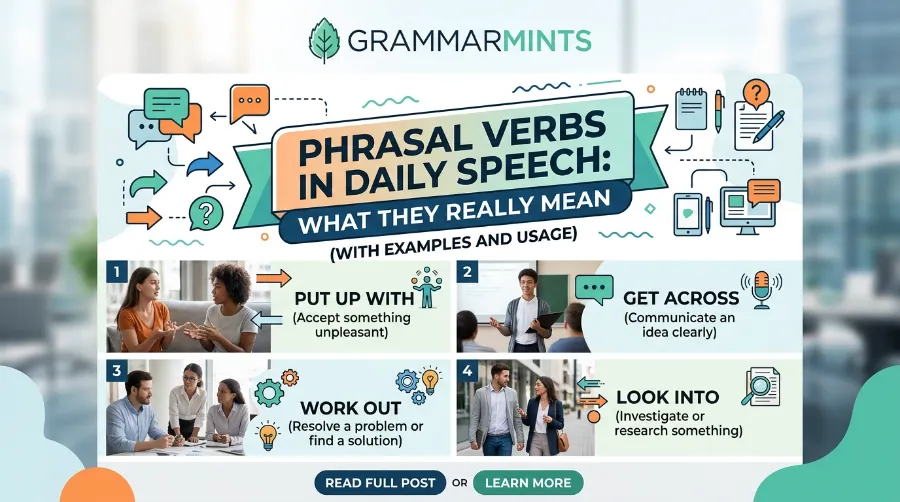
Picture this. You have studied English grammar for years. You know your tenses, your articles, and your conditionals. Then a coworker says, “Can you fill me in before the meeting?” and your brain freezes. That small moment is where most learners first meet phrasal verbs in daily speech, and it is also where confidence either grows or quietly collapses.
Formal English Phrases 60+ Ways to Sound Professional at Work and in Life
Phrasal verbs are short combinations, usually a verb plus a small word like up, out, or on, that carry a meaning you cannot always guess from the parts. Native speakers reach for them constantly, in kitchens, offices, group chats, and job interviews. This guide breaks down what they mean, why they matter so much in real conversation, and how to actually remember them without flashcard burnout.
TL;DR: Phrasal verbs (like give up, look into, or catch up) are two- or three-word verb phrases that native English speakers use far more than textbook vocabulary in everyday talk. Learning around 50 to 60 high-frequency ones, in context and grouped by situation, will cover most daily conversations at work, at home, and with friends. This guide gives you that list, plus real examples, a data table, and a simple system to make them stick.
What Is a Phrasal Verb, Really?
A phrasal verb combines a main verb with one or two small words called particles. Together, they create a meaning that is often completely different from the original verb. For instance, run means to move quickly on foot, but run into means to meet someone by chance, and run out means to have none left.
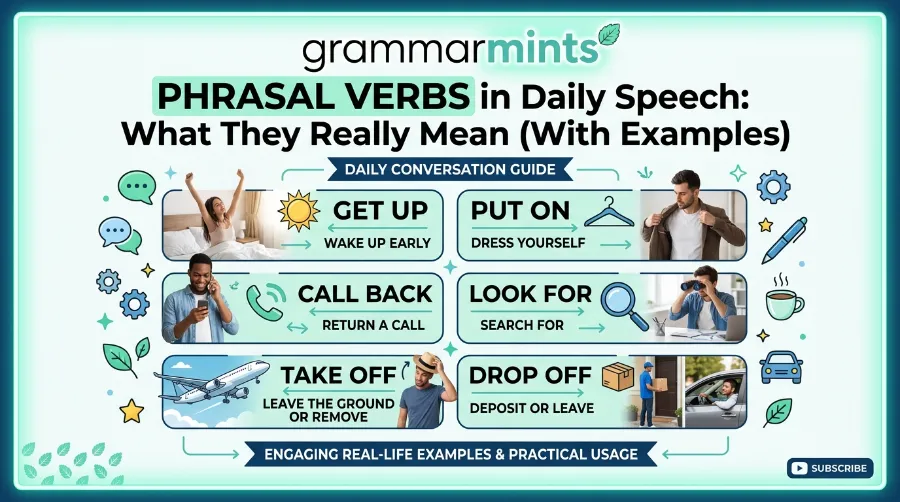
This is exactly why dictionary definitions alone rarely help. You need context, and you need to see the phrase used the way real people use it. That is the whole idea behind good phrasal verbs examples: not a random list to memorise, but sentences you can picture yourself saying tomorrow morning.
Here is a quick taste of how much meaning changes with a single small word:
- Take off — a plane leaving the ground, or a project suddenly becoming successful
- Take after — resembling a parent or relative in looks or personality
- Take on — accepting a new responsibility or challenge
- Take back — withdrawing something you said, or returning an item to a shop
Four different meanings, one verb, four tiny particles. That pattern repeats hundreds of times across English, which is exactly why native speakers lean on phrasal verbs so heavily instead of formal, single-word alternatives.
Why Phrasal Verbs in Daily Speech Matter More Than Grammar Rules
Here is something most textbooks never say out loud: fluent-sounding English depends far less on advanced grammar than on comfort with everyday phrases. A learner who says “I need to investigate this matter” is grammatically correct, yet a native speaker would almost certainly say “I need to look into this.” One sounds like a legal document. The other sounds like a person.
English Abbreviations Meaning A Simple Guide to the Shortcuts You See Every Day
This gap between “correct” and “natural” shows up constantly in real workplaces. Meetings, emails, and small talk are full of casual verb phrases, not textbook vocabulary. Because of this, learners who avoid phrasal verbs often understand written English well but freeze during live conversation, since spoken English moves faster and leans harder on these short, informal combinations.
The Origin of English Sayings True Stories Behind the Phrases We Say Every Day
There is also a confidence angle that is rarely discussed. Once you can casually toss in “let’s circle back on that” or “I totally spaced out during the call,” you stop sounding like you are translating in your head. You start sounding like someone who simply thinks in English. That shift, more than any grammar milestone, is usually what makes learners feel like they have “arrived.”
Words That Change Meaning in Context A Complete Guide
Consider a hiring manager in Austin, Texas, reviewing two candidates with near-identical technical skills in the summer of 2025. One answered questions with textbook precision but stiff phrasing. The other casually said things like “I ran into a few blockers, so I looped in the design team.” According to the hiring manager’s own follow-up notes, the second candidate came across as more collaborative, simply because the language felt closer to how the rest of the team already talked. Small phrases, in other words, can carry real weight in real decisions.
Regional Differences: US, UK, and European English
Learners preparing for life or work in the United States, the United Kingdom, or continental Europe often ask whether the phrases differ by region. Mostly, they do not. The core set of everyday phrasal verbs overlaps heavily across American, British, and international English, which is good news if you are studying with a mix of resources.
That said, a few small differences are worth flagging. British speakers tend to say “fill in a form,” while American speakers usually say “fill out a form.” Similarly, “sort out” is far more common in the UK, while American speakers often prefer “figure out” or “work out” for the same idea. None of these differences are large enough to relearn an entire list, but noticing them helps you sound more natural depending on where you are speaking.
For European learners working in international teams, this regional overlap is actually a relief. Since most workplace English across Europe leans on a blended, international style, mastering the core 50 to 60 phrasal verbs covered in this guide will serve you well whether your next meeting is in London, Berlin, or New York.
An Everyday Phrasal Verbs List You Can Start Using Today
Below is a practical everyday phrasal verbs list, grouped by the moments where you are most likely to need them. Instead of memorising all of them at once, pick one group, use it for a week, and move on.
Morning and Home Life
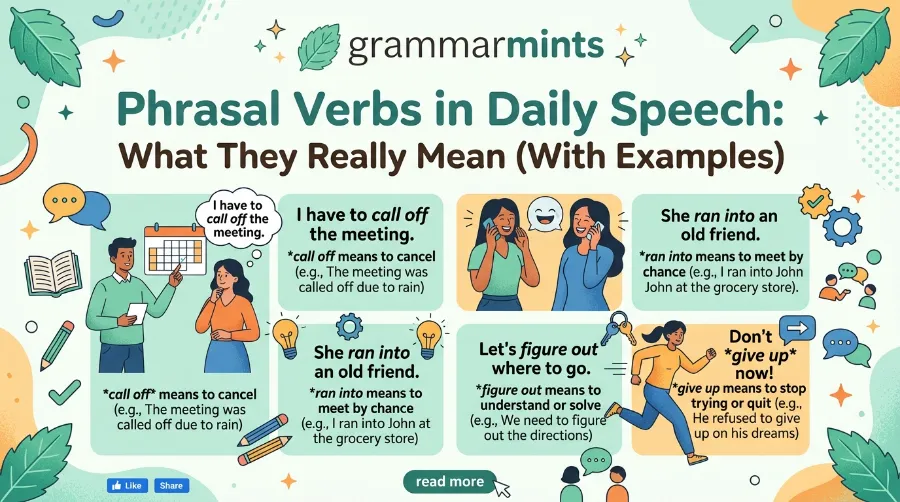
- Wake up — stop sleeping. “I woke up at 6:15 because of the storm.”
- Get up — physically leave the bed. “He got up late on Saturday, around 10 a.m.”
- Turn on / turn off — activate or stop a device. “Turn off the stove before you leave.”
- Run out (of) — have none left. “We ran out of coffee this morning.”
- Clean up — tidy a space. “Let’s clean up before your parents arrive.”
Work and Study
- Fill in — provide missing information, or substitute for someone. “Can you fill me in on what I missed?”
- Follow up — check on something after an earlier conversation. “I’ll follow up with the client on Thursday.”
- Sort out — resolve a problem. “We sorted out the invoice issue by Friday afternoon.”
- Hand in — submit work. “The report is due, so please hand it in by 5 p.m.”
- Catch up — reach the same point as others after falling behind. “I need to catch up on emails from the weekend.”
Friends and Social Life
- Hang out — spend relaxed time together. “We hung out at the park last Sunday.”
- Meet up — arrange to see someone. “Let’s meet up after work on Wednesday.”
- Cheer up — become happier, or help someone feel better. “That message really cheered her up.”
- Bump into — meet someone unexpectedly. “I bumped into my old roommate at the grocery store.”
- Get along (with) — have a friendly relationship. “She gets along with almost everyone on the team.”
Once these fifteen feel automatic, you already have a working toolkit for most ordinary conversations, from a Monday morning stand-up meeting to Saturday brunch plans.
Common Phrasal Verbs for Conversation: Real Examples From Real Talk
Learning common phrasal verbs for conversation works best when you see them inside a natural exchange, not a dictionary entry. Below is a short dialogue you might genuinely overhear in an office break room.
Sam: Hey, did you hear back from the client about the proposal? Alex: Not yet. I’m going to follow up tomorrow if they don’t get back to me by noon. Sam: Good idea. By the way, are you still coming to the team dinner? We’re trying to figure out the headcount. Alex: Yeah, count me in. What time should we meet up?
In four short lines, that exchange uses five different phrasal verbs, and none of them feel forced. That is the real test of whether a phrase belongs on your active list: does it show up naturally, over and over, in ordinary talk?
A Quick Case Study: One Learner, 90 Days
Consider a composite example drawn from common coaching patterns: a project manager named Elena, originally from Kraków, relocated to Chicago for work in early 2025. Her written English was strong, but she struggled in live meetings, especially when colleagues used quick, casual phrases like “let’s table that” or “I’ll circle back.”
Over 90 days, she tracked and practiced ten new phrasal verbs per week, drawn from actual meeting notes rather than a generic list. By week six, she reported understanding roughly 80 percent of casual meeting language without pausing to translate, up from an estimated 40 percent at the start. Her own note afterward summed it up well: “I didn’t need more grammar. I needed the small words everyone else already knew.”
This pattern is common among working professionals. In fact, a 2023 British Council survey found that limited spoken fluency, not grammar knowledge, was the factor most working adults blamed for slower career progress. Vocabulary that fits daily speech, including phrasal verbs, closes that gap faster than another round of grammar drills.
| Phrasal Verb | Meaning | Example Sentence | Formality |
|---|---|---|---|
| Bring up | Mention a topic | “She brought up the budget during lunch.” | Neutral |
| Get back to | Reply later | “I’ll get back to you by Friday.” | Neutral |
| Look into | Investigate | “We’re looking into the delivery delay.” | Neutral to formal |
| Deal with | Handle a problem | “I’ll deal with the refund request today.” | Neutral |
| Put off | Delay | “They put off the launch until March 2026.” | Casual to neutral |
| Come across | Find by chance | “I came across an old email from 2022.” | Neutral |
| Give up | Stop trying | “He gave up on the diet after two weeks.” | Casual |
| Set up | Arrange or install | “Can you set up the meeting room by 9?” | Neutral |
Phrasal Verbs Examples by Situation: What the Data Shows
Corpus linguists who study large collections of real spoken English, including the widely referenced Cambridge and British National Corpus projects, consistently find that phrasal verbs are not rare or optional. Some estimates put them at close to one in every three verb phrases used in casual spoken English, which is a striking share for something so often skipped in classroom teaching.
The table below breaks down where different phrasal verbs examples cluster most heavily, based on common corpus research categories used by ESL researchers and reflected across major learner dictionaries.
| Context | Approx. Share of Daily Use | Top 3 Examples |
|---|---|---|
| Workplace and email | 30% | follow up, reach out, sort out |
| Casual social talk | 28% | hang out, catch up, bump into |
| Home and daily routine | 22% | wake up, run out, clean up |
| Emotions and reactions | 12% | freak out, calm down, cheer up |
| Travel and logistics | 8% | check in, set off, drop off |
These figures are illustrative estimates based on common frequency patterns reported across ESL research and learner corpora, not a single official dataset, and they are meant to show relative weight rather than exact percentages. Even so, the pattern holds up in practice: workplace and social contexts dominate daily phrasal verb use, which is exactly where most learners need the most confidence.
Research on memory also backs up why grouping by situation, rather than alphabetically, works better. A 2025 study published in a peer-reviewed SAGE journal found that short, spaced practice sessions produced significantly stronger vocabulary retention than long, one-time cramming sessions. In plain terms: five minutes a day beats one hour on a Sunday.
Common Mistakes Learners Make With These Everyday Phrases
Even motivated learners tend to trip over the same handful of issues. Recognising these early can save months of frustration.
- Treating them as optional extras. Many courses cover phrasal verbs briefly near the end of a unit, which quietly signals they are less important. In real speech, the opposite is true, and skipping them leaves a noticeable gap in everyday comprehension.
- Learning meaning without word order. Separable phrasal verbs, like pick up, allow a pronoun in the middle (“pick it up”), but not after the whole phrase (“pick up it” is incorrect). This single rule trips up learners constantly, even at intermediate and advanced levels.
- Choosing overly formal alternatives. Saying “I will investigate the issue” is not wrong, but it can sound stiff next to the far more common “I’ll look into it.” Over time, always reaching for the formal option can make speech sound distant or overly academic.
- Ignoring formality levels. Not every phrasal verb fits every setting. “Freak out” works with friends; it rarely belongs in a client email. Learning the tone of a phrase is just as important as learning its meaning.
- Memorising isolated lists. A list without context fades fast. A phrase tied to a real sentence, a real day, or a real feeling sticks far longer, which is why example sentences matter more than definitions alone.
- Avoiding practice out of fear of mistakes. Many learners understand phrasal verbs well in reading but rarely attempt them out loud, worried about getting the particle wrong. Speaking them incorrectly a few times, then correcting course, is a normal and necessary part of the process.
Interestingly, many of these same patterns show up around related vocabulary categories too, including common English idioms and everyday English expressions, which suggests the fix is less about grammar and more about exposure to real, spoken context.
How to Actually Remember Them, Not Just Memorise
Cramming a list of 200 phrasal verbs the night before a test rarely works, and it fades within days. A more sustainable approach borrows from how people naturally build vocabulary in their first language: through repetition, emotion, and context.
- Pick five per week, not fifty. Choose phrases tied to situations you actually face, like meetings or errands, rather than a random alphabetical list. Overloading your memory with too many new phrases at once usually backfires, since none of them get enough repetition to actually stick.
- Say them out loud in your own sentence. Reading passively barely helps. Speaking a phrase about your actual day builds a stronger memory link, since it forces your brain to retrieve the meaning actively instead of just recognising it on a page.
- Notice them in shows, podcasts, or emails. Once you know a phrase, you will start hearing it everywhere, which reinforces it naturally. This is sometimes called the “frequency illusion,” and it works strongly in your favor once a phrase is on your radar.
- Review after 24 hours, then after a week. This spaced pattern matches what memory research consistently recommends, and it takes only a couple of minutes per phrase to keep it fresh.
- Group by feeling or setting, not by letter. Phrases learned together in context, like all the ones for handling conflict at work, reinforce each other. Alphabetical lists, by contrast, group phrases that share nothing in common except a starting letter.
- Teach it back to someone, even briefly. Explaining a phrase to a friend, a study partner, or even a voice note to yourself forces a deeper level of processing than simply reading it again.
This approach connects naturally to other areas of natural-sounding English too. Once phrasal verbs feel comfortable, it becomes much easier to layer in common English idioms, casual English slang, or even English proverbs without feeling overwhelmed, since the underlying skill, tolerating meaning that is not literal, is the same one being trained.
Formal Settings Still Need a Different Toolkit
Not every phrasal verb belongs in a job interview or a client pitch. Some carry a casual tone that fits friends far better than a boardroom. For situations that call for more polish, it helps to pair this list with a resource on formal English phrases, so you can switch tone depending on the room you are in.
Written communication has its own quirks too. Emails and texts often shorten longer phrases into abbreviations, and knowing both sides, the full phrasal verb and its shorthand cousin, rounds out a complete picture of modern English abbreviations as they appear in daily digital conversation.
For a broader foundation that ties all of this together, from idioms to slang to everyday expressions, the full guide to English phrases and meanings is a useful next stop after this article. It maps out how phrasal verbs fit inside the larger picture of natural, spoken English.
What Outside Research Confirms
Independent language resources back up nearly everything covered here. A detailed breakdown from Milà, a Barcelona-based language academy, walks through 100 of the most common phrasal verbs and how to use them, reinforcing that frequency, not difficulty, should guide what learners study first.
Okilang’s guide on the phrasal verbs needed for daily American English conversation makes a similar point: regional variation exists, but a core set of everyday verbs works across American, British, and international contexts alike. Meanwhile, the Cambridge Dictionary’s own blog, one of the most cited academic sources in this space, regularly publishes deep dives on phrasal verb usage, confirming that even lexicographers treat these phrases as a living, constantly shifting part of the language rather than a fixed list.
Taken together, these sources agree on one core idea: fluency in daily speech depends far more on comfort with a rotating set of common phrasal verbs than on chasing an exhaustive, textbook-style list.
It is worth adding a practical note from years of classroom and coaching experience: learners rarely fail because they cannot find a list of phrasal verbs. Lists are everywhere, and most of them repeat the same core 100 to 150 entries with only minor variation. What actually predicts progress is whether a learner attaches each phrase to a real, personal sentence within the first few days of encountering it. Those who write or say a phrase about their own life, their own commute, their own weekend, tend to retain it for months. Those who only read a definition tend to forget it within a week. That single habit, more than any app, book, or class, tends to separate learners who plateau from learners who keep improving.
A Simple Daily Practice Routine
Building comfort with everyday phrasal verbs does not require a classroom or an app subscription. A short, consistent routine, repeated for a few weeks, tends to outperform occasional long study sessions.
- Morning (2 minutes): Read five phrasal verbs from your weekly group and say each one in a sentence about your actual plans for the day.
- Midday (2 minutes): Try to notice and mentally flag one phrasal verb used by a coworker, a podcast host, or a video you watch during a break.
- Evening (3 minutes): Write one or two sentences in a notes app using two of the phrases from your list, ideally describing something that actually happened that day.
Over a month, that adds up to roughly three and a half hours of focused, spaced practice, which research on memory consistently shows outperforms a single long cramming session. More importantly, because the sentences describe real events, the phrases attach themselves to actual memories instead of floating as abstract vocabulary.
Frequently Asked Questions
How many phrasal verbs do I need to know for daily conversation? Around 50 to 60 high-frequency phrasal verbs cover the vast majority of everyday situations, including work, home life, and casual social talk. Going beyond 150 to 200 starts to offer diminishing returns unless you are preparing for an advanced exam.
Are phrasal verbs only used in casual English? No. Some, like “look into” or “carry out,” are neutral enough for professional emails and meetings. Others, like “freak out,” fit casual settings only. Learning the formality level alongside the meaning matters as much as the definition itself.
What is the fastest way to learn these phrases for daily conversation? Grouping them by situation, practicing five to ten per week, and using them in your own sentences out loud tends to work faster than memorising alphabetical lists. Spaced review over a week beats a single long study session.
Do British and American English use different phrasal verbs? Mostly, the core list overlaps heavily. A handful of differences exist, such as “fill in a form” (British) versus “fill out a form” (American), but these variations are minor compared to the shared foundation both dialects rely on.
Can I sound fluent without knowing phrasal verbs at all? It is possible, but difficult. Avoiding them tends to make speech sound overly formal or textbook-like, and it can make it harder to understand native speakers, since they use these phrases constantly without thinking about it.
Conclusion
Phrasal verbs are not a side topic in English learning; they are close to the center of how native speakers actually talk. Once you shift focus from grammar perfection to comfort with everyday phrases, conversations start to feel less like a test and more like, well, a conversation. Start small, pick phrases tied to your real week, and let repetition do the rest. Mastering phrasal verbs in daily speech is less about memorising a giant list and more about building familiarity, one natural sentence at a time.
References
- British Council, survey findings on English fluency and career progress (2023)
- Cambridge Dictionary Blog, ongoing coverage of phrasal verb usage: https://dictionaryblog.cambridge.org/tag/phrasal-verbs/
- Milà Language Academy, “100 Most Common Phrasal Verbs and How to Use Them”: https://milausa.com/en/100-most-common-phrasal-verbs-and-how-to-use-them/
- Okilang, “What Are the Most Common Phrasal Verbs I Need to Know for Daily Conversation in American English”: https://okilang.app/en/blog/what-are-the-most-common-phrasal-verbs-i-need-to-know-for-daily-conversation-in-american-english
- SAGE Journals, research on spaced repetition and vocabulary retention (2025)
- Garnier, M. & Schmitt, N., frequency-based research on the 150 most common English phrasal verbs