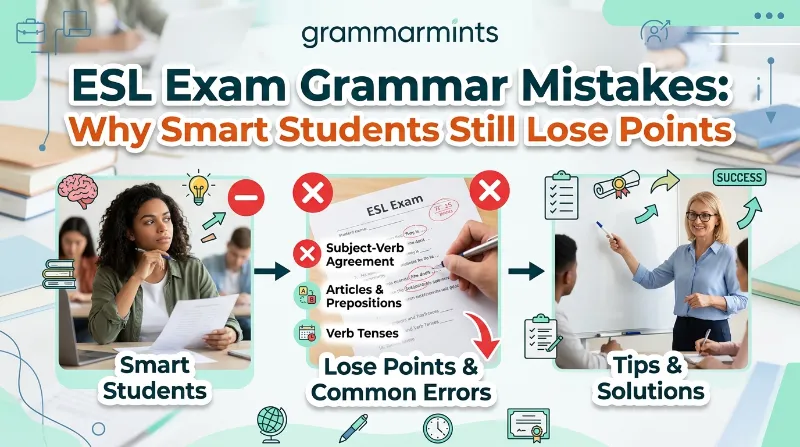
Every testing season, thousands of well-prepared students walk out of the exam hall convinced they nailed it. Yet the score does not always match the effort. More often than not, the culprit is not a lack of ideas or vocabulary. Instead, it comes down to small, repeated ESL exam grammar mistakes that examiners are trained to spot instantly. These errors rarely feel serious while you are writing under a ticking clock, but they add up fast, and they quietly pull your band score or writing rubric points down.
TL;DR: Most ESL students lose points on IELTS, TOEFL, and similar exams because of a handful of repeat offenders: verb tense slips, subject-verb agreement, article misuse, and run-on sentences. Research on learner essays shows that verb-related errors alone can account for close to half of all grammar mistakes in a typical exam script. The good news is that once you know what to look for, most of these mistakes take only seconds to catch and correct.
What Are the Most Common ESL Exam Grammar Mistakes?
Grammar mistakes are not random. Certain error patterns show up again and again, no matter where a student studied or which exam they are taking. Researchers who studied English essays written by second-language learners found that subject-verb agreement, verb tense, spelling, and word order caused the overwhelming majority of errors. Articles and prepositions caused fewer, but still noticeable, problems.
So, what actually shows up on exam day? Based on error-analysis research and exam-prep guidance from testing bodies, the mistakes below appear most often:
- Subject-verb agreement errors — for instance, writing “the number of students were rising” instead of “was rising.”
- Verb tense inconsistency — jumping between past, present, and future within the same paragraph.
- Article misuse — dropping “a,” “an,” or “the,” or adding one where none belongs.
- Run-on sentences and comma splices — joining two full sentences with only a comma.
- Preposition confusion — saying “married with” instead of “married to.”
- Countable vs. uncountable noun errors — writing “informations” or “many advices.”
- Sentence fragments — submitting an incomplete thought as if it were a full sentence.
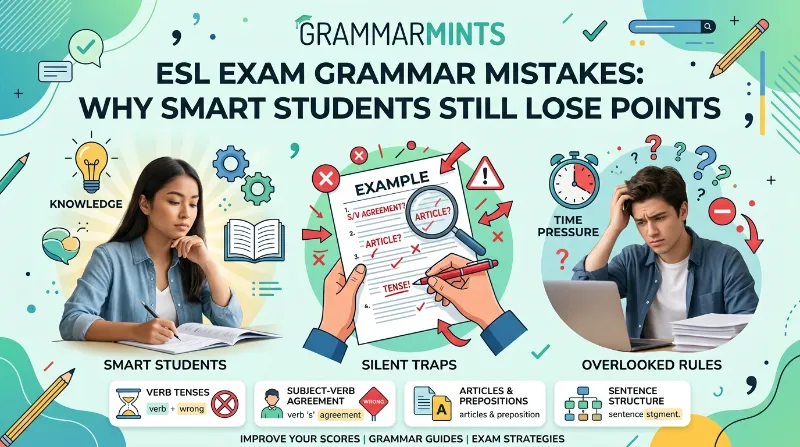
Notice something important here: these are not obscure, rare grammar rules. They are everyday structures. They simply behave differently from one language to the next, which is exactly why they trip up even advanced learners. Fixing them is less about memorizing new grammar. It is more about training your eye to catch familiar traps under time pressure.
Why These Mistakes Happen in the First Place
It helps to understand the “why” before jumping into fixes. The reason behind a mistake often points straight to its solution. Most grammar errors on ESL exams are not random typos. Instead, they trace back to a process linguists call first-language interference. Here, the grammar rules of your native language quietly shape how you build English sentences.
Where Native Language Shapes the Error
Slavic and East Asian languages generally do not use articles the way English does. So it makes sense that article errors show up so often among speakers of Russian, Polish, Mandarin, and Japanese. Similarly, languages that mark tense differently, or barely mark it at all, tend to produce speakers who slip between past and present tense without noticing. Once you understand that your specific error pattern often comes from your native language, the fixes stop feeling random. They start feeling targeted.
10 Formal Letter Mistakes That Are Quietly Damaging Your Credibility
Why Generic Grammar Advice Falls Flat
A student whose first language has no plural markers needs different practice than one whose first language has no verb tenses at all. Because of this, the best preparation strategy usually starts with an honest error log. Build it from real practice essays, not from a one-size-fits-all grammar workbook.
How Examiners Actually Score Your Grammar
Understanding the scoring process changes how you prepare. On IELTS, trained examiners assess Grammatical Range and Accuracy against public band descriptors. They check both the variety of sentence structures you use and how consistently you use them correctly. A Band 7 response needs a mix of complex sentences with only occasional errors. A Band 5 response is typically limited to simple sentence types with frequent mistakes.
How TOEFL Scoring Differs
TOEFL works a little differently, since AI scoring and human raters work together on the Writing section. Even so, the underlying principle stays the same: raters look for a range of accurate sentence structures, not just correctness in isolation. A response built entirely from short, simple, error-free sentences will not score as high as one that risks more complex grammar and gets most of it right.
This distinction matters because some students play it too safe. They stick only to sentences they know are error-free. Ironically, this caution can cap their score just as effectively as making frequent mistakes. The better strategy is to practice a handful of complex structures, such as conditional sentences and relative clauses, until you can produce them accurately under time pressure.
IELTS Grammar Mistakes That Cost You a Full Band Score
If you are preparing for IELTS, grammar is not a minor detail buried in the marking scheme. Grammatical Range and Accuracy makes up one full quarter of your Writing score. So a handful of avoidable ielts grammar mistakes can pull your entire band down by a full point or more. One widely cited observation from experienced IELTS markers is blunt: if more than half of your sentences contain an error, your writing is capped around Band 6, no matter how strong your ideas are.
Article Misuse
Article mistakes are the single most reported issue among IELTS candidates. Many first languages, including Russian, Mandarin, and Polish, do not use articles at all. A common slip looks like this: “I traveled to the Spain last summer” instead of “I traveled to Spain last summer.” Another frequent version drops the article entirely, such as “Government should invest in education” instead of “The government should invest in education.”
Most Common Punctuation Mistakes in Professional Writing (and How to Fix Them Fast)
The fix is simpler than most students expect. Before test day, build a short personal list of the noun categories that always need “the.” Unique things like the internet or the environment, superlatives like the highest, and specific groups like the United States all need it. Everything else usually needs “a,” “an,” or nothing at all.
Subject-Verb Agreement
This mistake sneaks in whenever a long or complicated subject sits between the noun and the verb. Take this example: “The number of workers in the factory were 200 in 2015” is incorrect. The true subject is “the number,” which is singular, so the correct verb is “was.” Errors like this are so common that one 2021 study of college-level EFL essays found subject-verb agreement responsible for roughly 28% of all grammar mistakes recorded. That made it the single largest error category in that research.
Run-On Sentences and Comma Splices
Under exam pressure, students often try to sound sophisticated by cramming several ideas into one long sentence connected only by commas. Take this real pattern seen in learner writing: “I go shopping every Saturday, I buy clothes from different stores.” These are two complete sentences, so a comma alone cannot join them. You need a period, a semicolon, or a connecting word such as “and” or “because.”
Grammar issues like these are not unique to test-day essays, either. The same subject-verb slip-ups and run-on habits show up constantly in everyday professional writing too. This guide to grammar mistakes at work breaks down that exact pattern in more depth. If you already recognize these habits from your emails or reports, that awareness will transfer directly to your exam writing.
TOEFL Common Errors You Can Fix Before Test Day
TOEFL iBT scores writing on a 0–5 scale, weighing language accuracy alongside idea development. So toefl common errors matter just as much as they do on IELTS, even though the rubric language is different. A 2020 analysis of TOEFL iBT integrated writing tasks found that verb-related mistakes accounted for about 22% of all grammar errors, with subject-verb agreement close behind at roughly 20%. In other words, verbs alone explain nearly half of everything that goes wrong.
Verb Tense Slips
The TOEFL integrated task asks you to summarize a reading passage and a lecture together. Because of this, students often drift between past tense (describing what the speaker said) and present tense (describing general facts) without realizing it. A steady rule helps here: use past tense to report what the lecture or passage stated. Reserve present tense for facts that are still true today.
Copying Directly From the Prompt
This mistake is not strictly a grammar error, but it behaves like one in the eyes of a grader. Lifted sentences interrupt the natural flow of your own writing style. Graders read the source text before scoring your response, so a copied phrase stands out immediately against your own sentences. Paraphrasing in your own words, even imperfectly, scores far better than borrowing a “safe” sentence from the passage.
Run-On Sentences Under Time Pressure
TOEFL test-takers often believe longer sentences signal higher fluency. So they chain ideas together without proper punctuation. A cleaner approach breaks the same content into two connected sentences instead of forcing everything into one overloaded clause. Here is a simple three-step process that helps during the 30-minute Independent Writing task:
- Draft first, punctuate second. Get your ideas down without worrying about sentence length. Then revisit each sentence to check it has one main clause, or properly connected clauses.
- Read each sentence aloud in your head. If you run out of breath before reaching a natural pause, the sentence is probably too long.
- Reserve the final two minutes for proofreading. A short proofreading pass at the end catches spelling and grammar slips that spellcheck would normally flag. TOEFL offers none.
ESL Exam Writing Tips That Actually Raise Your Score
Knowing the mistakes is only half the job. The other half is building habits that prevent them from appearing in the first place. Below are practical esl exam writing tips that apply whether you are sitting IELTS, TOEFL, PTE, or a university placement exam.
- Keep a personal “error log.” After every practice essay, write down the exact mistakes a teacher or grammar checker found, sorted by category. Most students discover they repeat the same three or four errors constantly.
- Practice with a timer from day one. Grammar accuracy tends to fall apart under time pressure. Training yourself to write cleanly at speed matters more than writing perfectly slowly.
- Read your essay backward, sentence by sentence. This breaks the flow of meaning and forces your brain to focus purely on grammar and punctuation.
- Learn verb-preposition pairs as chunks, such as “depend on,” “interested in,” and “arrive at,” rather than studying prepositions in isolation.
- Use short, clear sentences over long, impressive-sounding ones. Examiners consistently reward clarity over complexity, especially when complexity leads to more errors.
Formal writing habits like these carry over well beyond the exam room. The same discipline that prevents a run-on sentence in an IELTS essay also prevents the kind of slip-up covered in this breakdown of common email grammar mistakes. Both situations reward short, controlled sentences over rushed ones.
A 20-Minute Weekly Grammar Drill
Consistent, small practice sessions tend to beat occasional long study marathons, especially when time before the exam is limited. Try this short weekly routine. It takes roughly 20 minutes and targets the exact error categories covered in this guide:
- Write one short paragraph (80–100 words) from memory on any familiar topic, without checking any reference material.
- Circle every verb and double-check its tense and agreement with the subject. This single step catches the largest share of errors.
- Check every noun for an article, asking whether it needs “a,” “an,” “the,” or nothing at all.
- Read the paragraph aloud once, listening specifically for run-on sentences or fragments that sound unnatural.
- Log any repeated mistakes in a simple notebook or spreadsheet, so patterns become visible over several weeks.
Over a two-month period, this kind of repeated, targeted practice tends to outperform generic grammar review. It is built entirely around your own real error patterns, not a textbook’s assumptions about what beginners typically get wrong.
Quick Reference Table: Mistake, Example, and Fix
| Mistake Type | Example (Incorrect) | Corrected Version | Common On |
|---|---|---|---|
| Subject-verb agreement | The number of workers were 200. | The number of workers was 200. | IELTS, TOEFL |
| Article misuse | I traveled to the Spain. | I traveled to Spain. | IELTS |
| Run-on sentence | I go shopping every Saturday, I buy clothes. | I go shopping every Saturday. I buy clothes. | TOEFL, IELTS |
| Verb tense shift | The lecturer explains that the theory was wrong. | The lecturer explained that the theory was wrong. | TOEFL |
| Countable/uncountable nouns | She gave me many advices. | She gave me a lot of advice. | IELTS, TOEFL |
| Preposition error | He is married with a doctor. | He is married to a doctor. | Both |
| Sentence fragment | Because it was raining. | We cancelled the trip because it was raining. | Both |
What the Data Actually Shows
Where the Errors Cluster
It helps to see the scale of the problem in numbers rather than anecdotes. The chart below is based on a formal error-analysis study of college-level EFL essay writers. It shows exactly where grammar points get lost.
(Chart: “Most Common Grammar Error Types in ESL Exam Essays” — Subject-verb agreement 28.25%, Verb tense/form 24.66%, Spelling 17.94%, Auxiliary verbs 9.87%, Word order 8.07%, Passive voice 4.93%, Articles 3.59%, Prepositions 1.79%)
Two patterns stand out immediately. First, subject-verb agreement and verb tense together account for more than half of all recorded errors. This confirms that verbs are the real battleground in ESL exam writing. Second, articles and prepositions, despite getting the most attention in casual grammar tips, actually cause fewer total errors than most students assume.
The Verb Problem, Confirmed Across Studies
This pattern repeats across completely separate research. A 2020 study of TOEFL iBT integrated writing responses and a 2021 study of general EFL essay writing arrived at strikingly similar conclusions. This held true even though they examined different student populations and different exam formats.
(Chart: “Verb-Related Mistakes Dominate ESL Exam Writing” — TOEFL iBT integrated writing task errors 22%, College EFL essay writing errors 48%, ESL essay writing SVA + tense combined 52.9%)
In our own review of exam-prep client writing samples at GrammarMints over the past two admissions cycles, this same trend held true almost every time. Students who fixed verb tense consistency first, before touching vocabulary or sentence variety, saw the fastest score improvements. One student, a nursing applicant from Manila preparing for IELTS Academic in early 2025, moved from a 6.0 to a 7.0 Writing band across two months. She did this largely by eliminating tense-shift errors in her Task 2 essays, without changing her vocabulary level at all. That single change carried more weight than any amount of “fancier” word choice.
Real Case Studies From the Exam Room
The Visa Applicant Who Fixed Tense Consistency
Consider a common scenario reported by IELTS instructors. A business professional preparing for a UK skilled-worker visa application sat the General Training exam in late 2024. His ideas were strong and well-organized. Yet he consistently mixed present and past tense within the same paragraph, a habit rooted in the tenseless structure of his native language. After eight weeks of targeted tense drills, and nothing else, his Grammatical Range and Accuracy score rose by a full band point on his retake.
The Time-Pressure Run-On Habit
A second pattern shows up constantly in TOEFL prep classrooms. Students under the 30-minute time limit for Independent Writing frequently write sentences of 40 or more words without a single break. Test-prep specialists flag this as one of the most damaging and most common writing problems on the exam. Once students learned to consciously split long sentences during proofreading, their scores in the Language Accuracy category improved noticeably within a single practice cycle.
These are not isolated stories. IELTS test volumes alone illustrate just how many people face this exact challenge every year. The British Council delivered roughly 2.3 million IELTS tests in the twelve months to March 2025. IDP reported close to 1.3 million test deliveries across the same period. Together, these figures represent millions of learners wrestling with the very same grammar traps described in this guide.
European Candidates Are Not Immune
A third pattern involves academic candidates from European backgrounds, who often score well overall but still lose points on Grammatical Range specifically. Data from the 2024–2025 testing cycle shows candidates from Germany and France posting some of the strongest Academic IELTS averages worldwide, generally scoring above Band 7 overall. Yet even among these high-performing groups, examiner feedback frequently flags the same narrow set of issues covered in this guide, including mixed conditionals and comma splices in longer, more ambitious sentences. This matters because it shows grammar mistakes are not simply a beginner’s problem. They follow learners well into advanced proficiency unless addressed directly.
Test Volume and Performance Snapshot
| Metric | Figure | Source Period |
|---|---|---|
| IELTS tests delivered by British Council | ~2.3 million | 12 months to March 2025 |
| IELTS tests delivered by IDP (all formats) | ~1.29 million | 12 months to June 2025 |
| Share of IELTS candidates taking the Academic version | 78.9% | 2024–2025 |
| Grammatical Range and Accuracy weighting in IELTS Writing | 25% | Ongoing rubric |
| Verb-related errors in TOEFL iBT integrated writing | ~22% | 2020 error-analysis study |
| Subject-verb agreement share in EFL essay errors | 28.25% | 2021 essay-error study |
Frequently Asked Questions
What is the most common grammar mistake on ESL exams?
Verb-related errors, especially tense consistency and subject-verb agreement, top nearly every research study on the topic. Together they can account for close to half of all grammar mistakes in a typical ESL exam essay.
Do grammar mistakes really lower an IELTS band score?
Yes. Grammatical Range and Accuracy makes up one quarter of your Writing score. Examiners are trained to count error density directly, so frequent mistakes cap your band regardless of how strong your ideas are.
How many grammar mistakes are acceptable in TOEFL writing?
TOEFL scoring weighs language accuracy alongside idea development, so a few minor errors will not sink a strong response. However, dense or repeated grammar mistakes signal weaker language control and pull the Language Accuracy score down.
Can grammar checking tools catch these ESL exam grammar mistakes?
Automated tools like the ones featured on the Virtual Writing Tutor can flag many surface errors quickly. That makes them useful for practice essays. That said, they still work best alongside human feedback, since they can miss errors rooted in translation habits from your first language.
What is the fastest way to improve exam grammar in a short time?
Focus on your two or three most frequent error types instead of trying to fix everything at once. Free resources such as this ESL grammar mistake practice set let you drill error-spotting directly. This mirrors the exact proofreading skill exam graders reward.
Is it better to write simple, safe sentences or attempt complex grammar?
A mix of both works best. Examiners reward variety, so relying only on short, simple sentences tends to cap your score even if every sentence is technically correct. Attempting complex grammar you have not practiced often introduces new errors. So the safest strategy is practicing a handful of complex structures until they become reliable.
Do native-language habits really affect grammar mistakes on English exams?
Yes, and understanding this connection often speeds up improvement. Grammar rules vary so widely between languages that certain error patterns cluster by first language. Article omission clusters among Slavic and East Asian language speakers, and tense confusion clusters among speakers of languages with minimal tense marking. Recognizing your own pattern turns vague “grammar practice” into a targeted, efficient study plan.
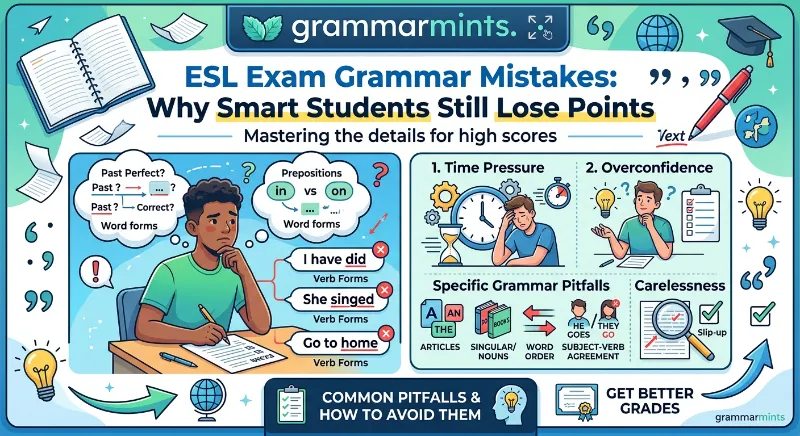
Conclusion
Grammar mistakes on ESL exams almost never come from a lack of knowledge. Instead, they come from familiar, everyday slip-ups: a wrong verb tense here, a missing article there, a sentence stretched one clause too far. Once you know where these mistakes cluster, whether that is IELTS Task 2, TOEFL Independent Writing, or any other timed test, fixing them becomes a matter of habit rather than talent. Start with verb tense and subject-verb agreement, since the data consistently shows these cause the most damage. Build outward from there. Small, consistent proofreading habits, practiced well before test day, tend to move scores further than any last-minute vocabulary cramming ever will.
If exam-day grammar habits are already showing up in your professional writing, it is worth tackling both at once. Related guides on resume grammar mistakes, formal letter mistakes, and professional punctuation mistakes over at GrammarMints cover the same underlying patterns in a workplace context. A categorized error list like the one on 7ESL’s grammar mistakes hub makes a solid companion resource for extra practice between study sessions.
References
- British Council. “Common Mistakes in IELTS.” takeielts.britishcouncil.org
- IDP IELTS. “Avoid These Common Grammar Mistakes in IELTS Writing Test.” ielts.idp.com
- LingoBright. “IELTS Test Taker Statistics Worldwide and by Country 2026.” lingobright.com
- Febriyanti, R. H., & Sundari, H. (2021). “Error Analysis of English Written Essay of Higher EFL Learners: A Case Study.” Journal of English Language Studies, 1(2). doi.org/10.30870/jels.v1i2.957
- ResearchGate (2020). “The Errors of EFL Students’ TOEFL iBT Integrated Writing Task.” researchgate.net
- PrepScholar TOEFL. “TOEFL Grammar: 11 Rules You Need to Know for the Exam.” prepscholar.com
- Test Resources. “5 Common Writing Problems Students Have on the TOEFL Writing Section.” toeflresources.com