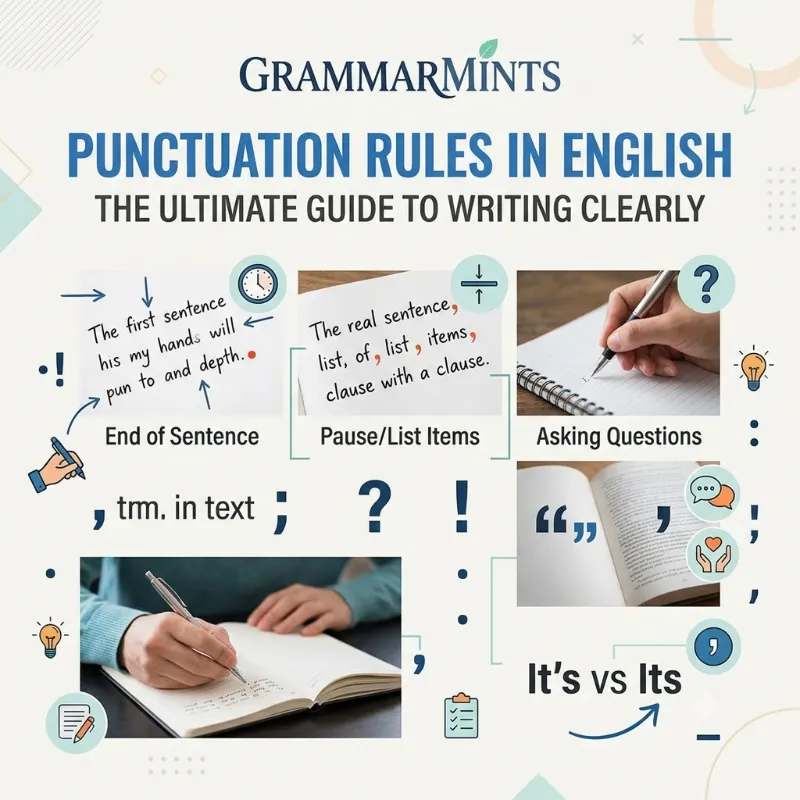
Good writing is not only about the words you pick. It is also about the small marks that sit between them. The punctuation rules in English decide where a sentence pauses, stops, or turns a corner. Get them right, and your reader glides through your writing. Get them wrong, and even a smart idea can sound confusing or careless. This guide walks you through every rule you actually need, with plain examples, so you can write with more confidence starting today.
Common Subject Verb Agreement Mistakes to Avoid
Why Punctuation Rules Matter More Than You Think
Most people learn punctuation in school and then forget the details. But small marks carry big weight. A missing comma can change who did what in a sentence. A misplaced apostrophe can turn a plural word into a possessive one by accident.
This is not just a classroom problem. In academic writing, editors have found that mechanical slip ups such as punctuation account for roughly 40% of all mechanical mistakes found in submitted manuscripts. That is a huge share of avoidable errors, and it shows up in business writing too. Style guides for professional communication warn that overusing devices such as multiple exclamation points or all capital words can send the wrong tone, even when the writer only meant to sound enthusiastic or urgent.
Lay vs Lie The Confusing Verbs Explained
So punctuation is not decoration. It is part of how your reader trusts you.
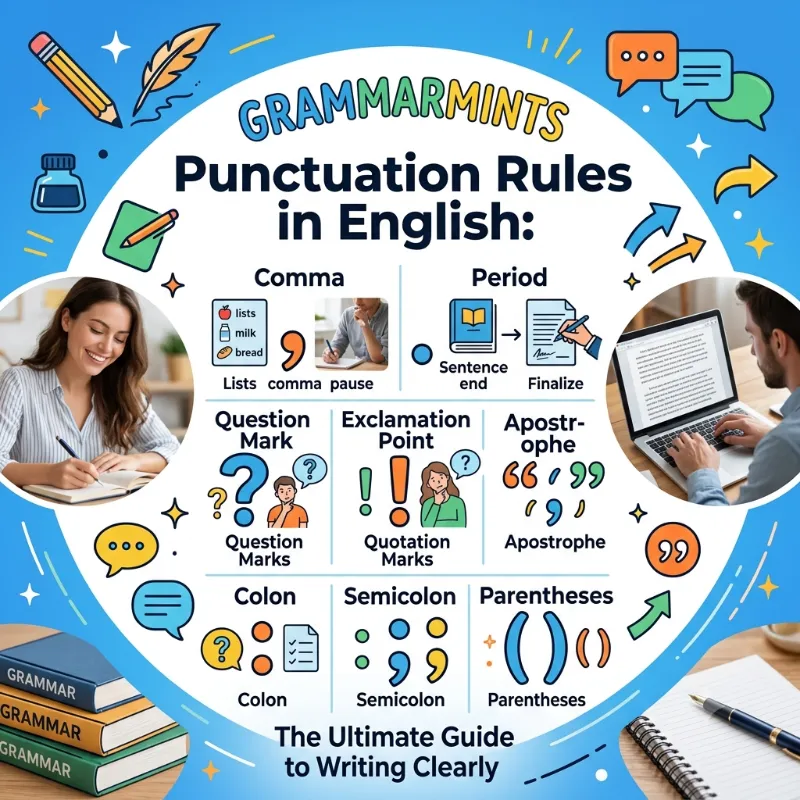
The Core Punctuation Rules in English Every Writer Should Know
Let’s break the essentials into digestible pieces: you do not need to memorize a textbook, just get these patterns into your head so they become automatic.
1. The Period (Full Stop)
A period ends a complete thought. The trap most writers fall into is the run on sentence, where two full thoughts get jammed together without a break.
- Wrong: “I finished the report I sent it to my manager.”
- Right: “I finished the report. I sent it to my manager.”
2. The Comma
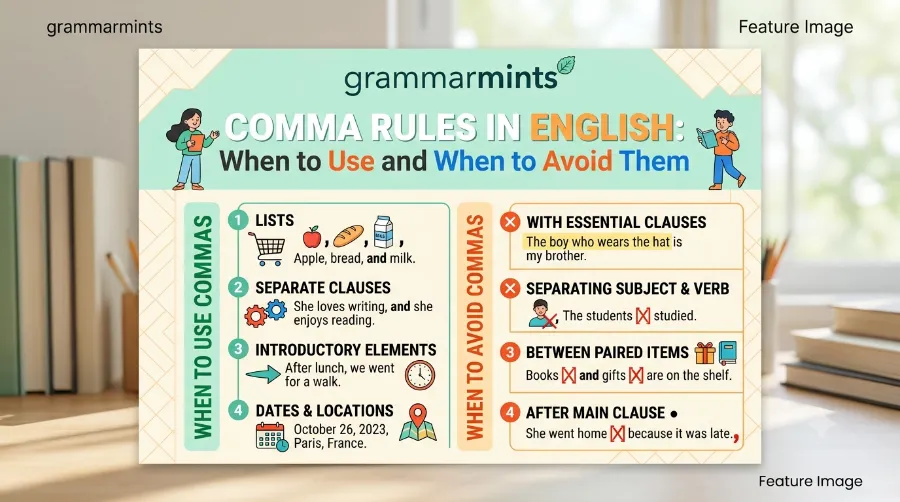
Commas separate items, clauses, and extra details. Three uses cause the most confusion:
- Listing items: “I bought pens, paper, and folders.”
- Joining two full sentences with a conjunction: “She left early, but the meeting continued.”
- Setting off extra information: “My colleague, who joined in March 2024, led the project.”
Then vs Than Understanding the Difference
3. The Apostrophe
Apostrophes show possession or mark a contraction, never a plain plural.
- Possession: “the client’s contract” (one client), “the clients’ contract” (many clients)
- Contraction: “it’s raining” (it is), not “its raining”
This single mix up, its versus it’s, is one of the most persistent errors even among experienced writers, and it is worth reviewing regularly through a dedicated <a href=”https://grammarmints.com/apostrophe-guide” target=”_blank” rel=”noopener”>apostrophe guide</a>.
4. The Semicolon and Colon
These two are the most avoided marks in English, mostly because writers are not sure when to use them.
- Semicolon: joins two related, complete sentences. “The deadline moved to June 2026; the team adjusted the schedule immediately.”
- Colon: introduces a list, explanation, or example. “The report covered three areas: budget, timeline, and staffing.”
5. Quotation Marks
Use quotation marks for direct speech or exact wording from a source. In American English, periods and commas usually go inside the closing quotation mark, while in British English they often sit outside. Knowing your audience’s convention matters, especially if you write for readers across the US and Europe.
6. Hyphens and Dashes
- Hyphen (-): joins compound words, such as “well known author” or “up to date figures.”
- En dash ( ): shows a range, such as “2020 2026.”
- Em dash: the mark that looks like this:. It adds emphasis or a break in thought. Instead of leaning on it, this guide uses commas, colons, and split sentences for that same effect, which is a cleaner habit worth building in your own writing too.
Common Punctuation Mistakes That Undermine Your Writing
Even confident writers repeat a handful of predictable mistakes. Style researchers point out that comma related errors are the single most frequent problem in everyday writing, since commas do the heavy lifting of showing readers when to pause, stop, or shift attention within a sentence.
Here are the mistakes that show up again and again:
- The comma splice: joining two full sentences with only a comma, no conjunction.
- Apostrophe confusion: writing “your” instead of “you’re,” or adding an apostrophe to a simple plural like “banana’s.”
- Overusing exclamation points: a habit that can make professional emails feel unpolished.
- Missing the Oxford comma: skipping the final comma before “and” in a list, which can occasionally create real ambiguity (compare “I invited my parents, Sam and Alex” with “I invited my parents, Sam, and Alex”).
- Dash and hyphen mix ups: using a hyphen where a longer dash is needed, or the other way around.
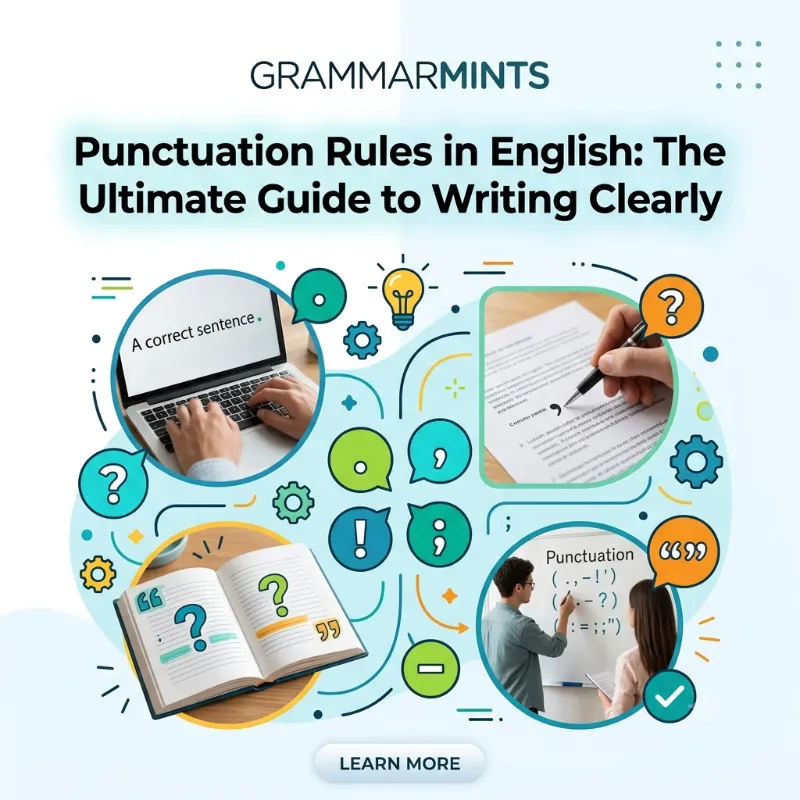
Punctuation Rules in English: Quick Reference Table
| Punctuation Mark | Main Job | Example |
|---|---|---|
| Period (.) | Ends a complete sentence | “The meeting ended at 5 p.m.” |
| Comma (,) | Separates items or clauses | “We reviewed the budget, the timeline, and the risks.” |
| Apostrophe (‘) | Shows possession or contraction | “The team’s goals; it’s finished.” |
| Semicolon (;) | Links two related sentences | “Sales rose in Q1 2026; costs stayed flat.” |
| Colon (:) | Introduces a list or explanation | “Three cities were chosen: Berlin, Austin, and Lyon.” |
| Quotation Marks (” “) | Marks direct speech or quotes | She said, “The launch is set for March 2026.” |
| Hyphen (-) | Joins compound words | “a well-researched article” |
| Em Dash (long dash) | Adds emphasis or a break | “The plan worked. It went better than expected.” |
How to Master These Rules: A Simple Practice Routine
You do not build punctuation confidence by reading rules once. You build it by practicing in short, repeated bursts.
- Pick one rule per week. Focus only on commas one week, then apostrophes the next.
- Read your writing out loud. Natural pauses usually match where a comma or period belongs.
- Use a style reference as you write, not just after. The <a href=”https://www.thepunctuationguide.com/” target=”_blank” rel=”noopener”>Punctuation Guide</a> offers clear examples for nearly every mark in English.
- Cross check tricky cases. When you are unsure about a rule, a trusted resource like <a href=”https://www.grammarbook.com/” target=”_blank” rel=”noopener”>GrammarBook.com</a> or the <a href=”https://www.english-grammar-revolution.com/punctuation-rules.html” target=”_blank” rel=”noopener”>English Grammar Revolution punctuation rules page</a> can confirm the correct usage quickly.
- Proofread once for content, once for punctuation only. Trying to catch both at the same time is how small errors slip through.
This routine takes a few extra minutes per piece of writing, but it pays off. Since 2024, more workplaces have started tracking writing quality as part of client communication reviews, and clean punctuation is consistently one of the easiest wins available to any writer.
Frequently Asked Questions
Is it wrong to start a sentence with “And” or “But”? No. Modern English usage allows it for emphasis, especially in blogs and conversational writing. It is a style choice, not a punctuation error.
Do I always need an Oxford comma? Not always, but it is recommended in most American style guides because it can prevent confusing lists.
What is the biggest punctuation mistake in professional emails? Overusing exclamation points and skipping proofreading before sending, according to business writing specialists.
Are punctuation rules the same in American and British English? Mostly, with a few differences: particularly around quotation marks and where periods and commas sit next to closing quotes.
Conclusion
Punctuation rules in English are not a memory test. They are a toolkit. Once you understand what each mark does, you stop guessing and start writing with intention. Whether you are drafting a report, a blog post, or an email to a client in another country, clean punctuation signals that you respect your reader’s time and attention. Start with one rule this week, apply it consistently, and the rest will follow naturally.
References
- The Punctuation Guide: https://www.thepunctuationguide.com/
- GrammarBook.com: https://www.grammarbook.com/
- English Grammar Revolution: Punctuation Rules: https://www.english-grammar-revolution.com/punctuation-rules.html
- Editor World, “Common Punctuation Errors in Academic Writing”
- ProofreadingServices.com, “6 Business Writing Errors That Cause Big Problems”
- Communication at Work, “5.3: Proofreading for Punctuation”