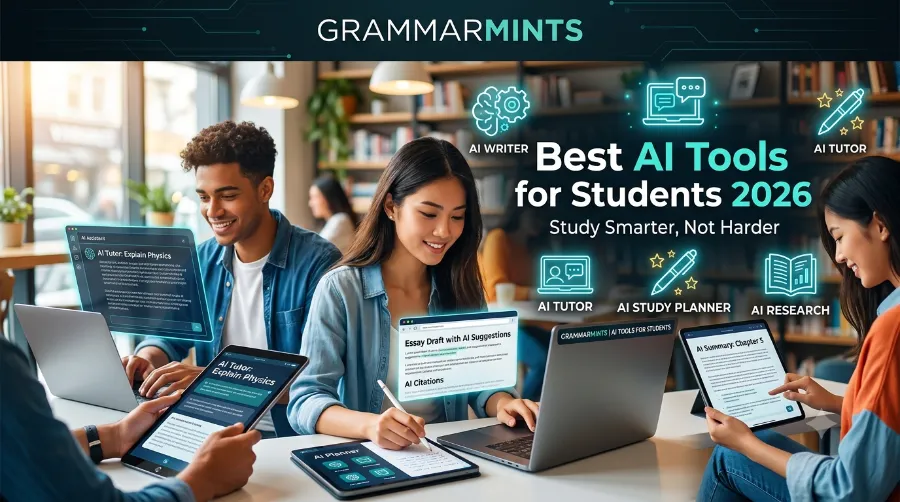
If your study routine still feels like a scramble between scattered notes, last-minute essays, and endless textbook pages, you are not alone. The best AI tools for students 2026 have quietly changed how millions of learners take notes, write essays, revise for exams, and even practice English. This guide walks through the tools that actually deliver, backed by real numbers, honest comparisons, and a few practical warnings so you use them wisely instead of blindly.
We will not just list app names. We will show you where each tool fits into your week, what it costs, and how to keep your own voice while letting AI handle the busywork.
Why AI Tools Matter for Students in 2026
AI stopped being a novelty in classrooms a while ago. It is now a daily habit. AI use among students is nearly universal at 92%, a six-point rise from the 86% adoption rate recorded in the 2024 Global AI Student Survey. That is a steep curve for just two years.
The growth story looks similar almost everywhere. Global student AI usage climbed from roughly 66% in 2024 to 92% in 2025, and by early 2026, most students in higher education were already leaning on AI for research and brainstorming. Meanwhile, in the UK specifically, HEPI’s third annual student survey found that about 95% of students report using AI in some form, and 94% say they lean on generative AI for assessed work.
Here is what that growth looks like on a simple chart:
[Chart: Student AI tool adoption growth from 2023 to 2026 — 27% (2023) → 66% (2024) → 92% (2025) → 92% (2026)]
Sources: Tyton Partners (2023), Digital Education Council Global AI Student Survey (2024–2025), Digital Education Council LATAM Survey (2026).
So, why the rush? Because AI genuinely saves time. Teachers who use AI weekly save close to six hours a week, and students report similar relief from repetitive tasks like summarizing readings or outlining essays. However, adoption without direction can backfire — nearly 1 in 5 students in a recent survey admitted to leaving unedited AI text in their coursework. That is exactly why picking the right tool, and using it the right way, matters more than ever.
How We Chose the Best AI Tools for Students 2026
Not every AI app deserves a spot on your home screen. Before adding anything to this list, we checked each tool against four criteria:
- Real classroom use – the tool is actually used by students, not just marketed to them.
- Clear pricing – free tiers or student discounts that will not drain a tight budget.
- Academic integrity fit – tools that support learning rather than encourage copy-paste shortcuts.
- Cross-subject flexibility – usefulness across essays, STEM homework, language practice, and career prep.
With that filter applied, here are the tools that consistently rise to the top.
Best AI Tools for Students 2026 (By Category)
1. AI Writing and Grammar Tools
Writing is still the most common use case for AI among students, and grammar checkers remain the entry point for most people. Globally, Grammarly sits just behind ChatGPT in popularity, used by roughly a quarter of students worldwide for polishing essays, emails, and applications.
A grammar checker catches typos, but it will not teach you why a sentence structure is wrong. That gap matters if you are also working on core writing skills. Pairing an AI grammar tool with a proper foundation — like practicing business English phrases for formal writing or reviewing common IELTS Writing Task 2 mistakes — helps you understand the “why” behind every correction instead of just accepting the fix.
Best for: essays, emails, cover letters, and cleaning up first drafts before submission.
2. AI Study and Note-Taking Tools
This category has exploded because it solves a very specific pain point: turning long lectures into something you can actually revise from. Mindgrasp, for example, converts recorded lectures, PDFs, and slides into notes, flashcards, and quizzes within minutes, and it now supports millions of student users across schools and universities, according to the Mindgrasp AI study platform.
The appeal is simple: instead of rereading a 40-slide deck three times before an exam, you get a structured summary plus a quiz to test whether it actually stuck. This mirrors what education researchers call active recall and spaced repetition, two of the most evidence-backed study methods available.
Best for: condensing lectures, building flashcards, and last-minute exam revision.
3. AI Research, Chat, and Brainstorming Tools
ChatGPT remains the single most popular AI tool among students worldwide, used by roughly two-thirds of them for research, outlining, and clarifying tricky concepts. Its biggest strength is versatility — one tool for brainstorming a thesis, explaining a math proof, or checking your logic before a debate.
The catch is that chat-based tools reward good prompting. If your queries are vague, the answers will be too. Students who treat these tools like a study partner, asking follow-up questions and pushing back on weak answers, tend to learn more than students who copy the first response.
Best for: brainstorming, concept explanations, and quick research summaries.
4. AI Tools for Language Learners
If English is not your first language, or you are polishing it for university-level writing, a dedicated AI tool built for language learners on top of general AI will save serious time. Purpose-built platforms like StudentAI combine tutoring with writing help, giving 24/7 feedback that a general chatbot might not tailor well.
That said, daily habits still beat any single app. Practicing daily English phrases for beginners, reviewing tricky prepositions in on at rules, or working through a science-backed vocabulary building guide will do more for long-term fluency than any AI shortcut alone. AI should speed up the process, not replace it.
Best for: grammar drills, vocabulary building, and structured feedback on written English.
5. AI Tools for Career and Application Prep
Cover letters and resumes are, somewhat surprisingly, one of the most appreciated AI use cases among students. Around three-quarters of surveyed students said AI-assisted resume and cover letter writing was useful or improved their outcomes. Before you let an AI tool draft your entire cover letter, though, it helps to understand the structure yourself — our guide on how to write a cover letter breaks down the format recruiters actually expect, so you can edit AI drafts with confidence instead of submitting something generic.
Best for: resumes, cover letters, LinkedIn summaries, and interview prep questions.
Which AI Tools Are Students Actually Using in 2026?
[Chart: Most-used AI tools among students in 2026 — ChatGPT 66%, Grammarly 25%, MS Copilot 25%, Mindgrasp/study tools 18%, StudentAI/tutor apps 14%]
Source: Digital Education Council Global AI Student Survey, 2026.
Comparison Table: Best AI Tools for Students 2026
| Tool Category | Example Tool | Best Use Case | Typical Price (2026) | Free Tier? |
|---|---|---|---|---|
| Writing & Grammar | Grammarly | Editing essays, emails | ~$12/month | Yes |
| Study & Notes | Mindgrasp | Lecture-to-flashcard conversion | ~$10–15/month | Yes, limited |
| Research & Chat | ChatGPT | Brainstorming, explanations | Free / $20/month (Plus) | Yes |
| Language Learning | StudentAI | Tutoring, writing feedback | Freemium | Yes |
| Career Prep | Various resume builders | Resumes, cover letters | Free–$10/month | Yes |
Prices change often, so always check the provider’s current page before subscribing.
Real Classroom Examples: How Students Use These Tools
Numbers only tell half the story, so here is how this plays out in practice:
- A UK undergraduate cohort (HEPI, December 2025): Based on 1,054 full-time undergraduates, the share of students who included AI-generated text directly in graded work rose to 12% in 2026, up from just 3% in 2024. This shows both growing comfort with AI and growing risk if institutions do not set clear boundaries.
- A U.S. teen sample (2023–2024): Reported use of ChatGPT for schoolwork doubled from 13% to 26% among 13–17-year-olds in a single year, mostly for research and math help.
- A Harvard physics classroom (2025): Students working with AI tutors reportedly learned more than twice as much in less time compared to a traditional active-learning setup, according to a widely cited Harvard University study.
These examples point to the same conclusion: AI helps most when it supports understanding, and it hurts most when it replaces thinking entirely.
How to Use AI Tools Without Losing Your Own Voice
AI can draft, summarize, and organize, but your grades (and your integrity) still depend on how you use the output. A few simple habits keep things balanced:
- Write your first draft yourself, then let AI edit it. This keeps your voice intact while still catching grammar slips.
- Ask AI to explain, not just answer. If it solves a problem, ask it to walk through the reasoning so you actually learn the method.
- Fact-check anything specific. Dates, statistics, and citations from AI chat tools should always be verified against a real source.
- Read your institution’s AI policy. Roughly four in ten students say their school discourages or limits AI use, according to Gallup’s 2026 State of Higher Education study, so know the rules before you submit anything.
- Keep a study log. Note which tool helped with which task; over a semester, this tells you which subscriptions are actually worth the money.
Frequently Asked Questions
What are the best AI tools for students in 2026?
The strongest lineup includes a general chat assistant like ChatGPT for research and brainstorming, a grammar tool like Grammarly for polishing writing, a study-notes tool like Mindgrasp for turning lectures into flashcards, and a language-focused assistant such as StudentAI for learners still building English fluency.
Are AI tools for students free?
Most major tools offer a usable free tier. ChatGPT, Grammarly, and Mindgrasp all provide free access with paid upgrades for higher usage limits or advanced features, so you can try before you commit to a subscription.
Will using AI tools count as cheating?
It depends entirely on your school’s policy and how you use the tool. Using AI to brainstorm or check grammar is usually fine; submitting unedited AI-written text as your own work is not. Around 65% of students in a recent survey said assessment methods have already changed because of this exact concern.
Do AI tools actually improve grades?
Some studies suggest meaningful gains, particularly when AI is used for active recall and personalized feedback rather than as a shortcut. That said, results vary by subject, tool, and how disciplined the student is about editing and verifying AI output.
Which AI tool is best for improving English writing specifically?
A grammar checker paired with structured practice works best. Combine an AI tool with resources like how to speak English fluently at home for consistent, low-pressure daily practice alongside your AI-assisted editing.
Conclusion
Choosing the best AI tools for students 2026 is not about collecting the flashiest apps. It is about matching a tool to a real task, whether that is condensing a dense lecture, tightening an essay’s grammar, or building genuine English fluency one phrase at a time. Used with intention, these tools give back hours every week without hollowing out the learning itself. Used carelessly, they just create a different kind of shortcut. Start with one or two tools from this list, build a habit around them, and let your grades — and your understanding — do the talking.
References
- Digital Education Council, Global AI Student Survey 2024–2026
- Digital Education Council, AI in Higher Education LATAM Survey 2026
- HEPI (Higher Education Policy Institute), Student Generative AI Survey 2026 (Report 199)
- Gallup / Lumina Foundation, State of Higher Education Study 2026
- Tyton Partners, Generative AI adoption research, 2023
- Mindgrasp AI, product data, 2026
- StudentAI, product overview, 2026