
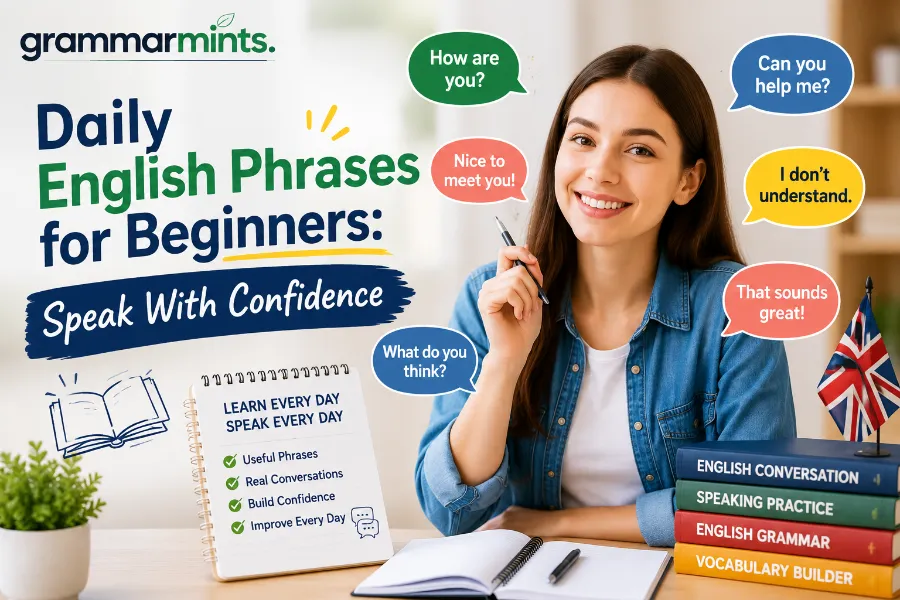
Learning daily English phrases for beginners is the fastest way to sound natural, even if your grammar is not perfect yet. Most new learners spend months memorizing grammar rules, but they still freeze when someone says “How’s it going?” at the coffee shop. That is because real conversations run on short, repeated phrases, not textbook sentences.
If you want to learn more about best ai tools for students 2026 guide for practical tips and expert advice.
In this guide, you will find ready-to-use phrases, a simple daily routine to practice them, common mistakes to avoid, and a few tools that make the process faster. Everything here is written in plain words, so you can start using it today.
To get a better understanding of how improve English vocabulary breaks down exactly what to expect.
Why Daily English Phrases for Beginners Matter
Native speakers do not think in full grammar rules when they talk. Instead, they reach for phrases they have heard a thousand times, such as “no worries” or “let me check.” So, if you learn these chunks first, you can join conversations much sooner than if you only study grammar charts.
To get a better understanding of how to speak English fluently at home breaks down exactly what to expect.
There is also strong demand behind this skill. As of 2026, roughly 1.5 billion people are learning or using English worldwide, according to the British Council. In addition, about 49% of all websites online are written in English, based on recent figures shared by Preply’s language learning report. Therefore, even a small daily habit of practicing phrases can open doors at work, in travel, and online.
A Quick Real-Life Example
Imagine Maria, a new employee in Madrid, who joined an international team in March 2025. She could read English emails well, but she struggled in meetings. After just six weeks of practicing 10 daily English phrases for beginners, such as “Could you say that again?” and “That makes sense,” she started joining calls without panic. Her manager noticed the change by May 2025.
15 Daily English Phrases for Beginners You Can Use Today
Below is a simple table of common phrases, grouped by situation. Copy this list, print it, or turn it into flashcards.
If you want to learn more about how to use ChatGPT for writing guide for practical tips and expert advice.
| Situation | Phrase | Example Sentence |
|---|---|---|
| Greeting | How’s it going? | Hey, how’s it going today? |
| Greeting | Long time no see | Long time no see, how have you been? |
| Small talk | What’s new with you? | So, what’s new with you this week? |
| Agreeing | That makes sense | Okay, that makes sense, thanks. |
| Disagreeing | I see it differently | I see it differently, but I get your point. |
| Asking for help | Could you help me out? | Could you help me out with this form? |
| Clarifying | Could you say that again? | Sorry, could you say that again? |
| Shopping | How much is this? | How much is this jacket? |
| Ordering food | I’ll have the same | I’ll have the same as her, please. |
| At work | Let me check | Let me check and get back to you. |
| At work | I’ll follow up | I’ll follow up by email tomorrow. |
| Apologizing | My bad | My bad, I forgot to reply. |
| Ending a chat | Take care | Take care, talk soon! |
| Encouraging | You’ve got this | Don’t worry, you’ve got this. |
| Thanking | I appreciate it | Thanks a lot, I appreciate it. |
Once these phrases feel natural, add them into short conversations with a friend, a language partner, or an app.
How to Practice Daily English Phrases for Beginners
A short daily habit beats a long weekly session. Below is a five-step routine you can follow every morning or evening.
- Pick 5 new phrases from the table above or from a trusted phrase list.
- Say each phrase out loud three times, so your mouth gets used to the sound.
- Write one sentence using each phrase, based on your own life.
- Use one phrase in a real chat, message, or voice note that same day.
- Review yesterday’s phrases for 2 minutes before adding new ones.
This routine takes about 15 minutes and builds real speaking confidence within a few weeks. For instance, learners who combine short daily study with a human conversation partner tend to progress much faster than those who rely on apps alone, based on 2026 research shared by Tutorbase.
Track Your Progress Weekly
Keep a small notebook or a notes app, and mark how many phrases you can use without stopping to think. Most beginners notice a clear jump after 30 days of steady practice.
Common Mistakes Beginners Make With Everyday English Phrases
Even motivated learners fall into a few traps. Watch out for these:
- Translating word for word from your native language, which often creates phrases native speakers never use.
- Learning too many phrases at once, which makes it hard to remember any of them well.
- Avoiding real conversations out of fear of mistakes, instead of practicing with real people.
- Ignoring pronunciation, since a phrase said in the wrong rhythm can confuse listeners.
- Skipping review, so phrases fade from memory within a week.
Small, steady habits usually beat occasional long study sessions, especially for busy adult learners.
Best Tools and Resources to Learn English Phrases Fast
You do not need expensive courses to build this skill. A few reliable options include:
- Mondly’s phrase and expression guide, which offers a well-organized collection of everyday English expressions with clear examples for different situations.
- A free downloadable phrase list, such as this PDF of 650 common English phrases for everyday speaking, which is handy for offline study or printing.
- A language exchange partner, since speaking with real people gives you feedback that apps cannot.
Once you can hold a basic conversation, many learners move on to more advanced writing goals, such as workplace English. If that is your next step, our guide on how to write a cover letter walks you through the process in the same simple style. You can also browse more grammar and vocabulary guides on the GrammarMints homepage to keep building your skills.
English Learners by the Numbers (2026 Snapshot)
The table below summarizes a few figures that show why daily practice is worth the effort.
| Metric | Figure | Source |
|---|---|---|
| People learning English worldwide | ~1.5 billion | British Council |
| Native English speakers | ~390–400 million | LingoBright, 2026 |
| Share of websites written in English | ~49% | Preply Global Language Report, 2026 |
| Employers assessing English skills | 98.5% (across 38 countries) | EC English |
| English learners in China | ~400 million | British Council |
These numbers show that daily English phrases for beginners are not a small side skill. They are part of a much bigger, ongoing shift toward English as the shared language of work, travel, and the internet.
Frequently Asked Questions
How many English phrases should a beginner learn per week? Around 20 to 25 phrases per week is realistic for most beginners, as long as you review them daily instead of only learning new ones.
Can I learn English phrases without a teacher? Yes. Many learners build strong conversational skills using free phrase lists, apps, and language exchange partners, though a tutor can speed up correction of mistakes.
How long does it take to sound natural in English? Most learners notice a clear improvement in everyday conversation within 2 to 3 months of consistent daily practice, though full fluency takes longer.
What is the difference between a phrase and an idiom? A phrase is a short, common group of words used in daily talk, such as “let me check.” An idiom has a meaning that is different from its individual words, such as “break the ice.”
Conclusion
Learning daily English phrases for beginners does not require perfect grammar or years of study. It simply asks for a short, steady habit: a handful of phrases each day, real practice, and honest review. Start with the table above, follow the five-step routine, and avoid the common mistakes shared here. Within a few weeks, you should notice real conversations feel far less stressful, and far more natural.
References
- British Council, “English in Numbers,” britishcouncil.cn
- LingoBright, “English Language Statistics 2026,” lingobright.com
- Preply, “Global Language Learning Report 2026,” preply.com
- EC English, “70 Fascinating English Language Statistics,” ecenglish.com
- Tutorbase Research, “Language Learning Statistics 2026,” tutorbase.com