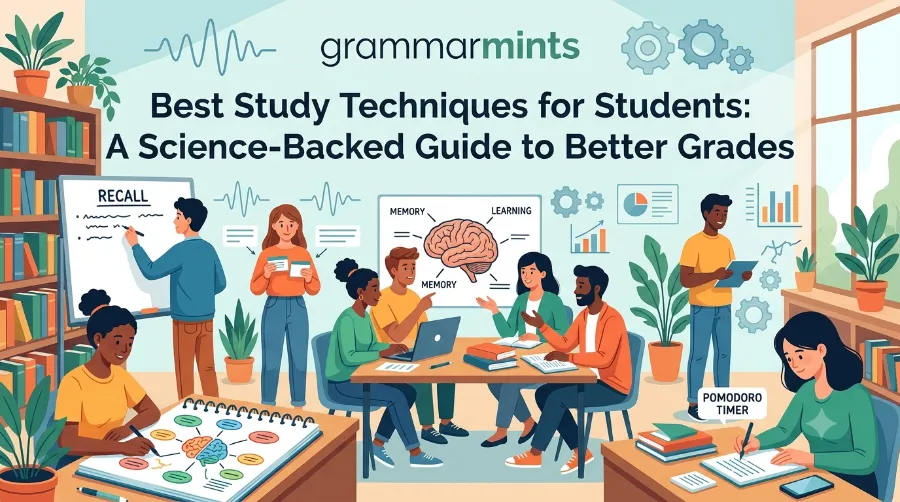
If you have ever reread a chapter three times and still blanked out on the exam, you are not alone. The best study techniques for students are not about spending more hours at your desk. They are about spending your hours the right way. In this guide, you will learn what cognitive science actually says works, and how to build a routine you can stick to, whether you are in high school, college, or grad school in the US or Europe.
If you want to learn more about Grammarly vs ChatGPT comparison for practical tips and expert advice.

We will walk through the methods with the strongest evidence behind them, show you real numbers from recent research, and give you a simple weekly plan you can copy today. No fluff, no vague advice. Just what works.
If you want to learn more about ChatGPT prompts for studying for practical tips and expert advice
Why Most Study Habits Fail (Even When You Try Hard)
Here is the uncomfortable truth. The study habits that feel productive are often the ones that help the least. Rereading notes, highlighting in three colors, and copying slides word for word all create a “fluency illusion.” The material feels familiar, so your brain assumes you know it. Then the exam arrives, and the words are gone.
A well-known 2006 study by Roediger and Karpicke put this to the test. One group reread material four times. Another group read it once and then tested themselves three times. A week later, the group that tested themselves remembered roughly 50% more than the group that only reread. Consequently, the extra hours spent rereading were, in a very real sense, wasted time.
If you want to learn more about best study techniques for students tips and expert advice.
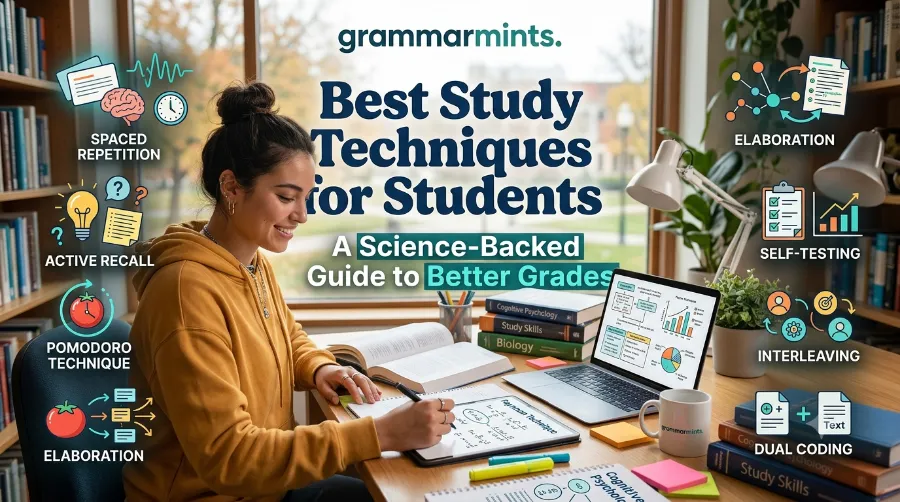
This gap between what feels effective and what actually works is the reason so many capable students underperform. Once you understand the forgetting curve, however, you can work with your brain instead of against it. Below are the techniques that consistently show up in the research as the biggest performance boosters.
If you want to learn more about best note taking methods for students tips and expert advice.
The Best Study Techniques for Students, Backed by Research
1. Active Recall: Test Yourself Instead of Rereading
Active recall means closing the book and trying to pull information out of your memory, rather than passively looking at it again. This single change has more solid evidence behind it than almost any other study method available today.
If you want to learn more about best Pomodoro technique for students tips and expert advice.
In practice, this looks like:
- Covering your notes and writing down everything you remember from a chapter
- Turning headings into questions and answering them from memory before checking
- Using flashcards and testing yourself in both directions (term to definition and back)
For instance, a 2024 pharmacy education survey found that 91% of 645 pharmacy students still relied mainly on rereading notes, textbooks, or lecture videos as their main study method, even though this approach ranks among the least effective according to cognitive science research. Switching even half your study time to self-testing tends to produce a noticeably sharper recall on exam day.
If you want a deeper breakdown of how to turn your notes into effective self-quizzes using AI, our guide on ChatGPT prompts for studying walks through ready-to-use prompts that generate practice questions from any topic in seconds.
2. Spaced Repetition: Beat the Forgetting Curve
Spaced repetition means reviewing material at increasing intervals instead of cramming it all in one sitting. The logic follows the forgetting curve, first mapped by psychologist Hermann Ebbinghaus, which shows memory decays fastest right after learning and then levels off with each review.
A rough rule researchers recommend: space your reviews at 10-20% of how long you want to remember something. So, to remember something for a week, review it every one to two days. To remember it for a month, review every three to seven days.
Real-world evidence backs this up. A 2024 quasi-experimental study at Bahria University Medical and Dental College in Karachi tracked 115 medical students over a four-week rotation. Students who used spaced repetition flashcards (via Anki) improved their post-test scores from 27.93 to 30.8 out of 50, a statistically significant gain. The control group, using traditional textbook study, actually saw a slight score decline. Similarly, a 2021 meta-analysis by Donoghue and Hattie, covering 242 studies and more than 169,000 participants, confirmed that distributed practice and practice testing were the two most effective techniques out of ten commonly used study strategies.
Free apps like Anki or Quizlet automate this spacing for you, so you do not need to build a schedule by hand.
3. The Pomodoro Technique: Study in Focused Sprints
The Pomodoro Technique breaks your study time into short, focused sprints, usually 25 minutes of work followed by a 5-minute break. After four sprints, you take a longer 15-20 minute break. The goal is to reduce procrastination and mental fatigue by making each work block feel small and manageable.
A 2025 comparative study published in the International Journal of Multidisciplinary: Applied Business and Education Research found that the Pomodoro Technique outperformed the more flexible “Flowtime” method specifically in memory retention, academic performance, and time management among college students. A separate 2025 Maastricht University study of 94 students also found that structured, externally-timed breaks (like Pomodoro) helped reduce the mental load of deciding when to stop working, something self-regulated breaks often failed to do.
To try it yourself:
- Pick one task and set a timer for 25 minutes
- Work with zero distractions, no phone, no tabs
- Take a genuine 5-minute break away from your screen
- Repeat, and take a longer break after four rounds
4. Interleaving: Mix Topics Instead of Studying One at a Time
Interleaving means mixing different subjects or problem types within a single study session, rather than mastering one topic completely before moving to the next (a method called “blocking”). It feels harder in the moment, which is exactly why it works. Your brain has to actively figure out which strategy applies to which problem, rather than running on autopilot.
This technique is especially useful for math and science students, since exams rarely ask questions in the same order you studied them. Instead of doing 20 algebra problems in a row, try mixing algebra, geometry, and word problems in the same session.
5. The Feynman Technique: Teach It to Learn It
Named after physicist Richard Feynman, this method asks you to explain a concept in plain, simple language, as if teaching it to a twelve-year-old. When you get stuck or start using jargon to cover a gap, that is exactly where your understanding is weak.
Here is how to use it:
- Write the concept’s name at the top of a blank page
- Explain it in your own words, as simply as possible
- Circle any spot where you struggled or used a complicated term
- Go back to your source material, relearn that specific gap, then try again
This technique pairs naturally with study groups, since explaining a topic out loud to a classmate forces the same kind of clarity.
6. Mind Mapping: Visualize How Ideas Connect
Mind mapping works well for subjects where ideas branch off from a central concept, such as history, biology, or literature themes. You start with a central topic in the middle of the page, then draw branches out to subtopics, and smaller branches from those. It helps because it forces you to organize information by relationship rather than by memorized order.
Free tools such as Miro, Coggle, or even a plain sheet of paper work well here. Mind maps are particularly useful right before an exam, since they let you scan an entire topic’s structure in one glance.
7. Use AI Tools the Smart Way, Not as a Shortcut
AI writing and study tools can genuinely speed up your learning, but only if you use them to strengthen your understanding rather than replace it. For example, you can ask an AI tool to generate practice quiz questions from your lecture notes, summarize a dense research paper into plain language, or create flashcards automatically from a textbook chapter.
That said, not every AI tool is built for the same job. If you are polishing an essay for grammar and clarity versus generating study content from scratch, the right tool changes. Our detailed comparison of Grammarly vs ChatGPT breaks down which tool actually catches more writing errors and which one is better suited for brainstorming and explaining concepts, so you are not guessing which app to open at 11 p.m. before a deadline.
How to Build a Study Routine That Actually Sticks
Knowing the techniques is one thing. Turning them into a weekly habit is another. Here is a simple way to combine everything above into a routine:
- Plan your week on Sunday. List every topic or assignment due, then assign each one a Pomodoro block.
- Study new material with active recall, not rereading. Read once, then close the book and quiz yourself.
- Schedule review sessions for material from 2, 7, and 16 days ago, using spaced repetition.
- Mix subjects within a single sitting instead of blocking one subject for hours.
- End each week explaining your hardest topic out loud using the Feynman Technique, ideally to a friend or study partner.
A Sample Weekly Study Plan
| Day | Focus | Technique Used | Time |
|---|---|---|---|
| Monday | New material (Subject A) | Active recall + Pomodoro | 50 min |
| Tuesday | New material (Subject B) | Active recall + Pomodoro | 50 min |
| Wednesday | Review Monday + Tuesday topics | Spaced repetition (flashcards) | 30 min |
| Thursday | Mixed practice problems | Interleaving | 45 min |
| Friday | Explain hardest topic aloud | Feynman Technique | 20 min |
| Saturday | Light review + mind map | Mind mapping | 30 min |
| Sunday | Plan next week + rest | Weekly planning | 15 min |
Comparing the Techniques at a Glance
| Technique | Best For | Typical Retention Gain* | Time Investment |
|---|---|---|---|
| Active Recall | Facts, definitions, formulas | Up to 50% more recall vs. rereading | Low-Medium |
| Spaced Repetition | Long-term retention, cumulative exams | Significant score gains over 4+ weeks | Low (automated by apps) |
| Pomodoro Technique | Focus, reducing procrastination | Improved task completion & retention | Low |
| Interleaving | Math, science, mixed problem sets | Better transfer to new problems | Medium |
| Feynman Technique | Deep conceptual understanding | Identifies knowledge gaps fast | Medium |
| Mind Mapping | Visual/relational subjects | Faster review before exams | Low |
*Figures are approximate, drawn from the cited studies below; actual results vary by subject and individual.
Common Study Mistakes to Avoid
Even motivated students fall into these traps. Watch out for:
- Highlighting everything. If most of the page is yellow, you have not actually decided what matters.
- Studying in long, unbroken blocks. Focus drops sharply after 40-50 minutes without a break.
- Cramming the night before. It boosts short-term recall but collapses within days, which is a poor trade for a cumulative exam.
- Multitasking with your phone nearby. Even a silenced phone on the desk has been shown to pull attention away from the task at hand.
- Skipping practice tests. Past exams and practice questions are some of the closest simulations of the real thing.
For students looking for more structured resources, the USA.edu guide to study techniques offers additional strategies tailored to different learning styles, while TopUniversities’ list of useful student websites is a solid starting point for free tools beyond what is covered here.
What the Research Says About Studying Smart, Not Just Hard
The American Psychological Association has long emphasized that working smarter, rather than simply putting in more hours, is what separates high-performing students from burned-out ones. Their guide on studying smart points out that effective students plan their study sessions around how memory actually works, rather than around how much time looks impressive on paper.
This lines up with what more recent research confirms. A 2023 systematic review on spaced learning and retrieval practice in radiology education found that spaced study significantly improved long-term retention compared to massed, single-session cramming, even when the total number of study hours stayed the same.
Frequently Asked Questions
What is the single best study technique for students? Active recall consistently ranks as the most effective single technique across cognitive science research, since it forces retrieval rather than passive review. Pairing it with spaced repetition tends to produce the strongest long-term results.
How many hours should a student study per day? There is no universal number, since it depends on course load and subject difficulty. However, research suggests that shorter, focused sessions (like 25-50 minute blocks) with regular breaks outperform long, unbroken study marathons.
Is the Pomodoro Technique good for exam preparation? Yes. Studies from 2025 found it particularly effective at improving memory retention and reducing procrastination compared to unstructured study sessions, especially for students who struggle to self-regulate their breaks.
Can AI tools like ChatGPT actually help me study, or is it cheating? Used correctly, AI tools can generate practice questions, explain confusing concepts in simpler terms, and create flashcards, which supports active recall rather than replacing your learning. Using AI to write entire assignments for you is a different matter, and most institutions consider that academic dishonesty.
How long does it take to see results from changing study habits? Many students notice a difference in recall and confidence within two to three weeks of consistently using active recall and spaced repetition, though full academic results (like grades) typically show up over a full semester.
Conclusion
The best study techniques for students all share one thing in common: they trade short-term comfort for long-term memory. Rereading and highlighting feel productive, but active recall, spaced repetition, the Pomodoro Technique, interleaving, and the Feynman Technique are the methods that research consistently backs. Start small. Pick one or two techniques from this guide, apply them to your next study session, and build from there. Over a few weeks, you should notice you are studying less overall while remembering more, which is really the whole point.
References
- Roediger, H. L., & Karpicke, J. D. (2006). Test-enhanced learning: Taking memory tests improves long-term retention.
- Donoghue, G. M., & Hattie, J. A. C. (2021). A meta-analysis of ten learning techniques.
- Bahria University Medical and Dental College spaced repetition study, NCBI/PMC, 2024.
- Smits, E. J. C., Wenzel, N., & de Bruin, A. (2025). Investigating the Effectiveness of Self-Regulated, Pomodoro, and Flowtime Break-Taking Techniques Among Students. Behavioral Sciences, 15(7), 861.
- Renacido, J. M. D., Mayordo, E. L., & Biray, E. T. (2025). A Comparative Study Between Pomodoro and Flowtime Techniques Among College Students. International Journal of Multidisciplinary: Applied Business and Education Research, 6(8).
- American Psychological Association, GradPsych, “Study Smart.”
- Systematic Review on Spaced Learning, Interleaving, and Retrieval Practice in Radiology Education, ScienceDirect, 2023.