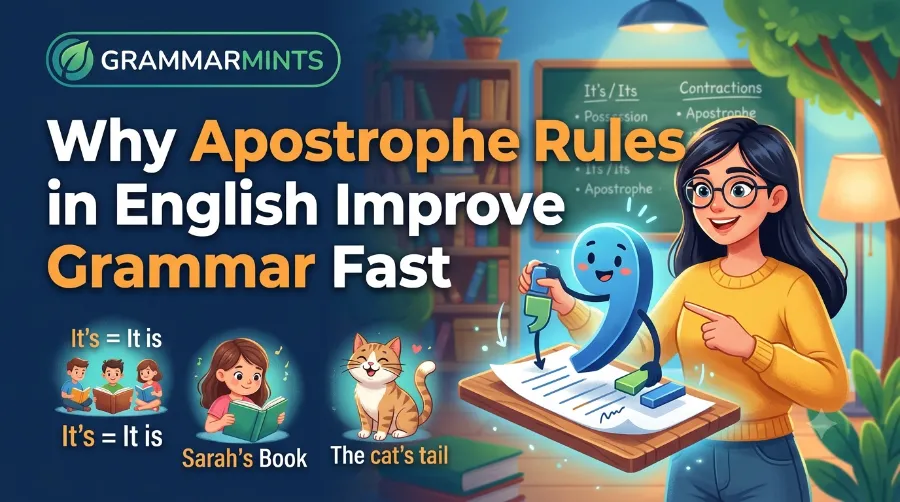
Have you ever wondered why one tiny punctuation mark causes so many writing mistakes? Surprisingly, the apostrophe is one of the most misunderstood punctuation marks in English. Yet, learning apostrophe rules in English can instantly make your writing look more professional, accurate, and easy to understand.
Whether you write emails, essays, blog posts, business reports, or social media captions, correct apostrophe usage helps readers understand exactly what you mean. Moreover, it builds confidence because your sentences appear polished and trustworthy.
In this guide, you’ll discover the most important apostrophe rules, learn practical examples, avoid common mistakes, and improve your grammar much faster than memorizing long grammar books.
Why Learning Apostrophe Rules Matters
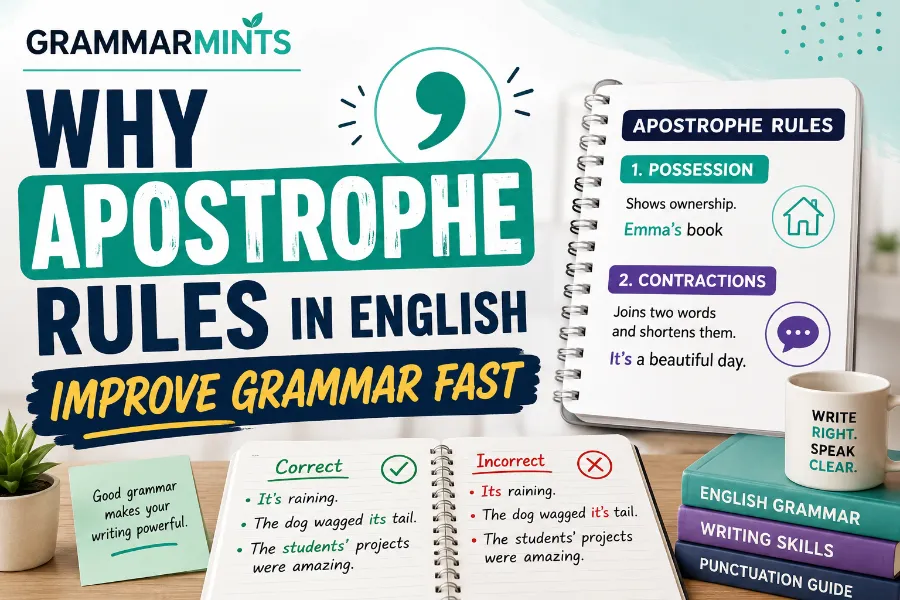
Many people believe apostrophes are only for contractions. However, they also show possession and help readers avoid confusion.
For example:
| Incorrect | Correct |
|---|---|
| The dogs bone | The dog’s bone |
| Its raining | It’s raining |
| The students books | The students’ books |
Notice how one small punctuation mark completely changes the meaning.
As a result, mastering apostrophes improves:
- Writing clarity
- Reading comprehension
- Academic performance
- Workplace communication
- Professional credibility
According to educational writing experts, punctuation errors remain one of the most common grammar mistakes in student and workplace writing.
What Is an Apostrophe?
An apostrophe ( ‘ ) is a punctuation mark used mainly for two purposes:
- Showing possession
- Forming contractions
Although its uses seem simple, many writers confuse these two functions.
Example
Possession:
- Sarah’s laptop
- James’s notebook
- The teacher’s desk
Contractions:
- It’s = It is
- Don’t = Do not
- They’re = They are
- We’ll = We will
The key difference is simple:
If you’re shortening two words, use an apostrophe.
If you’re showing ownership, use an apostrophe.
Rule 1: Apostrophes for Singular Possession
When one person or thing owns something, add ‘s.
Examples
| Owner | Correct Form |
|---|---|
| Emma | Emma’s book |
| The cat | The cat’s toy |
| The company | The company’s policy |
| My brother | My brother’s car |
Real-Life Example
Imagine you borrow your friend’s phone.
Correct:
My friend’s phone is new.
Incorrect:
My friends phone is new.
Without the apostrophe, the sentence looks incomplete.
Rule 2: Apostrophes for Plural Possession
If multiple people own something together, place the apostrophe after the plural s.
Examples
| Incorrect | Correct |
|---|---|
| Teachers lounge | Teachers’ lounge |
| Players uniforms | Players’ uniforms |
| Students projects | Students’ projects |
Example Sentence
The students’ projects were displayed during the science fair.
Because several students own the projects, the apostrophe comes after s.
Rule 3: Irregular Plural Nouns
Some plural nouns do not end with s.
Examples include:
- children
- men
- women
- people
- mice
For these nouns, simply add ‘s.
| Noun | Correct Form |
|---|---|
| children | children’s books |
| women | women’s clothing |
| men | men’s shoes |
| people | people’s opinions |
| mice | mice’s habitat |
These words often confuse learners because they already look plural.
Rule 4: Apostrophes in Contractions
Contractions combine two words by removing letters.
The apostrophe replaces the missing letters.
Common Examples
| Full Form | Contraction |
|---|---|
| It is | It’s |
| They are | They’re |
| Cannot | Can’t |
| I will | I’ll |
| We have | We’ve |
| Should not | Shouldn’t |
| Do not | Don’t |
Why Contractions Matter
Contractions make writing sound natural and conversational.
Instead of writing:
I will not attend because I cannot travel.
Most people naturally write:
I’ll not attend because I can’t travel.
Business writing often avoids too many contractions, while blogs and everyday communication use them frequently.
Rule 5: Its vs It’s
This is one of the most common grammar mistakes.
It’s
Means:
It is
or
It has
Example:
It’s raining today.
It’s been a wonderful week.
Its
Shows possession.
Example:
The dog wagged its tail.
The company changed its logo.
Easy Memory Trick
If you can replace the word with it is, use it’s.
Otherwise, use its.
Quick Comparison Table
| Word | Meaning |
|---|---|
| It’s | It is / It has |
| Its | Possession |
| You’re | You are |
| Your | Possession |
| They’re | They are |
| Their | Possession |
| Whose | Possession |
| Who’s | Who is |
These pairs appear frequently in emails, assignments, and online writing.
Signs That You Need Better Apostrophe Skills
You may need more practice if you often:
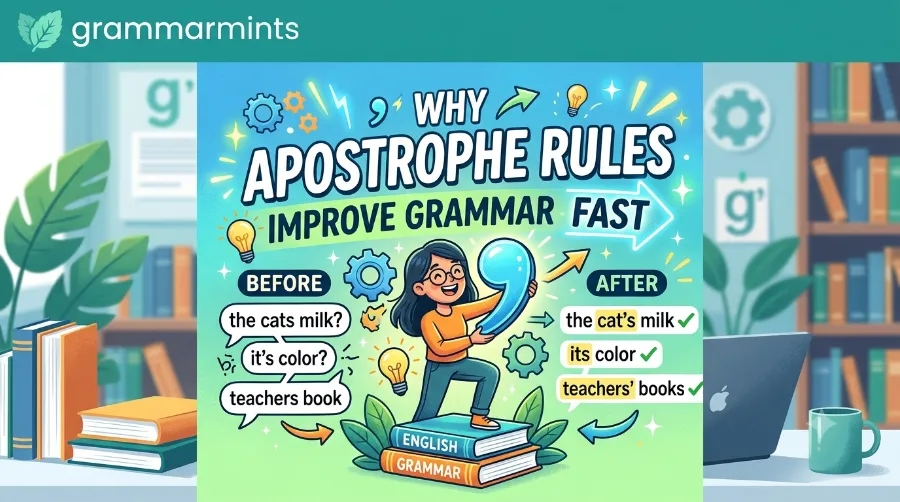
- Confuse its and it’s
- Write plurals with apostrophes
- Forget apostrophes in contractions
- Avoid contractions completely
- Lose marks on grammar tests
- Receive corrections from editors
Fortunately, these mistakes are easy to fix with regular practice and clear rules.
Real-Life Example
A survey by education professionals in recent years found that punctuation errors remain among the top grammar issues in student essays and workplace communication. Even skilled writers occasionally misuse apostrophes when writing quickly. Therefore, proofreading before publishing or submitting any document is an effective habit that improves accuracy and professionalism.
Rule 6: Apostrophes with Names Ending in S
Names that end with s often confuse writers. Most modern style guides recommend adding ‘s to singular names, although some publishers follow different house styles. The important point is to stay consistent.
Examples
| Name | Preferred Form |
|---|---|
| James | James’s bicycle |
| Chris | Chris’s laptop |
| Charles | Charles’s office |
Some newspapers may write James’ bicycle, but James’s bicycle is accepted by many grammar authorities.
Rule 7: Joint vs. Separate Ownership
Understanding who owns what is important.
Joint Ownership
When two people own one item together, add the apostrophe only to the second name.
Examples
- Jack and Emma’s house
- David and Sarah’s business
Separate Ownership
When each person owns a different item, each name takes an apostrophe.
Examples
- Jack’s and Emma’s cars
- David’s and Sarah’s offices
Rule 8: Never Use Apostrophes for Regular Plurals
One of the biggest grammar mistakes is adding an apostrophe to make a word plural.
Incorrect
- Apple’s for sale
- Book’s
- Dog’s available
- Teacher’s wanted
Correct
- Apples for sale
- Books
- Dogs available
- Teachers wanted
Remember this simple rule:
Plural words usually do not need apostrophes.
Rule 9: Apostrophes with Time and Money
Time, distance, and money can show possession.
Examples
- One day’s work
- Two weeks’ notice
- A dollar’s value
- Three months’ salary
- Five years’ experience
These expressions are common in business writing, contracts, and formal documents.
Rule 10: Apostrophes in Decades and Abbreviations
Many writers mistakenly add apostrophes when writing decades.
Correct
- the 1990s
- the 1980s
- the 2000s
Incorrect
- the 1990’s
- the 1980’s
However, apostrophes can appear when letters are omitted.
Example:
- the ’90s
Most Common Apostrophe Mistakes
Avoid these errors to improve your grammar quickly.
| Incorrect | Correct |
| Your welcome | You’re welcome |
| Its raining | It’s raining |
| The girls bag | The girl’s bag |
| The girls’ bags | The girls’ bags |
| Apple’s for sale | Apples for sale |
| Childrens toys | Children’s toys |
| Mens room | Men’s room |
| Whos coming? | Who’s coming? |
| Teachers lounge | Teachers’ lounge |
| Everyones ready | Everyone’s ready |
Simple Memory Tricks
Instead of memorizing dozens of grammar rules, use these easy checks.
Trick 1
Can you replace the word with it is?
- It’s cold. ✔
- Its color is blue. ✔
Trick 2
Ask yourself:
Who owns this?
If someone owns something, an apostrophe is probably needed.
Trick 3
If you are only making a word plural, leave the apostrophe out.
Everyday Examples
At School
The student’s homework was excellent.
At Work
The company’s annual report impressed investors.
At Home
The children’s toys covered the living room floor.
Online
You’re going to love this article.
Each sentence follows the correct apostrophe rule and reads naturally.
Quick Practice Quiz
Choose the correct answer.
1. ______ going to the meeting.
A. Your
B. You’re
Answer: You’re
2. The dog wagged ______ tail.
A. it’s
B. its
Answer: its
3. The ______ playground is new.
A. childrens’
B. children’s
Answer: children’s
4. Those are my ______ books.
A. friends
B. friend’s
Answer: friend’s (if one friend owns them)
5. We loved music from the ______.
A. 1990’s
B. 1990s
Answer: 1990s
Practical Tips to Improve Faster
If you want better grammar in everyday writing, follow these habits.
- Read your sentence aloud before publishing.
- Look for every apostrophe during proofreading.
- Check whether you are showing ownership or shortening words.
- Use a trusted grammar checker for a final review.
- Read quality newspapers, books, and educational websites regularly.
- Practice writing five sentences every day using different apostrophe rules.
Small improvements each day produce noticeable results over time.
Comparison Chart
| Usage | Apostrophe Needed? | Example |
| Possession | Yes | Maria’s notebook |
| Contraction | Yes | They’re ready |
| Regular plural | No | Cars |
| Decade | No | 1980s |
| Omitted numbers | Yes | ’80s |
| Irregular plural possession | Yes | Children’s games |
Research Snapshot
Studies from educational organizations and university writing centers consistently show that punctuation remains one of the most frequently corrected areas in student assignments and workplace documents. Apostrophe mistakes appear regularly because writers often confuse possession with plural forms. Fortunately, these errors are also among the easiest to eliminate through regular proofreading and targeted practice.
Frequently Asked Questions (FAQ)
What are apostrophe rules in English?
Apostrophe rules in English explain how to use the apostrophe (‘) correctly for possession and contractions. They help make your writing clear, accurate, and easy to understand
What is the most common apostrophe mistake?
The most common mistake is confusing its and it’s.
- It’s = It is or It has
- Its = Shows possession
Example:
- It’s a beautiful day.
- The bird spread its wings.
Do plural words need an apostrophe?
No. Regular plural nouns do not need an apostrophe.
Correct
- Books
- Teachers
- Cars
Incorrect
- Book’s
- Teacher’s
- Car’s
Only use an apostrophe if the plural noun shows ownership.
Example:
- The teachers’ meeting lasted two hours.
How do I know when to use an apostrophe?
Ask yourself one question:
Am I showing ownership or combining two words?
If the answer is yes, an apostrophe is probably needed.
Are apostrophe rules the same in British and American English?
Yes. The core apostrophe rules are the same in both British and American English. However, some publishers and style guides differ slightly when writing possessive forms of names ending in s (for example, James’s vs. James’). Whichever style you choose, stay consistent throughout your writing.
Why are apostrophes important?
Apostrophes improve readability and prevent confusion. Correct punctuation also makes emails, reports, essays, blog posts, and social media content look more professional.
Key Takeaways
Remember these simple rules:
- Use ‘s to show singular possession.
- Add s’ after most plural nouns ending in s.
- Use ‘s with irregular plural nouns such as children and women.
- Use apostrophes in contractions.
- Never use apostrophes simply to make a word plural.
- Always proofread before publishing or submitting your work.
Mastering these habits will significantly improve your grammar and writing confidence.
Conclusion
Learning apostrophe rules in English may seem challenging at first, but the basics are surprisingly simple. Once you understand the difference between possession, contractions, and plurals, you’ll avoid many of the mistakes that appear in everyday writing.
Whether you’re a student, professional, blogger, or English learner, correct apostrophe usage makes your writing clearer and more trustworthy. Practice these rules regularly, review your work before publishing, and you’ll soon use apostrophes with confidence.
References
The guidance in this article is based on widely accepted grammar standards and trusted educational resources, including:
- Purdue Online Writing Lab (OWL)
- Cambridge Dictionary – Grammar
- Merriam-Webster Dictionary – Grammar
- The Chicago Manual of Style
- Oxford Learner’s Dictionaries – Grammar