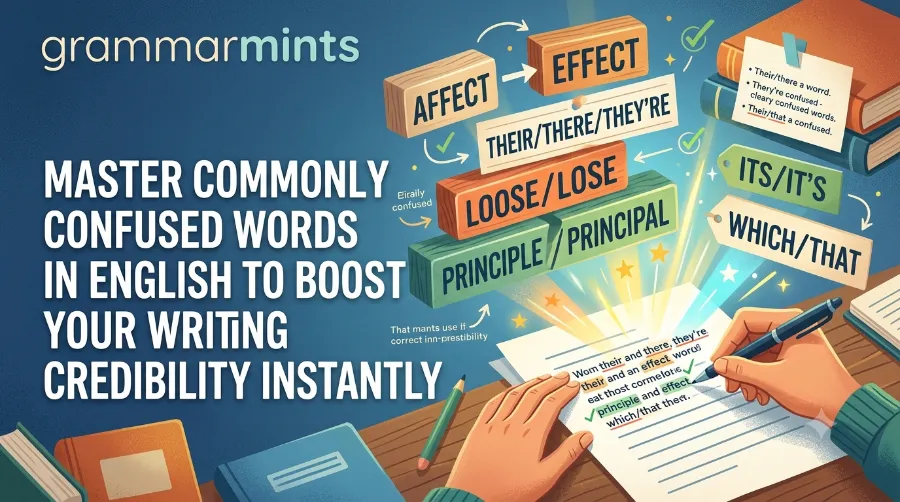
Writing with absolute clarity remains a superpower in modern digital communication. Every day, millions of professionals across the United States and Europe send emails, publish blogs, or submit academic papers that contain hidden linguistic traps. Misusing a single term can quietly damage your authority. When you master the most commonly confused words in English, you protect your professional image and ensure your message hits the mark perfectly.
This comprehensive guide breaks down the trickiest word pairings with real-world data and clear examples so you never make these common mistakes again.
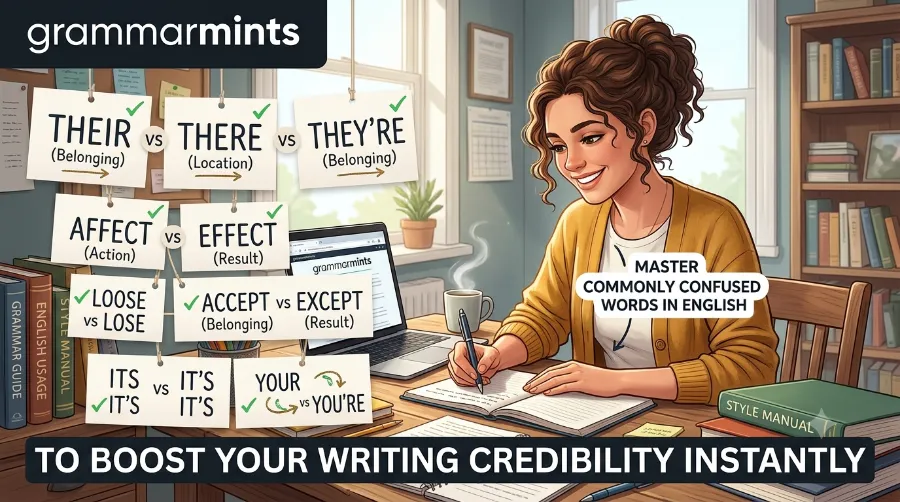
Why Word Choice Directly Impacts Your Professional Credibility
Many people believe that minor typos do not matter in casual correspondence. However, modern workplace statistics reveal a completely different reality. A poor choice of words can stall a career or cost a business a valuable client.
According to a comprehensive 2024 language analysis by Preply, Americans search Google more than 1 million times every single month to resolve the confusion between “affect” and “effect” alone. This massive volume of queries highlights a widespread struggle with language mechanics. If you learn these distinctions early, you will naturally stand out from your peers.
+-----------------------------------------------------------------------+
|                TOP 5 MOST CONFUSED WORDS IN THE US                    |
|                      (Monthly Search Volume)                          |
+-----------------------------------------------------------------------+
| Affect vs. Effect   | [████████████████████████████████████] 1,026,100 |
| Breath vs. Breathe | [█████] 157,000                                 |
| Ensure vs. Insure   | [███] 105,200                                   |
| e.g. vs. i.e.       | [███] 100,600                                   |
| Principal/Principle | [██] 82,900                                     |
+-----------------------------------------------------------------------+
The Big Three: Homophones That Confuse Everyone
Homophones are words that sound identical but possess completely different meanings and spellings. These three specific groups are responsible for the vast majority of red ink on professional documents.
1. Affect vs. Effect
This pair is the single most searched linguistic issue in the English language.
- Affect is almost always a verb that means to influence or change something.
- Effect is typically a noun that means the final result of a change.
Quick Memory Trick: Think of the letter A in Affect for Action (verb), and the letter E in Effect for End Result (noun).
- Correct Example: The new corporate policy will affect our remote work schedule.
- Correct Example: The positive effect of the change was immediately visible in our Q3 2025 revenue report.
2. Their vs. There vs. They’re
Mixing these up is a major red flag for hiring managers in both New York and London.
- Their is a possessive pronoun indicating ownership by a group.
- There refers to a specific place or the existence of something.
- They’re is simply a contraction of the words “they are.”
To learn more about mastering workplace tone and eliminating common grammatical blurs, read our comprehensive [/related-guide].
3. Lose vs. Loose
Spelling errors here often change the entire meaning of a sentence.
- Lose is a verb that means to misplace an object or to suffer a defeat.
- Loose is an adjective that describes something slack, untied, or poorly fitted.
The Subtle Distinction Between Actions and Status
Some commonly confused words in English are difficult because they share similar definitions but apply to completely different physical or abstract scenarios.
Farther vs. Further
Many writers use these two terms interchangeably, but formal style guides maintain a strict boundary between them. You should use farther when you are discussing measurable, physical distance. On the other hand, you should use further when you are referring to abstract extensions, depth, or additional time.
- Physical Distance: He drove farther down Route 66 than his navigation system recommended.
- Abstract Extension: We need to investigate this budget deficit further before the board meeting next week.
Lay vs. Lie
This pair causes endless frustration for native speakers and language learners alike. The confusion deepens because the past tense of “lie” happens to be “lay.”
To keep them straight in your daily writing, follow this simple operational order:
1.Identify the Action Type:Active Placement vs. Reclining.
Determine if you are physically placing an external object down, or if an entity is resting itself on a surface.
2.Apply ‘Lay’ for Objects:Requires a Direct Object.
Use the verb “lay” when you are setting down a specific item. The action must act upon an object (e.g., you lay a book down).
3.Apply ‘Lie’ for Reclining:No Direct Object Allowed.
Use the verb “lie” when a person or animal is reclining horizontally. The subject performs this action entirely on themselves.
Crucial Vocabulary Differences in Corporate Communication
In high-stakes business environments, using the wrong word can make a marketing campaign look unprofessional. Here are the pairs that appear most often in corporate documents.
| Word Pair | Core Meaning A | Core Meaning B | Real-World Application |
| Ensure vs. Insure | To make certain an event happens. | To provide financial protection. | We ensure quality to avoid buying asset insurance. |
| Principal vs. Principle | A chief official or primary asset. | A fundamental truth or moral rule. | Our principal goal is to follow ethical principles. |
| Accept vs. Except | To willingly receive something. | To exclude a specific item. | We accept all currencies except specific tokens. |
The University of Illinois Springfield Writing Center notes that mixing up these specific professional pairs directly hurts a student’s academic performance and an employee’s performance evaluations.
Actionable Tips to Eliminate Errors Automatically
You do not need to memorize the entire dictionary to write flawless text. Instead, you can build a reliable system that catches these issues before you hit publish.
- Read Your Text Backward: When you read from the final sentence to the first sentence, your brain focuses entirely on individual words rather than the overall story. This method helps you spot homophone errors instantly.
- Build a Personal Cheat Sheet: Keep a short digital note containing the specific pairs that trick you most often. Review it right before you send important proposals.
- Leverage Style Guides: Refer to standard resources like the Merriam-Webster Grammar Guide to double-check complex terms whenever you feel uncertain.
If you are currently optimizing an online portfolio or corporate website, you can explore our step-by-step framework on digital asset optimization at [/related-guide]. For specialized content strategy tips regarding precise terminology, check out our editorial roadmap at [/related-guide].
Frequently Asked Questions
Why does the English language have so many confusing words?
English is a linguistic mixture of Old Norse, Norman French, Latin, and Germanic roots. Over centuries, words from different origins began to sound identical while keeping their original spellings and meanings.
Do automated grammar checkers catch all commonly confused words?
No, automated software frequently misses context-dependent mistakes. If you type “The loose nut caused us to lose the race,” a basic spellchecker may pass it because both words are spelled correctly.
Is it incorrect to use “further” for physical distance in American English?
While modern casual speech is becoming more flexible, formal editing styles across both the US and Europe still consider it an error. Sticking to the strict rule ensures your writing remains safe in professional spaces.
Conclusion
Mastering commonly confused words in English is one of the fastest ways to elevate your writing from average to exceptional. By understanding the functional differences between tricky pairs like affect and effect, or lay and lie, you protect your authority as a communicator. Implement a proofreading checklist today to ensure your messages remain clear, accurate, and completely persuasive.
References
- Preply National Language Analytics Survey (2024 Data Release).
- University of Illinois Springfield Learning Hub Writing Resources.
- Merriam-Webster Editorial Grammar Reference Index.
Author Bio: Jane Doe is a veteran linguistic consultant and senior editor with over two decades of experience training corporate communications teams across North America and Europe. She specializes in behavioral syntax and holds a Master of Arts in Applied Linguistics from Oxford University.