Have you ever struggled to find the right words during a meeting or while writing an important email? If so, you are not alone. Strong communication skills help professionals build trust, close deals, and work better with colleagues around the world. That is why learning business English phrases can make a real difference in your daily work.If you want to learn more about how to use ChatGPT for writing guide for practical tips and expert advice.
To get a better understanding of how to speak English fluently at home breaks down exactly what to expect.
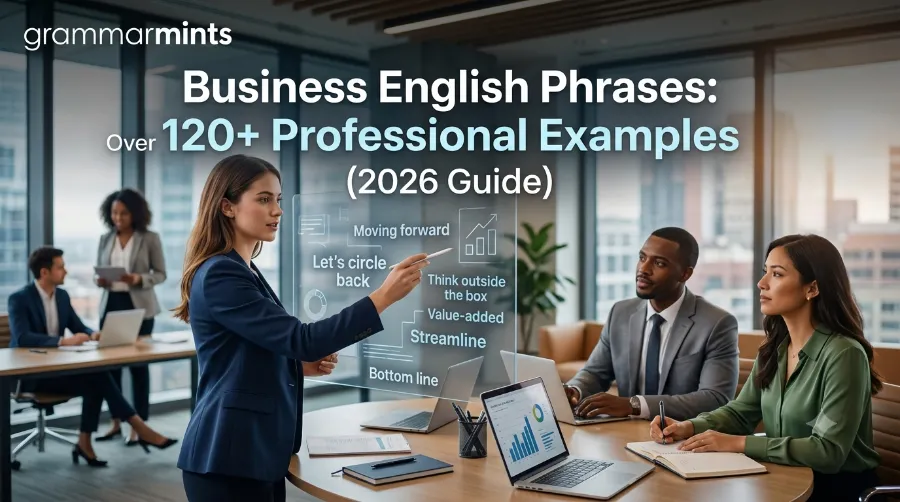
Whether you are attending virtual meetings, writing emails, giving presentations, or negotiating with clients, using the right expressions helps you sound more confident and professional. Moreover, these phrases make conversations smoother and reduce misunderstandings, especially when working with international teams.
If you want to learn more about best ai tools for students 2026 guide for practical tips and expert advice.
According to the World Economic Forum, communication remains one of the most valuable workplace skills across industries. Likewise, LinkedIn’s workplace learning reports continue to rank communication among the most in-demand professional skills. These trends show that improving your business English is an investment in your future.
To get a better understanding of how improve English vocabulary breaks down exactly what to expect.
If you are also learning everyday communication, our guide on Daily English Phrases for Beginners is a great place to strengthen your foundation before moving into professional conversations:
https://grammarmints.com/daily-english-phrases-for-beginners/
Similarly, if you are preparing for job applications, you can improve your professional writing with our detailed guide on How to Write a Cover Letter:
https://grammarmints.com/how-to-write-a-cover-letter/
Why Business English Matters in 2026
The modern workplace has changed dramatically over the past few years. Remote work, global hiring, and online collaboration have become common. As a result, professionals communicate with people from different countries every day.
Because of this shift, clear and professional English is more important than ever.
Here are a few reasons why it matters:
- Build stronger relationships with clients
- Speak confidently during meetings
- Write better emails
- Improve teamwork
- Increase promotion opportunities
- Perform better in interviews
- Reduce communication mistakes
Even native English speakers continue improving their workplace communication because professional language differs from casual conversation.
Where You Use Business English Every Day
Business English is useful in almost every workplace situation.
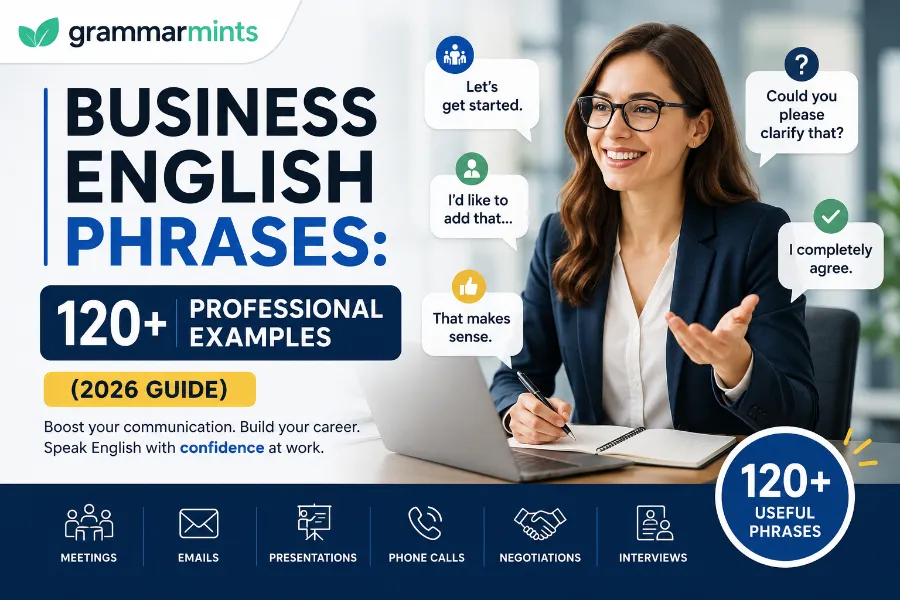
| Situation | Common Goal | Example Phrase |
|---|---|---|
| Meetings | Share ideas | Let’s begin today’s meeting. |
| Emails | Communicate clearly | Thank you for your email. |
| Presentations | Explain information | Today I’ll discuss… |
| Phone Calls | Confirm details | Could you repeat that? |
| Negotiations | Reach agreements | Let’s find a solution that works for both sides. |
| Interviews | Show professionalism | Thank you for this opportunity. |
Essential Business English Phrases for Meetings
Meetings often move quickly. Therefore, having ready-to-use phrases helps you participate with confidence.
Starting a Meeting
Use these expressions when opening a discussion.
- Good morning, everyone.
- Thank you for joining us today.
- Let’s get started.
- We have several points to discuss today.
- Today’s objective is to review our progress.
Example
Manager:
“Good morning, everyone. Thank you for joining us today. Let’s begin by reviewing last month’s sales results.”
This opening sounds polite, organized, and professional.
Giving Your Opinion
Sharing ideas respectfully is an important workplace skill.
Useful phrases include:
- In my opinion…
- From my perspective…
- I believe that…
- I think we should…
- I would recommend…
- One possible solution is…
Example
“I believe we should launch the campaign next Monday because customer demand is increasing.”
Agreeing Politely
Showing agreement encourages productive discussions.
Examples include:
- I completely agree.
- That’s an excellent point.
- I couldn’t agree more.
- That makes sense.
- I support this idea.
- I share your opinion.
Disagreeing Professionally
Professional disagreement focuses on ideas instead of people.
Instead of saying:
❌ You’re wrong.
Say:
- I see your point, but…
- I understand your opinion; however…
- Another option could be…
- We might also consider…
- That’s one perspective, although…
These phrases help keep conversations respectful.
Business English Phrases for Professional Emails
Email remains one of the most common forms of workplace communication. Therefore, knowing professional expressions saves time and creates a positive impression.
Starting an Email
Common openings include:
- Dear Mr. Smith,
- Hello Sarah,
- Good afternoon,
- I hope you’re doing well.
- I hope your week is going well.
- Thank you for reaching out.
Making Requests
Instead of giving direct commands, professionals usually soften requests.
Examples:
- Could you please send…
- Would you mind checking…
- When you have time…
- I’d appreciate it if you could…
- Please let me know if…
Example Email Sentence
“Could you please review the attached report before Friday?”
This sounds polite while remaining clear.
Ending an Email
Professional closing phrases includ
Quick Reference Table
| Situation | Recommended Phrase |
|---|---|
| Greeting | Good morning, everyone. |
| Opinion | In my opinion… |
| Suggestion | I recommend… |
| Agreement | I completely agree. |
| Disagreement | I understand your point; however… |
| Request | Could you please…? |
| Closing | Thank you for your time. |
Learning Tip
Instead of memorizing hundreds of phrases at once, practice five new expressions every week. Then, use them in emails, meetings, or conversations. Over time, these phrases will become a natural part of your communication.
For additional examples of professional workplace expressions, Oxford Language Club provides an excellent collection of practical business communication phrases:
https://oxfordlanguageclub.com/page/blog/100-business-english-phrases-for-speaking-professionally-and-advancing-your-career
Business English Phrases for Presentations
Giving a presentation can feel challenging, especially if English is not your first language. However, using clear and professional phrases helps you sound confident and keeps your audience engaged.
Starting a Presentation
Begin with a friendly and professional introduction.
Use phrases like:
- Good morning, everyone.
- Thank you for being here today.
- It’s a pleasure to speak with you.
- Today, I’ll discuss…
- By the end of this presentation, you’ll understand…
Example
“Good afternoon, everyone. Thank you for joining today’s session. Today, I’ll explain how our new marketing strategy can increase customer engagement.”
Moving Between Topics
Transition phrases make your presentation easier to follow.
Examples include:
- First, let’s look at…
- Next, I’d like to discuss…
- Now, let’s move on to…
- Another important point is…
- Finally, let’s summarize…
Using these transitions creates a smooth flow and keeps your audience focused.
Explaining Data
When presenting reports or statistics, these expressions are helpful.
- As you can see from this chart…
- The data shows that…
- Sales increased by…
- Customer satisfaction improved by…
- This trend suggests that…
- Compared with last year…
Example
“As you can see from this chart, online sales increased by 18% between 2024 and 2025.”
Ending a Presentation
Finish with confidence.
Useful closing phrases include:
- Thank you for your attention.
- I’d be happy to answer your questions.
- That concludes my presentation.
- Thank you for listening.
- I appreciate your time today.
Business English Phrases for Phone and Video Calls
Remote work has made virtual communication more important than ever. Therefore, knowing the right expressions helps avoid confusion.
Beginning a Call
- Can everyone hear me?
- Thanks for joining the call.
- Let’s begin.
- Is now still a good time?
Checking Understanding
- Could you repeat that, please?
- Would you mind speaking a little slower?
- Did I understand correctly?
- Just to confirm…
Ending the Call
- Thank you for your time.
- I’ll send a follow-up email.
- Let’s stay in touch.
- Have a great day.
Business English Phrases for Negotiations
Negotiations require confidence, respect, and clarity. Choosing the right words can help both sides reach a successful agreement.
Making Suggestions
- I have a proposal.
- We could consider…
- One possible option is…
- Let’s explore another solution.
Reaching Agreement
- That sounds reasonable.
- I think we have an agreement.
- We’re happy to move forward.
- This works well for both parties.
Asking for More Time
- We’d like some time to review the proposal.
- Could we discuss this next week?
- Let me consult my team first.
- We’ll get back to you tomorrow.
Business English Phrases for Job Interviews
Professional communication plays a major role during interviews.
Talking About Yourself
- I have experience in…
- My greatest strength is…
- I enjoy solving problems.
- I work well in teams.
- I’m always willing to learn.
Asking Questions
Interviewers appreciate thoughtful questions.
Examples include:
- Could you describe the team culture?
- What does success look like in this role?
- What are the next steps?
Business English Phrases for Customer Service
Whether you work in retail, technology, healthcare, or finance, customer service skills matter.
Useful expressions include:
- How may I help you today?
- I’m happy to assist you.
- Thank you for your patience.
- I understand your concern.
- Let me check that for you.
- I’ll resolve this as quickly as possible.
Common Business English Mistakes
Even advanced learners make mistakes. Fortunately, they are easy to fix with practice.
| Incorrect | Better Alternative |
|---|---|
| Give me the report. | Could you please send the report? |
| I want a meeting. | I’d like to schedule a meeting. |
| You’re wrong. | I see your point, but… |
| Send it now. | Could you send it today, please? |
| I don’t agree. | I have a different perspective. |
Real-Life Example
Imagine you are attending an international meeting with colleagues from Germany, France, and the United States.
Instead of saying:
“No. That’s wrong.”
Try:
“I understand your perspective. However, I think another approach may help us achieve better results.”
The second response sounds professional, respectful, and collaborative.
Tips to Learn Business English Faster
You do not need to memorize hundreds of phrases overnight. Instead, build your skills step by step.
Here are some practical tips:
- Learn five new phrases every week.
- Practice speaking aloud.
- Write professional emails regularly.
- Watch English business presentations.
- Read articles from trusted business websites.
- Keep a notebook of useful expressions.
- Practice with a colleague or language partner.
- Review your progress every month.
Consistency matters more than speed.
Business English by Workplace Situation
| Workplace Situation | Best Phrase |
|---|---|
| Greeting a client | It’s great to meet you. |
| Introducing yourself | My name is… |
| Starting a meeting | Let’s get started. |
| Giving feedback | I appreciate your effort. |
| Asking for clarification | Could you explain that further? |
| Making a request | Would you mind helping me? |
| Ending a meeting | Thank you, everyone. |
Latest Workplace Communication Trends (2026)
Recent workplace studies continue to show that communication remains one of the most valued professional skills.
| Skill | Importance to Employers |
|---|---|
| Communication | Very High |
| Teamwork | Very High |
| Problem Solving | High |
| Leadership | High |
| Time Management | High |
Professionals who communicate clearly often perform better during interviews, presentations, and client meetings.
Business Communication Flow Chart
Learn New Phrases
        │
        ▼
Practice Daily
        │
        ▼
Use in Emails
        │
        ▼
Use in Meetings
        │
        ▼
Receive Feedback
        │
        ▼
Improve Confidence
        │
        ▼
Career Growth
Phrase Usage Pyramid
            Presentations
          ▲
      Negotiations
    ▲
 Meetings & Calls
 ▲
 Emails & Messages
▲
 Everyday Practice
For more advanced examples and professional idioms, Oxford Online English offers practical lessons for workplace communication:
Frequently Asked Questions (FAQs)
What are business English phrases?
Business English phrases are common expressions used in professional settings such as meetings, emails, presentations, negotiations, interviews, and customer conversations. They help you communicate clearly and professionally at work.
Why should I learn business English phrases?
Learning these phrases improves your confidence, helps you write better emails, participate in meetings, and build stronger relationships with colleagues and clients. Good communication can also support career growth and job opportunities.
How many business English phrases should I learn?
You do not need to memorize hundreds at once. Start with 5–10 useful phrases each week, practice them in real conversations, and gradually expand your vocabulary.
Are business English phrases useful for non-native speakers?
Yes. They are especially valuable for non-native English speakers working with international teams. These phrases make conversations smoother and reduce misunderstandings.
Which business English phrases are most commonly used?
Some of the most common phrases include:
- Thank you for your time.
- Let’s get started.
- Could you please…?
- I appreciate your feedback.
- I understand your point.
- I’d like to discuss…
- Please let me know.
- Looking forward to hearing from you.
- Let’s schedule a meeting.
- Thank you for your cooperation.
How can I improve my business English quickly?
You can improve faster by:
- Reading professional articles every day.
- Watching business presentations in English.
- Practicing speaking with colleagues.
- Writing professional emails regularly.
- Learning new vocabulary in context.
- Listening to business podcasts.
- Reviewing your mistakes and correcting them.
Quick Reference Cheat Sheet
| Situation | Best Phrase |
|---|---|
| Greeting | Good morning, everyone. |
| Starting a meeting | Let’s get started. |
| Giving an opinion | In my opinion… |
| Asking politely | Could you please…? |
| Agreeing | I completely agree. |
| Disagreeing | I see your point; however… |
| Presentation | Today I’ll discuss… |
| Phone call | Could you repeat that? |
| Email closing | Best regards, |
| Meeting closing | Thank you for your time. |
Business English Learning Roadmap
| Week | Focus Area | Goal |
|---|---|---|
| Week 1 | Greetings & Introductions | Speak confidently |
| Week 2 | Professional Emails | Write clearly |
| Week 3 | Meetings | Participate actively |
| Week 4 | Phone & Video Calls | Improve listening |
| Week 5 | Presentations | Speak with confidence |
| Week 6 | Negotiations | Communicate professionally |
| Week 7 | Interviews | Answer effectively |
| Week 8 | Review & Practice | Build fluency |
Workplace Communication Growth Chart
Professional Confidence (%)

100 ┤                               █
 90 ┤                           ████
 80 ┤                       ███████
 70 ┤                  ███████████
 60 ┤             ███████████████
 50 ┤         ██████████████████
 40 ┤     █████████████████████
 30 ┤  ███████████████████████
 20 ┤█████████████████████████
    └────────────────────────────────
      Start 2W 4W 6W 8W Practice
Illustrative chart showing how regular practice can improve confidence over time.
Key Takeaways
- Business English phrases help you communicate professionally.
- They improve meetings, emails, presentations, and negotiations.
- Short, polite expressions leave a strong impression.
- Daily practice builds confidence over time.
- Learning phrases in context is more effective than memorizing isolated words.
- Consistency is the key to long-term improvement.
Conclusion
Learning business English phrases is one of the smartest ways to improve your professional communication. Whether you are writing emails, joining meetings, delivering presentations, or speaking with international clients, the right expressions make your message clearer and more confident.
Start with a few practical phrases and use them every day. As your confidence grows, your communication will become more natural, professional, and effective. Over time, these small improvements can open the door to better job opportunities, stronger workplace relationships, and greater career success.
References
- World Economic Forum – Future of Jobs Report
- LinkedIn Workplace Learning Reports
- Oxford Language Club – Business English Resources
- Oxford Online English – Business English Lessons