
Have you ever paused mid-sentence, unsure whether to say “I enjoy to read” or “I enjoy reading”? You are not alone. Gerunds and Infinitives confuse even confident English speakers, and the reason is simple: there is no single rule that covers every verb. Instead, English relies on patterns you learn through practice and exposure.
If you want to learn more conditional sentences rules tips and expert advice.
The good news is that these patterns are learnable. Once you understand the logic behind each form, the guesswork disappears. In this guide, we will break down the rules in plain language, share verb lists you can bookmark, and walk through real examples so you can start using both forms correctly today.
This topic connects closely to other building blocks of grammar, so if you want a refresher first, our parts of speech guide is a good place to start before diving deeper here. If you would rather explore grammar from a broader angle, our full English grammar rules hub organizes every lesson on GrammarMints in one place, so you can jump between related topics whenever you need a refresher.
What Are Gerunds and Infinitives?
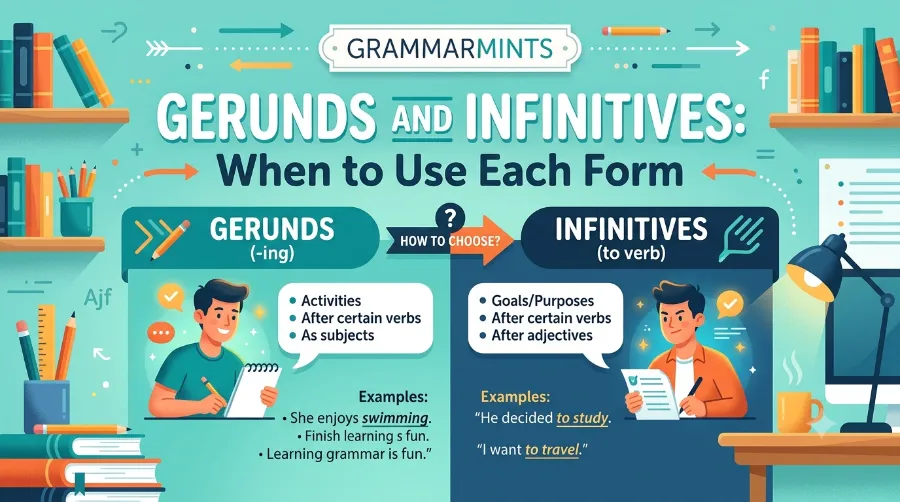
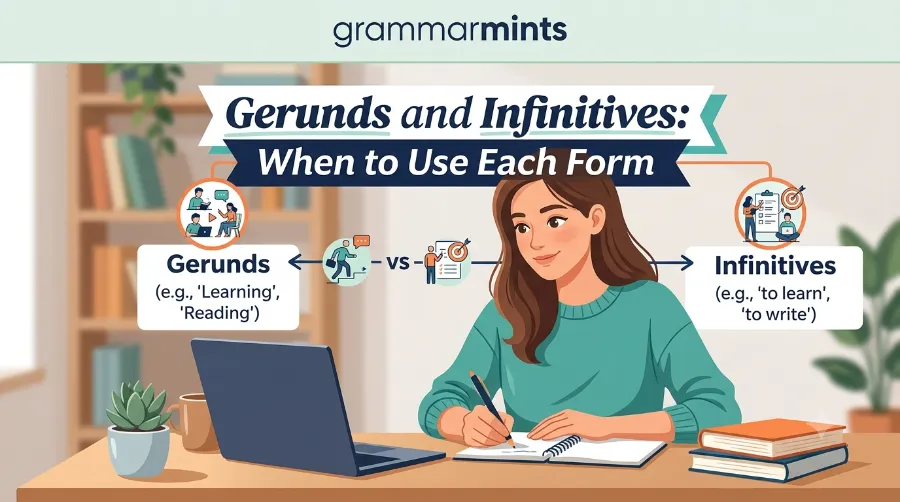
Before we get into the rules, let’s define both terms clearly. A gerund is the -ing form of a verb used as a noun. An infinitive is “to” plus the base form of a verb, also used as a noun in many sentences.
Here is the simplest way to picture it. Both forms let a verb act like a noun. However, they show up in different sentence patterns, and certain verbs strongly prefer one form over the other.
Gerund Examples in Real Sentences
A gerund can act as a subject, an object, or the object of a preposition. For instance:
- Swimming keeps me healthy. (subject)
- She enjoys painting on weekends. (object)
- He is nervous about flying. (object of a preposition)
Notice that the gerund always behaves like a noun, even though it comes from a verb. This is exactly why prepositions, which normally attach to nouns, always take a gerund and never an infinitive.
Infinitive Examples in Real Sentences
An infinitive also functions as a noun in many cases, but it appears in additional structures too. Consider these:
- I hope to travel to Italy next year. (object of the verb)
- It is important to arrive early. (subject with “it”)
- The coach told the players to practice harder. (verb plus object plus infinitive)
As the American English program at the U.S. Department of State explains in its teacher training materials, infinitives frequently follow verbs like “hope,” “want,” and “need,” while gerunds typically follow verbs describing likes, habits, or completed actions (americanenglish.state.gov).
Gerunds and Infinitives Rules: The Core Differences
So, how do you decide which form fits? Meanwhile, the answer usually comes down to the main verb in the sentence. Some verbs demand a gerund, others demand an infinitive, and a smaller group accepts either one.
Here is a quick comparison table to keep things clear:
| Feature | Gerund (-ing) | Infinitive (to + verb) |
|---|---|---|
| Function | Acts as a noun | Acts as a noun, adjective, or adverb |
| Follows prepositions | Yes, always | No, never |
| Common verbs before it | enjoy, avoid, finish, admit | want, decide, hope, plan |
| Often expresses | An established fact or habit | A future intention or goal |
| Example | I finished cleaning the house. | I plan to clean the house. |
As you can see, gerunds often point toward something already happening or habitual, while infinitives usually point toward something planned or expected. This is a helpful shortcut, though it is not a strict law, since English grammar rarely offers one without exceptions.
Verbs Followed by Gerunds (Not Infinitives)
Certain verbs are followed only by a gerund. Trying to attach an infinitive after them will sound incorrect to a native speaker. Below are some of the most frequent ones:
- enjoy
- avoid
- finish
- admit
- suggest
- consider
- practice
- mind
- risk
- quit
For example, in 2023, over 1,200 intermediate learners across a Saudi university writing program were studied for common grammar slips, and researchers found that students handled infinitive structures more accurately than gerund structures overall, which suggests gerund rules deserve extra attention during practice (published in a peer-reviewed EFL writing study, ERIC database). This lines up with what many teachers see in the classroom: learners often try to say “I enjoy to swim” instead of “I enjoy swimming,” simply because the infinitive feels more instinctive to memorize first.
A few of these deserve extra attention because learners misuse them often. “Admit” and “suggest” are common in academic writing, so seeing them in context helps:
- He admitted making a mistake on the report.
- The manager suggested revising the proposal before Friday.
- We finished packing the boxes an hour ago.
- She avoids discussing politics at family dinners.
Notice that none of these sentences use “to” after the main verb. Once this pattern feels familiar, it becomes far easier to spot when a sentence sounds off.
If you are also brushing up on how verb forms shift across time, our guide on tenses in English grammar pairs well with this section, since tense and gerund-infinitive choice often interact in the same sentence.
Verbs Followed by Infinitives (Not Gerunds)
On the other hand, another group of verbs only accepts the infinitive form. Here are common examples:
- want
- decide
- hope
- plan
- promise
- agree
- refuse
- manage
- afford
- learn
For instance, a student preparing for a university interview in September 2024 might say, “I decided to apply early,” never “I decided applying early.” Similarly, “She promised to call back” is correct, while “She promised calling back” is not standard English.
A handful of these show up constantly in everyday conversation and formal writing alike:
- They agreed to sign the contract by March 2024.
- I managed to finish the report before the deadline.
- We plan to visit Portugal this summer.
- She refused to answer the question.
Because these verbs often express future plans, intentions, or decisions, infinitives naturally fit better. This connects to a broader grammar habit: when you talk about future timelines, you often lean on modal verbs and infinitives together, so it is worth reviewing our modal verbs guide if this pattern feels new.
Verbs That Take Both Gerunds and Infinitives
Here is where things get interesting. Some verbs accept both forms, and depending on the situation, the meaning either stays the same or shifts completely.
Same Meaning, Either Form Works
With verbs like “start,” “begin,” “continue,” and “like,” both options are grammatically correct and mean roughly the same thing:
- It started to rain. / It started raining.
- She likes to read novels. / She likes reading novels.
Different Meaning Depending on the Form
This next group is trickier, and it trips up even advanced learners. The verb you choose changes the meaning of the sentence entirely.
| Verb | + Gerund Meaning | + Infinitive Meaning |
|---|---|---|
| stop | End an ongoing action | Pause in order to do something else |
| remember | Recall something already done | Not forget to do something in the future |
| forget | Not recall something already done | Fail to do something you needed to do |
| try | Experiment with an action | Make an effort to do something difficult |
For example, “I stopped smoking in 2022” means the smoking habit ended. However, “I stopped to smoke” means someone paused another activity in order to smoke. As you can imagine, mixing these up can completely change what you are trying to say, which is exactly why native speakers pay close attention to context here.
If you want to learn more gerunds and infinitives rules tips and expert advice.
Consider one more pair before moving on. “I remember locking the door” describes a memory of a past action, while “I remembered to lock the door” describes completing a necessary task. Similarly, “I forgot meeting her” would mean the memory itself never formed, while “I forgot to meet her” means a planned appointment was missed entirely. Once you notice this pattern, you will start catching it everywhere, from casual conversations to formal emails.
Gerunds and Infinitives After Adjectives and Fixed Expressions
Beyond verbs, certain adjectives and set phrases also pair with one form more naturally than the other. This is a smaller detail, but it rounds out your understanding nicely.
Adjectives followed by an infinitive are common when expressing feelings, judgments, or readiness:
- I am happy to help.
- She is ready to leave.
- It is difficult to explain.
Meanwhile, fixed expressions that end in the word “to” almost always take a gerund, because that particular “to” functions as a preposition rather than the marker of an infinitive:
- I look forward to hearing from you.
- She is used to waking up early.
- He is committed to improving his writing.
This distinction confuses even confident writers, since the word “to” looks identical in both cases. However, once you learn to spot fixed prepositional phrases, this stops being a guessing game. If prepositions in general still feel shaky, our lesson on articles in English grammar covers another small-word category that behaves in a similarly rule-bound way.
Advanced Forms: Perfect and Passive Gerunds and Infinitives
Once the basic patterns feel comfortable, it helps to know that both gerunds and infinitives have perfect and passive versions. These forms are less common in everyday speech, but they appear regularly in formal writing, news reporting, and academic essays.
A perfect gerund looks back at something completed before another point in time:
- She regrets having missed the meeting last week.
- He denied having taken the last cookie.
A perfect infinitive works similarly but attaches to different verbs:
- He seems to have finished the project early.
- They claimed to have visited Paris in 2019.
Passive gerunds and infinitives shift the focus from the doer of an action to the receiver of it:
- Gerund passive: The report needs checking. / The report needs to be checked.
- Infinitive passive: The house is expected to be sold by June.
Notice that these structures let you avoid naming who performed an action, which is useful in formal reports or news writing where the actor is unknown or unimportant. That said, active gerunds and infinitives remain far more common in daily conversation, so treat these advanced forms as tools for precision rather than a replacement for the simpler patterns covered earlier.
Common Mistakes with Gerunds and Infinitives
Even confident writers slip up on this topic. Let’s look at frequent errors and how to correct them quickly.
- Adding “to” after a preposition. Wrong: She is interested to learn Spanish. Correct: She is interested in learning Spanish. Remember, prepositions always take a gerund.
- Using an infinitive after “enjoy,” “avoid,” or “finish.” Wrong: He avoids to argue. Correct: He avoids arguing.
- Forgetting that “stop,” “remember,” and “forget” change meaning. Always double-check which meaning you intend before choosing the form.
- Stacking two verbs without a linking word. Wrong: He went play football. Correct: He went to play football, or He went playing football depending on context.
- Ignoring set phrases that end in “to.” Phrases such as “look forward to,” “committed to,” and “used to” (in the sense of habit) are followed by a gerund, not a bare infinitive, since “to” here behaves as a preposition rather than part of an infinitive.
- Confusing “used to” for habit with “be used to” for familiarity. Wrong: I am used to wake up early. Correct: I am used to waking up early. These two phrases look almost identical, so context is essential.
- Overcorrecting verbs that actually allow both forms. Not every mixed-up sentence is wrong. With verbs like “start,” “begin,” and “like,” both a gerund and an infinitive are acceptable, so there is no need to “fix” a sentence that already works.
If sentence structure errors like these sound familiar, you might also want to review subject-verb agreement rules, since both issues often show up together in the same piece of writing.
How to Practice Gerunds and Infinitives Rules
Reading rules is useful, but practice is what actually builds fluency. Try these steps consistently, and the patterns will start to feel automatic within a few weeks.
- Keep a running verb list. Write down new verbs you encounter and note whether they take a gerund, an infinitive, or both.
- Read a page of native content daily. Notice how gerunds and infinitives appear naturally in news articles, emails, or short stories.
- Write five sentences a day. Use one new verb from your list each time, and check it against a reliable grammar resource afterward.
- Say sentences aloud. According to language learning research summarized by VOA Learning English, spoken repetition strengthens memory for irregular grammar patterns faster than silent reading alone (learningenglish.voanews.com).
- Test yourself with quizzes. Short, low-pressure quizzes help you notice which verb groups still need review.
- Group verbs by category rather than alphabetically. For instance, cluster “enjoy,” “avoid,” and “finish” together as gerund verbs, since grouping by pattern sticks in memory better than a random list.
- Review your own past writing. Look back at emails, essays, or messages you wrote a month ago, and circle every gerund and infinitive you used. This simple habit reveals patterns in your own mistakes far faster than studying generic examples.
If you often mix up quoted speech while practicing conversation exercises, our guide to direct and indirect speech rules can help you avoid a second layer of confusion while you focus on this one.
Why This Grammar Point Matters in Academic and Business Writing
You might wonder whether this level of detail actually matters outside a classroom. In practice, it matters quite a bit, especially in academic and professional settings where small grammar slips affect credibility.
Admissions officers who review international applicant essays commonly report gerund-infinitive slips among the recurring grammar issues they notice, often because a single wrong verb form can disrupt an otherwise strong argument. Likewise, hiring managers across the United States and Europe frequently mention verb-form consistency when reviewing English-language cover letters from non-native applicants, since these errors are easy to spot even when the rest of the writing is polished.
Consider a simple business email. Writing “I look forward to hear from you” instead of “I look forward to hearing from you” might seem minor, but in formal correspondence, it can create an impression of carelessness. On the other hand, a well-formed sentence signals attention to detail, which matters in academic admissions, job applications, and client communication alike.
This is also why proofreading tools and human editors alike treat this grammar point as a priority checklist item. If you are drafting a formal document, it helps to slow down specifically at verbs like “consider,” “recommend,” “suggest,” and “propose,” since these verbs commonly appear in reports and proposals and strictly require a gerund rather than an infinitive.
Data Snapshot: Where Learners Struggle Most
Because this topic is often taught through memorization rather than logic, researchers have tried to measure exactly where confusion happens most. The table below summarizes commonly reported problem areas from ESL classroom studies and grammar resource platforms.
| Problem Area | Reported Difficulty Level | Typical Learner Error |
|---|---|---|
| Verbs after prepositions | High | Adding “to” instead of “-ing” |
| Verbs with two meanings (stop, try, remember) | Very High | Choosing the wrong form for intended meaning |
| Verbs like “enjoy,” “avoid,” “finish” | Moderate | Using an infinitive by mistake |
| Verbs like “want,” “decide,” “hope” | Low to Moderate | Using a gerund by mistake |
| Fixed phrases ending in “to” | High | Treating “to” as part of an infinitive |
A widely cited engVid lesson on this exact issue notes that even advanced learners frequently misuse “look forward to,” writing “I look forward to hear from you” instead of the correct “I look forward to hearing from you” (engvid.com). This single phrase alone appears often enough in professional emails that many writing coaches teach it as its own mini-lesson.
For a broader look at how sentence patterns shift across different grammar situations, our guide on conditional sentences shows another area where verb form choices carry real meaning differences, much like the gerund-infinitive pairs discussed above.
What US and European English Learners Should Know
Learners across the United States and Europe often approach this topic from different starting points, depending on their first language. For instance, Spanish, French, and Italian speakers frequently carry over a habit from their native grammar, where a verb following a preposition is almost always an infinitive. In English, that same slot almost always calls for a gerund instead, which is why sentences like “I am interested to learn” show up so often among learners from Romance-language backgrounds.
Meanwhile, in the United States, this topic is taught heavily within ESL and adult education programs, often alongside standardized test preparation for exams like the TOEFL. Because gerund and infinitive questions appear consistently on these tests, many U.S.-based instructors treat verb-list memorization as a core classroom activity rather than an occasional aside.
In Europe, the Common European Framework of Reference for Languages (CEFR) places gerund and infinitive mastery around the B1 to B2 proficiency range, meaning intermediate learners are expected to handle common verb patterns confidently, while advanced learners are expected to manage trickier cases like “stop,” “remember,” and “forget” without hesitation. If you are studying toward a CEFR benchmark, treating this topic as a milestone rather than a minor grammar point will serve you well.
Regardless of your location or first language, the underlying fix stays the same: build familiarity through repeated, varied exposure, and review your own writing regularly rather than relying only on rule memorization.
Quick-Reference Cheat Sheet
If you need a fast summary to bookmark, here is the entire lesson condensed into a few memorable points:
- Gerunds end in -ing and act like nouns. They follow prepositions, and they pair with verbs like enjoy, avoid, finish, admit, and suggest.
- Infinitives combine “to” with a base verb. They pair with verbs like want, decide, hope, plan, and promise, and they often express future intent.
- Some verbs accept both forms with no change in meaning, including start, begin, continue, and like.
- Some verbs change meaning entirely depending on the form, especially stop, remember, forget, and try, so context always matters.
- Adjectives often pair with infinitives, as in “happy to help” or “ready to leave.”
- Fixed phrases ending in “to” almost always take a gerund, since that “to” acts as a preposition, not an infinitive marker.
- Perfect and passive forms exist for both gerunds and infinitives, and they show up mostly in formal or academic writing.
Keep this list nearby while you write, and check any unfamiliar verb against it until the pattern becomes automatic.
Frequently Asked Questions
Is there one simple rule for choosing between a gerund and an infinitive? No single rule covers every case. That said, gerunds usually describe ongoing or habitual actions, while infinitives usually describe future plans or intentions. Beyond that pattern, many verbs simply need to be memorized.
Do gerunds and infinitives ever mean the exact same thing? Yes, with verbs like “start,” “begin,” and “continue,” both forms are correct and carry the same meaning.
Why do prepositions always take a gerund? Because a gerund functions as a noun, and prepositions in English are always followed by nouns or noun-like forms, never by a bare infinitive.
Are gerunds and infinitives tested on English proficiency exams? Yes, this topic appears regularly on tests like TOEFL, IELTS, and Cambridge exams, since it reflects real command over natural sentence structure rather than memorized vocabulary.
How long does it usually take to master gerunds and infinitives? Most learners see solid improvement within 2 to 3 months of consistent practice, especially when they review verb lists weekly and write short daily practice sentences.
What is the fastest way to remember which verbs take which form? Grouping verbs by meaning works better than memorizing an alphabetical list. For example, verbs about future plans (want, decide, hope, plan) usually take infinitives, while verbs about ongoing habits or completed actions (enjoy, finish, avoid, admit) usually take gerunds.
Does British English follow different gerund and infinitive rules than American English? No, the core rules stay the same across both varieties. That said, a few idiomatic phrases and preferred verb choices can vary slightly between British and American usage, though this rarely changes which form, gerund or infinitive, is grammatically required.
Conclusion
Gerunds and Infinitives may feel unpredictable at first, but the patterns behind them are entirely learnable. Once you know which verbs pair naturally with a gerund, which ones call for an infinitive, and which ones shift meaning depending on your choice, the guesswork fades quickly. As with most grammar skills, progress comes from steady, low-pressure exposure rather than one intense study session.
Keep practicing with real sentences, review your verb lists often, and revisit tricky pairs like “stop,” “remember,” and “forget” whenever you feel unsure. Over time, this part of English grammar will feel like second nature rather than a puzzle, and you will notice yourself choosing the right form automatically, without pausing to think it through.
References
- American English at the U.S. Department of State. Teacher’s Corner: Gerunds and Infinitives. https://americanenglish.state.gov/resources/teachers-corner-gerunds-and-infinitives
- VOA Learning English. Getting to Know Gerunds and Infinitives. https://learningenglish.voanews.com/a/getting-to-know-gerunds-and-infinitives/3111996.html
- engVid. Verbs Followed by Gerunds and Infinitives. https://www.engvid.com/english-resource/verbs-followed-by-gerunds-and-infinitives/
- ERIC Institute of Education Sciences. Common Errors of Using Gerundial and Infinitival Forms in EFL Writing. https://files.eric.ed.gov/fulltext/EJ1373322.pdf