
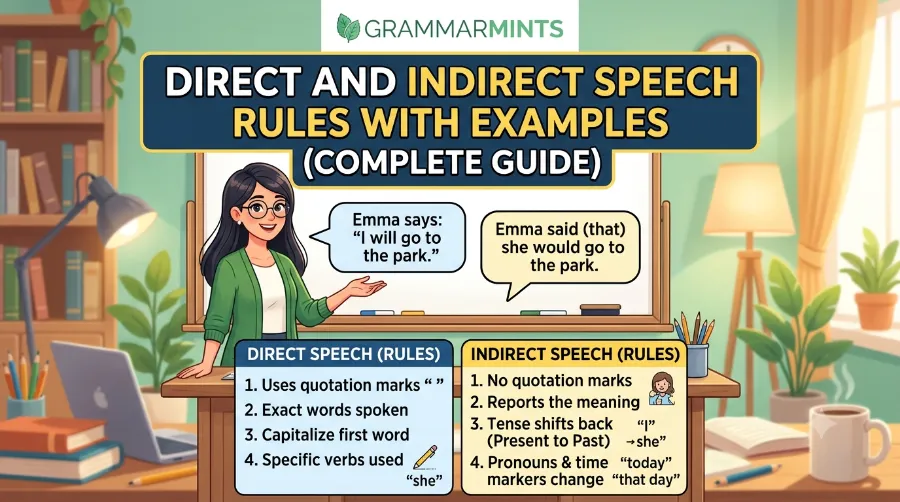
Have you ever repeated what a friend told you and felt unsure whether your sentence was correct? That confusion is common. It usually comes down to one thing: the direct and indirect speech rules that guide how we quote or report someone’s words. In this guide you will learn both forms step by step. You will see real examples with real numbers and dates. You will also pick up simple tricks so you never mix them up again. Whether you are a student or a teacher or just polishing your writing this guide from our English grammar rules hub will make the topic click.
If you want to learn more conditional sentences rules tips and expert advice.
If you want to learn more about direct and indirect speech rules tips and expert advice.

Before we go further it helps to know that grammar clarity is not just an academic exercise. According to English learning market data compiled by British Council researchers more than 1.5 billion people worldwide are currently learning English. Reported speech is one of the trickiest topics they face. So let’s break it down clearly.
If you want to learn more about modal verbs in english tips and expert advice.
What Is Direct Speech?
Direct speech repeats a person’s exact words. We place those words inside quotation marks and nothing about the wording changes. Think of it as a word for word photograph of what someone said.
If you want to learn more gerunds and infinitives rules tips and expert advice.
For example:
- Maria said “I am finishing the report today.”
- The manager said “We will launch the product on March 5 2026.”
- “I have never seen sales grow by 20% in one quarter” said Ahmed.
Notice that the quotation marks capture the speaker’s original tense and wording exactly. Nothing is adjusted because we are quoting not summarizing.
What Is Indirect Speech (Reported Speech)?
Indirect speech also called reported speech describes what someone said without quoting their exact words. Instead of quotation marks we use reporting verbs such as said or told or asked or explained often followed by that. As the EF English resource on direct and indirect speech explains this form is generally used when talking about something that happened in the past. That is why the tense usually shifts backward.
For example:
- Maria said that she was finishing the report that day.
- The manager said that they would launch the product on March 5 2026.
- Ahmed said that he had never seen sales grow by 20% in one quarter.
This shift from present to past and from “today” to “that day” is exactly what trips learners up. Let’s look at each rule individually so it becomes second nature.
Direct and Indirect Speech Rules for Tense Changes
The most important of all the direct and indirect speech rules involves shifting the verb tense one step into the past. Grammar teachers often call this “backshifting.” Once you understand this single pattern most sentences fall into place naturally.
If you want to learn more articles in english grammar tips and expert advice.
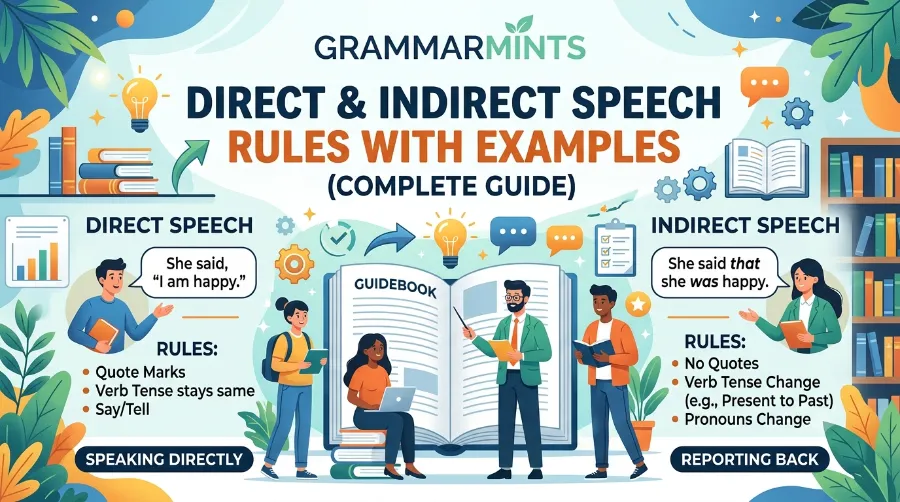
Here is a simple reference table you can bookmark:
| Direct Speech Tense | Indirect Speech Tense | Example (Direct to Indirect) |
|---|---|---|
| Simple Present | Simple Past | “I work here” she said. Becomes: She said she worked there. |
| Present Continuous | Past Continuous | “I am working” he said. Becomes: He said he was working. |
| Simple Past | Past Perfect | “I finished it” she said. Becomes: She said she had finished it. |
| Present Perfect | Past Perfect | “I have called him” he said. Becomes: He said he had called him. |
| Future (will) | Would | “I will help” she said. Becomes: She said she would help. |
| Can | Could | “I can swim” he said. Becomes: He said he could swim. |
If you want a deeper breakdown of every tense form in English our guide on tenses in English grammar covers each one with additional practice sentences.
There is one useful exception though. If the reported statement is still true or is a general fact the tense does not need to shift. For instance “The sun rises in the east” she said becomes She said that the sun rises in the east not “rose.” This small detail keeps your sentences accurate and natural.
Pronoun and Possessive Changes in Reported Speech
Tense is not the only thing that changes. Pronouns also shift to match the new speaker’s point of view. Since pronouns are one of the core parts of speech getting this rule right also strengthens your overall grammar foundation.
Consider these examples:
- “I love my job” said Sarah. Becomes: Sarah said that she loved her job.
- “You forgot your keys” John told me. Becomes: John told me that I had forgotten my keys.
- “We finished our project” the students said. Becomes: The students said that they had finished their project.
As you can see the pronoun always matches the person being talked about not the original speaker’s exact word choice. This is one of the small details that native speakers do automatically. Learners must practice it consciously.
Time and Place Word Changes
Words that describe time and place also shift when you move from direct to indirect speech because the reporting usually happens later or somewhere else. Here is a quick reference table:
| Direct Speech | Indirect Speech |
|---|---|
| now | then |
| today | that day |
| tomorrow | the next day / the following day |
| yesterday | the day before / the previous day |
| here | there |
| this | that |
| these | those |
| ago | before |
| next week | the following week |
For example: “I will finish this today” she said becomes She said she would finish that that day. Here is a real world use case. A company assistant reporting a client’s message might write “The client said the shipment which was due today would now arrive the following week.” That single sentence turns a same day promise into an accurately dated record for the file.
Rules for Reporting Questions
Reporting questions follows slightly different logic since we are no longer using question marks or the same word order.
For yes/no questions add if or whether and switch to statement word order:
- “Do you live here?” he asked. Becomes: He asked if I lived there.
- “Can she drive?” they asked. Becomes: They asked whether she could drive.
For wh questions (who what where when why how) keep the question word but drop the question format:
- “Where do you work?” she asked. Becomes: She asked where I worked.
- “Why did the meeting start late?” the client asked. Becomes: The client asked why the meeting had started late.
A common mistake is keeping the auxiliary verb structure and writing something like “She asked where did I work” which is incorrect. Removing the inverted word order is one of the direct and indirect speech rules most learners forget first.
Rules for Reporting Commands Requests and Advice
Commands and requests and pieces of advice do not usually need “that” clauses. Instead we convert them into a to + infinitive structure.
- “Close the door” she said. Becomes: She told him to close the door.
- “Please help me” he said. Becomes: He asked her to help him.
- “Don’t be late” the teacher said. Becomes: The teacher told the students not to be late.
For negative commands simply add not before the infinitive as shown in the last example above. This structure is compact and once you practice it a few times it becomes automatic.
Common Mistakes to Avoid
Even confident English speakers slip up on a few recurring points. Here are the most frequent errors:
- Forgetting to shift the tense backward when the reporting verb is in the past.
- Leaving question word order unchanged after “asked” (for example writing “asked where was he” instead of “asked where he was”).
- Mixing up “say” and “tell.” Remember tell always needs a listener (tell someone) while say does not.
- Forgetting to change time and place words which can make a reported sentence factually confusing.
- Ignoring subject verb agreement after the pronoun changes. A quick check of our subject-verb agreement rules guide can help you catch these slips before you publish or submit your writing.
Real-Life Examples With Numbers and Dates
Grammar sticks best when it is tied to something concrete. So here are a few practical everyday scenarios.
A retail manager tells her team on a Monday morning “Our store sold 1200 units last week and I expect the same result this week.” Reported the next day this becomes: The manager said their store had sold 1200 units the previous week and that she expected the same result that week.
A student says on June 3 2026 “I submitted my assignment yesterday and I will present it tomorrow.” A classmate reporting this a week later would write: She said she had submitted her assignment the day before and that she would present it the following day.
A customer support agent reports a client call from March 14 2026: The client said the invoice worth $4500 had not arrived yet and that they needed it within 48 hours. Notice how the numbers and the urgency stay fully intact even though the exact wording has changed.
Quick Practice: Test Yourself
Try converting these direct speech sentences into indirect speech before checking the answers below.
- “I am learning French” said Alex.
- “We finished the audit last month” the accountant said.
- “Will you join us tomorrow?” she asked.
- “Turn off the lights” the supervisor said.
Suggested answers:
- Alex said he was learning French.
- The accountant said they had finished the audit the previous month.
- She asked if I would join them the next day.
- The supervisor told them to turn off the lights.
If you would like more grammar exercises like these organized by topic our academic notes on reported speech structures offer additional practice sentences worth reviewing.
English Learners Worldwide: Why Grammar Rules Like This Matter
Reported speech is not just a classroom topic. It plays a real role in global communication. The table below highlights the scale of English learning today.
| Statistic | Approximate Figure (2026) |
|---|---|
| Total English speakers worldwide (native + second language) | 1.5 billion |
| People currently learning English as a foreign language | Over 750 million |
| Countries where English is an official language | 59 |
| Countries requiring English in national education policy | 142 |
With grammar topics like reported speech taught to hundreds of millions of learners each year mastering rules like these is genuinely useful. It matters not just for exams but for clear communication in work and travel and daily conversation.
Frequently Asked Questions
1. What is the main rule for changing direct speech to indirect speech? The main rule is to shift the tense one step into the past and adjust pronouns to match the new speaker and update time or place words so the sentence still makes sense later.
2. Do all tenses shift backward in reported speech? Not always. If the reporting verb is in the present tense or if the statement is a general truth the tense usually stays the same.
3. What is the difference between “say” and “tell” in reported speech? Use say when there is no listener mentioned and use tell when you mention who was spoken to such as “tell him” or “tell them.”
4. How do you report a question in indirect speech? Drop the question mark and the inverted word order. Add if or whether for yes/no questions or keep the question word for wh questions.
5. Is punctuation different in indirect speech? Yes. Indirect speech does not use quotation marks since you are summarizing rather than quoting the exact words.
Conclusion
Direct and indirect speech rules might feel tricky at first but they follow a clear learnable pattern. Shift the tense. Adjust the pronouns. Update the time and place words. Reshape questions and commands into statement form. With the tables and examples and practice sentences in this guide you now have a complete reference you can return to any time you are unsure. Keep practicing with real sentences from your own conversations and this grammar point will soon feel completely natural.
References
- EF Education First “Direct and Indirect Speech” EF English Resources. https://www.ef.edu/english-resources/english-grammar/direct-and-indirect-speech/
- University of Gujrat English Lecture Notes ENG-102. https://uogenglish.wordpress.com/english-lecture-notes/eng-102/306-2/
- British Council Future of English report (learner population estimates) 2026.
Studying grammar rules can be overwhelming with so much to keep track of. I use Taskai on my Android to set reminders to review these specific examples regularly so they actually stick.