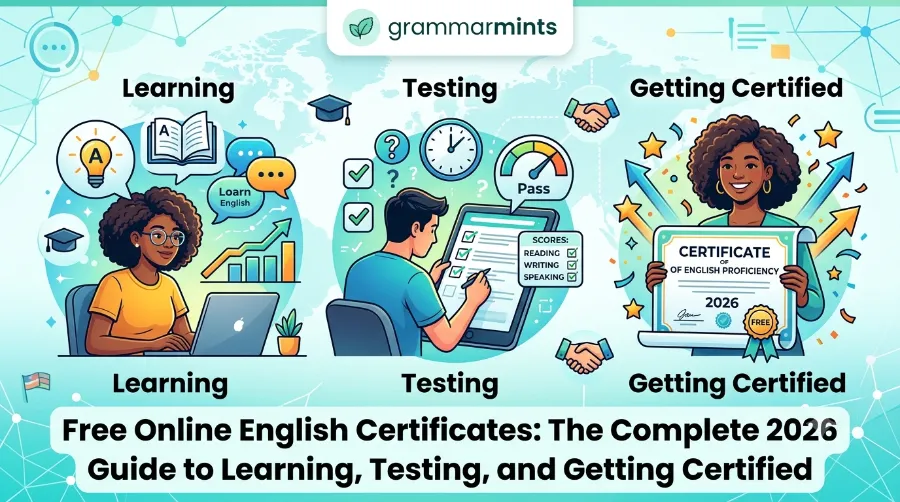
Looking for free online English certificates that are actually worth your time? In fact, you are not alone. Millions of learners search for this every year, and the results online can be confusing. For instance, some sites promise a “diploma” in three days. Meanwhile, others bury the real cost behind a “free” label.
So, this guide clears up the confusion. First, we will walk through the best free platforms. Then, we will explain what their certificates really mean, and how to pick one that fits your goals. Whether you want a certificate for your resume, a school application, or just personal pride, you will find a clear path here.
What Are Free Online English Certificates, Really?
First, before you sign up for anything, it helps to understand what you are actually getting. Not every certificate carries the same weight, so this distinction matters more than most learners realize.
Overall, there are two very different categories:
- Completion certificates In other words, these confirm you finished a course. For example, platforms like Coursera, edX, and FutureLearn issue these once you complete all modules. However, they show effort and consistency, but they do not measure your actual English level.
- Proficiency certificates Specifically, these measure your real skill level, usually against the CEFR (Common European Framework of Reference) scale from A1 to C2. Notably, IELTS, TOEFL, and Cambridge English exams fall into this group, and they are rarely free.
Consequently, a free certificate from a MOOC platform is a great addition to a CV, but it is not a substitute for an official exam result if a university or employer specifically asks for one. Therefore, always check what the requesting institution actually needs before you invest your time.
Why Free Online English Certificates Matter in 2026
Overall, English remains the leading language of business, travel, and higher education, so a certificate can genuinely open doors. In fact, remote job listings increasingly ask candidates to prove written and spoken English skills before an interview is even scheduled.
So, here is why learners across the United States and Europe are turning to free certification routes this year:
- Zero financial risk For instance, you can test a platform, a teaching style, or an entire course track without spending money first.
- Flexible scheduling Similarly, most self-paced courses fit around a job, studies, or family life.
- Resume and LinkedIn value Also, a shareable badge or certificate signals initiative to recruiters, even if it is a completion certificate.
- A stepping stone to paid exams In addition, free courses often prepare learners for IELTS or TOEFL, saving money on tutoring later.
- Confidence building Finally, structured lessons reduce the anxiety that often comes with speaking a second language at work.
As a result, free certification is less about the paper itself and more about the structured practice that gets you there.
Top Platforms Offering Free Online English Certificates
Overall, several well known platforms currently offer strong free options. So, the table below compares them, based on independent course comparisons published in 2026, to help you decide quickly.
| Platform | Cost Structure | Certificate Type | Best For |
|---|---|---|---|
| edX | Free audit; paid verified certificate | Course completion | University-style English, business writing, TEFL prep |
| British Council | Free courses; optional paid certificate | Completion + CEFR-aligned badges | IELTS prep, UK English, teacher training |
| Coursera | Free audit; paid certificate | University-branded completion | Academic and business English |
| FutureLearn | Free access during course run | Completion (paid upgrade) | British culture and general English |
| U.S. Department of State OPEN Program | Fully free | Completion certificate | Teachers and advanced learners worldwide |
For example, on edX, learners get free access to online English courses, with the option to upgrade to a verified certificate for a fee, through courses provided by instructors from well-known universities. Additionally, you can browse the full catalog directly on edX’s English course page, which currently lists dozens of English focused courses and specialized professional certificate tracks.
Likewise, the British Council also runs one of the most respected free programs in this space. Specifically, all of the organization’s online courses are free, with an optional paid certificate for learners who want a formal record. Interestingly, in a notable 2026 example, Banco Santander and the British Council partnered to offer 10,000 free places for an 8 week self paced English course, with a stronger-performing group of 1,500 learners earning an additional 20 weeks of live classes. Overall, that kind of large scale free access shows how seriously major institutions now treat online English certification.
Meanwhile, government-backed options exist too. Specifically, the Online Professional English Network, better known as the OPEN Program, offers global online courses and massive open online courses that stay freely open to any interested participant. It is primarily aimed at educators, but many independent learners use it to sharpen advanced skills. Also, you can review current course listings through the OPEN Program page.
Furthermore, if you want a single place to compare dozens of free options side by side, Oxford Home Study’s directory of free online courses with certificates is a useful starting point, since it groups courses by subject and certificate type.
A Closer Look at Three More Free Options
Beyond the five platforms in the table above, a few other free routes deserve a mention, especially for learners on a tight budget.
For instance, FutureLearn, which partners with the British Council and Newcastle University, offers free access to course material during a scheduled run. However, access typically expires once the run closes, so certificates require a paid upgrade if you want a permanent record. Overall, it works well for learners interested in British culture alongside general English skills.
Similarly, Alison pairs free courses with certification options and covers everything from workplace English to grammar fundamentals. Thus, it suits learners who want a no frills, self paced experience without navigating a university-style interface.
In addition, Udemy runs frequent sales that make its certificate courses extremely affordable, and it regularly publishes free English courses as well. While Udemy certificates carry less institutional weight than a university branded one, they still document real study hours, which some employers value for entry-level roles.
Taken together, these three options give you room to explore different teaching styles before settling on the platform that fits your schedule and budget best.
A Simple 8-Week Study Plan
Overall, structure beats motivation over the long run, so here is a sample plan you can adapt to almost any free platform.
| Week | Focus | Weekly Goal |
|---|---|---|
| 1–2 | Placement test and foundations | Confirm your CEFR level; complete introductory modules |
| 3–4 | Grammar and vocabulary building | Finish 2–3 graded quizzes per week |
| 5–6 | Reading and listening practice | Complete comprehension exercises daily |
| 7 | Writing and speaking practice | Submit at least one graded writing assignment |
| 8 | Final assessment and certificate download | Pass the final quiz; save your certificate immediately |
Because most self-paced tracks run four to twelve weeks, this eight week structure fits comfortably within a single course session on platforms like edX or the British Council. Also, if you are managing schoolwork or a full time job, our guide on best study techniques for students offers additional pacing strategies that reduce burnout during longer study sprints.
Free vs Paid: Which Certificate Actually Counts?
Overall, this is where most learners get tripped up, so it deserves its own section. However, a completion certificate and a proficiency certificate solve different problems, and mixing them up can cost you an opportunity.
| Situation | Certificate You Need | Free Option Available? |
|---|---|---|
| Adding a skill badge to LinkedIn | Completion certificate | Yes, widely available |
| University admission requirement | IELTS, TOEFL, or CEFR exam | Rarely free |
| Visa or immigration application | Official language test | Almost never free |
| Internal company skill tracking | Completion certificate | Yes |
| Teaching English abroad (TEFL) | Professional certificate | Partially free (some platforms) |
According to a 2026 comparison of online English platforms, free platform certificates from providers such as Coursera, FutureLearn, or edX only confirm that a learner completed a course, not that they reached a verified English level. Therefore, they are not equivalent to IELTS, Cambridge English, or CEFR certified school results. In short, use free certificates to build skills and confidence, then budget for an official exam only when an institution specifically requires one.
How to Get a Free Online English Certificate: Step-by-Step
Overall, getting started is simpler than it looks. So, follow these steps in order, and you will avoid the common mistakes that waste learners’ time.
- Assess your current level first. First, take a short placement quiz on any major platform before choosing a course, since this prevents you from picking content that is too easy or too advanced.
- Pick a goal-matched platform. Next, if you need academic English, choose edX or Coursera. Alternatively, if you want UK-style IELTS prep, go with the British Council.
- Enroll in the audit or free track. Then, most platforms clearly separate “free access” from “paid certificate,” so read the enrollment page carefully.
- Set a weekly study rhythm. After that, because most free courses run 4 to 12 weeks, a consistent 3–4 hours per week keeps you on schedule without burnout.
- Complete every graded activity. Meanwhile, certificates typically require passing quizzes or assignments, not just watching videos.
- Download your certificate immediately. Also, many platforms remove access to certificates once a course session closes, so save a copy the day you finish.
- Add it strategically. Finally, place the certificate on LinkedIn, your resume, or a portfolio site, and mention the specific skill it demonstrates rather than just the platform name.
Additionally, if you are teaching a child or a beginner at home rather than studying for yourself, our guide on how to teach grammar to kids at home pairs well with these free certificate tracks, since strong grammar habits make course assignments much easier to pass.
Tips to Choose the Right Certificate for Your Goals
Overall, not every free certificate suits every learner, so match the option to your actual situation rather than picking the most popular name.
- For job seekers: For instance, prioritize business English or workplace communication tracks, since recruiters respond better to specific, applied skills.
- For students: Similarly, choose academic writing or reading comprehension courses that mirror university coursework.
- For teachers: Meanwhile, the OPEN Program and British Council’s TeachingEnglish platform both offer specialized, education-focused tracks.
- For travelers or hobbyists: Generally, conversational courses from FutureLearn or Coursera are usually enough.
Additionally, pairing your certificate course with strong study habits makes a real difference. For example, our resource on best study techniques for students covers spaced repetition and active recall methods that work particularly well for language learning. Also, you might find our list of best free learning apps for students in 2026 helpful for daily practice between formal course modules.
Furthermore, taking organized notes during video lessons genuinely improves retention, and pairing that habit with the daily practice apps mentioned earlier tends to speed up progress noticeably by the midpoint of any course.
Grammar Tools and AI: A Quick Reality Check
Many learners now use AI tools alongside these courses to check grammar and practice writing. That said, it helps to understand what each tool is actually good at before relying on it for certification prep. For instance, our detailed comparison, Grammarly vs ChatGPT, explains where each tool shines, and it is worth reading before you submit any graded writing assignment. Similarly, if you are using AI to help you revise for exams, our collection of ChatGPT prompts for studying offers a practical starting point.
Real-Life Examples: How Learners Use These Certificates
Overall, numbers tell the story better than theory. So, consider a few real cases from the current free certificate landscape.
For example, in May 2026, Banco Santander and the British Council opened 10,000 free seats for an 8-week self-paced English program. Of those, the top 1,500 performers earned an extra 20 weeks of live, teacher-led classes at no cost. Notably, the program was open to residents of 12 countries, including the United States, Spain, Germany, and Poland, which shows how far free certification programs now reach across the Atlantic.
Similarly, the U.S. Department of State’s OPEN Program has run continuously for over a decade, connecting non-U.S. English teachers with American instructors through free, asynchronous, five-week courses. Because the courses run on a standard learning management system, participants can complete assignments on their own schedule, then download a certificate once they finish all graded work.
Meanwhile, on the university side, edX currently lists dozens of English courses and seven distinct certificate tracks from institutions such as Arizona State University and Georgetown University. For example, a learner preparing for a TOEFL exam might complete a free academic writing course first, then pay only for the final verified certificate once confident in the material. Consequently, this staged approach saves money while still producing a credential that a graduate program will recognize.
Overall, these examples share a common thread: free access removes the first barrier to entry, while the paid or verified layer remains optional until a learner actually needs formal proof.
Common Mistakes to Avoid
Even motivated learners lose time by making a few avoidable errors. So, watch out for these:
- Assuming “free” means “free certificate.” In reality, many platforms only make the course content free; the certificate itself often costs money unless stated otherwise.
- Skipping the placement test. As a result, starting at the wrong level leads to frustration and, eventually, dropped courses.
- Ignoring enrollment deadlines. For instance, programs like the Santander-British Council partnership run limited application windows, so late applicants miss out entirely.
- Ignoring certificate expiration. Therefore, some platforms archive certificates after a course session ends, so download yours the moment you finish.
- Treating a completion badge as proof of fluency. As covered earlier, only recognized exams like IELTS or TOEFL carry that weight for formal applications.
CEFR Levels at a Glance
Because so many free courses reference the CEFR scale, it helps to understand what each level actually means before you enroll.
| CEFR Level | Description | Typical Use Case |
|---|---|---|
| A1–A2 | Basic user; simple phrases and everyday expressions | Travel, casual conversation |
| B1–B2 | Independent user; can handle most workplace situations | Most job applications, general study abroad |
| C1–C2 | Proficient user; near-native fluency | Graduate admissions, professional certification, competitive scholarships |
Overall, most free online courses target the A1 to B2 range, since that covers the largest share of learners. However, if your goal is a C1 or C2 result, plan on combining free study material with a paid, proctored exam eventually, since self paced platforms rarely test speaking and listening at that depth.
How Employers and Universities in the US and Europe View These Certificates
Generally, hiring managers and admissions officers welcome any documented effort to improve English skills, but they weigh certificates differently depending on the decision at stake. For instance, for an internal promotion or a junior role, a completion certificate from Coursera or edX often satisfies HR’s requirement to “show English proficiency.” However, for university admission or a work visa, institutions almost always specify an accepted exam list, and self-paced completion certificates rarely appear on it.
As a result, the smartest strategy is a layered one. First, build core skills through free courses. Next, use free practice tests to gauge readiness. Finally, register for the specific paid exam an employer or school actually names, rather than guessing which credential will be accepted.
Quick Glossary of Terms You’ll See Often
A few terms show up repeatedly across free English certification platforms. So, knowing them upfront makes course descriptions much easier to parse.
- CEFR Specifically, the Common European Framework of Reference for Languages; the A1–C2 scale used to describe proficiency levels across Europe and increasingly worldwide.
- MOOC In other words, a Massive Open Online Course; a large-scale course, usually free to access, delivered through platforms like edX or Coursera.
- Audit track Essentially, a free way to access course videos and readings without graded assignments or a certificate.
- Verified certificate By contrast, a paid, identity-checked certificate that some platforms issue after audit-track learners upgrade.
- Proctored exam Typically, a formally supervised test, either in person or via webcam, used for official results like IELTS or TOEFL.
- Badge Additionally, a digital credential, often shareable on LinkedIn, that some platforms issue alongside or instead of a formal certificate.
Overall, understanding this vocabulary before you enroll helps you avoid the most common source of confusion: mistaking a free audit track for a free certificate track, when the two are often listed right next to each other on the same enrollment page.
Keeping Your Study Notes Organized
One detail learners often overlook is how they capture what they learn along the way. Because free courses move quickly, useful notes on grammar rules or new vocabulary can easily get lost between modules without a system. However, taking a few minutes to set up a simple note taking method before your first lesson pays off by week three or four, when review sessions become far more useful with organized material to revisit. For example, our guide on best note-taking methods for students walks through several approaches, from the Cornell method to simple digital folders, so you can pick one that matches how you actually study.
Frequently Asked Questions
Are free online English certificates recognized by employers?
Generally, yes, for demonstrating initiative and basic skill level. However, employers requiring formal proof of fluency usually ask for IELTS, TOEFL, or a similar accredited exam instead.
How long does it take to earn one?
Typically, most self-paced courses run four to twelve weeks at a steady pace, while specializations on platforms like Coursera can take three to six months.
Can I get a certificate without paying anything at all?
Yes. For example, platforms including the British Council and the U.S. Department of State’s OPEN Program offer certificates with no cost at any stage, though some other platforms only offer free course access and charge for the certificate itself.
Is a completion certificate the same as an English proficiency level?
No. A completion certificate simply shows you finished a course. By contrast, a proficiency certificate, like IELTS or a CEFR exam result, measures your actual English ability and is what most formal institutions require.
Which platform is best for beginners?
Generally, for true beginners, structured CEFR-aligned courses tend to work best because they build vocabulary and grammar gradually without assuming prior knowledge.
Do free certificates expire?
Typically, the certificate itself does not carry an expiration date. However, some platforms remove your access to download it once a course session officially closes, so it is best to save a copy the same week you finish.
Can free courses help me prepare for IELTS or TOEFL?
Yes, in fact, many learners use free grammar, vocabulary, and writing courses as a warm-up before registering for a paid, official exam. As a result, this staged approach builds confidence and often reduces the number of paid attempts needed to reach a target score.
What “Free” Actually Costs You
Even when a course carries no price tag, it still costs something: your time. So, before enrolling, it helps to estimate that investment honestly to plan around work, school, or family commitments.
| Course Type | Typical Time Investment | Hidden Cost to Watch For |
|---|---|---|
| Single MOOC course | 10–20 hours total | Paid certificate upgrade |
| Specialization (Coursera) | 3–6 months | Monthly subscription after free trial |
| British Council course | 4–8 weeks | Optional paid certificate |
| OPEN Program course | 5 weeks, asynchronous | None; fully free including certificate |
| University-branded edX course | 4–10 weeks | Verified certificate fee, usually $50–$150 |
Consequently, “free” should really be read as “free to start,” since a small number of platforms attach a fee only at the certificate stage. Therefore, reading the enrollment page carefully before you begin saves you from an unwelcome surprise in week seven of an eight-week course.
Building Long-Term English Skills Beyond the Certificate
Overall, a certificate marks a milestone, not an endpoint. Because language skills fade without regular use, it helps to build habits that keep you improving after the course ends.
- Read daily in English, for instance, even short news articles or blog posts, to keep vocabulary active.
- Practice writing consistently, whether through journaling, email, or structured prompts.
- Use spaced repetition tools, instead, to retain new vocabulary rather than relearning it from scratch each month.
- Join a conversation group or language exchange to keep speaking skills sharp between formal courses.
Additionally, if writing practice is part of your routine, comparing tools before you commit to one saves both time and money. For instance, our breakdown of Grammarly vs ChatGPT explains which tool catches grammar errors more reliably and which is better suited for brainstorming ideas. Also, if you eventually want to combine AI assistance with structured coursework, our list of ChatGPT prompts for studying offers ready-made prompts you can adapt to any English course.
Conclusion
Overall, free online English certificates are not a shortcut to fluency, but they are a genuinely useful tool when you understand their real value. So, use them to build consistent practice, gain confidence, and add credible skill markers to your resume. Then, when a specific opportunity calls for an official exam, invest in that separately with a clear goal in mind.
With the right platform and a steady weekly routine, most learners can complete a certificate track within just a few months, and the skills gained tend to outlast the certificate itself. So, start small: pick one platform from the table above, take the placement test this week, and commit to a realistic weekly study block. Ultimately, momentum, more than any single credential, is what actually moves your English forward.
References
- British Council Online Courses
- edX English Courses Online
- U.S. Department of State Online Professional English Network (OPEN) Program
- LearnEnglish.life Online English Courses 2026 Comparison Guide
- Direct English Live Online English Courses with Certificates, 2026
- Santander Open Academy British Council English Online 2026 Program Details
- Oxford Home Study Free Online Courses with Certificates