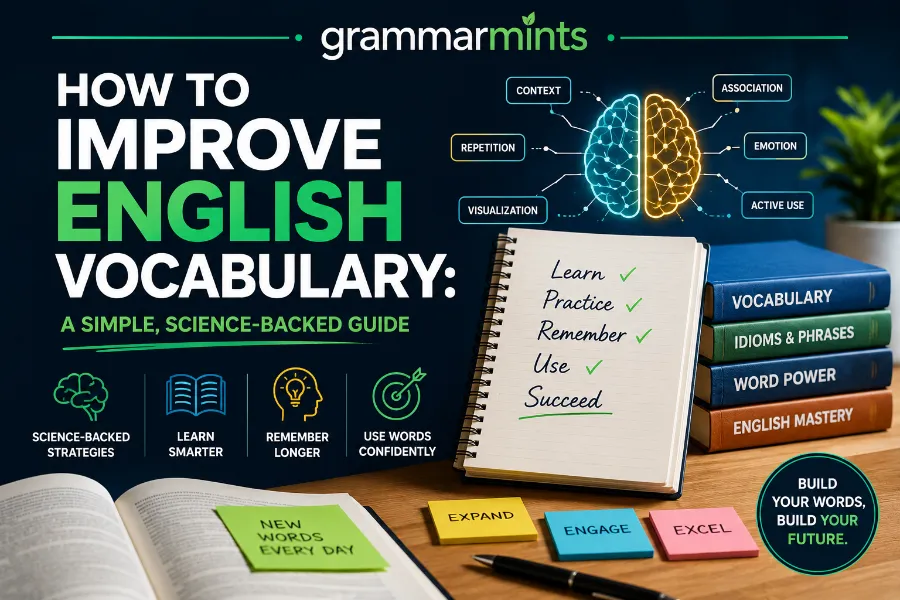
Learning how to improve English vocabulary is one of the fastest ways to feel more confident in daily conversations, job interviews, and exams. Most learners get stuck because they memorize random word lists and forget them within days. In this guide, you will find simple, tested methods that actually stick, along with real numbers, real examples, and a plan you can start today.
To get a better understanding of how to speak English fluently at home breaks down exactly what to expect.
Whether you are preparing for IELTS, writing business emails, or just chatting with friends, a stronger vocabulary changes how people see you. So let’s get into it.
If you want to learn more about best ai tools for students 2026 guide for practical tips and expert advice.
Why Vocabulary Growth Slows Down After a Certain Age
Here is something most learners don’t know. A widely cited 2016 study from Ghent University, published in Frontiers in Psychology, estimated that an average 20-year-old native English speaker knows about 42,000 word forms. Between ages 20 and 60, growth slows down sharply, adding only around 6,000 more words over four decades, roughly one new word every two days.
If you want to learn more about how to use ChatGPT for writing guide for practical tips and expert advice.
Non-native speakers usually plateau even earlier. A large-scale analysis of over 220,000 test takers found that native English speakers averaged 27,000 to 29,000 word families, while even highly proficient non-native speakers averaged only around 15,000 to 20,000. That gap is not about intelligence. It’s about method.

This is exactly why learning how to improve English vocabulary the right way matters so much. Passive listening alone will not close that gap. You need active, structured practice.
Step 1: Read Daily, But Read With a Purpose
Reading is still the single biggest driver of vocabulary growth. But reading alone is not enough; you need to notice new words and actually use them.
Try this simple routine:
- Read one short article, blog post, or book chapter every day.
- Circle or highlight 3 to 5 unfamiliar words.
- Guess the meaning from context before checking a dictionary.
- Write one original sentence using each new word.
- Review those sentences the next morning.
If you are a beginner, start small. Our guide on daily English phrases for beginners is a good place to build a foundation before moving to longer texts.
For intermediate to advanced learners preparing for exams, weak vocabulary usage often shows up in writing scores. If that sounds familiar, our breakdown of common IELTS Writing Task 2 mistakes explains how vocabulary choices affect your band score directly.
Step 2: Use Spaced Repetition Instead of Cramming
Cramming feels productive, but it rarely works long term. Spaced repetition, on the other hand, has decades of cognitive science behind it.
A well-known study by Karpicke and Roediger found that spacing out review sessions produces much stronger long-term retention than reviewing everything at once. More recent classroom research backs this up too. One study on web-based vocabulary tools found that students who spent an average of three minutes a day on automated spaced repetition activities roughly tripled their long-term vocabulary retention rate compared to traditional study methods.

Here’s how to apply it without any fancy app:
| Review Round | Timing After First Learning |
|---|---|
| Round 1 | Same day (10 minutes after learning) |
| Round 2 | Next day |
| Round 3 | 3 days later |
| Round 4 | 7 days later |
| Round 5 | 21 days later |
You can build this into a simple flashcard app, or even a notebook. The key is the growing gap between reviews, not the tool itself.
Step 3: Learn Words in Chunks, Not Isolation
One of the biggest mistakes learners make is memorizing single words instead of phrases. Native speakers rarely use words alone; they use collocations and set expressions.
For example, instead of learning “make” as a standalone word, learn:
- Make a decision
- Make progress
- Make an effort
- Make sense
This chunk-based approach mirrors how you’ll actually hear and use English. If your goal is workplace communication, our list of business English phrases groups vocabulary this same way, by real situation rather than by random topic.
Free tools like Langeek’s vocabulary section organize words by theme and level, which makes chunk-based learning much easier than flipping through a plain dictionary.
Step 4: Practice Active Recall, Not Passive Recognition
There’s a big difference between recognizing a word on a page and actually recalling it when you speak. Passive recognition feels like learning, but it builds weak memory. Active recall, forcing your brain to retrieve a word without hints, builds strong memory.
Try these active recall exercises:
- Cover the word list and try to say each definition out loud from memory.
- Use new words in a two-minute voice recording about your day.
- Teach a new word to a friend or write a short paragraph using five new words together.
A 2023 study from Boonshoft School of Medicine found that spaced, active recall techniques outperformed traditional reading and lecture-based review, and the same principle applies directly to language learning, not just academic subjects.
Step 5: Use Real Context, Not Just Word Lists
Watching shows, listening to podcasts, and reading news in English exposes you to vocabulary in natural context. This matters because a word’s meaning often shifts slightly depending on tone and situation.
The free vocabulary resources at USA Learns are built specifically for adult learners who want real-life context rather than academic word lists. Pairing a resource like this with your daily reading habit builds both breadth (how many words you know) and depth (how well you understand each one).
If you are also job hunting or applying to schools abroad, strong vocabulary directly affects how your application reads. Our guide on writing a cover letter shows how the right word choices can make your writing sound more professional without sounding stiff.
Real-Life Examples That Show the Difference
Numbers make this easier to picture. In 2013, the independent project TestYourVocab.com published multi-year results comparing native speakers with classroom learners, and the gap between the two groups was already visible by the teenage years. More recently, a 2026 analysis of over 169,000 vocabulary test results found an average gap of roughly 6,600 words between typical learners and native speakers, and this gap widened fastest for learners who relied only on passive listening rather than active study.
Here is a practical way to see this in your own life. Say you learn seven new words a day using the weekly plan below. In one month, that’s around 210 words reviewed with spaced repetition. Even if you only retain 60 percent of those long term, that’s still over 120 new usable words in four weeks, and that number compounds every month you stay consistent.
Consider two learners preparing for the same job interview in October 2026. One spends 20 minutes a day cramming a printed word list the night before. The other spends 15 minutes a day for six weeks using the chunk-based and spaced repetition methods above. The second learner walks in able to naturally use phrases like “streamline the process” or “meet a tight deadline,” while the first learner is still translating word by word in their head. Vocabulary depth, not just quantity, is what interviewers and examiners actually notice.
Tools That Can Support Your Routine
You don’t need expensive software to see results, but a few tools can make the habit easier to stick to:
- Digital flashcard apps that use spaced repetition algorithms, so you don’t have to calculate review intervals yourself.
- Voice memo apps for recording yourself using new words in short, spoken sentences.
- A simple notebook or spreadsheet to log new words, their context, and review dates, which works just as well as any app if you’re consistent.
- Themed vocabulary sites, grouped by topic or proficiency level, so you learn words that are actually relevant to your goals rather than random entries from a dictionary.
The tool matters far less than the habit. Choose whichever option you’ll actually use every day, not the one with the most features.
A Simple Weekly Plan
Here is a sample weekly structure that ties everything together:
| Day | Focus | Time Needed |
|---|---|---|
| Monday | Read + highlight new words | 20 minutes |
| Tuesday | Spaced repetition review | 10 minutes |
| Wednesday | Chunk-based practice (phrases) | 15 minutes |
| Thursday | Active recall speaking practice | 10 minutes |
| Friday | Watch or listen to real content | 20 minutes |
| Saturday | Write a short paragraph using new words | 15 minutes |
| Sunday | Light review of the whole week | 10 minutes |
This adds up to under two hours a week, which is realistic for most people with busy schedules in the United States and across Europe.
Common Mistakes to Avoid
- Learning too many new words per day. Five to seven solid words beat twenty forgotten ones.
- Skipping review sessions. Without spaced repetition, most new words fade within a week.
- Memorizing definitions without usage. A word you cannot use in a sentence is not really learned yet.
- Avoiding speaking practice out of fear of mistakes. Mistakes are part of building fluency, not a sign of failure.
Frequently Asked Questions
How long does it take to improve English vocabulary noticeably? Most learners notice a real difference within 6 to 8 weeks of consistent daily practice, especially when combining reading with spaced repetition.
How many new words should I learn per day? Five to seven words per day, reviewed properly, is more effective than trying to memorize twenty or more at once.
Do vocabulary apps actually work? Yes, when they use spaced repetition. Research on web-based tools has shown retention improvements of up to three times compared to standard study methods.
Is reading enough to build vocabulary, or do I need extra study? Reading builds exposure, but active practice, like writing sentences or speaking new words aloud, is what moves a word from recognition to actual usage.
Conclusion
Building a stronger vocabulary is not about memorizing endless word lists overnight. It comes down to a few honest habits: reading with purpose, spacing out your reviews, learning phrases instead of isolated words, and actually using what you learn in speech and writing. Start small, stay consistent for a few weeks, and you will notice real, measurable progress in how confidently you read, write, and speak English.
References
- Brysbaert, M., Stevens, M., Mandera, P., & Keuleers, E. (2016). How Many Words Do We Know? Frontiers in Psychology. https://www.ncbi.nlm.nih.gov/pmc/articles/PMC4965448/
- Karpicke, J. D., & Roediger, H. L. (2007). Expanding Retrieval Practice Promotes Short-Term Retention, but Equally Spaced Retrieval Enhances Long-Term Retention. Journal of Experimental Psychology: Learning, Memory, and Cognition.
- Effects of Web-Based Spaced Repetition on Vocabulary Retention of Foreign Language Learners, ResearchGate.
- Vocabulary size research summary, vocabulary-test.com.