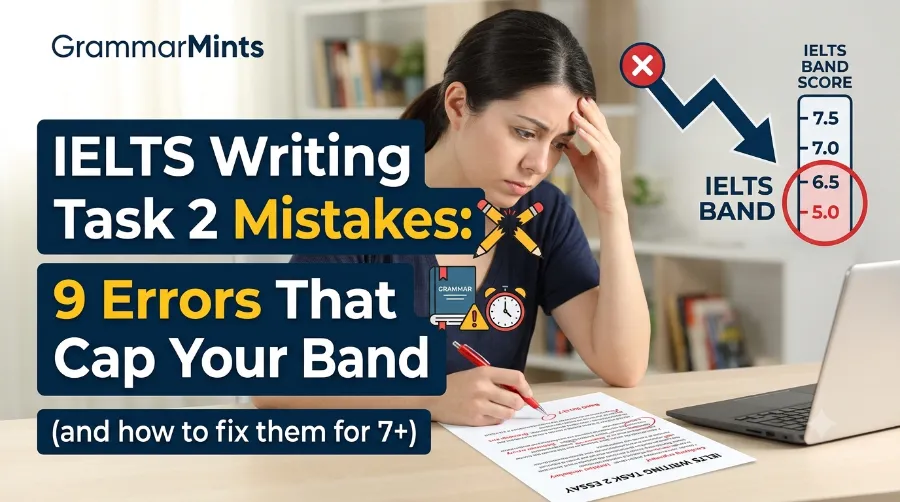
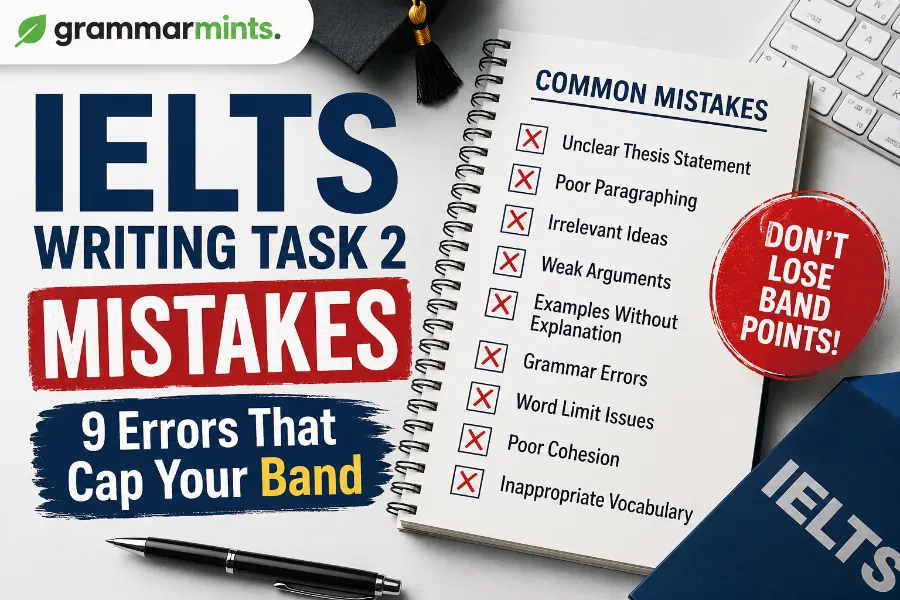
Most IELTS Writing Task 2 mistakes are small. They do not look dangerous on the page. But examiners notice them fast, and they can hold your score at Band 5 or 6 no matter how good your grammar is. So, before your next practice essay, it helps to know exactly what these errors look like and why they happen.
If you want to learn more about best ai tools for students 2026 guide for practical tips and expert advice.
This guide walks through the mistakes that show up again and again in real exam scripts. It also uses a real 2026 exam example about love-measurement apps to show how easily a good writer can misread a modern, unusual prompt. By the end, you will have a clear checklist you can use before every practice essay.
To get a better understanding of how improve English vocabulary breaks down exactly what to expect.
Why IELTS Writing Task 2 Mistakes Matter More Than Grammar Alone
Task 2 makes up two-thirds of your total Writing score, so a weak essay here pulls your whole band down. Examiners score four criteria equally: Task Response, Coherence and Cohesion, Lexical Resource, and Grammatical Range and Accuracy. Each one is worth 25 percent of your Task 2 mark.
To get a better understanding of how to speak English fluently at home breaks down exactly what to expect.
Here is the part most students miss. If you answer the wrong question, your Task Response score is capped, and it does not matter how polished your English sounds. Cambridge Assessment English examiner reports have identified partial task completion as the leading cause of Task Achievement scores below Band 6, a pattern that affects roughly 3 in 10 candidates who fall short of Band 7. That single habit quietly blocks thousands of test-takers every year.
If you want a quick, free way to check your own draft against these criteria, tools like the IELTS Writing Task 2 essay checker can flag structural issues before you even reach the exam hall.
The 7 Most Common IELTS Writing Task 2 Mistakes
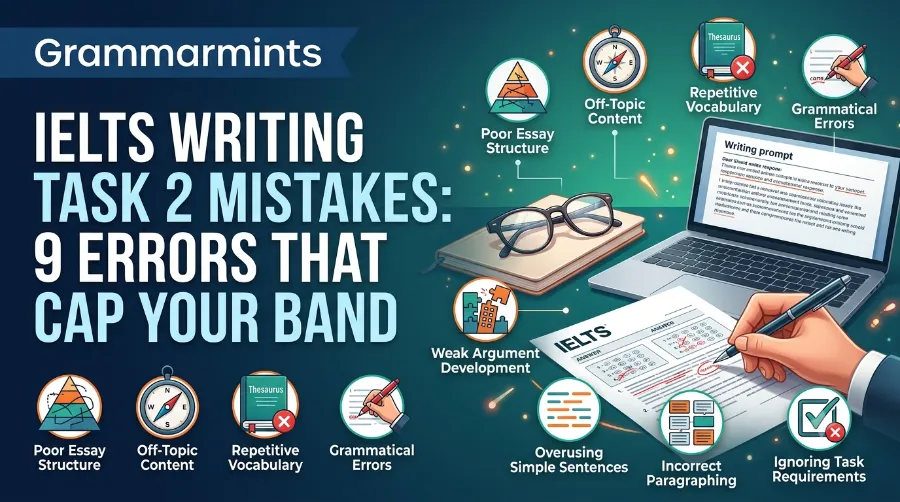
Let’s break down the errors that show up most often, along with why each one costs marks.
1. Misreading or Only Half-Answering the Question
Two-part questions trip up thousands of candidates every session. For example, if a prompt asks “Why is this happening, and what can be done about it?”, spending most of your essay on the cause and rushing the solution in two lines will hold your Task Response at a low band, because the task simply is not complete.
If you want to learn more about how to use ChatGPT for writing guide for practical tips and expert advice.
Underline the actual question before you write a single sentence. Circle every verb (discuss, agree, evaluate) and every noun phrase, then match one paragraph to each part.
2. Writing a Memorised or Generic Essay
Templates feel safe under exam pressure, so many learners lean on them. However, an essay that could be pasted onto any topic tells the examiner you did not actually engage with the prompt in front of you. A template essay can be capped for Task Response regardless of how clean the grammar is, since examiners are trained to spot these patterns instantly.
3. Overusing Mechanical Linking Words
“Firstly,” “Moreover,” and “In conclusion” are not wrong, but stacking them at the start of every sentence signals a memorised structure rather than natural writing. Examiner reports from both British Council and IDP Education repeatedly flag this pattern as one of the errors that keeps candidates from moving past a 6.5. A British Council guide to common IELTS mistakes is worth reading if you want more detail straight from an official source.
Natural cohesion actually comes from referencing words like “this,” “these,” and “it,” plus smart paragraph order, not from stacking connectors.
4. Cramming Every Idea Into One Paragraph
A body paragraph should carry one main idea, fully developed. Cramming two or three ideas into a single paragraph confuses the logical flow and lowers your Coherence and Cohesion score. Instead, treat each idea like a small circle: state it, explain it, then link it back to your position before moving on.
5. Reaching for Big Words You Don’t Fully Control
Swapping “use” for “utilise” or “start” for “commence” does not automatically raise your score. If the word does not fit the context, it actually lowers your Lexical Resource mark. Precision beats complexity almost every time in Task 2 writing.
6. Forcing Long, Complex Sentences
Complex grammar only helps when it works. A long sentence that collapses halfway through, losing its punctuation or its subject, creates confusion rather than confidence. Many Band 7 essays actually read simply, because clean and accurate sentences build more trust than ambitious but broken ones.
7. Copying the Question Word-for-Word
Pasting the prompt straight into your introduction wastes your word count, since copied language is not assessed. A stronger opening paraphrases the question using different nouns and a different sentence structure, then adds a clear one-sentence thesis. That two-part introduction alone can set the tone for a much stronger Task Response score.
Real Example: The 2026 “Love Measurement Tools” Essay Question
Here is a case that shows how these mistakes play out on a genuinely unusual prompt. In early 2026, a Task 2 question in several test sessions asked candidates to discuss whether apps and wearable devices that claim to measure emotional compatibility or “love scores” between couples are a helpful or harmful trend in modern relationships.
Many candidates, according to teacher reports shared in prep forums, reacted the same way test-takers do with any unfamiliar topic: they fell back on a memorised “technology” essay about smartphones and social media in general, instead of engaging with the specific claim about relationship-measuring apps. That single decision capped their Task Response, even when their grammar was close to Band 8 quality.
The lesson is simple. However strange or specific a topic sounds, whether it is love-measurement apps, plastic packaging, or remote work, the examiner is checking whether you answered that question, not a nearby one you already practised. If you want a broader vocabulary bank for talking about modern relationships and technology in plain English, our daily English phrases for beginners guide is a useful starting point before you move into IELTS-level essay vocabulary.
How to Fix These Mistakes: A Step-by-Step Approach
Use this simple sequence every time you sit down to write a practice essay.
- Read the prompt twice. Underline the topic, then underline the exact task (agree/disagree, discuss both views, problem/solution).
- Plan for two minutes before writing. Jot down one main idea per paragraph and a one-line example for each.
- Paraphrase the question in your introduction, then add a clear thesis sentence stating your position.
- Write one idea per body paragraph, and fully explain it with a specific, real example rather than a vague generalisation.
- Vary your sentence length. Mix short, accurate sentences with one or two complex ones per paragraph.
- Leave five minutes to check for subject-verb agreement, articles, and whether you actually answered every part of the question.
Practising this sequence on 20 to 25 full essays, with honest self-scoring against the band descriptors after each one, does more for your score than writing 50 rushed drafts ever will.
Band Score Breakdown: Where Each Mistake Hits Hardest
| Mistake | Criterion Affected | Typical Band Cap |
|---|---|---|
| Half-answering a two-part question | Task Response | 5.0 |
| Generic or memorised essay | Task Response | 5.0–5.5 |
| One paragraph, multiple ideas | Coherence and Cohesion | 5.5–6.0 |
| Overused mechanical linkers | Coherence and Cohesion | 6.0–6.5 |
| Misused advanced vocabulary | Lexical Resource | 6.0 |
| Simple sentences only | Grammatical Range | 6.0 |
| Copied question in intro | Lexical Resource | 6.0 |
Where Candidates Actually Get Stuck (2026 Data)
| Band Target | Most Common Bottleneck |
|---|---|
| Band 5 to 6 | Misreading the question type; underdeveloped paragraphs |
| Band 6 to 7 | Overused connectors; almost-right word choices |
| Band 7 to 8 | Collocation accuracy, not vocabulary size |
| Band 8 to 9 | Stylistic flexibility and rare, natural errors only |
For candidates aiming at Band 7, the main obstacle tends to be Task Response, specifically the failure to fully develop and support every main idea. For those pushing toward Band 8, Lexical Resource is usually the final hurdle, particularly around natural collocation and stylistic flexibility rather than raw vocabulary size. This pattern lines up closely with what we see in the table above, and it explains why simply memorising more words rarely moves a Band 6.5 writer up to a 7.
If English business vocabulary is part of your goal alongside IELTS prep, our business English phrases guide pairs well with Task 2 topics on work, careers, and the economy.
Frequently Asked Questions
Does one grammar mistake ruin my Task 2 score? No, a single small error rarely matters. Examiners look for patterns across the whole essay, not one slip.
Is it fine to use complex vocabulary I am not sure about? Not really. A simple, accurate word almost always scores better than an impressive word used incorrectly.
How many words should a Task 2 essay be? Aim for 270 to 320 words. The minimum is 250, and going far past 350 usually introduces more errors than it fixes.
Do examiners penalise short, simple sentences? Only if that is all you write. A healthy mix of simple and complex sentences, used accurately, scores higher than either extreme alone.
Conclusion
Most IELTS Writing Task 2 mistakes are not about talent or intelligence. They come from rushing the plan, leaning on templates, and misreading exactly what a prompt is asking, even on unusual topics like love-measurement apps. Fix these seven patterns, plan for two minutes before every essay, and read the question twice, and your band score has real room to move. If you are polishing your English for work applications too, take a look at our cover letter writing guide for another place to apply the same clear, structured writing habits.
References
- Cathoven, “IELTS Writing Task 2 Common Mistakes,” 2024 examiner report data
- British Council, “Common Mistakes in IELTS Writing”
- Cambridge Assessment English, IELTS Annual Review 2024
- CareerWise English, “IELTS Writing Task 2 Band Score Guide,” 2026
- Practice9, “3 Common IELTS Writing Task 2 Mistakes and Solutions for Band 8.0”