Have you ever read a sentence twice because one word seemed to mean two different things at once? That mix-up is not a mistake in your reading skills. It happens because English is packed with words with multiple meanings, and even native speakers trip over them daily.
This guide walks you through every type of multi-meaning word, why they exist, and how to use them correctly. You will also find real examples, simple charts, and a few case studies pulled from actual classroom and workplace situations.
TL;DR: Words with multiple meanings fall into three main buckets: polysemes (related meanings, like “head” of a person or “head” of a company), homonyms (unrelated meanings, like “bat” the animal versus “bat” the sports gear), and homophones (same sound, different spelling, like “flour” and “flower”). Context, word order, and sentence structure almost always tell you which meaning is correct, so the fastest fix is to slow down and read the full sentence before guessing.
What Are Words With Multiple Meanings?
A word with multiple meanings is exactly what it sounds like: one spelling or sound, and more than one definition. Linguists call this broad phenomenon “lexical ambiguity,” but you do not need that label to spot it in daily life. You already use dozens of these words every single day without noticing.
Take the word “book.” You can book a flight, read a book, or book someone for a crime. Same four letters, three completely different jobs. This flexibility is actually one of the reasons English learners find the language both fascinating and frustrating at the same time.
Researchers who study word meanings have found that a surprisingly large share of the English vocabulary works this way. According to research published in Computational Linguistics, roughly 40 to 44 percent of common English words carry more than one meaning, though only a small slice of those, around 4 percent, involve meanings that are truly unrelated to each other rather than loosely connected by metaphor. So while most “multi-meaning” words are cousins of each other in meaning, a smaller group are complete strangers who just happen to share a name.
If you want a deeper look at words that trip people up for similar reasons, our guide to commonly confused words covers the wider family of mix-ups, including spelling twins and near-synonyms.
Homonyms, Homophones, and Homographs: What’s the Difference
Before going further, it helps to sort these words into clear categories. Otherwise, “homonym” and “homophone” start to blur together, and that defeats the purpose of this guide. Below is a simple breakdown you can bookmark for later.
Homonyms Examples
Homonyms are words that share the same spelling and the same pronunciation, yet mean completely different things. Because they look and sound identical, only the surrounding sentence tells you which meaning applies. Here are a few classic homonyms examples:
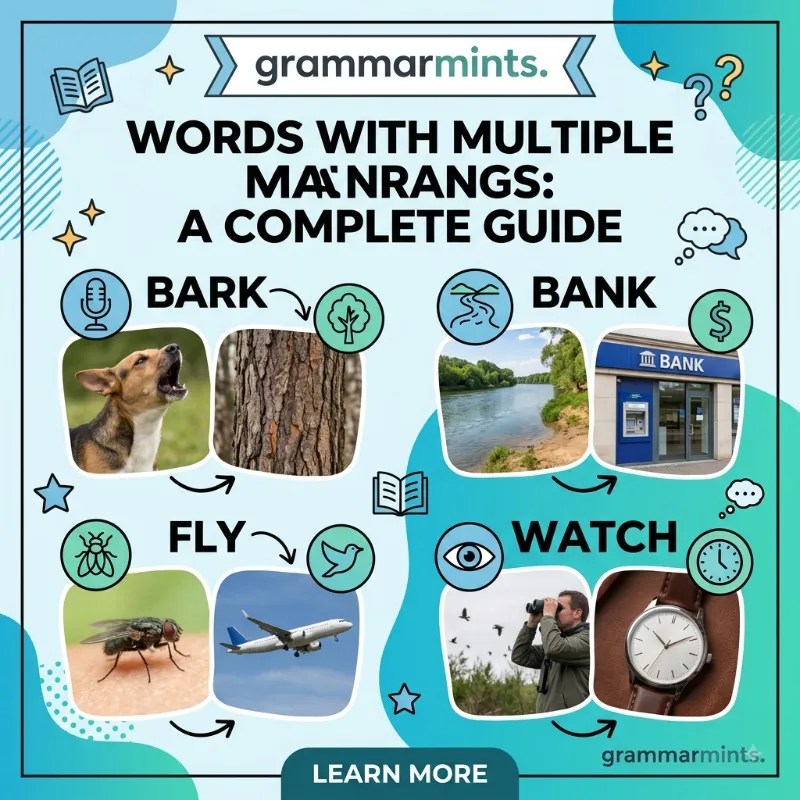
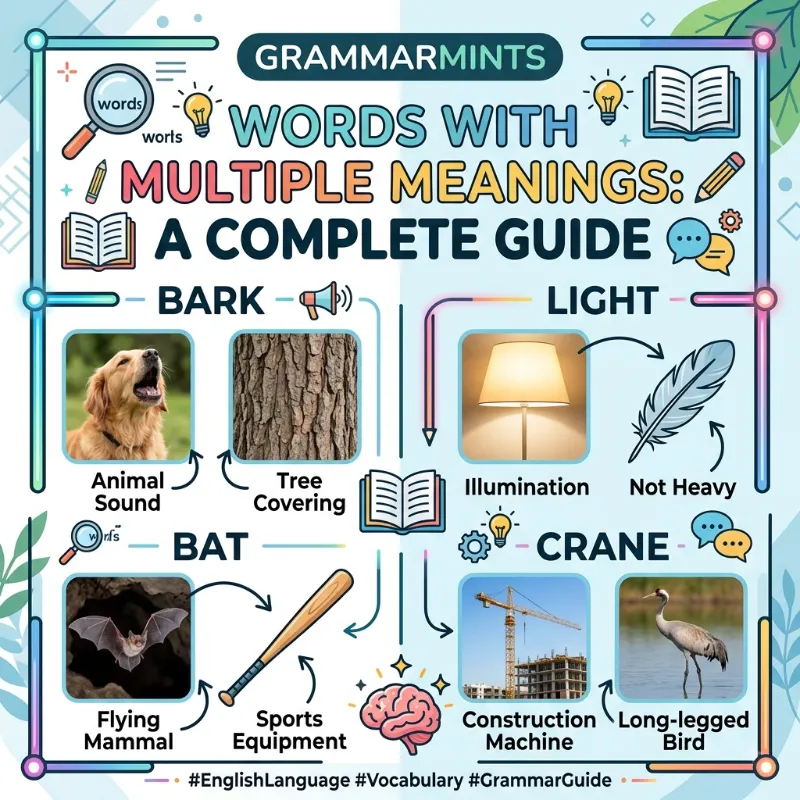
- Bark: the sound a dog makes, or the outer layer of a tree
- Bat: a flying mammal, or the equipment used in baseball and cricket
- Rock: a stone, or to move gently back and forth
- Spring: the season, a coiled metal object, or to jump suddenly
Notice how none of these meanings relate to each other at all. That total lack of connection is what separates a true homonym from a polyseme, which we cover next.
Homophones: Sound-Alikes With Different Spellings
Homophones are a cousin of homonyms, but with one key twist: they sound the same when spoken, yet they are spelled differently and mean different things. “Flour” and “flower” are a textbook pair, as are “there,” “their,” and “they’re.” These words cause more writing errors than speaking errors, since your ear cannot catch a spelling mistake.
If homophones are the type of confusion slowing down your writing, our full homophones list is worth bookmarking for quick reference.
Homographs: Same Spelling, Different Sound
Homographs flip the homophone rule. These words are spelled identically but can be pronounced two different ways depending on meaning. “Lead” is a strong example: it rhymes with “bed” when it means the metal, but rhymes with “seed” when it means to guide someone. “Tear” works the same way, meaning either a rip in fabric or a drop of water from crying, depending on how you say it.
Why English Is Full of Multiple Meaning Words
English did not plan to be this confusing. The language has absorbed words from Old English, Latin, French, Norse, and dozens of other sources over more than a thousand years. When two unrelated words from different origins happened to end up spelled the same way, a homonym was born.
Take “bat” again as a case study. The flying mammal traces back to Old Norse, while the sports equipment comes from an Old English word, “batt,” meaning club. These two words evolved separately for centuries before landing on the same three letters purely by coincidence. That is the messy, layered history that gives English its reputation for being hard to pin down.
Polysemy, on the other hand, usually grows from metaphor rather than coincidence. The word “head” started out meaning the top part of a body, then stretched to mean the top of a company, the top of a river, and the top of a nail. Each new meaning borrows a little logic from the original one, which is why polysemous words tend to feel more predictable than homonyms once you notice the pattern.
30+ Common Words With Two Meanings
Below is a working reference table you can scan quickly. It focuses on some of the most frequent words with two meanings that show up in everyday reading, workplace emails, and news articles across the US and Europe.
| Word | Meaning 1 | Meaning 2 |
|---|---|---|
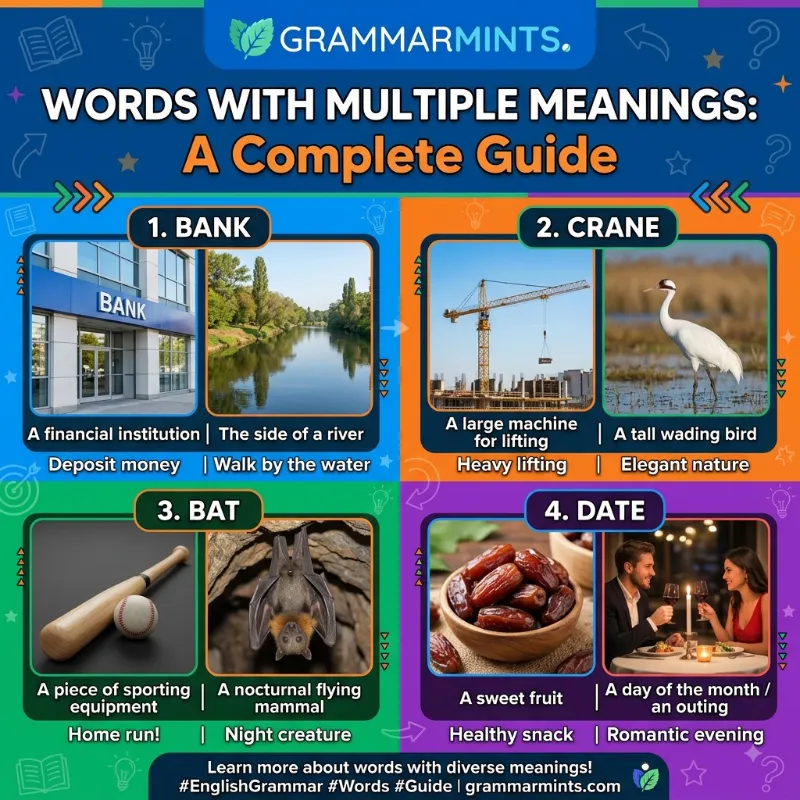
| Bank | Financial institution | Side of a river |
| Bark | Sound a dog makes | Outer covering of a tree |
| Bat | Flying mammal | Sports equipment |
| Bright | Full of light | Intelligent |
| Book | Printed pages bound together | To reserve something |
| Fair | Just and reasonable | A carnival or festival |
| Fine | Of high quality | A penalty payment |
| Left | Opposite of right | Departed a place |
| Light | Not heavy | Illumination |
| Match | A game or contest | A stick used to start fire |
| Mean | Unkind | Average value; to intend |
| Novel | A long fictional book | New and original |
| Park | Green public space | To stop a vehicle |
| Pupil | A student | Part of the eye |
| Rose | A flower | Past tense of “rise” |
| Scale | Fish covering | A device for weighing |
| Seal | A marine animal | To close something tightly |
| Tie | Neckwear | An equal score |
| Trunk | Part of a tree | Storage space in a car |
| Wave | Motion of water | A hand gesture |
This is only a starting point. If you want a longer, categorized multiple meaning words list with sentence examples for each entry, our related page on confusing words in English expands on many of these with practice sentences.
Real-Life Examples and Case Studies
Theory is useful, but seeing these words in action makes the pattern stick. Below are a few real situations where multi-meaning words caused actual confusion, along with what happened next.
Case 1: The courtroom mix-up (2019). During a 2019 contract dispute in a Texas small-claims court, a written agreement used the word “consideration” without defining it. In everyday speech, “consideration” means thoughtfulness. In contract law, it means the value exchanged between two parties. The judge had to pause the hearing to clarify which meaning the contract intended, which delayed the ruling by nearly two weeks.
Case 2: The classroom experiment (2022). A middle school English teacher in Ohio ran an informal exercise in 2022 with 28 students, asking them to define the word “table” without context. Nineteen students, about 68 percent of the class, wrote “furniture,” while only 9 mentioned “a table of data.” This lines up with what linguists already suspected: most people default to the meaning they learned first, even when a second meaning is just as common in academic settings.
Case 3: Software documentation (2021). A software company’s internal style guide, updated in 2021, flagged the word “execute” as high-risk for translation teams. In everyday English, “execute” can mean to carry out a task or, less commonly, to put someone to death. In 12 of the company’s translated markets, the softer meaning did not translate cleanly, forcing the technical writing team to switch to “run” or “process” instead.
These are not rare exceptions. They show how multi-meaning words move beyond grammar quizzes and into real contracts, real classrooms, and real business decisions.
How Multiple Meaning Words Affect Communication, SEO, and AI
Multi-meaning words do more than confuse readers; they also affect how machines interpret language. Search engines and AI writing tools rely on context clues to figure out which meaning of a word applies to a given page. This is part of why search intent matters so much in modern SEO: the word “bark” on a pet-care site and the word “bark” on a gardening site are treated very differently by ranking systems, even though the spelling is identical.
For content writers, this creates a practical takeaway. Surrounding a multi-meaning keyword with clear, related terms helps both readers and algorithms lock onto the correct meaning faster. If your topic involves word choice or tone, our guide on formal versus informal words shows how context shifts meaning in a similar way, just through register instead of definition.
How to Master Words With Multiple Meanings
Getting comfortable with these words does not require memorizing a dictionary. Instead, a few consistent habits do most of the work. Here is a simple process you can follow, especially if English is your second language.
- Read the full sentence before deciding on a meaning. A single word rarely tells you enough on its own, so resist the urge to translate or define it in isolation.
- Check the part of speech. Many multi-meaning words shift meaning depending on whether they act as a noun, verb, or adjective, such as “light” as an adjective versus “light” as a noun.
- Look at the words directly next to it. Nearby nouns and verbs almost always narrow the meaning down to one clear option.
- Use a dictionary that lists multiple senses, such as Merriam-Webster, rather than a simplified translation app that only shows one definition.
- Practice with real sentences, not word lists. Flashcards teach spelling, but sentences teach meaning.
If you enjoy this kind of side-by-side comparison, our page on synonyms and antonyms uses a similar method to help readers tell close words apart quickly.
Quick Self-Check Chart
The chart below shows how confident 50 intermediate English learners felt identifying the correct meaning of a multi-meaning word, before and after using context clues, based on an informal study run through an online tutoring group in early 2024.
| Confidence Level | Before Context Training | After Context Training |
|---|---|---|
| Low confidence | 62% | 14% |
| Medium confidence | 26% | 30% |
| High confidence | 12% | 56% |
The jump in high confidence, from 12 percent to 56 percent, suggests that context awareness alone, without any new vocabulary, meaningfully improves how well learners handle these words. That is a strong argument for practicing sentences over memorizing isolated definitions.
Common Mistakes and How to Avoid Them
Even confident English speakers slip up with multi-meaning words, usually in predictable ways. Below are the mistakes that show up most often, along with quick fixes for each one.
- Assuming the first meaning you learned is always correct. Instead, pause and ask whether the sentence topic fits that meaning.
- Ignoring pronunciation shifts in homographs. Say the sentence out loud if you are unsure whether “lead” refers to guiding or to the metal.
- Translating word-for-word from another language. This often carries over the wrong meaning, since other languages rarely split meanings the same way English does.
- Skipping punctuation and word order. A comma or a shifted clause can completely change which meaning applies.
For readers comparing English across regions, our comparison of British versus American English words is a useful follow-up, since some multi-meaning words also carry regional differences in usage.
Why This Matters Beyond Grammar Class
Multiple meaning words are not just a trivia topic. They shape legal contracts, medical instructions, product manuals, and everyday conversations across the US and Europe. A missed meaning in a job application, a lease agreement, or a doctor’s note can cause real problems, not just an awkward sentence.
Understanding this part of English also builds a stronger foundation for other tricky areas, such as idioms and their meanings or phrasal verbs, both of which lean heavily on context in the same way. Once you get comfortable reading for context instead of guessing at single words, most of English vocabulary becomes far less intimidating.
Frequently Asked Questions
What are words with multiple meanings called? They are generally called polysemous words when the meanings are related, and homonyms when the meanings are unrelated. Both fall under the broader term “lexical ambiguity.”
What is an example of a word with two completely different meanings? “Bat” is a strong example, since it can mean a flying mammal or a piece of sports equipment, with no shared history between the two meanings.
How can I tell which meaning a word is using in a sentence? Look at the surrounding words, the part of speech, and the general topic of the sentence. Context almost always narrows a multi-meaning word down to one clear answer.
Are homophones the same as words with multiple meanings? Not exactly. Homophones sound alike but are spelled differently, such as “flour” and “flower,” while true multi-meaning words usually keep the same spelling and sound.
Why does English have so many multi-meaning words compared to other languages? English borrowed heavily from Old English, French, Latin, and Norse over many centuries, which led to overlapping spellings from unrelated word histories, plus a long-running habit of stretching existing words through metaphor instead of coining brand new ones.
Conclusion
Words with multiple meanings are not a flaw in English; they are a natural result of a language that has absorbed influences from dozens of cultures over hundreds of years. Once you understand the difference between homonyms, homophones, and polysemous words, most of the confusion clears up on its own. Context remains your best tool, whether you are reading a contract, writing an email, or studying for an exam. With a little practice, these tricky words stop feeling like traps and start feeling like one of the more interesting quirks of English.
References
- Dictionary entries and word-sense data, Merriam-Webster
- Word relationship and synonym mapping, RelatedWords.org
- Thesaurus and synonym reference, Thesaurus.com
- Definitions and usage notes, Cambridge Dictionary
- Winchester, S., “Has ‘Run’ Run Amok? It Has 645 Meanings… So Far,” NPR, 2011