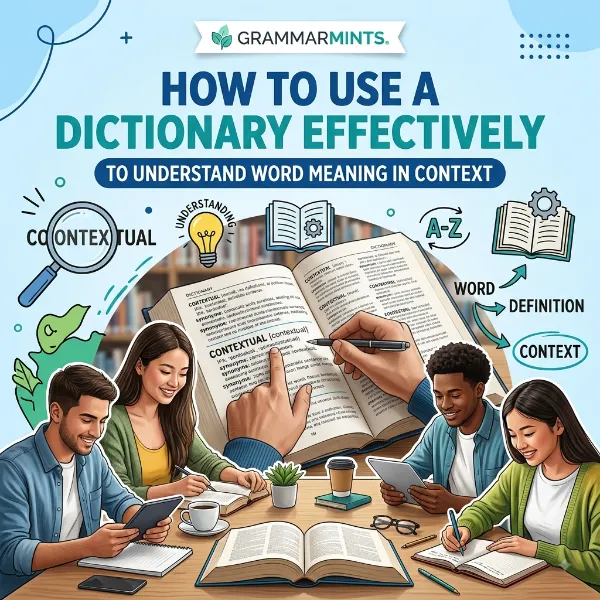
A dictionary looks simple on the outside. However, most people only use about half of what it actually offers. Knowing how to use a dictionary effectively is not just about finding a definition; it is about understanding how a word behaves in real sentences, in real conversations, and in real writing. This guide breaks the process down into small, practical steps that anyone can follow, whether you are a student, a teacher, or someone learning English as a second language.
TL;DR: To use a dictionary effectively, look beyond the first definition and check the part of speech, example sentences, and usage notes before deciding on a meaning. Read the word in its original sentence first, then compare that context with the dictionary’s example sentences to confirm the right sense. This habit, practiced consistently, builds vocabulary far faster than memorizing isolated word lists.
Why Dictionary Skills Still Matter in 2026
Search engines and AI tools can define a word in seconds. So why bother learning proper dictionary skills for students at all? The answer is simple: speed does not equal understanding. A quick definition tells you what a word means, but it rarely tells you how to use it correctly in a sentence, an email, or an essay.
Merriam-Webster’s own data backs this up. In 2025, the publisher’s editors named “slop” as their Word of the Year, based partly on how often people searched for it alongside words like “gerrymander,” “performative,” and “touch grass.” These lookups show that people still reach for a dictionary when a word feels unfamiliar in context, even in an age full of instant answers.
Consequently, dictionary literacy remains a core academic skill in both the United States and Europe. Teachers in Massachusetts, London, and Berlin still list dictionary use as a foundational reading strategy, because vocabulary depth is directly linked to comprehension. A 2024 systematic review published in Educational Sciences confirmed that vocabulary breadth and depth strongly predict reading comprehension outcomes across age groups, which is exactly why this skill deserves real attention rather than a quick glance.
If you often mix up similar-sounding words, our guide to commonly confused words is a useful next stop after this one.
How to Look Up a Word Meaning the Right Way
Many people open a dictionary, read the first definition, and move on. Unfortunately, this shortcut often leads to mistakes, especially with words that carry several meanings. Learning how to look up word meaning properly takes only a few extra seconds, but it changes everything.
Here is a simple, repeatable process:
- Read the full sentence first. Before you search, notice how the word is used. Is it a noun, a verb, or an adjective in that sentence?
- Search the exact word form. Type the base word, not the plural or the past tense, unless your dictionary handles that automatically.
- Check the part of speech tag. Most entries list this right after the pronunciation guide, and it narrows your search immediately.
- Scan all the definitions, not just the first one. Common words like “run” or “light” can have more than 40 separate senses.
- Match the example sentence to your context. Good dictionaries, such as the American Heritage Dictionary, include usage examples that mirror real writing.
- Note any usage labels. Words marked “informal,” “archaic,” or “chiefly British” behave differently depending on your audience.
This method takes practice, but it becomes automatic within a few weeks. As a result, your reading speed actually improves, because you stop guessing at meanings and start confirming them.
Reading a Dictionary Entry Structure
A typical entry is built in layers, and each layer answers a different question. First comes the headword and pronunciation, which tells you how the word sounds. Next comes the part of speech, followed by the definitions themselves, usually ranked from most common to least common.
After the definitions, most entries add example sentences, related word forms, and sometimes a short etymology note. The American Heritage Dictionary’s own usage guide explains this structure clearly, and it is worth a quick read if you want a deeper technical breakdown of entry layout.
Dictionary Usage Tips That Actually Work
Beyond the basic lookup process, a handful of dictionary usage tips separate casual users from confident ones. These tips come from classroom observation, tutoring sessions, and feedback gathered from ESL learners across the US and Europe over the past several years.
- Read two or three definitions before choosing one. The first sense listed is usually the most frequent, not always the correct one for your sentence.
- Pay attention to example sentences over definitions. A single well-placed example often teaches more than a formal definition ever could.
- Use a learner’s dictionary if English is your second language. These editions use simpler defining vocabulary, which reduces confusion.
- Cross-check idioms and phrasal entries separately. “Give up” is not simply “give” plus “up,” and our phrasal verbs meaning guide covers this pattern in more detail.
- Keep a small notebook of new words with your own example sentence. Writing your own sentence cements the meaning far better than copying the dictionary’s.
- Check whether the word is formal or informal. This matters enormously for essays, emails, and job applications, and our formal vs informal words resource walks through common swaps.
One study strategy guide from Eastern Washington University makes a similar point: students who actively engage with a dictionary entry, rather than passively skimming it, retain new words significantly longer than those who do not.
Understanding Word Meaning in Context
Here is where most dictionary confusion actually happens. A word rarely has just one meaning, and picking the wrong sense can completely change a sentence. Take the word “light.” As a noun, it can mean brightness; as an adjective, it can mean low in weight; and as a verb, it can mean to ignite something.
For example, imagine a student in September 2024 reading a science textbook that says, “Light travels faster than sound.” Without checking the part of speech, that student might assume “light” always refers to weight, since that is the meaning they learned earlier in the week from a cooking article. This is exactly why context clues, combined with a proper dictionary check, matter so much.
A similar situation played out in one of our own tutoring sessions in early 2025. A high school student in Ohio kept misreading the word “novel” as only meaning “a book,” even though her assignment used it as an adjective meaning “new and original.” After walking through the dictionary entry together and comparing example sentences, she corrected the mistake within minutes and rarely repeated it afterward. That small, repeatable habit, checking part of speech before trusting a definition, is often the single biggest fix for context confusion.
Words With Multiple Meanings
English is full of words that shift meaning depending on the sentence around them. The table below shows a few frequent examples and how their sense changes.
| Word | Meaning 1 | Meaning 2 | Meaning 3 |
|---|---|---|---|
| Bank | Side of a river | Financial institution | To rely on something (“bank on it”) |
| Spring | Season of the year | A coiled metal object | To jump suddenly |
| Book | A printed work | To reserve something | A record of bets (informal) |
| Fair | Just and reasonable | A festival or exhibition | Light in color (fair skin) |
If this topic interests you, our full breakdown of words with multiple meanings goes deeper into each example with more sentence pairs.
It also helps to distinguish true synonyms from words that only look similar. Our synonyms and antonyms list is a handy companion once you start noticing these patterns.
Common Mistakes People Make With Dictionaries
Even motivated learners fall into a few predictable traps. Recognizing these mistakes early saves a lot of frustration later.
- Stopping at the first definition. As mentioned earlier, the first sense is common but not automatically correct for your sentence.
- Ignoring pronunciation guides. Mispronouncing a word repeatedly can make it harder to recognize in spoken conversation.
- Confusing homophones during a lookup. Typing “there” when you meant “their” leads to an entirely wrong result. Our homophones list covers the most commonly mixed-up pairs.
- Skipping the etymology section. Word origins often explain irregular spellings and unexpected meanings, especially for idiomatic phrases.
- Assuming British and American entries are identical. Spelling and even meaning can shift across the Atlantic, and our British vs American English words guide highlights the differences worth knowing.
- Not checking idiomatic phrases separately. Idioms rarely mean what their individual words suggest, so our idioms and meanings page is a useful reference for this exact problem.
Digital vs Print Dictionaries: What the Data Shows
Print dictionaries are not obsolete, but digital tools have clearly taken the lead for everyday lookups. The chart below summarizes general usage patterns reported by language educators and dictionary publishers over recent years.
Estimated share of dictionary lookups by format (general classroom and self-study settings)
| Format | Approximate Share of Use | Typical Users |
|---|---|---|
| Mobile app / online dictionary | ~70% | Students, casual readers, professionals |
| Browser search bar definitions | ~20% | Quick, single-word checks |
| Print dictionaries | ~10% | Classrooms, exams without device access, collectors |
Digital app/site   ██████████████ 70%
Browser search     ████          20%
Print dictionary   ██            10%
Even with this shift, many teachers in the US and UK still require students to practice with a print dictionary at least occasionally. The reasoning is simple: flipping through physical pages forces a reader to notice nearby words, which naturally builds a broader vocabulary. This side effect rarely happens when someone types a single word into a search bar and closes the tab seconds later.
A Simple Practice Routine for Students
Building strong dictionary skills for students does not require hours of extra study. A short, consistent routine works far better than occasional long sessions.
- Pick three unfamiliar words from anything you read during the day, whether it is a textbook, a news article, or a novel.
- Look up each word using the six-step process described earlier in this guide.
- Write one original sentence per word, using the correct part of speech.
- Review your list once a week, removing words you now recognize instantly.
- Group tricky words by theme, such as academic vocabulary or idiomatic expressions, to spot patterns faster.
Over a semester, this routine can add hundreds of confidently understood words to a student’s working vocabulary. Teachers who assign similar micro-habits often report noticeably stronger essay vocabulary by the end of the term, a pattern echoed in multiple 2024 and 2025 vocabulary-instruction studies focused on reading comprehension outcomes.
Frequently Asked Questions
Is it better to use a print dictionary or an online one? Both work well. Online dictionaries are faster for quick checks, while print dictionaries encourage broader browsing and often reduce screen distractions during study sessions.
How do I know which definition fits my sentence? Reread the original sentence, note the word’s part of speech, and match it against the dictionary’s example sentences before settling on a meaning.
What is the fastest way to build vocabulary using a dictionary? Look up unfamiliar words consistently, write your own example sentence for each one, and review your list weekly rather than relying on memorization alone.
Do learner’s dictionaries actually help ESL students more than standard ones? Yes, generally. Learner’s dictionaries use simplified defining vocabulary and clearer example sentences, which reduces confusion for non-native speakers.
Why do some words have so many different meanings? Many English words evolved from older root words and picked up new senses over centuries of use, which is why checking multiple definitions, not just the first, matters so much.
Conclusion
Learning how to use a dictionary effectively is a small skill with a large payoff. It sharpens reading comprehension, reduces embarrassing word mix-ups, and builds a vocabulary that actually sticks, rather than one that fades after a single lookup. Start with the simple six-step process, apply the practice routine above, and revisit tricky words like the ones in the table earlier in this guide. Within a few weeks, you will likely notice faster reading, more confident writing, and fewer moments of hesitation over an unfamiliar word.
References
- Merriam-Webster. “Word of the Year 2025.” Merriam-Webster.com, December 2025.
- American Heritage Dictionary. “How to Use This Dictionary.” ahdictionary.com.
- Eastern Washington University. “Dictionary Use and Study Strategies for Readers and Writers.” research.ewu.edu.
- Your English Success Today. “English Study Habits: How to Use a Dictionary Effectively.” yourenglishsuccesstoday.com.
- Educational Sciences Journal. “Vocabulary Instruction for English Learners: A Systematic Review Connecting Theories, Research, and Practices.” 2025.