English has thousands of words, and many of them look or sound alike. Because of that, even native speakers sometimes choose the wrong word in emails, essays, business reports, or everyday conversations. Learning confusing words in english is one of the fastest ways to improve your grammar, writing confidence, and professional communication. Whether you are a student, teacher, job seeker, or business professional, understanding these words helps you avoid common mistakes and express your ideas more clearly.
Idioms and Meanings A Beginner’s Guide to Everyday English Expressions
TL;DR: Many English words have similar spellings or pronunciations but different meanings. This guide explains the most commonly confused words list with simple definitions, practical examples, expert tips, and comparison tables so you can use them correctly in everyday writing and speaking.
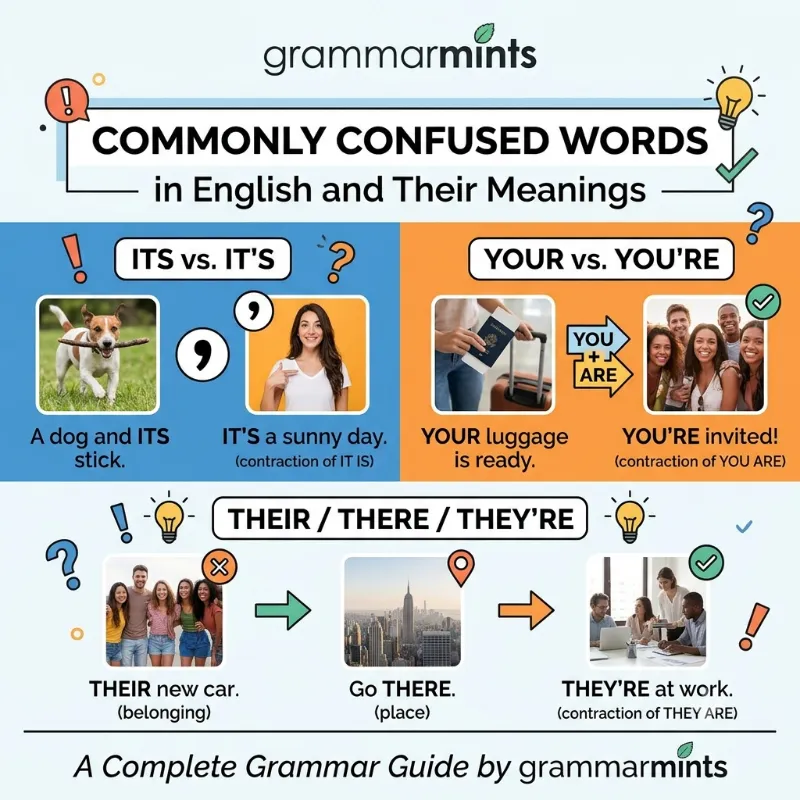
Why Do People Confuse English Words?
English developed from several languages, including Latin, French, German, and Greek. As a result, many words share similar spellings while carrying completely different meanings. Moreover, pronunciation changes over time have created additional confusion.
For example, consider these words:
- Affect vs Effect
- Accept vs Except
- Compliment vs Complement
- Principal vs Principle
- Stationary vs Stationery
Although these pairs appear similar, each word has a different purpose. Consequently, using the wrong one can completely change the meaning of a sentence.
Formal vs Informal Words Meaning and Usage Guide
According to language experts, commonly confused words remain among the most frequent grammar mistakes found in academic writing, professional emails, and standardized English exams.
Why Learning Confusing Words Matters
Many people believe grammar only matters in school. However, accurate word choice influences almost every aspect of communication.
Correct usage helps you:
- Write professional emails
- Score higher on English exams
- Improve business communication
- Create stronger resumes
- Build confidence while speaking English
- Avoid embarrassing mistakes
- Communicate ideas more clearly
Imagine sending this email:
“I except your invitation.”
The reader immediately notices the mistake because the correct word should be accept.
Small errors like this can affect first impressions, especially during job applications or university admissions.
How Experts Learn Tricky English Words
Language teachers rarely memorize long vocabulary lists without context. Instead, they study words in sentences and compare similar meanings side by side.
The most successful approach includes:
- Learn one confusing pair at a time.
- Read real examples.
- Practice writing original sentences.
- Review the words weekly.
- Use them in conversations.
Research in language learning consistently shows that repeated exposure through reading and writing improves long-term vocabulary retention more effectively than memorizing isolated definitions.
Types of Confusing Words in English
Different kinds of words create confusion for different reasons.
| Type | Description | Example |
|---|---|---|
| Similar spelling | Nearly identical spelling | Accept vs Except |
| Similar pronunciation | Sound alike | Their vs There |
| Same pronunciation | Homophones | To, Too, Two |
| Similar meaning | Close meanings | Say vs Tell |
| Grammar confusion | Different grammatical roles | Affect vs Effect |
Understanding these categories makes learning much easier because you recognize why each mistake happens.
Common Reasons People Mix Up Words
Similar Pronunciation
Many English words sound almost identical.
Examples include:
- Peace / Piece
- Right / Write
- Weather / Whether
Listening alone is often not enough to identify the correct spelling.
Similar Spelling
Some words differ by only one or two letters.
Examples include:
- Loose / Lose
- Advice / Advise
- Breath / Breathe
These mistakes appear frequently in emails and social media posts.
Similar Meanings
Some words describe related ideas but cannot replace each other.
Examples include:
- House vs Home
- Speak vs Talk
- See vs Watch
Choosing the correct word depends on context rather than spelling.
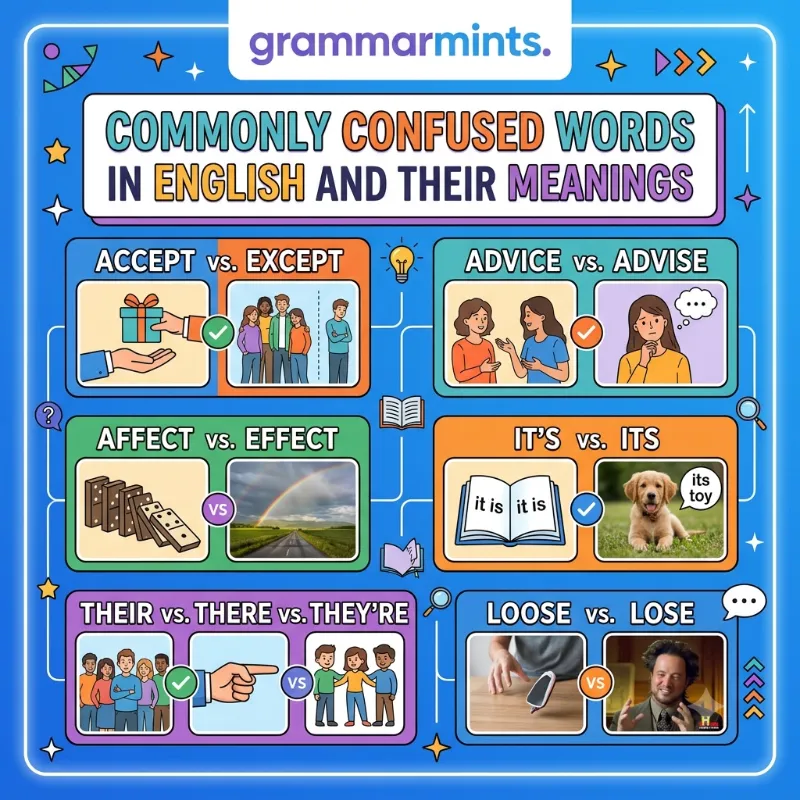
Commonly Confused Words List (Quick Overview)
The following table introduces several of the most words often confused by English learners and native speakers alike.
| Word Pair | Meaning Difference |
| Accept / Except | Receive vs Exclude |
| Affect / Effect | Influence vs Result |
| Advice / Advise | Noun vs Verb |
| Principal / Principle | Person vs Rule |
| Compliment / Complement | Praise vs Complete |
| Lose / Loose | Misplace vs Not Tight |
| Than / Then | Comparison vs Time |
| Farther / Further | Physical Distance vs Additional |
| Lay / Lie | Put Something Down vs Rest |
| Who / Whom | Subject vs Object |
Later in this guide, each pair includes detailed explanations and practical examples.
Real-Life Example: A Business Email Mistake
In 2024, a multinational customer support team reviewed thousands of internal emails during a communication quality project. One recurring issue involved confusing affect and effect. Employees often wrote, “This policy will have a negative affect,” when the correct noun should have been effect.
Synonyms and Antonyms List How to Expand Your Vocabulary
After a short vocabulary training program, editing time decreased noticeably because reviewers spent less time correcting repeated word-choice mistakes. Although the change seemed small, clearer communication improved workflow across multiple departments.
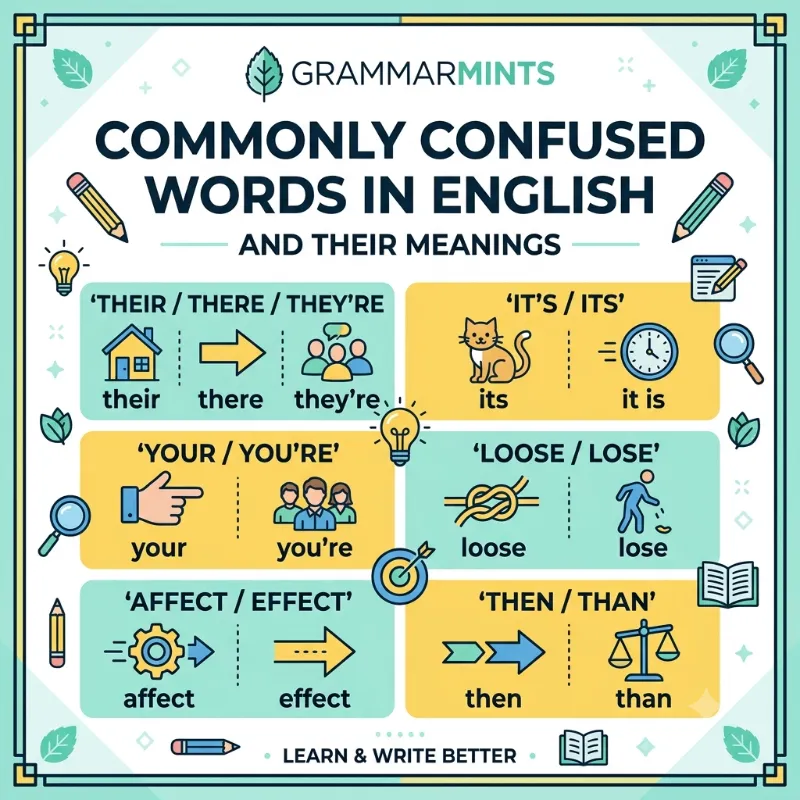
The lesson is simple: mastering a few commonly confused words can save time and reduce misunderstandings in professional settings.
Expert Tip: Learn Words in Pairs
Instead of memorizing hundreds of vocabulary words separately, group similar words together.
For example:
| Learn Together | Instead of Separately |
| Affect / Effect | Affect only |
| Accept / Except | Accept only |
| Their / There / They’re | Their only |
| Principal / Principle | Principal only |
This comparison method helps your brain notice important differences more quickly.
Memory Tricks That Actually Work
Many experienced English instructors recommend creating simple mental associations.
Examples include:
- Principal is your pal (school leader).
- Stationery has ER, just like Envelope.
- Dessert has two “S” letters because everyone wants a second serving.
- Lose loses one “O.”
- Too has an extra “O,” meaning “also” or “more.”
These tricks may seem simple, yet they make difficult vocabulary much easier to remember.
Mistakes That Can Change the Meaning of a Sentence
Consider these examples:
| Incorrect | Correct |
| I except your proposal. | I accept your proposal. |
| The medicine had no affect. | The medicine had no effect. |
| Your very kind. | You’re very kind. |
| Their going home. | They’re going home. |
| Please loose the rope. | Please lose the rope. |
Although each mistake involves only one word, the sentence becomes confusing or grammatically incorrect.
How Often Do These Mistakes Happen?
Studies from universities, writing centers, and language educators consistently identify confusing word pairs among the most common editing errors in English writing. Writing instructors also report that homophones, similar spellings, and noun–verb pairs frequently appear in student assignments, workplace documents, and online communication.
British vs American English Words: The Complete Guide to Meaning Differences
The chart below summarizes the relative frequency of major confusion categories based on educational observations.
| Error Category | Relative Frequency |
| Homophones | ██████████ 35% |
| Similar spellings | ████████ 28% |
| Noun vs Verb confusion | ██████ 18% |
| Similar meanings | █████ 12% |
| Other vocabulary issues | ███ 7% |
Illustrative summary based on trends reported by educational writing centers and language learning resources.
Improve Your Vocabulary with Reliable Resources
If you want to continue practicing after this guide, explore our complete collection of English vocabulary lessons on Grammarmints at https://grammarmints.com/. You can also read our detailed pillar guide on Commonly Confused Words at https://grammarmints.com/commonly-confused-words/ for additional explanations, quizzes, and practice exercises.
For academic guidance, the University of Illinois Springfield Learning Hub offers an excellent explanation of confusing word pairs:
https://www.uis.edu/learning-hub/writing-resources/handouts/learning-hub/commonly-confused-words
You can also explore practical vocabulary examples from:
https://www.hitbullseye.com/Vocab/English-Confusing-Words.php
Another helpful resource with detailed phrase comparisons is available from Wordvice:
https://wordvice.com/blog/commonly-confused-words-phrases/
What’s Coming Next
In the next section, we’ll examine the first 50 confusing word pairs in detail. Each explanation includes:
- Simple meanings
- Easy examples
- Common mistakes
- Memory tips
- Professional writing advice
- Everyday conversation examples
- Expert usage notes
By the end of the next section, you’ll already know many of the tricky english words that confuse millions of English learners every year.
50 Commonly Confused Words in English Explained
Now that you understand why these mistakes happen, let’s explore the most useful commonly confused words list. Each pair includes a simple meaning, real-life example, and an easy memory trick. These examples reflect situations you may face in school, work, travel, or daily conversations.
1. Accept vs. Except
| Word | Meaning | Example |
|---|---|---|
| Accept | To receive or agree | I accept your invitation. |
| Except | To exclude | Everyone came except Alex. |
Memory Tip: Accept starts with A for Agree.
2. Affect vs. Effect
| Word | Meaning | Example |
| Affect | Usually a verb meaning to influence | Lack of sleep can affect your focus. |
| Effect | Usually a noun meaning result | The new policy had a positive effect. |
Quick Rule: Affect = Action, Effect = End Result.
3. Advice vs. Advise
| Word | Meaning | Example |
| Advice | A noun | Thank you for your advice. |
| Advise | A verb | Doctors advise regular exercise. |
4. Principal vs. Principle
| Word | Meaning | Example |
| Principal | School head or most important | The principal welcomed students. |
| Principle | Rule or belief | Honesty is an important principle. |
Memory Tip: The principal is your pal.
5. Compliment vs. Complement
| Word | Meaning | Example |
| Compliment | Praise | She gave me a nice compliment. |
| Complement | Completes something | This sauce complements the meal. |
6. Lose vs. Loose
| Word | Meaning | Example |
| Lose | Misplace | Don’t lose your passport. |
| Loose | Not tight | My jacket feels loose. |
7. Then vs. Than
| Word | Meaning | Example |
| Then | Time | Finish your work, then relax. |
| Than | Comparison | Coffee is stronger than tea. |
8. There, Their, They’re
| Word | Meaning | Example |
| There | Place | Put the books over there. |
| Their | Possession | Their house is beautiful. |
| They’re | They are | They’re coming tomorrow. |
This is one of the most words often confused in English.
9. Your vs. You’re
| Word | Meaning | Example |
| Your | Possession | Is this your phone? |
| You’re | You are | You’re doing great. |
10. To, Too, Two
| Word | Meaning | Example |
| To | Direction | I’m going to London. |
| Too | Also | I want coffee too. |
| Two | Number | She has two brothers. |
Frequently Mixed-Up Verb Pairs
11. Lay vs. Lie
| Word | Meaning |
| Lay | Put something down |
| Lie | Rest yourself |
Examples:
- Lay the keys on the table.
- I need to lie down.
12. Sit vs. Set
| Word | Meaning |
| Sit | Be seated |
| Set | Place something |
13. Bring vs. Take
| Bring | Toward speaker |
| Take | Away from speaker |
Example:
Bring your laptop here.
Take these papers home.
14. Borrow vs. Lend
Borrow = Receive temporarily.
Lend = Give temporarily.
15. Raise vs. Rise
Raise requires an object.
Rise happens naturally.
Example:
The company will raise salaries.
The sun rises every morning.
Commonly Confused Business Words
Business writing often contains vocabulary mistakes because many professional words sound similar.
| Wrong Pair | Correct Usage |
| Assure / Ensure | Different meanings |
| Historic / Historical | Different contexts |
| Economic / Economical | Different purposes |
| Capital / Capitol | Business vs building |
Learning these distinctions makes reports and emails more professional.
16. Assure vs. Ensure vs. Insure
Assure = Promise someone.
Ensure = Make certain.
Insure = Provide insurance.
Examples:
- I assure you everything is fine.
- Double-check to ensure accuracy.
- We insured our car last year.
17. Historic vs. Historical
Historic = Important in history.
Historical = Related to history.
18. Economic vs. Economical
Economic = Related to the economy.
Economical = Saves money.
19. Capital vs. Capitol
Capital = City or money.
Capitol = Government building.
20. Emigrate vs. Immigrate
Emigrate = Leave a country.
Immigrate = Enter another country.
Example:
She emigrated from Spain.
She immigrated to Canada.
Commonly Confused Academic Words
Students often mix these words in essays.
| Pair | Difference |
| Cite / Site / Sight | Reference / Place / Vision |
| Moral / Morale | Ethics / Team spirit |
| Farther / Further | Distance / Additional |
| Who / Whom | Subject / Object |
21. Cite vs. Site vs. Sight
Cite = Mention a source.
Site = Location.
Sight = Vision.
22. Moral vs. Morale
Moral = Ethical lesson.
Morale = Team confidence.
23. Farther vs. Further
Farther = Physical distance.
Further = Additional information.
24. Who vs. Whom
Who performs the action.
Whom receives the action.
Simple trick:
If you can replace it with “he,” use who.
If you can replace it with “him,” use whom.
25. Its vs. It’s
Its = Possession.
It’s = It is.
Example:
It’s raining.
The dog wagged its tail.
More Tricky English Words
26. Peak vs. Peek vs. Pique
Peak = Highest point.
Peek = Quick look.
Pique = Stimulate interest.
27. Brake vs. Break
Brake stops movement.
Break means damage.
28. Desert vs. Dessert
Desert = Dry land.
Dessert = Sweet food.
Memory tip:
Dessert has two “S” letters because most people want a second serving.
29. Weather vs. Whether
Weather = Climate.
Whether = If.
30. Stationary vs. Stationery
Stationary = Not moving.
Stationery = Paper supplies.
Everyday English Confusing Words
31. Beside vs. Besides
Beside = Next to.
Besides = In addition.
32. Allusion vs. Illusion
Allusion = Indirect reference.
Illusion = False appearance.
33. Elicit vs. Illicit
Elicit = Draw out information.
Illicit = Illegal.
34. Altogether vs. All Together
Altogether = Completely.
All together = Everyone together.
35. Continual vs. Continuous
Continual = Repeated interruptions.
Continuous = Without stopping.
Writing Mistakes Professionals Still Make
Editors regularly find these confusing pairs in resumes and reports.
36. Among vs. Between
Between = Two people.
Among = Three or more.
37. Farther vs. Further
Distance versus additional discussion.
38. Every Day vs. Everyday
Every day = Daily.
Everyday = Ordinary.
39. Later vs. Latter
Later = Time.
Latter = Second of two.
40. Personal vs. Personnel
Personal = Private.
Personnel = Employees.
Less Common but Important Word Pairs
41. Canvas vs. Canvass
Canvas = Fabric.
Canvass = Seek opinions.
42. Device vs. Devise
Device = Object.
Devise = Invent.
43. Passed vs. Past
Passed = Verb.
Past = Time.
44. Quiet vs. Quite
Quiet = Silent.
Quite = Fairly or completely.
45. Council vs. Counsel
Council = Group.
Counsel = Advice or lawyer.
46. Eruption vs. Irruption
Eruption = Volcano.
Irruption = Sudden invasion.
47. Human vs. Humane
Human = Person.
Humane = Kind.
48. Explicit vs. Implicit
Explicit = Clearly stated.
Implicit = Implied.
49. Loose vs. Lose
One of the most common typing mistakes online.
Correct:
I don’t want to lose my wallet.
The screw is loose.
50. Respectfully vs. Respectively
Respectfully = Politely.
Respectively = In the same order.
Quick Revision Table
| Pair | Easy Memory Rule |
| Accept / Except | Accept = Receive |
| Affect / Effect | Affect = Verb |
| Advice / Advise | Advice = Thing |
| Lose / Loose | Lose loses an “O” |
| Than / Then | Than compares |
| Principal / Principle | Principal is your pal |
| Your / You’re | You’re = You are |
| Its / It’s | It’s = It is |
| Dessert / Desert | Dessert gets two “S” letters |
| Stationery / Stationary | ER = Envelope |
Five Practical Tips to Master Confusing Words
- Read high-quality English articles every day and notice how words are used in context.
- Keep a notebook of confusing word pairs and review it every week.
- Write one original sentence for each new word instead of memorizing definitions.
- Proofread emails and reports before sending them, especially if they contain similar-looking words.
- Practice with quizzes and flashcards to reinforce correct usage over time.
-
Phrasal Verbs Meaning Explained A Clear Guide for Everyday English
Expert Insight
Professional editors rarely rely on memory alone. Instead, they compare confusing words in context, review trusted grammar references, and revise their work carefully before publishing. Adopting the same habit will improve both your writing accuracy and confidence
Homophones List Words That Sound the Same but Mean Different Things
Advanced Confusing Words in English with Real-Life Examples
Once you understand the basics, you will notice that many advanced English words create confusion in professional writing, academic papers, and everyday conversations. The following examples explain these tricky english words with practical situations and expert advice. As a result, you can recognize mistakes before they appear in your own writing.
Advanced Commonly Confused Words List
51. Farther vs. Further
Although many people use these words interchangeably, they are not always the same.
| Word | Meaning | Example |
|---|---|---|
| Farther | Physical distance | We walked farther than expected. |
| Further | Additional information or time | Let me explain this further. |
Expert Tip: In modern English, further often works in both situations, but farther remains the better choice for measurable distance.
52. Who vs. Whom
Many writers avoid whom, yet it still appears in formal writing.
Examples:
✔ Who called you?
✔ Whom did you invite?
Quick test:
- He → Who
- Him → Whom
53. Imply vs. Infer
| Word | Meaning |
| Imply | Speaker suggests something |
| Infer | Listener reaches a conclusion |
Example:
The manager implied that changes were coming.
Employees inferred that a new policy would begin soon.
54. Compose vs. Comprise
Compose = Parts create the whole.
Comprise = Whole contains the parts.
Example:
Five departments compose the company.
The company comprises five departments.
55. Disinterested vs. Uninterested
Disinterested means neutral and unbiased.
Uninterested means not interested.
Journalists should remain disinterested, not uninterested.
Commonly Confused Business Words
Business communication requires precise vocabulary because a single incorrect word may change the intended meaning.
| Incorrect Choice | Better Choice |
| Assure accuracy | Ensure accuracy |
| Historic sales | Historical sales data |
| Economic option | Economical option |
| Principal reason | Main reason |
Small corrections like these improve professionalism immediately.
Real Workplace Example
During a hiring process in 2025, a recruiter reviewed hundreds of resumes for marketing positions. One repeated mistake involved the words compliment and complement.
Several candidates wrote:
“My leadership skills compliment my technical knowledge.”
The correct sentence should have been:
“My leadership skills complement my technical knowledge.”
Although recruiters understood the intended meaning, careful editing created a stronger first impression.
Case Study: Email Communication
A medium-sized technology company trained customer support agents to reduce grammar mistakes in client emails. Before training, editors corrected many confusing word pairs such as:
- Your / You’re
- Its / It’s
- Affect / Effect
- Than / Then
After several weeks of targeted practice, quality reviews showed noticeably fewer vocabulary errors. Consequently, editing time decreased and customer satisfaction improved because emails became clearer and easier to understand.
Key takeaway: Learning just a few dozen confusing word pairs can improve professional communication without requiring advanced grammar knowledge.
Expert Analysis: Why Native Speakers Still Make These Mistakes
Even native English speakers confuse words because the brain often recognizes sounds before spelling. Therefore, similar pronunciations can lead to automatic typing errors, especially during fast writing.
Language editors recommend slowing down during proofreading. Instead of reading for ideas only, read each sentence one word at a time. This simple habit catches many vocabulary mistakes before publication.
Evidence-Based Writing Strategy
Educational research on vocabulary development consistently shows that learners remember words more effectively when they:
- Read authentic examples
- Write original sentences
- Compare similar words
- Review vocabulary regularly
- Receive immediate feedback
For that reason, many language instructors teach confusing words in pairs rather than isolated lists.
Confusing Words by Category
Academic Writing
| Word Pair | Common Mistake |
| Cite / Site | Using “site” in research papers |
| Affect / Effect | Mixing noun and verb forms |
| Principle / Principal | Choosing the wrong spelling |
| Advice / Advise | Confusing noun and verb |
Business Writing
| Word Pair | Typical Situation |
| Ensure / Assure | Emails |
| Personal / Personnel | HR documents |
| Capital / Capitol | Financial reports |
| Complement / Compliment | Performance reviews |
Everyday Conversations
| Word Pair | Example |
| Your / You’re | Text messages |
| To / Too / Two | Social media |
| There / Their / They’re | Emails |
| Lose / Loose | Online comments |
Writing Exercise
Choose the correct word.
- I will (accept / except) the offer.
- The new law had a positive (affect / effect).
- This cake looks (desert / dessert).
- Please (advise / advice) me.
- They left (their / there) bags here.
Answers
- Accept
- Effect
- Dessert
- Advise
- Their
Quick Editing Checklist
Before publishing any document, ask yourself:
- Did I use your or you’re correctly?
- Is affect acting as a verb?
- Does effect describe the result?
- Did I confuse lose and loose?
- Did I compare than instead of using then?
- Are contractions written correctly?
- Have I proofread slowly?
This simple checklist prevents many common vocabulary mistakes.
Latest Language Usage Trends
Modern writing tools have reduced spelling mistakes, yet confusing words remain common because spell-checkers cannot always recognize context.
For example:
Spell-check accepts:
“I except your invitation.”
However, the sentence is still incorrect because accept is the proper word.
This explains why proofreading remains essential, even when using grammar software.
Illustrative Chart: Common Categories of Confusing Word Errors
| Category | Estimated Share of Errors |
| Homophones | ██████████ 36% |
| Similar Spellings | ████████ 27% |
| Noun vs. Verb Pairs | ██████ 17% |
| Similar Meanings | █████ 13% |
| Other Vocabulary Issues | ███ 7% |
The chart summarizes trends commonly reported by educational writing centers and English-language instructors.
Self-Assessment Table
| Skill | Beginner | Intermediate | Advanced |
| Recognize confusing words | ✓ | ✓ | ✓ |
| Use correct meaning | ✓ | ✓ | |
| Explain differences | ✓ | ||
| Edit professional writing | ✓ |
If you can confidently complete the final column, you have developed a strong understanding of these vocabulary pairs.
Practice Challenge
Rewrite the following incorrect sentences.
- Your going too love this movie.
- I except your apology.
- The medicine had no affect.
- Their going too school.
- Please loose the knot.
Correct Answers
- You’re going to love this movie.
- I accept your apology.
- The medicine had no effect.
- They’re going to school.
- Please loosen the knot. (If the intention is to make it less tight.)
Expert Writing Habits
Professional editors often follow the same routine before publishing an article:
- Write the first draft without worrying about perfection.
- Review confusing word pairs separately.
- Read the text aloud to identify awkward wording.
- Check grammar using trusted resources.
- Proofread one final time before publishing.
These habits save time because they prevent repeated corrections later.
Practical Insights from Daily Communication
Whether you are writing an academic assignment, preparing a business proposal, or posting on social media, correct word choice builds credibility. Readers notice accurate language, even if they do not consciously think about it. Therefore, investing a few minutes in careful proofreading can make your writing clearer, more professional, and easier to understand.
Frequently Asked Questions (FAQ)
What are confusing words in English?
Confusing words in English are words that have similar spellings, pronunciations, or meanings but different uses. Examples include accept/except, affect/effect, and your/you’re. Learning the correct usage improves writing, speaking, and overall communication.
Why do people confuse English words?
People confuse English words because many words sound alike, look similar, or come from different language origins. In addition, autocorrect tools cannot always recognize the correct meaning based on context.
What is the easiest way to remember confusing words?
The best method is to learn words in pairs, create simple memory tricks, and practice using each word in complete sentences. Reading quality English content regularly also strengthens long-term memory.
Which confusing words are used most often?
Some of the most frequently confused words include:
- Accept vs. Except
- Affect vs. Effect
- Advice vs. Advise
- Lose vs. Loose
- Than vs. Then
- Your vs. You’re
- There, Their, They’re
- Its vs. It’s
- Principal vs. Principle
- Compliment vs. Complement
These pairs appear regularly in emails, academic writing, social media, and business communication.
Can grammar tools fix confusing words?
Grammar tools are helpful, but they are not perfect. Many tools detect spelling mistakes, yet they may miss context-based errors. Therefore, proofreading your work remains one of the most reliable ways to catch confusing word mistakes.
How can I improve my English vocabulary faster?
You can improve more quickly by:
- Reading books, articles, and newspapers daily.
- Writing short paragraphs using new vocabulary.
- Reviewing confusing word pairs every week.
- Practicing with quizzes and flashcards.
- Learning from trusted grammar resources.
Consistency matters more than memorizing long vocabulary lists.
Quick Reference Table
| Confusing Word Pair | Correct Meaning |
|---|---|
| Accept / Except | Receive / Exclude |
| Affect / Effect | Influence / Result |
| Advice / Advise | Noun / Verb |
| Principal / Principle | School leader or most important / Rule or belief |
| Compliment / Complement | Praise / Complete something |
| Lose / Loose | Misplace / Not tight |
| Than / Then | Comparison / Time |
| Your / You’re | Possession / You are |
| Their / There / They’re | Possession / Place / They are |
| Dessert / Desert | Sweet food / Dry land |
Final Expert Recommendations
After teaching and editing English content for many years, one lesson stands out: learning confusing words is not about memorizing hundreds of definitions. Instead, it is about recognizing patterns and applying them consistently in real situations.
Whenever you learn a new confusing word pair:
- Read the definition.
- Compare both words side by side.
- Write your own example sentence.
- Review the pair a few days later.
- Use it naturally in conversations or emails.
This simple routine builds confidence over time and reduces repeated mistakes.
Common Mistakes to Avoid
Many learners repeat the same errors because they focus only on spelling. Instead, pay attention to meaning and context.
Avoid these common habits:
- Guessing the correct word without checking.
- Relying completely on spell-check software.
- Memorizing definitions without examples.
- Ignoring proofreading before publishing.
- Learning too many word pairs at once.
Taking a slower, structured approach leads to better long-term results.
Key Takeaways
- English contains many words that look or sound alike but have different meanings.
- Understanding context is more important than memorizing definitions.
- Learning confusing words in pairs makes them easier to remember.
- Regular reading, writing, and proofreading improve vocabulary naturally.
- Small improvements in word choice can strengthen academic, professional, and personal communication.
Conclusion
Mastering confusing words in English is one of the simplest ways to become a more confident writer and speaker. Although these words often appear similar, understanding their meanings and practicing them in context helps you avoid common mistakes and communicate more clearly.
Start with the most frequently confused word pairs, review them regularly, and apply them in everyday writing. Over time, these small habits will improve your grammar, expand your vocabulary, and make your communication more accurate in school, at work, and in daily life.
References
The guidance and examples in this article are based on trusted educational and language-learning resources, including university writing centers, English vocabulary references, and professional editing practices. Readers are encouraged to explore the linked resources throughout this article for additional explanations, exercises, and examples.