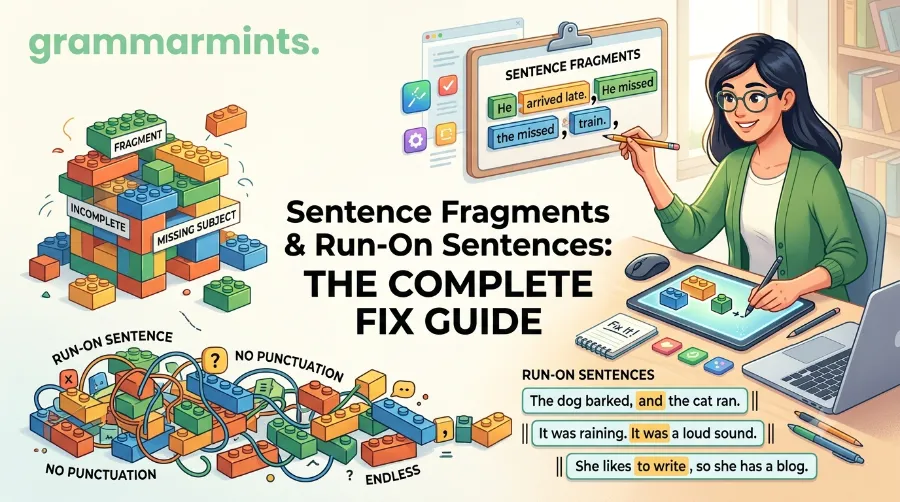
Sentence fragments and run-on sentences are two of the most common writing mistakes people make, whether they’re drafting an email, a school essay, or a blog post. Both errors can make your writing confusing, and both are easy to fix once you know what to look for. In this guide, we’ll break down what these errors look like, why they happen, and how you can catch them before you hit publish or submit.If you’ve ever wondered why a sentence “feels off” but couldn’t explain why, chances are a fragment or a run-on is the culprit. So, let’s clear things up.Before you can fix a problem, you need to recognize it. Here’s a simple breakdown of each error, along with the difference between them.
To get a better understanding of how improve English vocabulary breaks down exactly what to expect.
Sentence Fragments Explained
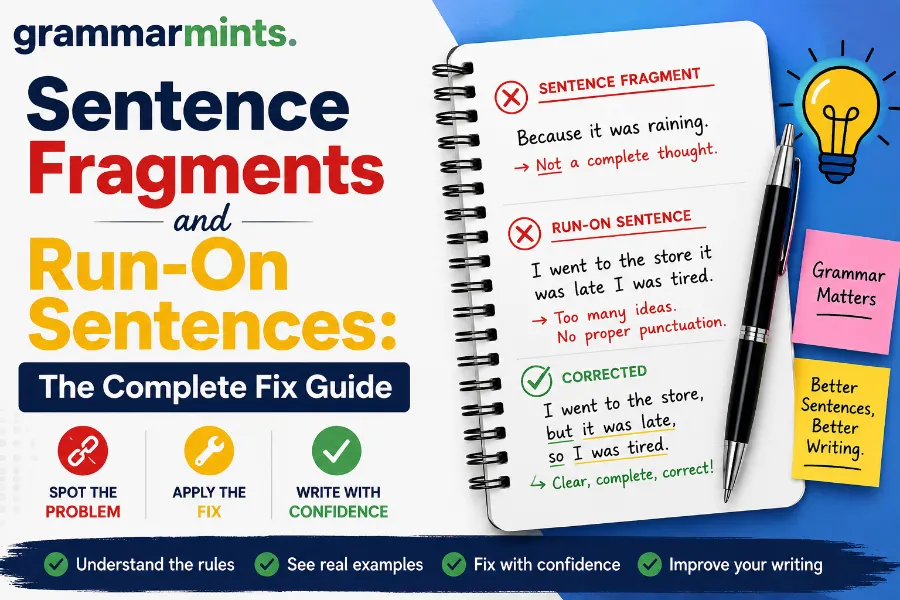
A sentence fragment is a group of words that looks like a sentence but is missing something important. Usually, it’s missing a subject, a verb, or a complete thought. For example, “Running through the park every morning” sounds like it belongs to a sentence, but it isn’t one. It’s a fragment because it never tells us who is running or what happened next.
To get a better understanding of how to speak English fluently at home breaks down exactly what to expect.
Fragments often sneak in when writers break a long sentence into pieces without checking that each piece can stand alone. They also show up a lot in casual writing, like text messages and social captions, where readers usually forgive the shortcut. In formal writing, though, fragments can make your work look unpolished.
If you want to learn more about best ai tools for students 2026 guide for practical tips and expert advice.
Run-On Sentences Explained
A run-on sentence happens when two or more complete thoughts are jammed together without the right punctuation or connecting word. For instance, “I finished the report I sent it to my manager” is a run-on because it contains two separate ideas with nothing joining them properly.
If you want to learn more about how to use ChatGPT for writing guide for practical tips and expert advice.
Run-on sentences aren’t the same as long sentences. A sentence can be long and still be grammatically correct, as long as its clauses are connected the right way. The trouble starts when a writer strings ideas together with only a comma, or with no punctuation at all, hoping the reader will sort it out.
Interestingly, this mistake isn’t rare or minor. According to a computational linguistics study on sentence-level grammar errors, run-on sentences rank among the top 20 most frequent errors made by college students in the United States, and they’re even more common among writers who learned English as a second language. That single data point shows just how widespread this issue really is, even among experienced writers.
Why These Two Errors Quietly Damage Your Writing
Readers form an opinion about your writing within the first few lines. If your sentences trail off unfinished or crash into each other without a pause, readers have to work harder to follow you. That extra effort often causes them to lose interest, skim past your message, or misread your point entirely.
This matters even more if you’re writing for the web. Search engines and readers both reward content that’s easy to scan and understand. Poor sentence structure doesn’t just annoy your audience, it also makes your writing harder to trust. If you want a deeper look at how sentence-level mistakes affect credibility, the Touro University Writing Center has a helpful breakdown of both errors with more examples.
Because these two mistakes are so closely tied to overall clarity, they usually show up alongside other common grammar mistakes, like shaky subject-verb agreement or misplaced punctuation. Fixing one issue often means you naturally clean up the others too.
How to Spot Sentence Fragments and Run-On Sentences
You don’t need a grammar degree to catch these errors. A quick, repeatable check works well for most writers. Try these steps every time you edit a paragraph:
- Read the sentence out loud. If you run out of breath or lose the thread halfway through, it’s likely a run-on.
- Ask “who” and “what.” Every complete sentence needs a subject doing an action. If you can’t answer both questions, you’re probably looking at a fragment.
- Count the independent clauses. If a sentence has two complete thoughts, check that they’re joined with a period, semicolon, or a comma plus a conjunction like “and,” “but,” or “so.”
- Watch for comma-only joins. A comma alone can rarely connect two complete sentences; this specific mistake is often called a comma splice, and it’s closely related to run-ons. Our guide on comma rules covers this in more detail.
- Read backward, sentence by sentence. Reading your paragraph from the last sentence to the first forces you to judge each sentence on its own, without the flow of the paragraph covering up gaps.
Real-Life Examples With Fixes
Seeing the mistake and the fix side by side makes the pattern much easier to remember. Here’s a table with common examples, including a couple pulled from everyday writing situations.
| Situation | Original (Incorrect) | Fixed Version |
|---|---|---|
| Work email, sent March 2024 | “Attached is the Q1 report. Which covers January through March.” | “Attached is the Q1 report, which covers January through March.” |
| Student essay draft | “The French Revolution began in 1789 it changed Europe forever.” | “The French Revolution began in 1789, and it changed Europe forever.” |
| Blog introduction | “Because the market shifted so quickly.” | “The market shifted so quickly that most retailers had to change strategy within 90 days.” |
| Cover letter line | “I managed five projects, I delivered all of them on time.” | “I managed five projects, and I delivered all of them on time.” |
| Social media caption | “Woke up early. Made coffee. Feeling great today.” | Left as is (fragments are acceptable in casual, stylistic writing like captions). |
Notice that the last row is intentional. Fragments aren’t always wrong; professional writers use them for style and rhythm all the time. The problem only appears when a fragment shows up by accident in formal writing, like a cover letter or a business email, where clarity and polish matter most.
Quick Fixes You Can Apply Today
Once you’ve spotted the error, fixing it usually takes just one of these five approaches:
- Split it into two sentences. This is the fastest fix for most run-ons.
- Add a coordinating conjunction. Words like “and,” “but,” “or,” and “so” connect two full thoughts smoothly.
- Use a semicolon. This works well when both clauses are closely related in meaning.
- Attach the fragment to a nearby sentence. Most fragments just need to be joined to the sentence before or after them.
- Add the missing subject or verb. Sometimes a fragment only needs one or two extra words to become complete.
If you’re not sure which fix suits your sentence, read the UNC Writing Center’s guide to fragments and run-ons, which walks through several before-and-after examples in plain language.
Sentence Fragments and Run-On Sentences: A Quick Data Snapshot
To put these two errors in context, here’s how they typically rank against other common grammar mistakes writers make, based on general findings from writing centers and grammar research.
| Grammar Mistake | How Often Writers Make It | Typical Root Cause |
|---|---|---|
| Run-on sentences | Very common, especially under time pressure | Skipping punctuation between two full ideas |
| Sentence fragments | Common in first drafts | Breaking long sentences without checking each part |
| Comma splices | Common, closely related to run-ons | Using only a comma to join two full sentences |
| Subject-verb agreement errors | Frequent, especially with collective nouns | Losing track of the subject in a long sentence |
| Apostrophe misuse | Frequent in casual writing | Confusing contractions with possessives |
As the table shows, fragments and run-ons don’t exist in isolation. They usually travel together with other small grammar slips, which is why editing for one almost always improves the rest of your writing too. If apostrophes trip you up as well, our apostrophe rules guide is worth a quick read.
Where These Mistakes Show Up Most Often
Some writing situations are more prone to fragments and run-ons than others. Here’s where we see them most:
- Essay introductions, where writers try to pack a big idea into one sentence. Our essay introduction guide shows how to open strong without losing clarity.
- Emails written quickly, especially on mobile devices, where punctuation gets skipped under time pressure. See our professional email guide for a cleaner structure.
- Long paragraphs with no breaks, where one idea bleeds into the next. Our paragraph writing guide explains how to structure ideas so each one gets room to breathe.
- Transitions between ideas, when writers aren’t sure how to link two thoughts smoothly. A list of solid transition words for essays can help bridge sentences without creating a run-on.
Frequently Asked Questions
What is the easiest way to tell a fragment from a full sentence? Check for a subject and a verb that together express a complete thought. If either is missing, it’s a fragment.
Are run-on sentences always long? No. A run-on can be short, like “I’m tired I want to sleep.” Length isn’t the problem; missing punctuation between two complete ideas is.
Can fragments ever be correct in professional writing? Yes, in small doses. Marketing copy, headlines, and captions often use fragments on purpose for punch and rhythm. The key is that it looks intentional, not accidental.
Is a comma splice the same as a run-on sentence? They’re related but not identical. A comma splice uses only a comma to join two full sentences, while a run-on sentence often skips punctuation entirely. Both are usually fixed the same way.
What tool can help me catch these errors automatically? Grammar checkers can flag likely fragments and run-ons, but they aren’t perfect. Reading your work aloud, or using the step-by-step check above, still catches issues that software sometimes misses.
Conclusion
Sentence fragments and run-on sentences are small mistakes with a big impact on how readers experience your writing. The good news is that both are easy to catch once you know the signs, and even easier to fix with a few simple techniques. Read your sentences aloud, check for a clear subject and verb, and watch how you’re joining your ideas together. Do that consistently, and your writing will read cleaner, feel more confident, and hold your reader’s attention from the first line to the last.
References
- Touro University Writing Center. “Run-on Sentences/Sentence Fragments.” touro.edu.
- UNC Writing Center. “Fragments and Run-ons.” writingcenter.unc.edu.
- Leacock, C., et al. (2014). Research on grammatical error frequency among U.S. college writers, cited in computational linguistics literature on run-on sentence correction.