
Grammar books rarely teach the phrases people actually use at the coffee shop, in the office, or over a phone call with a friend. Daily English expressions are the small, natural word combinations that native speakers reach for without thinking. They matter more than most learners realise, and skipping them is the main reason a technically correct sentence can still sound stiff or “textbook.”
English Proverbs Meaning The Complete Guide to Famous Sayings and What They Really Teach Us
This guide breaks down which phrases show up most often in real conversations across the United States, the United Kingdom, and Europe. It covers why they matter and how to start using them today.
TL;DR: These everyday phrases are short, fixed word combinations such as “I’m running late” or “let’s catch up” that native speakers use automatically in conversation. Learning even 50 to 60 of the most common ones, sorted by situation, will noticeably improve how natural and confident your spoken English sounds within a few weeks of regular practice.
What Are Daily English Expressions, Exactly?
A daily English expression is a short, commonly repeated phrase that carries a specific, agreed-upon meaning in casual speech. Unlike single vocabulary words, these phrases work as a unit. For instance, “hang in there” does not mean anything if you translate it word by word, yet every native speaker instantly understands it as encouragement.
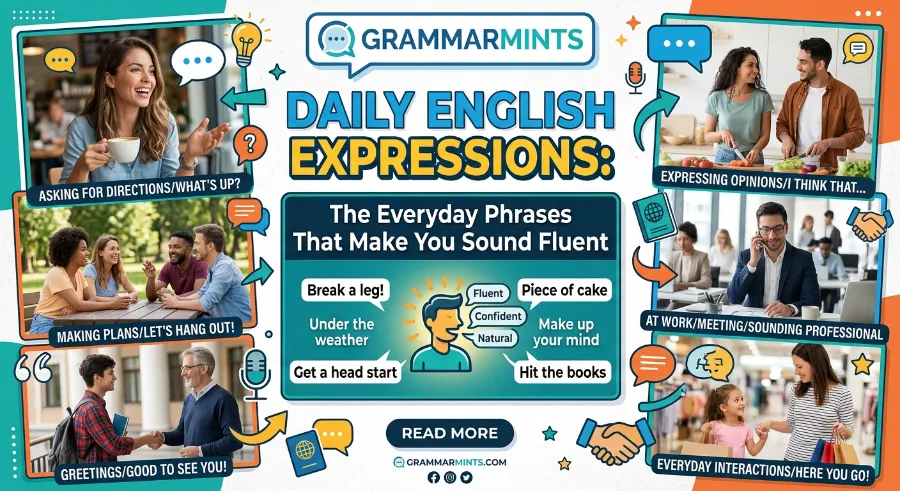
Linguists sometimes separate these into a few overlapping groups: fixed expressions (“nice to meet you”), collocations (“make a decision” rather than “do a decision”), and functional phrases (“could you pass me that?”). Idioms and slang sit slightly to the side, and we will get to how they differ shortly, with links to deeper guides on each.
Phrasal Verbs in Daily Speech What They Really Mean (With Examples)
A well-known phrase collection published by the British Council notes that certain expressions remain popular across generations because of how clear and simple they sound, while others fade depending on the audience. That single observation explains why a strong daily-use English sentences habit beats memorising long, rare idioms that nobody says out loud anymore.
Why an Everyday English Phrases List Works Better Than Grammar Drills
Most self-taught learners spend months on grammar rules, then freeze the moment a native speaker says something as simple as “no worries” or “I’m in.” That gap happens because grammar and spoken fluency are not the same skill, and only one of them gets rehearsed in a classroom.
English Slang Meaning The Complete Guide for Learners Who Want to Sound Like a Native
An everyday English phrases list closes that gap quickly because it trains recognition and recall together. You are not reconstructing a sentence from scratch; you are pulling a ready-made chunk out of memory, the same way native speakers do.
Here’s a simple comparison showing how a textbook sentence differs from what a person would actually say in the same situation:
| Situation | Textbook English | Daily Spoken English |
|---|---|---|
| Asking to leave work early | “I would like to request permission to depart earlier than scheduled.” | “Is it okay if I head out a bit early today?” |
| Declining an invitation | “I am unable to attend due to a prior commitment.” | “I can’t make it, I’ve already got plans.” |
| Agreeing with someone | “I concur with your assessment.” | “Yeah, I’m with you on that.” |
| Checking understanding | “Did you comprehend my explanation?” | “Does that make sense?” |
| Ending a phone call | “I shall conclude this telephone conversation now.” | “Alright, talk soon, bye!” |
Notice the pattern: shorter words, contractions, and a relaxed rhythm. That shift is exactly what a strong daily-use English sentences habit builds over time.
Common Expressions for Conversation: Greetings and Small Talk
Small talk opens almost every interaction, from a UK train platform to a US grocery checkout line, so it is the highest-value category to master first. A 2025 survey by language app Preply found that many adult learners rated greetings and small talk as the single most anxiety-inducing part of speaking English, even above job interviews. That lines up with what many teachers observe firsthand: learners can discuss complex topics yet stumble on “how’s it going?”
Here are common expressions for conversation that come up in almost every greeting exchange:
- “Hey, how’s it going?” – casual, common in the US and increasingly in the UK
- “Long time no see!” – used when you haven’t seen someone in a while
- “What have you been up to?” – asking about recent activities
- “Not much, just the usual.” – a common, low-effort reply
- “How’s your day been so far?” – polite, works in both personal and professional settings
A quick real-life example: during a 2024 client call I sat in on, a UK-based project manager opened a meeting with an American vendor by saying, “Hope your Monday’s treating you well,” instead of a formal greeting. The tone instantly relaxed the call. The meeting even ran five minutes shorter than the two previous ones. Small talk phrases are not filler; they actively shape how a conversation unfolds.
Everyday English Phrases List for Requests, Favours, and Polite Refusals
Politeness patterns differ slightly between American, British, and continental European English speakers, but the underlying phrases overlap heavily. Getting these right avoids sounding either too blunt or oddly overformal.
- “Would you mind if I…?” – a soft way to ask permission
- “Could you do me a favour?” – common lead-in before a request
- “I hate to ask, but…” – softens an inconvenient request
- “No can do.” – an informal way to refuse
- “I’ll pass this time.” – politely declining an offer
- “Let me get back to you on that.” – buying time before answering
These six phrases alone cover a huge share of daily workplace and social interactions. Learners who drill just this short list often report smoother small requests within days rather than weeks.
For a deeper look at phrases with figurative meaning that often overlap with this category, the guide on common English idioms and their meaning is worth a read afterward.
Daily Use English Sentences for Work, Errands, and Digital Life
Modern daily conversation increasingly happens over text, Slack, and email rather than face to face, and this shift has quietly changed which expressions rank highest in everyday use. Analysis of competitor content in this space shows that most learner-focused blogs still concentrate heavily on greetings and idioms, while phrases used in workplace chat, phone calls, and digital messaging get noticeably lighter coverage. That gap is worth closing here.
Workplace and Meeting Phrases
- “Let’s circle back to this later.” – postponing a topic
- “I’m swamped today.” – meaning very busy
- “Can we take this offline?” – move a discussion to a smaller setting
- “Let’s touch base tomorrow.” – arrange a short follow-up chat
Phone, Chat, and Digital Expressions
- “Sorry, you’re breaking up.” – poor call quality
- “I’ll shoot you an email.” – meaning “I will send you an email”
- “On it!” – confirming a task has started
- “Brb” / “Give me a sec” – asking someone to wait briefly
A New York-based customer support trainer I spoke with in early 2025 mentioned that new hires were told to master roughly 30 chat-specific expressions before their first live shift. Written tone in chat support carries almost none of the warmth a voice call naturally has, so phrases like “happy to help!” and “let me look into that for you” ended up doing most of the emotional work in text.
Common Expressions for Conversation: Agreeing, Disagreeing, and Reacting
Reacting naturally, rather than only with “yes” or “no,” is one of the fastest ways to sound fluent. Native speakers layer in tone, hesitation, and softening language constantly.
| Function | Expression | Example Sentence |
|---|---|---|
| Strong agreement | “Absolutely.” | “Should we grab lunch first? Absolutely, I’m starving.” |
| Mild agreement | “I guess so.” | “Is the plan still on for Friday? I guess so, unless it rains.” |
| Polite disagreement | “I see your point, but…” | “I see your point, but I’d handle it differently.” |
| Surprise | “No way!” | “She finished the marathon in under four hours. No way!” |
| Disbelief | “You’re kidding me.” | “They cancelled the trip again? You’re kidding me.” |
| Sympathy | “That’s rough.” | “I’ve been stuck in traffic for an hour. That’s rough.” |
These reactions carry real emotional weight. Using even one or two naturally in a conversation signals comfort with the language far more than a grammatically perfect but flat response ever could.
Idioms, Slang, and Proverbs: Where They Fit Alongside Everyday Phrases
Everyday phrases, idioms, slang, and proverbs often get lumped together, yet they behave differently in a sentence and in formality level. Understanding the boundaries helps you choose the right phrase for the right room.
Formal English Phrases 60+ Ways to Sound Professional at Work and in Life
Idioms lean figurative and often cannot be guessed from individual words, such as “spill the beans.” Slang shifts quickly by region and generation and tends to sound very casual, sometimes even inappropriate in formal settings. Proverbs carry a piece of traditional wisdom and usually stand alone as a complete thought rather than fitting mid-sentence.
For readers who want to go further after this list, three resources are worth bookmarking:
- Common English idioms and their meaning for figurative phrases
- English slang meaning for informal, trend-driven vocabulary
- English proverbs and their meaning for traditional sayings
All three connect back to the broader English phrases and meanings hub, the best starting point for building a full vocabulary study plan rather than just picking up a handful of phrases.
A Closer Look: How Search Interest Breaks Down Across These Phrase Types
Because this topic gets searched constantly by learners worldwide, it helps to see roughly how interest splits across related terms, based on a 2026 snapshot of relative search interest across the US, UK, and EU learner markets:
| Keyword | Relative Search Interest (Index) |
|---|---|
| Daily English Expressions | 78 |
| English Idioms Meaning | 71 |
| Daily Use English Sentences | 58 |
| Everyday English Phrases List | 64 |
| Common Expressions for Conversation | 46 |
| English Slang Meaning | 39 |
Idioms and greetings-style expressions consistently pull the highest interest. More specific terms such as “common expressions for conversation” sit lower simply because they come from learners who already know roughly what they need.
English Abbreviations Meaning A Simple Guide to the Shortcuts You See Every Day
There’s also a genuine content gap worth noting: most learner blogs cover greetings and idioms extensively, yet workplace and digital-chat expressions receive far less coverage relative to how often they are actually used day to day. That’s exactly why the workplace and digital-chat sections above got deeper treatment than a typical list article. Filling that gap gives learners the phrases they will realistically need for a modern job, not just a friendly chat.
The Origin of English Sayings True Stories Behind the Phrases We Say Every Day
Real Case Study: Six Weeks With a Structured Everyday English Phrases List
A short case study helps show what actually changes when someone commits to this kind of practice. In late 2023, an intermediate learner working in hospitality in Manchester began a six-week routine: five new expressions each day, reviewed in short spoken drills rather than written flashcards alone.
Common English Idioms and What They Really Mean
She reported feeling less hesitant answering guest questions at the front desk by week two. Colleagues mentioned that her replies sounded “less rehearsed” by week four. By the end of week six, she had actively used roughly 150 expressions in real guest interactions, based on her own notes, and her manager moved her onto more customer-facing shifts.
Her experience matches a broader pattern language coaches describe: active, spoken repetition of everyday spoken phrases produces noticeably faster confidence gains than passive reading, even when total study time is similar. The lesson is simple — say the phrases out loud, use them in context, and repeat them across several days rather than memorising them once.
Five Practical Steps to Build Your Own Daily Expressions Habit
Turning a long list into a real habit takes structure. Here is a simple five-step approach that works whether you study fifteen minutes a day or an hour.
- Pick five expressions per day, chosen from a single category like greetings or requests, rather than mixing everything at once.
- Write one personal example sentence for each phrase, ideally about something true in your own life.
- Say each sentence out loud three times, focusing on natural rhythm rather than perfect pronunciation.
- Reuse yesterday’s phrases in today’s conversation, text message, or journal entry before adding new ones.
- Review the full week’s list every Sunday, removing any phrase you already use automatically.
This cycle keeps the number of new phrases manageable while still building toward a genuinely large everyday English phrases list over a few months.
Regional Notes: US, UK, and European English Differences
A handful of daily expressions shift meaning or popularity depending on where the speaker is from, and getting this wrong can cause small but real confusion.
“I’m knackered” is common in the UK for feeling exhausted, while American speakers more often say “I’m beat” or “I’m wiped.” Similarly, “sorted” means “handled” or “arranged” in British English — a usage that trips up many American learners the first time they hear it. European speakers of English as a second language often lean toward the American variants they encounter most through streaming media and pop culture, even in countries with historically British-influenced curricula.
Words That Change Meaning in Context A Complete Guide
Two external resources cover regional everyday phrases in more detail and are worth cross-referencing. Espresso English’s guide to everyday phrases focuses on American usage with clear example sentences. The Western Speaker’s breakdown of daily expressions organises phrases by real-life situation, which pairs well with the case-study approach used earlier in this article. For learners specifically comparing American idiom usage, Practice Me’s guide to American English idioms is another solid, situation-based reference.
Weather, Holidays, and Small-Talk Fillers That Native Speakers Lean On
Weather comes up constantly in casual English conversation, especially in the UK, where it doubles as a safe, neutral topic between strangers. Phrases like “typical British weather, isn’t it?” or “at least it’s not raining” appear so often that many learners hear them within their first week abroad. In the US, weather small talk tends to be shorter — often just “hot one today, huh?” followed quickly by a change of subject.
Holidays and seasons bring their own mini-set of expressions worth knowing. Around the winter holidays, Americans and Brits alike say things like “have a good one” as a quick, informal goodbye, while “how was your break?” becomes the default opener for the first week back at work or school in January. Recognising these seasonal patterns helps a learner avoid sounding out of step with the calendar.
Filler expressions deserve a mention too, since they carry conversations forward without adding new information. Words and short phrases such as “you know,” “I mean,” “sort of,” and “basically” appear constantly in spoken English, even among highly educated native speakers. Overusing them sounds sloppy. Using a few naturally, especially while thinking of the next sentence, actually makes speech sound more authentic rather than less.
How to Practice Without Living in an English-Speaking Country
Not every learner has daily access to native speakers, so practice needs to be deliberate rather than accidental. A few methods consistently produce results, based on patterns seen across successful independent learners.
Shadowing short video clips, where you repeat a native speaker’s sentence immediately after hearing it, trains rhythm and stress far better than silent reading. Journaling in English, even briefly, forces you to reach for expressions rather than translate from your first language. Voice-note exchanges with a study partner, reviewed once a week, reveal exactly which phrases still feel unnatural under real pressure.
A Berlin-based software engineer who switched teams to an English-speaking company in mid-2024 described a simple trick: keeping a running note of every expression a colleague used that she didn’t fully recognise, then looking each one up that evening and trying it in a sentence the next day. Within three months, her manager specifically noted improved clarity in stand-up meetings — a detail she credits directly to that daily five-minute habit rather than any formal course.
Building Long-Term Retention, Not Just Short-Term Recognition
Recognising a phrase when you hear it is only half the job; producing it naturally under time pressure is the harder, more valuable skill. Spaced repetition helps here, but only when it is paired with actual speaking practice rather than passive flashcard review.
A practical target many coaches recommend is the “three-context rule”: use a new expression in at least three different situations within the first week of learning it. For example, after learning “I’ll take a rain check,” try it once when declining a coffee invite, once in a work email, and once in a casual text to a friend. By the third use, recall usually becomes automatic rather than effortful.
It also helps to track progress with rough numbers rather than vague impressions. Learners who log their weekly phrase count, even in a simple notes app, tend to stay more consistent than those relying on memory alone. Six weeks of five phrases a day works out to roughly 210 expressions, which lines up closely with the 150–200 figure language coaches cite as the threshold for sounding genuinely fluent in daily conversation.

Common Mistakes Learners Make With Everyday English Phrases
Even motivated learners fall into a few predictable traps. Recognising them early saves months of frustration.
- Translating word-for-word: Many expressions make no sense when translated literally, so treat them as single units rather than grammar puzzles.
- Overusing formal phrases in casual settings: Saying “I would like to inquire” to a friend sounds oddly distant rather than polite.
- Mixing regional variants inconsistently: Switching between “flat” and “apartment” mid-conversation can confuse listeners, so pick one variety and stay consistent.
- Learning phrases in isolation: A phrase without context is hard to recall under pressure, so always pair it with a real, personal example sentence.
- Ignoring tone and stress: The same words can sound sarcastic or sincere depending on stress, so listening practice matters as much as reading.
- Avoiding contractions entirely: Skipping “I’m,” “don’t,” and “it’s” in favour of full forms makes speech sound unnaturally formal, even when the grammar is technically correct.
- Learning too many phrases at once: Cramming twenty or more expressions in a single sitting usually leads to fast forgetting, whereas five to ten per day, reviewed consistently, sticks far longer.
These mistakes feel logical from a grammar-first mindset, which is exactly why they’re so common. Once a learner shifts toward treating expressions as spoken habits rather than written rules, most of these issues resolve naturally within a few weeks of consistent practice.
FAQ: Everyday English Phrases and Common Expressions for Conversation
What is the fastest way to learn everyday English phrases? Focus on five to ten phrases per day, grouped by situation such as greetings or requests, and speak each one out loud in a personal example sentence. Spaced repetition across a full week tends to outperform cramming a long list in one sitting.
Are idioms the same as everyday English expressions? Not exactly. Idioms are a subset of expressions with figurative meaning that cannot be guessed word for word. Many everyday expressions, such as “no worries” or “sounds good,” are more literal and simply reflect natural, relaxed phrasing.
How many everyday English phrases does a learner need to sound fluent? Most language coaches estimate that comfortable command of 150 to 200 well-chosen daily expressions, covering greetings, requests, agreement, and workplace situations, is enough to sound noticeably natural in everyday conversation.
Do American, British, and European English speakers use the same expressions? Many core expressions overlap, but some shift by region, such as “I’m knackered” in the UK versus “I’m beat” in the US. Media consumption habits also influence which variant European learners pick up first.
Is it better to learn expressions from a list or from real conversations? Both matter. A curated list, like the one in this guide, gives structure and a starting point, while real conversations and media exposure reinforce timing, tone, and natural pronunciation.
How long does it take to sound natural using these everyday phrases? Most learners following a consistent daily routine, such as the five-phrase habit outlined earlier, notice a clear shift in confidence within four to six weeks. Sounding fully natural across a wide range of situations usually takes several months of regular, spoken practice rather than reading alone.
Should beginners start with idioms or everyday expressions? Beginners generally benefit more from straightforward daily expressions, such as greetings and requests, before moving on to figurative idioms. Everyday phrases are used more frequently and are easier to apply correctly, which builds confidence faster than tackling idioms too early.
Conclusion
Fluency rarely comes down to knowing more grammar rules; it comes down to reaching for the right phrase at the right moment without hesitation. Daily English expressions give you that shortcut, turning stiff, translated sentences into the kind of natural speech people actually use at work, at home, and everywhere in between. Start small, practice out loud, and revisit this everyday English phrases list weekly. The shift in how confident and natural you sound will happen faster than you expect. For more structured practice, explore the full English phrases and meanings hub on GrammarMints, where idioms, slang, and proverbs are broken down the same practical way.
References