You have studied grammar for years. You know your past perfect from your present continuous. Then a native speaker says “that’s so mid” or “I’m dead broke, no cap,” and you freeze. This is exactly why so many learners search for english slang meaning every single day — textbooks simply do not teach this side of the language.
So, before we go further, here is the short version.
TL;DR: Slang covers the informal words and phrases native speakers use daily that rarely appear in textbooks, such as “lit,” “salty,” or “rizz.” Learning around 50-60 high-frequency terms, along with the context in which people use them, is usually enough to follow most everyday conversations in the US, UK, and across English-speaking Europe. This guide breaks those words down by category, with real examples and a simple table you can bookmark.
This gap between classroom English and real English is not just your imagination. According to a 2025 Preply survey of nearly 2,000 English speakers, 50% of Americans use slang terms without knowing what they actually mean, and 20% admit they use slang in every single conversation. If native speakers themselves get confused, it makes sense that learners feel lost too. That is exactly why we built this guide — to walk you through common slang words meaning, where each term comes from, and how to use it without embarrassing yourself at the coffee shop.
Daily English Expressions The Everyday Phrases That Make You Sound Fluent
I have taught English to adult learners in London and online for over a decade, and slang questions come up in almost every single lesson. This article pulls together classroom experience, recent language research, and fresh 2026 data so you get something practical, not just a dictionary dump.
English Proverbs Meaning The Complete Guide to Famous Sayings and What They Really Teach Us
What Does “Slang” Actually Mean in English?
Slang is informal vocabulary that groups of people use in casual speech, and it rarely shows up in formal writing or business emails. It usually starts within a smaller community — teenagers, a city neighbourhood, a fandom, or an online platform — and then spreads outward once enough people pick it up.
Slang is different from an idiom. An idiom, like “it’s raining cats and dogs,” has a fixed meaning that does not change much over decades. Slang, on the other hand, shifts constantly, and a word can mean something completely different five years later. If idioms interest you too, our complete guide to common English idioms covers that side of informal English in detail.
A few features make slang easy to spot once you know what to look for:
- It sounds casual and would feel out of place in a job interview or a formal essay.
- It often has a short shelf life — some words fade out within a year or two.
- It changes meaning depending on tone, region, or even punctuation in a text message.
- It frequently comes from music, television, sport, or, these days, social media trends.
English Slang Meaning: Why It Matters for Fluency
Some teachers will tell you slang is optional. I disagree, and here is why. Fluency is not just about grammar accuracy; it is about understanding what is actually being said to you. If a colleague in New York tells you a project is “a total mess, no cap,” and you do not understand “no cap,” you miss half the sentence.
English Slang Meaning The Complete Guide for Learners Who Want to Sound Like a Native
Understanding informal vocabulary also builds cultural confidence. It helps you follow films, podcasts, sitcoms, and casual conversations without constantly pausing to look words up. In one Preply classroom case study from a recent semester, a student who practised idioms and slang through episodes of Friends reported feeling noticeably more confident in real, unscripted conversations within a few weeks. That improvement came directly from exposure to dating-related slang and idioms used in natural context, rather than from a vocabulary list alone.
Common English Idioms and What They Really Mean
There is also a professional angle worth mentioning. The same Preply research found that 46% of Americans think it is appropriate to use slang in a professional setting, and 42% would use it in front of their boss. Workplace English is getting more casual, especially in tech, marketing, and startup culture, so learners heading into US or UK offices genuinely benefit from knowing this vocabulary.
Common Slang Words and Their Meanings
Let’s start with the classics. These are words you will hear constantly across the US, UK, Canada, and Australia, and they rarely go out of style completely.
| Slang Word | Meaning | Example Sentence |
|---|---|---|
| Lit | Exciting, amazing, or fun | “The concert last night was absolutely lit.” |
| Salty | Annoyed or bitter about something small | “He’s still salty about losing the match.” |
| Ghosted | Suddenly ignored by someone, especially online | “She texted him twice and got ghosted.” |
| On point | Done perfectly, exactly right | “Your presentation was on point today.” |
| Chill | Relaxed, calm, or “hang out casually” | “Let’s just chill at my place tonight.” |
| Legit | Genuine or real | “That’s a legit excuse, actually.” |
| Pain in the neck | Someone or something annoying | “My little brother is such a pain in the neck.” |
| For the birds | Worthless or not worth taking seriously | “His opinion on my outfit is for the birds.” |
| Jonesing | Craving something strongly | “I’m jonesing for a coffee right now.” |
| No biggie | Not a big deal | “You’re late? No biggie, we just started.” |
According to the same 2025 Preply data, the three most recognised slang words and phrases in America right now are “ghosted,” “salty,” and “on point” — which lines up with what I hear from students in almost every intermediate class.
Modern English Slang List: 2025-2026 Trending Words
Slang from social media moves fast, and honestly, it can be exhausting to keep up with even for native speakers. This next section is your modern english slang list for what is actually trending right now, based on genuine search and usage data rather than guesswork.
Phrasal Verbs in Daily Speech What They Really Mean (With Examples)
An analysis of Google Trends search data from January through September 2025 found some surprising numbers. “6-7,” a phrase with no fixed meaning that became a symbol of internet “brain rot” culture, was the most-searched confusing slang term of the year, with 141,000 lookups. It later attached itself to basketball player LaMelo Ball because of his height.
The Origin of English Sayings True Stories Behind the Phrases We Say Every Day
Here are some of the terms defining 2025 and 2026 conversations:
- Rizz — short for “charisma,” meaning the ability to flirt or charm someone smoothly. “He’s got serious rizz.”
- Mogging — outshining someone else in looks, skill, or success. It drew nearly 80,000 searches in the recent Google Trends analysis.
- Aura / Aura points — a distinct, cool energy someone gives off; “points” are earned or lost for impressive or embarrassing behaviour.
- Huzz — a flirty term for an attractive girl or group of girls, searched more than 61,000 times, quickly replacing older terms like “boo” or “bae”.
- Chopped — TikTok slang for someone unattractive, with roughly 59,000 searches, and the opposite of “ate” or “served.”
- Side quest — a small, unplanned detour in your day, borrowed from video game culture.
- Canon — used to joke about what “officially” counts as part of someone’s personal story, borrowed from fandom terminology.
- Looksmaxxing — trying to maximise your physical appearance through grooming, fitness, or style choices.
- Yapping — talking too much, often without saying much of value.
- Brain rot — the mental fog people joke about after consuming too much low-value short-form video content.
It is worth noting that slang evolves fastest among Gen Z and Gen Alpha, and a word can already feel dated by the time it reaches a wider audience. If you are a learner, focus on the terms that keep repeating across contexts rather than memorising every micro-trend.
Words That Change Meaning in Context A Complete Guide
Slang Words for Beginners: Start Here
If the list above feels overwhelming, take a breath. Not everyone needs to know “6-7” or “looksmaxxing” to get by in daily conversation. Here is a shorter, friendlier set of slang words for beginners that will serve you in almost any casual US or UK situation.
- Gonna / Wanna / Gotta — informal contractions of “going to,” “want to,” and “got to.”
- Awesome — great, impressive, or exciting.
- Dunno — a casual way of saying “I don’t know.”
- Hang out — to spend relaxed, casual time with friends.
- What’s up? — a casual greeting meaning “how are you?”
- Buck — informal American word for a dollar.
- BRB — “be right back,” common in texting and messaging.
- Same here — used to agree with what someone just said.
A practical tip from my own teaching notes: start by learning five slang words a week, and only use them in casual settings with friends, not in emails or formal writing. Slang used incorrectly, or in the wrong context, can sound strange rather than natural, so context always matters more than the word itself.
Formal English Phrases 60+ Ways to Sound Professional at Work and in Life
British vs American Slang: Know the Difference
Slang meaning also depends heavily on which side of the Atlantic you are on. British slang has its own history and character, shaped partly by regional dialects. Cockney Rhyming Slang, for example, originated in the East End of London and was reportedly used by criminals so police could not easily understand them — “have a butcher’s hook” simply means “have a look.”
English Abbreviations Meaning A Simple Guide to the Shortcuts You See Every Day
Regional differences show up across the UK too: Cockneys might say “apples and pears” for stairs, Liverpudlians might say “bird” for girlfriend, and people from Glasgow might say “tats” for potatoes. American slang tends to travel faster globally thanks to Hollywood, music, and social media, but British slang still holds its own distinct flavour.
Here is a quick side-by-side comparison table to keep the two systems straight.
| Concept | American Slang | British Slang |
|---|---|---|
| Great / excellent | Awesome, lit | Brilliant, chuffed |
| Money | Bucks, cash | Quid, dosh |
| Tired | Beat, zapped | Knackered |
| Friend | Buddy, dude | Mate, pal |
| Crazy / unbelievable | Wild, nuts | Bonkers, mental |
| Annoying person | Pain in the neck | Pain in the backside |
Both sets are useful, but mixing them incorrectly can sound odd to a native listener. Someone in New York will understand “chuffed,” but it will immediately mark you as having learned British English, not American English, which is not a problem, just something worth knowing.
Slang From Music, Sport, and TV: Real Examples With Dates
Slang rarely comes from nowhere. It almost always has an origin story, and knowing that story makes the word far easier to remember.
Take “for the birds,” meaning something worthless. This phrase dates back to World War II, when soldiers noticed birds pecking at horse droppings while searching for seeds — the original, ruder version of the phrase referenced exactly that. Decades later, it simply means “not worth your time.”
Or take “YOLO,” short for “you only live once.” The phrase exploded in popularity around 2012, largely thanks to a Drake song, but earned widespread disdain within just months of its peak — a perfect example of how fast slang can rise and fall.
Even older words evolve rather than disappear completely. “Bully” was actually a positive term for a loved one back in the sixteenth century, and by the 1860s the phrase “bully for you” was used to praise someone’s courage; today it means the opposite — someone who intimidates others. Language really does travel a long way over time.
More recently, in 2024, Collins Dictionary named “brat” its Word of the Year, following a cultural wave sparked by Charli XCX’s album of the same name. Other major shortlisted terms that year included “rawdogging,” referring to travelling without any entertainment, and “supermajority,” referring to a decisive legislative majority — showing how slang, politics, and pop culture constantly intersect.
How Slang Spreads: A Simple Breakdown
Understanding where slang comes from also helps you predict which new words are worth learning. Based on current research and my own observations from teaching online classes to students across Germany, Spain, and Poland, slang generally spreads through four main channels:
- Music and entertainment — songs, films, and celebrities popularise a word quickly, often within weeks.
- Social media platforms — TikTok and Instagram now drive slang faster than any previous generation of media.
- Subcultures and communities — gaming, fandoms, and regional groups create insider terms that later go mainstream.
- Historical shift — old words quietly change meaning over decades, like “bully” or “hussy” did.
A study from Trinity College London found that 80% of Gen Z students acquire a significant portion of their language skills from watching social media platforms like TikTok and Instagram, which explains why so much current slang has social video roots rather than traditional media origins.
A Quick Look at Slang Search Trends (2025 Data)
Numbers help make this concrete. Below is a simplified breakdown of how often people searched to understand specific slang terms in 2025, based on Google Trends analysis reported by Unscramblerer.com and covered by major outlets.
| Slang Term | Approximate Searches (2025) | Core Meaning |
|---|---|---|
| 6-7 | 141,000 | No fixed meaning; internet “brain rot” phrase |
| Mogging | 80,000 | Outshining others in looks or success |
| Huzz | 61,000 | Attractive girl or group of girls |
| Chopped | 59,000 | Unattractive; opposite of “ate” |
These figures come from an analysis of Google Trends data covering January through September, identifying which slang terms Americans searched most often because they simply did not understand them. The pattern tells us something important: even native English speakers regularly Google slang, so as a learner, you are in good company.
Slang Tips for European Learners of English
If you are learning English in Germany, Spain, Poland, France, or anywhere else in Europe, you likely get most of your exposure through streaming shows, YouTube, and social media rather than daily contact with native speakers. That changes how you should approach slang.
A Trinity College London study on Gen Z language habits found that the majority of younger learners now pick up new vocabulary from short-form video before they ever encounter it in a classroom. This means European learners are often already familiar with viral terms like “rizz” or “mid” long before more traditional words like “chuffed” or “knackered,” simply because of what algorithms show them.
My advice for European students is slightly different from what I tell learners already living in an English-speaking country:
- Pick a “target” version of English first — American or British — rather than mixing both, since it will make your speech sound more consistent.
- Use subtitles in English, not your native language, when watching shows, and pause on slang you do not recognise.
- Join a conversation exchange or online tutoring session at least once a week, since slang genuinely needs to be heard and repeated to stick.
- Do not worry about sounding “too formal” at first. It is far better to sound polished than to misuse trendy slang in the wrong setting.
If you want a broader foundation before diving into slang, our pillar guide to English phrases and their meanings is a good place to build core vocabulary first, and you can always come back to this page as a reference. You can also browse more learner resources on the Grammarmints homepage whenever you want a fresh topic to study.
Common Mistakes Learners Make With Slang
After years of teaching, I keep seeing the same slip-ups. Avoiding these will save you some awkward moments.
- Using slang in formal writing. Emails to clients or academic essays should stay slang-free unless you are quoting someone directly.
- Mixing British and American slang in the same sentence, which can sound inconsistent to native ears.
- Overusing trendy words like “rizz” or “6-7” in contexts where they simply do not fit, which can come across as forced.
- Ignoring tone and body language. The same slang word can sound playful or rude depending on delivery, so watch how native speakers use it before trying it yourself.
- Assuming slang never changes. A word that was cool in 2015, like “on fleek,” already sounds dated in 2026.
If grammar mistakes are still tripping you up alongside vocabulary, our broader guide on English phrases and their meanings is a solid next stop, since it covers the everyday expressions that sit between formal grammar and full slang.
How to Practise Slang Without Sounding Awkward
Learning slang from a list is a start, but real fluency comes from exposure and low-risk practice. Here is a simple, practical approach that has worked well for my own students.
- Watch one sitcom episode a week and note down any slang you do not recognise.
- Look up each word’s meaning and origin, since context genuinely helps memory.
- Try using just one or two new slang words per week in casual conversation or messaging with friends.
- Ask a native-speaking friend or tutor to correct you if the word sounds off in context.
- Revisit older slang occasionally too, since some terms, like “chill” or “legit,” never really go out of style.
Sites like Preply and language communities such as Heylama’s guide to English slang, Slang.net, and Slang.org also offer searchable slang dictionaries if you want to look up a specific word you heard but could not place.
Slang and the EEAT Test: Why Source Matters
One thing worth mentioning before we wrap up: not every slang definition online is accurate. Urban dictionary-style sites let anyone submit entries, so definitions can be exaggerated, outdated, or simply wrong. When in doubt, cross-check a term against a recognised dictionary or a well-established language-learning resource, and pay attention to whether the source explains context, tone, and regional use rather than just a one-line definition.
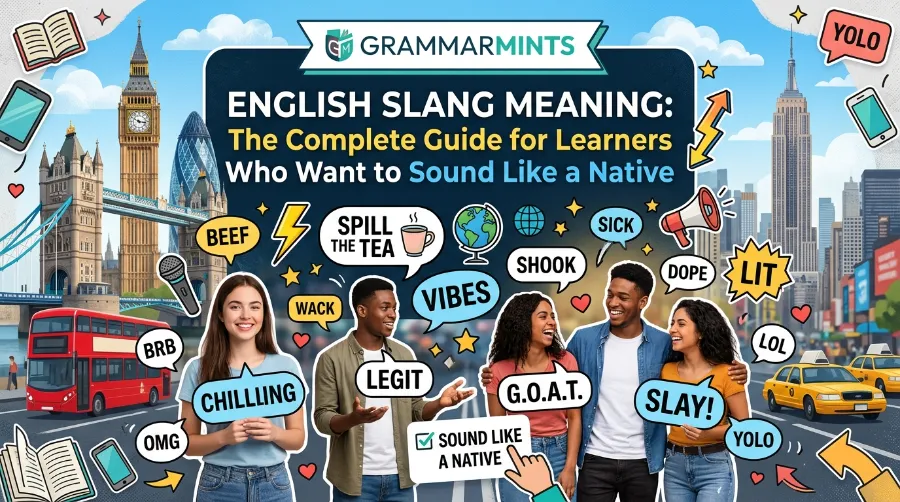
This matters more than it might seem. A word like “sick,” for instance, means “unwell” in a medical context but “impressive” as slang, and only real usage examples show you which meaning applies. Reliable slang resources will always show you a sentence, not just a word, and that is the standard worth holding any source to, including this one.
Frequently Asked Questions
What is the difference between slang and an idiom? Slang is informal vocabulary that shifts quickly and often comes from pop culture or online trends, while an idiom is a fixed, traditional expression whose meaning rarely changes over time, such as “break the ice.”
Is it okay to use slang at work? It depends heavily on the workplace culture. Research shows nearly half of Americans consider some slang appropriate at work, but it is always safer to read the room first, especially in client-facing or formal roles.
How many slang words should a beginner learn? Around 20 to 30 high-frequency slang words is a realistic starting point. Focus on words that appear repeatedly across conversations, TV shows, and social media rather than trying to memorise everything at once.
Does British slang differ a lot from American slang? Yes, quite a bit. While some slang overlaps, many terms are region-specific, and using British slang in the US, or the other way around, can sound noticeably out of place, even though it is usually still understood.
Why does slang change so fast now compared to the past? Social media has sped up the entire cycle. A word can now go from unknown to mainstream to outdated within a single year, largely driven by short-form video platforms like TikTok.
Will using slang make my English sound less professional? Not if you use it selectively. Slang used with friends, on social media, or in casual conversation adds warmth and personality, but it is best avoided in emails, interviews, and formal presentations unless you know your audience well.
What is the fastest way to learn slang as a beginner? Watch native-speaker content daily, keep a small running list of new words with example sentences, and try each new term out loud with a tutor or conversation partner before using it in real situations. Repetition in context beats memorising long lists every time.
Conclusion
Slang is not a shortcut around proper English; it is simply another layer of the language that textbooks tend to skip over. Once you understand the core idea of english slang meaning, along with a working list of common slang words meaning and a sense of the current modern english slang list, everyday conversations with native speakers get noticeably easier. Start small, focus on the terms that keep showing up around you, and let your ear guide the rest. Fluency has always been built one real conversation at a time, not one flashcard at a time.
References
- Preply. “Popular Slang: 50% of Americans Use Slang Without Knowing Meaning.” Preply Blog, 2025.
- Preply. “American Slang vs. British Slang: Terms & Phrases Compared.” Preply Blog, 2026.
- Grammarly. “Slang to Standard: How Casual Language Can Become Acceptable.” Grammarly Blog, 2022.
- Wikipedia. “British Slang.” Accessed 2026.
- Fox News. “Test Yourself on the Gen Z Slang of 2025: Can You Decode ‘Huzz’ and ‘Glazing’?” 2025.
- Colorado State University. “New Year, New Slang: Words Social Media Managers Should Know in 2026.” Colorado State University Social Media Blog, 2026.
- Gulf News. “Yeet! ‘Brat’ Is Collins’s Word of the Year. Can You Keep Up With Gen Z?” 2024.
- Youth of Europe. “Gen Z Slang Words and Phrases of 2024.” European Youth Portal, 2025.