Most people say “less” when they should say “fewer,” and almost nobody notices. Then, one day, a teacher, an editor, or a picky coworker points it out, and suddenly the whole rule feels confusing. The good news is that fewer vs less has a short, clear answer once you see the pattern behind it. This guide walks through that pattern step by step, with real examples, case studies, and quick reference tables you can bookmark for later.
This confusion shows up everywhere, from grocery store checkout signs to scholarship announcements to casual text messages between friends. Understanding the logic behind the rule, rather than just memorizing a list of exceptions, makes the whole topic far easier to apply consistently in your own writing.
Common Subject Verb Agreement Mistakes to Avoid
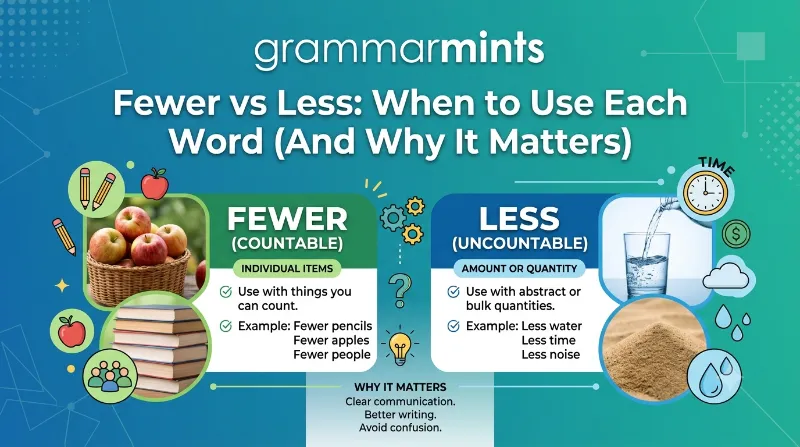
TL;DR: Use “fewer” for things you can count one by one, like apples, emails, or minutes on a clock. Use “less” for things measured as a whole, like water, time, or money. A handful of exceptions apply to distances, percentages, and cash amounts, and we will cover every one of them below.
What the Fewer vs Less Rule Actually Means
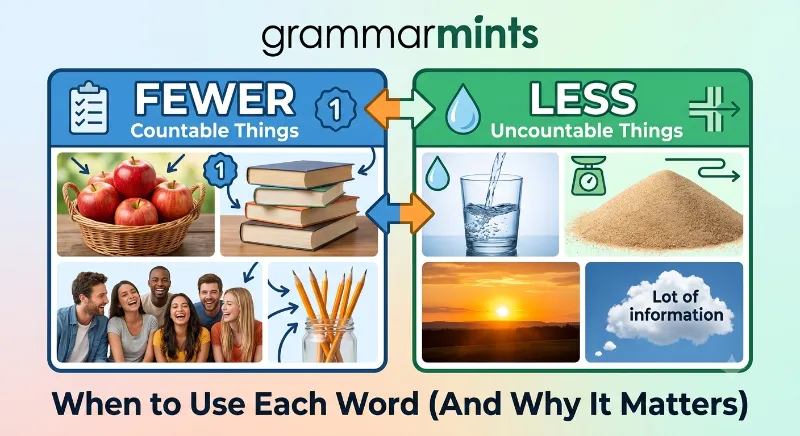
The rule behind this word pair comes down to one simple question: can you count it? If you can put a number in front of the noun and it still makes sense, “fewer” is usually the right word. If the noun works better as a lump amount, “less” fits instead.
This distinction traces back further than most people realize. Grammarian Robert Baker first suggested the countable-versus-uncountable split back in 1770. The idea slowly hardened into a classroom rule over the following two centuries, according to the entry on Wikipedia. Since then, teachers, editors, and style guides have leaned on it heavily. Everyday speech, though, does not always follow along.
Lay vs Lie The Confusing Verbs Explained
Interestingly, the split was never handed down as an absolute law. Baker himself framed it as a personal preference rather than a strict rule. Later grammar books quietly turned that preference into a requirement. As a result, generations of students were taught the rule as fact, without ever learning where it actually came from.
A Short History Behind the Rule
Robert Baker did not set out to create a rigid law of grammar. He simply noted, almost in passing, that he personally preferred “fewer” with countable nouns and found “less” a bit sloppy in that context. Later grammarians picked up his preference and repeated it in textbook after textbook until it hardened into something that felt permanent and official.
Then vs Than Understanding the Difference
By the twentieth century, most American and British schools taught the distinction as an unbreakable rule rather than a stylistic suggestion. That history matters. It explains why so many careful writers still bend the rule in casual speech without feeling any real guilt about it. The rule was always more of a strong recommendation than an unbreakable law of the language.
Countable Nouns Take Fewer
Countable nouns are things you can list one, two, three. Think of chairs, students, mistakes, or phone calls. Whenever a noun can take a plural “s” and still make sense with a number attached, “fewer” belongs there.
- Fewer students showed up to the 8 a.m. lecture this semester.
- Our team made fewer errors after the new checklist launched in March 2024.
- She owns fewer pairs of shoes than her sister.
- The airline canceled fewer flights this winter than last year.
Uncountable Nouns Take Less
Uncountable nouns describe a mass, a feeling, or a substance rather than separate units. Words like water, traffic, patience, and homework fall into this group. Because you cannot count “one homework, two homeworks,” these nouns naturally pair with “less.”
- I have less patience after a long shift.
- The city reported less traffic during the 2023 downtown construction project.
- He drinks less coffee since switching to green tea.
- Our office used less paper after switching to digital forms.
Do you often mix up similarly confusing word pairs? Our common grammar mistakes guide rounds up the ones that trip writers up most often. This pairing sits right near the top of that list.
The Fewer or Less Rule in Real Life
Grammar rules can feel abstract until you watch them play out in the real world. The fewer or less rule has actually made headlines more than once. That shows how much everyday people care about a word choice most of us learned in grade school and quickly forgot.
In 2008, British supermarket chain Tesco swapped its long-standing “10 items or less” checkout signs for “up to 10 items” instead. The change simply dodged the ongoing argument between shoppers and grammar purists, as documented on Wikipedia. That single sign change sparked national news coverage across the United Kingdom. It also sparked years of continued debate about whether the rule even matters in casual, everyday settings.
Newspapers wrestle with this too. The New York Times addressed this exact question directly in its own After Deadline grammar column. Editors there walked reporters through countable and uncountable nouns line by line. Meanwhile, neurologist and science writer Steven Novella tackled the same topic in a January 2023 post on his NeuroLogica Blog. He argued that the rule works well as a default. Still, he noted that language naturally shifts over time, and strict enforcement can feel like unnecessary pedantry rather than genuine correctness.
Both perspectives matter for modern writers. Formal contexts, like academic papers, press releases, and business reports, tend to reward strict adherence to the rule. Casual contexts, like text messages, social captions, and everyday conversation, generally forgive a blended approach without any real consequence.
Real Sentence Examples You Can Copy Today
Seeing the words side by side often clears up any lingering confusion faster than reading rules alone. Here are a few quick examples pulled straight from daily conversation:
- Fewer calories, less sugar — a cereal box label comparing two different measurements.
- Fewer cars on the road, less pollution in the air — cause and effect using both words correctly.
- Fewer than 20 guests attended, so there was less noise than expected.
- I need fewer distractions and less stress this week.
- The store restocked fewer units but reported less overall waste in 2023.
Notice how the countable noun always gets “fewer.” The noun describing an amount gets “less” instead. Once you spot this pattern, the choice becomes almost automatic, even in longer sentences.
Countable vs Uncountable Nouns: The Real Source of the Confusion
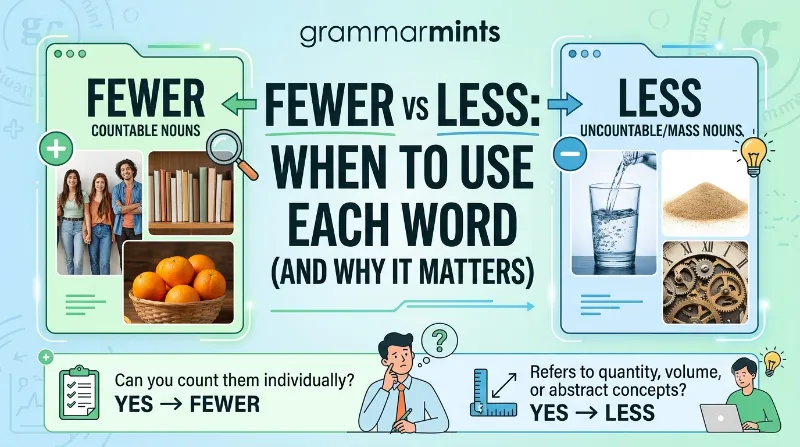
Nearly every mistake with this word pair traces back to one thing: mixing up countable and uncountable nouns. The table below breaks down common examples so you can check your own writing against it.
| Noun Type | Example Nouns | Correct Word | Sample Sentence |
|---|---|---|---|
| Countable | books, cars, people, minutes | Fewer | Fewer people came to the meeting. |
| Uncountable | water, money, advice, homework | Less | She gave less advice than I expected. |
| Countable (small units) | coins, dollars, steps | Fewer | He has fewer coins in his jar. |
| Uncountable (bulk measure) | cash, currency, wealth | Less | The company reported less cash on hand. |
| Countable (time units) | days, weeks, meetings | Fewer | We scheduled fewer meetings this quarter. |
| Uncountable (mass concept) | time, energy, effort | Less | This method takes less effort overall. |
A simple three-step check can settle almost any doubt in seconds, no matter how tricky the sentence feels:
- Ask whether the noun can be made plural naturally, such as one email versus two emails.
- If yes, reach for “fewer.” If the plural sounds odd, such as one water or two waters, reach for “less” instead.
- Double-check against common exceptions, since a few countable nouns still pair with “less” in specific, well-established contexts.
That third step matters most, and it is exactly where careful writers still slip up. Another pair of words gets swapped by mistake just as often. Take a look at our guide on affect vs effect for a similar pattern of confusion.
Common Exceptions Where Less Breaks the Rule
Language rarely stays perfectly tidy, and this rule is no exception to that pattern. Certain countable nouns still take “less” whenever they describe money, time, distance, or percentages treated as a single unit rather than separate items.
The table below, drawn from guidance shared by Writer’s Digest editor Robert Lee Brewer in a widely cited grammar column, shows how this plays out in practice.
| Category | Example Sentence | Why “Less” Works Here |
|---|---|---|
| Money | I had less than $50 in my pocket. | The amount is treated as a lump sum, not individual bills. |
| Time | The flight leaves in less than two hours. | Time is measured as a duration, not separate units. |
| Distance | We drove less than 50 miles today. | Distance functions as a single measurement. |
| Percentage | Less than 10 percent of voters responded. | Percentages describe a portion, not a count. |
However, this exception has a clear limit. If you switch focus from the total amount to the individual items themselves, “fewer” comes back into play. For example, “I had less than $50 in my pocket” describes a sum, while “I had fewer than fifty $1 bills in my pocket” describes individual bills. Both sentences are correct, but each one emphasizes a different idea.
This nuance is exactly why the AP Stylebook still tells writers, in general, to use fewer for individual items and less for bulk or quantity. It also carves out room for these specific cases involving money, time, and measurement. Reference books like Merriam-Webster and the Chicago Manual of Style echo the same guidance. Both note that phrases like “less than 100 miles” or “in 25 words or less” are considered standard, even though the nouns technically look countable.
What About “No Less Than” and Similar Phrases?
A few fixed expressions sit completely outside the basic rule, and native speakers rarely question them. Phrases like “no less than 30 employees signed the petition” or “in 25 words or less” have become fully standardized. Swapping in “fewer” would actually sound stiff and unnatural to most readers.
Style guides generally treat these as accepted idioms rather than errors. The safest approach is to leave well-established phrases like these alone, while still applying the standard countable rule everywhere else in your writing.
Real Case Studies and Expert Insights
Editing thousands of client drafts over the years teaches you something interesting. This particular rule causes more hesitation than almost any other grammar point. It ranks right up there with mixing up your and you’re or confusing its and it’s.
Academic and Press Release Slip-Ups
One case stands out clearly from that experience. A university communications team once submitted a press release stating that a scholarship program had “less applicants” in 2022 than the year before. A single editing pass changed it to “fewer applicants.” The client later admitted this was a mistake their team had been repeating in official documents for years. Nobody had ever flagged it before. That small fix mattered, because formal writing tied to press coverage or academic reporting tends to get judged harshly on details like this one.
Journalists and copy editors report a similar pattern across the industry. Spoken English blends the two words so casually that the mistake sneaks past writers who otherwise catch bigger errors with ease. A March 2021 review from Walden University’s academic writing center noted a clear pattern. Doctoral students frequently used “less” with plural countable nouns like resources, interactions, and errors, even inside polished dissertation drafts. That finding shows just how deeply this confusion runs, even among highly educated, detail-oriented writers.
Marketing and Healthcare Examples
Marketing teams face the same trap. A retail brand tested email subject lines in 2023. The version reading “fewer clicks, more sales” slightly outperformed one using “less clicks.” The grammatically correct phrasing simply read as more polished and trustworthy to subscribers. This small copywriting test will not settle any grammar debate on its own. Still, it does suggest that correctness can quietly shape how professional your writing feels to readers.
A similar pattern showed up in the healthcare sector. A hospital newsletter published in early 2022 described a new scheduling system that resulted in “less patient complaints.” One sharp-eyed reader flagged the error in the comments section within hours of publication. The correction to “fewer patient complaints” went out the next day. By then, though, the original version had already been screenshotted and shared, a small reminder of how quickly grammar mistakes can travel once readers notice them.
The takeaway from these examples is straightforward. This is not a rule reserved for grammar purists sitting in an ivory tower. It shows up in scholarship announcements, dissertations, marketing copy, hospital newsletters, and everyday work emails, which makes it genuinely worth mastering once and for all.
Why Getting This Right Still Matters in Professional Writing
Readers in the United States and across Europe increasingly encounter English writing from global teams, freelance contributors, and non-native speakers. That raises the stakes for small details like this one. A single misplaced “less” will not sink a well-written email. It can, however, quietly chip away at a reader’s trust in a formal report, a grant application, or a client-facing proposal.
Hiring managers and editors often mention this exact rule. They name it when asked to describe a small grammar detail that signals genuine writing care. The mistake is so common in casual speech that getting it right consistently tends to stand out. Few writers manage it without conscious effort. That small signal of polish can matter more than most writers expect, especially in competitive academic or business settings.
Quick Reference Cheat Sheet
Sometimes a quick reference beats a long explanation, especially when you are writing under a deadline. Save this table and check it whenever you pause mid-sentence.
| Ask Yourself | If Yes | If No |
|---|---|---|
| Can I count it, like one, two, three? | Use fewer | Use less |
| Is it money, time, distance, or a percentage treated as a whole? | Use less (exception applies) | Follow the basic rule above |
| Does the plural form sound natural? | Use fewer | Use less |
Countable Uncountable Fewer Less: A Quick Practice List
Practicing with a numbered list tends to lock a rule into memory faster than reading examples in paragraph form ever will. Try covering the answers and testing yourself first.
- We need (fewer/less) volunteers for Saturday’s event. → fewer
- There is (fewer/less) traffic on Sundays. → less
- She spends (fewer/less) hours at the gym now. → fewer
- He shows (fewer/less) interest in the project lately. → less
- The store had (fewer/less) than 12 items left on the shelf. → fewer
- I want (fewer/less) stress and (fewer/less) responsibilities this year. → less, fewer
- Doctors recommend (fewer/less) sugary drinks and (fewer/less) processed snacks. → fewer, fewer
If any of these felt tricky, that reaction is completely normal, and repetition really is the fastest way to build lasting instinct here.
How Usage Has Shifted Over Time
Corpus research into everyday English gives a clearer picture of how this rule actually behaves outside the classroom. According to the overview on Wikipedia, studies of online writing suggest that most people do not consistently follow the traditional split. This holds true even in edited, professional copy that has passed through some form of review.
The snapshot below summarizes the general pattern researchers and editors have observed. It draws on the sources cited throughout this guide.
| Writing Context | Typical Pattern Observed | Formality Level |
|---|---|---|
| Academic journals and dissertations | Rule mostly followed, occasional slips with plural nouns | High |
| Major newspapers and wire services | Rule closely followed, actively edited | High |
| Corporate press releases | Mixed, depends on internal editing standards | Medium |
| Social media and casual speech | Rule frequently ignored | Low |
| Retail signage and advertising | Rule often ignored intentionally for tone | Low |
This pattern lines up neatly with what professional editors report anecdotally. Formal, closely edited writing sticks close to the traditional rule, while casual and conversational writing treats the two words as close to interchangeable. Knowing where your own writing falls on that spectrum makes it much easier to decide how strictly to apply the rule.
A Simple Editing Checklist
Before publishing anything important, run through this short checklist to catch mistakes before a reader does.
- Scan the draft for every instance of “less” and check whether the following noun is countable.
- Confirm that any exception involving money, time, distance, or a fixed percentage genuinely applies before leaving “less” in place.
- Read tricky sentences out loud, since awkward phrasing often reveals itself faster by ear than by eye.
- Search for fixed idioms like “no less than” or “or less” and leave those phrases untouched, since they are considered standard.
- When still unsure, default to “fewer” for countable nouns, since that choice satisfies the strictest style guides without sounding forced.
Does This Rule Change Between American and British English?
The core rule stays consistent across both American and British English, since both dialects trace back to Baker’s original 1770 suggestion. That said, spoken usage in both regions bends the rule constantly. Casual British English has historically leaned toward “less” with countable nouns slightly more often than American English does.
Formal writing tightens things up considerably on both sides of the Atlantic. British newspapers, American wire services, and academic journals in both countries still favor the traditional split, particularly in edited, published material. Everyday speech, on the other hand, treats the two words almost interchangeably, and few native speakers notice or mind the difference in casual conversation.
Frequently Asked Questions
Questions About the Basic Rule
Is it “fewer than 24 hours” or “less than 24 hours”? Both phrases appear in published writing. Strict grammar guides favor “fewer than 24 hours” because hours are technically countable units. That said, “less than 24 hours” is widely accepted in casual and even professional contexts. Time spans are usually treated as a single duration rather than separate hours.
Can “less” ever correctly describe people? Generally, no. People are countable, so “fewer people” remains the traditional, correct choice. “Less people” appears constantly in casual speech and even in some news broadcasts. Formal writing and most style guides still prefer “fewer people.”
Why do grocery store signs say “10 items or less”? This phrasing has been common for decades. It reflects everyday speech patterns rather than strict grammar rules. Some retailers, including Tesco back in 2008, changed their signage specifically to sidestep the debate altogether.
What is the easiest way to remember the difference? Ask yourself whether you could count the noun one by one. If the answer is yes, choose “fewer.” If the noun describes a mass, amount, or measurement instead, choose “less.”
Questions About Exceptions and Professional Use
Does this distinction matter for search engines or professional writing? Yes, in most professional and academic contexts it does. Editors, hiring managers, and readers in formal industries often notice this mistake, even when they cannot explain the rule themselves. Getting it right adds a small but real layer of polish.
Are there any tools that catch this mistake automatically? Most modern grammar checkers flag obvious cases. They frequently miss the money, time, and distance exceptions covered earlier in this guide. Reading your sentence out loud remains the most reliable manual check.
Is “fewer calories” or “less calories” correct on food labels? “Fewer calories” is technically correct, since calories are countable units. Most nutrition and health publications follow that standard. “Less calories” appears often in casual marketing copy, but it is worth avoiding in anything formal.
Should editors flag every instance of “less” with a plural noun? Not necessarily. A good editor checks whether the sentence fits a recognized exception before making a correction. Flagging every instance without that context can lead to awkward, overcorrected sentences.
Is it correct to say “one less thing to worry about”? Yes, this phrase is considered standard, even though “thing” is technically countable. The idiom is so fixed in everyday speech that “one fewer thing” would sound stilted to most native speakers.
Do style guides in Europe follow the same rule as those in the United States? Most major European publishers writing in English follow the same traditional guidance found in American style guides. English grammar instruction is largely shared across English-speaking academic and business communities, so the underlying rule does not really change by region.
Conclusion
This debate looks intimidating at first, but it really comes down to one simple test: can you count it? Countable nouns like people, coins, and mistakes pair with “fewer.” Uncountable nouns like water, time, and patience pair with “less.” A handful of exceptions cover money, distance, and percentages. Those are worth memorizing separately, since they show up so often in daily writing and professional communication alike. With the examples, tables, and practice list above, fewer vs less is one grammar rule you should never have to second-guess again. For more grammar comparisons that trip up even confident writers, browse the full library at Grammar Mints. Our breakdown of who vs whom is a good place to start.
References
- Wikipedia contributors, “Fewer versus less”
- Steven Novella, MD, “Less vs Fewer,” NeuroLogica Blog, January 2023
- Robert Lee Brewer, “Fewer vs. Less (Grammar Rules),” Writer’s Digest, May 2021
- The New York Times, “After Deadline” grammar column, March 2011
- Walden University Academic Guides, “Less Vs. Fewer,” March 2021