Almost everyone makes common grammar mistakes at some point, even skilled writers and native speakers. A single typo or a mixed-up word pair can change how a reader sees you, whether you are sending a work email or finishing a college essay. This guide walks through the errors that show up most often, explains why they happen, and gives you clear steps to fix them for good.
Their, There and They’re The Complete Guide
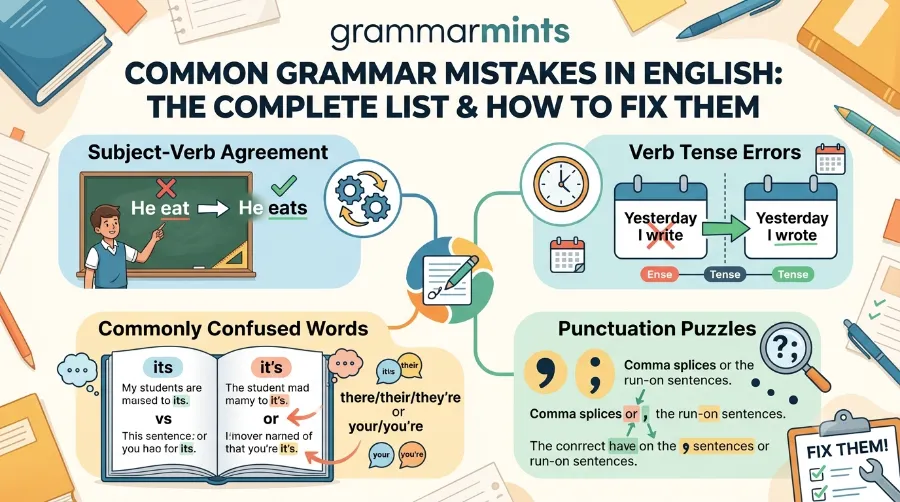
TL;DR: The most frequent English errors fall into a handful of buckets: subject-verb agreement, homophones (your/you’re, its/it’s), comma splices, wrong verb tense, and article misuse. Once you learn to spot these patterns, you can fix roughly 80% of your writing errors just by reviewing for these five categories before you hit send.
Affect vs Effect How to Use Each Word Correctly
Why Common Grammar Mistakes Still Trip Up Careful Writers
You would think that spell-checkers and AI writing tools would have wiped out grammar errors by now. Yet research from the Cambridge English Corpus, which reviewed more than 20 million learner texts, found that 94% of English learners make grammar mistakes regularly, and 78% of those errors fall into just five categories: articles, verb tense, subject-verb agreement, prepositions, and homophones. That single finding explains why the same handful of mistakes keeps showing up in emails, essays, and even published articles.
Who vs Whom A Simple Trick to Get It Right
Part of the problem is habit. Most people learn English by listening and copying patterns, so small errors get baked in early and never get corrected. Tools like Grammarly and Microsoft Editor catch some of these slips, but they miss context-based errors fairly often. Meanwhile, the cost of getting it wrong keeps climbing, especially now that hiring managers and readers judge writing quality within seconds.
Their, There and They’re The Complete Guide
There is also a speed problem. Text messages, quick Slack replies, and social media captions train people to write fast and skip review entirely. That habit then bleeds into formal writing, where the stakes are much higher and a quick skim is not enough to catch a dangling modifier or a misplaced apostrophe. Slowing down for even thirty extra seconds before sending a message solves a surprising share of these errors.
Because of this, understanding grammar mistakes in english is no longer just a classroom exercise. It is a practical skill that affects job applications, client emails, and even how trustworthy a brand sounds online. So, before diving into fixes, it helps to see exactly how much these errors matter in the real world.
Its vs It’s Simple Rules to Remember the Difference
The Real Cost of Ignoring Grammar Errors
Consider a 2023 peer-reviewed hiring study, which found that resumes containing writing errors saw an 18.5 percentage point lower chance of landing an interview, showing how much writing quality shapes real hiring outcomes. That is not a small dip; it is often the difference between getting a callback and getting ignored.
Workplace communication carries the same weight. A recent workplace survey found that 65% of respondents said spelling and grammar mistakes in workplace messages were simply unacceptable. On top of that, a well-known customer trust survey by Tidio reported that 97% of people say grammar mistakes shape how they view a company or an individual. In short, grammar is quietly judging you before anyone reads your ideas.
Academic writers face a similar reality. A 2024 Springer Nature survey of non-native English researchers found that 68% had a manuscript rejected at least once because of language errors, including common grammar and punctuation problems. A single misplaced comma might not sink a paper on its own, but a pattern of avoidable mistakes clearly does.
Grammar Errors List: The Complete Breakdown by Category
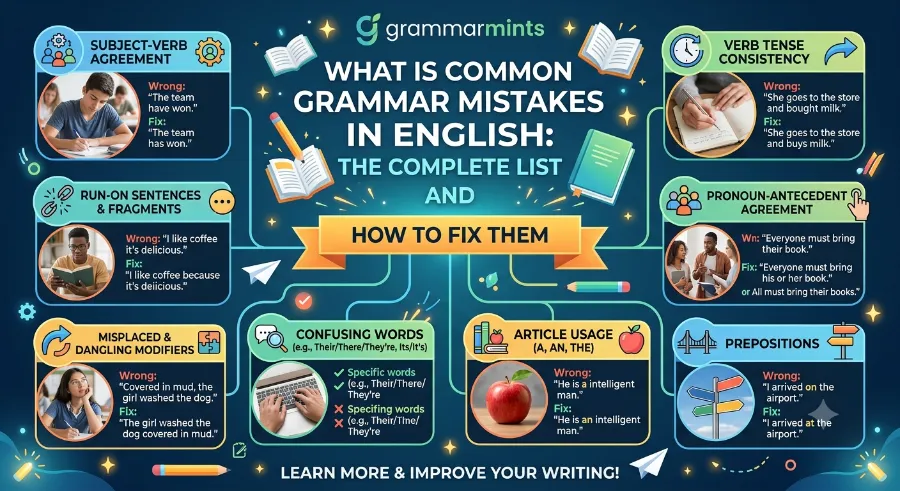
This section is the heart of this grammar errors list. Each mistake below includes a wrong example, a corrected version, and a short explanation you can remember later. For a deeper dive into any single rule, our grammar fundamentals guide breaks each one down step by step.
1. Subject-Verb Agreement
This mistake happens when the verb does not match the number of the subject. It is one of the five categories that make up most learner errors, according to Cambridge Corpus data referenced earlier.
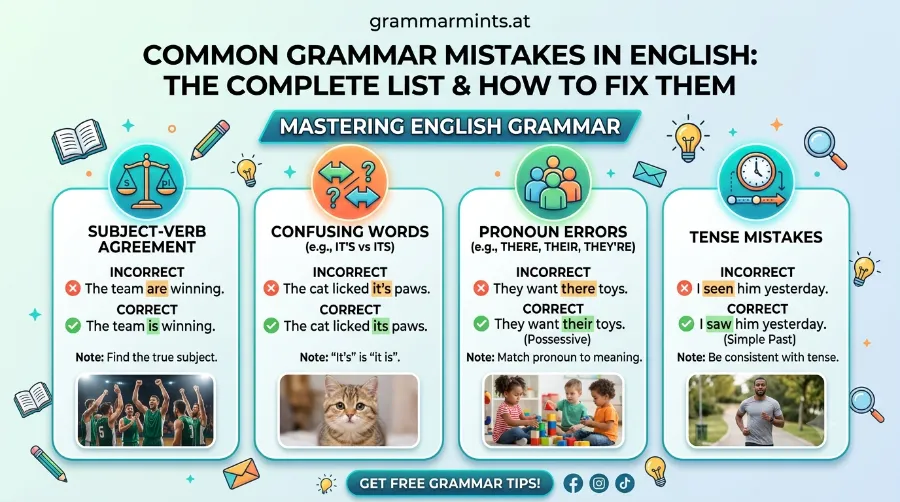
- ❌ The list of items are on the table.
- ✅ The list of items is on the table.
- Tip: find the true subject (list), not the closest noun (items), then match the verb to it.
2. Homophone Confusion (Your vs You’re, Its vs It’s)
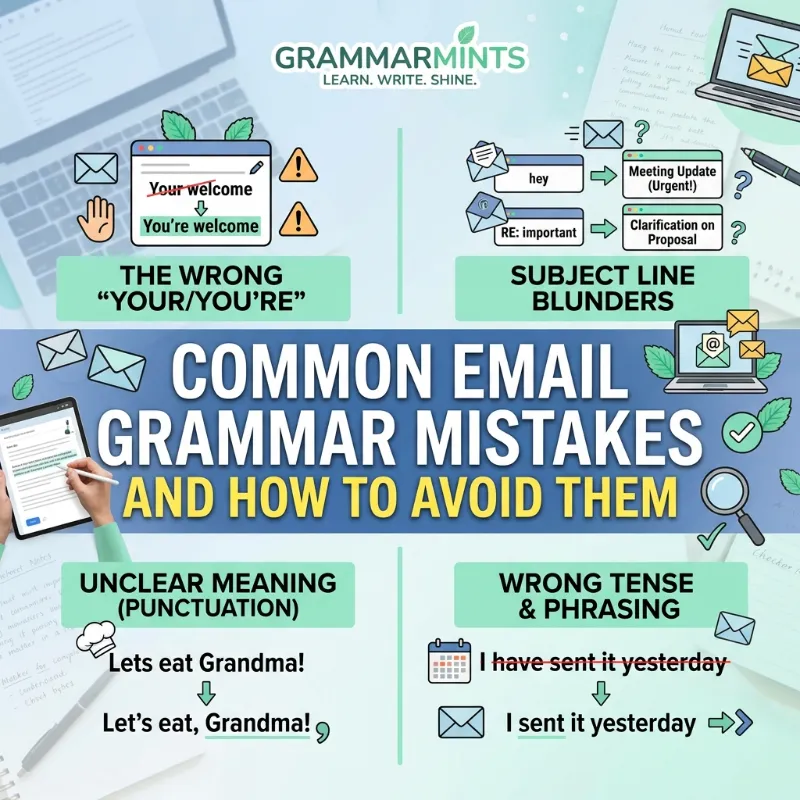
Homophones sound alike but mean different things, so spell-check often lets them slide right through. One writing coach admitted that they once sent an important client email with “your welcome” instead of “you’re welcome,” and that slip taught them to always double-check contractions before sending anything important.
- ❌ Your going to love this.
- ✅ You’re going to love this.
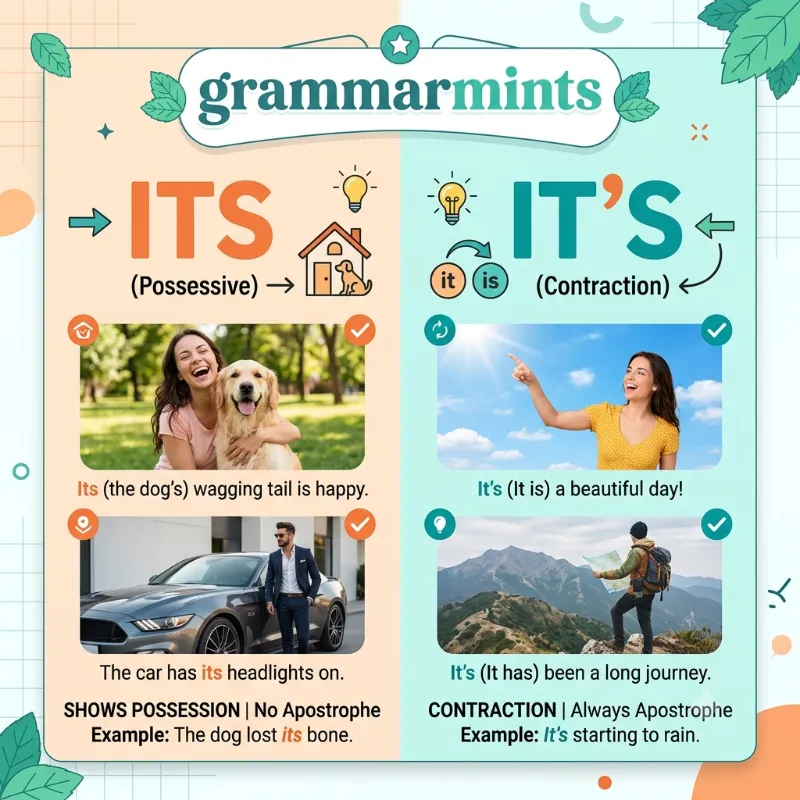
- ❌ The dog wagged it’s tail.
- ✅ The dog wagged its tail.
A Cambridge English survey backs up how common this is: researchers found that 65% of English learners confuse there, their, and they’re at least once during their first year of study. Native speakers slip up here too, usually because these words sound identical out loud.
3. Comma Splices and Run-On Sentences
A comma splice joins two complete sentences with only a comma, which is not strong enough to do the job. Run-ons skip the punctuation altogether and just keep going.
- ❌ I finished the report, I sent it to my manager.
- ✅ I finished the report, and I sent it to my manager.
- ✅ I finished the report. Then I sent it to my manager.
Fixing this mistake usually just means adding a conjunction, splitting the sentence in two, or swapping the comma for a semicolon.
4. Verb Tense Mistakes
Mixing tenses inside one sentence confuses readers about when something happened. This shows up constantly in speech and casual writing, especially with irregular verbs.
- ❌ I did not went to the market yesterday.
- ✅ I did not go to the market yesterday.
The rule is simple: after “did” or “did not,” the main verb always stays in its base form, never the past tense form.
5. Article Errors (A, An, The)
Articles are tiny words, but they carry real weight in a sentence. Many non-native speakers either skip them or use the wrong one, since many languages do not use articles the same way English does.
- ❌ I bought car yesterday.
- ✅ I bought a car yesterday.
- ❌ I like the music in general.
- ✅ I like music in general.
6. Preposition Mix-Ups
Prepositions rarely translate directly between languages, which is why phrases like “depend from” instead of “depend on” show up so often. English prepositions mostly need to be memorized alongside the words they pair with.
- ❌ It depends from the weather.
- ✅ It depends on the weather.
- ❌ Married with a doctor.
- ✅ Married to a doctor.
7. Dangling and Misplaced Modifiers
A modifier describes the word right next to it, so if that word is missing or wrong, the sentence says something you did not intend. These errors often go unnoticed because the sentence still sounds fine when read quickly.
- ❌ Walking to the store, the rain started falling.
- ✅ While I was walking to the store, the rain started falling.
Read the sentence and ask “who is doing this action?” If the answer is not right there, the modifier is dangling.
8. Apostrophe Misuse in Plurals and Possessives
Apostrophes show possession or mark a missing letter, but they do not belong in ordinary plurals. This mix-up is one of the most frequent errors on signs, menus, and social media posts.
- ❌ The dog’s are barking.
- ✅ The dogs are barking.
- ✅ The dog’s leash snapped.
9. Overusing Passive Voice
Passive voice is not wrong, but leaning on it too heavily makes writing feel distant and harder to follow. Academic reviewers have flagged this pattern directly: one editing guide noted that passive voice has a legitimate place in sections like methodology, but once more than 40% of a paper’s sentences turn passive, reviewers start to notice.
- ❌ The report was written by the team.
- ✅ The team wrote the report.
Swapping passive sentences for active ones instantly makes your writing punchier and easier to skim.
10. Pronoun-Antecedent Disagreement
A pronoun needs to match the noun it replaces in both number and gender. Skipping this rule is common when the subject is a group noun like “everyone” or “the company.”
- ❌ Every student must bring their own laptop and hand in it before Friday.
- ✅ Every student must bring a laptop and hand it in before Friday.
11. Affect vs. Effect
These two words trip up even confident writers because they sound almost identical in casual speech. “Affect” is usually a verb meaning to influence something, while “effect” is usually a noun meaning the result of an action.
- ❌ The weather will effect our plans.
- ✅ The weather will affect our plans.
- ✅ The effect of the weather was a canceled picnic.
12. Fewer vs. Less
English draws a line between things you can count and things you cannot, and this rule gets ignored constantly in casual writing and even store signage. “Fewer” belongs with countable items, while “less” belongs with amounts that cannot be counted one by one.
- ❌ I have less problems than I used to.
- ✅ I have fewer problems than I used to.
- ✅ I have less stress than I used to.
13. Who vs. Whom
This mistake causes hesitation because the rule feels old-fashioned, even though it still applies in formal writing. “Who” acts as the subject of a sentence, while “whom” acts as the object.
- ❌ Whom is calling?
- ✅ Who is calling?
- ✅ To whom should I address this letter?
A quick trick works here: if you can replace the word with “he” or “she,” use “who.” If “him” or “her” fits better instead, use “whom.”
Below is a quick-reference table you can bookmark for the mistakes above.
| # | Mistake | Wrong Example | Correct Example |
|---|---|---|---|
| 1 | Subject-verb agreement | The list of items are ready | The list of items is ready |
| 2 | Homophones | Your welcome | You’re welcome |
| 3 | Comma splice | I left, I called her | I left, and I called her |
| 4 | Verb tense | I did not went | I did not go |
| 5 | Articles | I bought car | I bought a car |
| 6 | Prepositions | Depend from | Depend on |
| 7 | Dangling modifiers | Walking home, rain started | While walking home, it started to rain |
| 8 | Apostrophes | The dog’s are loud | The dogs are loud |
| 9 | Passive overuse | The letter was sent by me | I sent the letter |
| 10 | Pronoun agreement | Everyone bring their laptop and hand in it | Everyone should bring a laptop and hand it in |
| 11 | Affect vs. effect | The weather will effect our plans | The weather will affect our plans |
| 12 | Fewer vs. less | I have less problems | I have fewer problems |
| 13 | Who vs. whom | Whom is calling? | Who is calling? |
US and European English: Do the Rules Change?
Readers in the United States and readers across Europe generally follow the same core grammar rules, but a few small differences can look like mistakes when they are really just regional style. Knowing which is which saves you from “fixing” something that was never actually wrong.
- Collective nouns: American English treats a group like “the team” as singular (“the team is winning”), while British and much of European English often treats it as plural (“the team are winning”).
- Punctuation with quotes: US style places commas and periods inside quotation marks, while UK style often places them outside, depending on the sentence.
- Spelling pairs: Words like “color/colour” and “organize/organise” are not grammar errors at all; they are simply regional spelling conventions taught in different school systems.
For international teams and remote workplaces, the safest approach is consistency rather than “correctness.” Pick one style guide, such as the Associated Press Stylebook for US audiences or the Oxford Style Guide for European ones, and apply it across every document. Purdue’s Online Writing Lab is a widely trusted, free resource if your team needs a shared reference point.
Real Case Studies: What Grammar Mistakes Cost in Practice
Numbers only tell part of the story, so it helps to look at real situations where grammar mistakes changed an outcome. Here are three short case studies pulled from published research and reported experience.
- The resume test (2023): Researchers compared identical resumes, one clean and one with scattered grammar errors, and sent both to real hiring managers. The version with mistakes saw an 18.5 percentage point drop in interview requests, even though the candidate’s actual qualifications were identical.
- The academic manuscript review (2024): A Springer Nature survey followed non-native English researchers through the journal submission process. More than two-thirds reported at least one rejection tied to language issues, and reviewers specifically flagged run-on sentences and inconsistent verb tense as recurring problems.
- The client email slip: A working writing coach shared a personal account of sending “your welcome” to a paying client instead of “you’re welcome.” The email still closed the deal, but the coach later admitted the mistake nearly cost the client’s trust, and it changed how carefully they proofread client-facing messages afterward.
- The small business review pattern: Several customer experience surveys, including the Tidio research cited earlier, link sloppy writing on websites and product listings to lower buyer trust. A small e-commerce seller who cleaned up product descriptions in early 2025, fixing apostrophe errors and inconsistent tense across roughly 200 listings, later reported fewer customer questions about product details, since clearer copy left less room for confusion.
These examples show a pattern: grammar rarely breaks a relationship on its own, but it quietly shapes first impressions, hiring decisions, and even research outcomes. For a closer look at how editors handle these issues professionally, Editage’s breakdown of frequent writing errors is a solid next read.
How to Avoid Grammar Mistakes: A Simple Step-by-Step System
Knowing the rules is only half the job, so here is a practical system for catching errors before anyone else sees them. This process works whether you are writing an email, a blog post, or a school assignment.
- Read your sentence out loud. Your ear often catches awkward phrasing that your eyes skip over, especially with homophones and dangling modifiers.
- Check the subject and verb first. Find the true subject of each sentence and confirm the verb matches it, ignoring any words sitting in between.
- Search for “was” and “were.” These words often signal passive voice, so use them as a flag to rewrite the sentence in active voice when possible.
- Isolate every comma. Ask whether each comma is joining two full sentences without a conjunction; if so, add “and,” “but,” or split the sentence.
- Run a grammar checker, then review it yourself. Tools like Grammarly or the built-in checker in Microsoft Word catch obvious slips, but they still miss context-based errors, so always give the text one more human read.
- Keep a personal mistake log. Write down the errors you repeat most often; most writers only make five to seven recurring mistakes, so a short list is usually enough to fix 80% of your errors.
None of these steps takes more than a minute or two once it becomes routine, and together they catch the vast majority of everyday grammar mistakes before anyone else sees them. Most professional editors actually use a version of this exact process, just applied at a larger scale across full manuscripts. Building the habit early means you will spend far less time fixing mistakes after the fact, whether that is in a client email or a job application.
Following this checklist consistently is genuinely one of the fastest ways to learn how to avoid grammar mistakes without memorizing an entire textbook. For more detailed practice exercises, check out our grammar practice worksheets or browse the proofreading checklist for a printable version. You can also explore the full grammar mistakes in english library for topic-specific breakdowns.
If you want a second opinion on tricky sentences, ProofreadNow’s grammar errors resource hub covers dozens of specific cases with detailed explanations. Likewise, the Organization for World Adult Achievement offers a clear rundown of three especially frequent slip-ups that trip up even experienced writers.
Grammar Mistakes by the Numbers: A Quick Look at the Data
The chart below shows how grammar errors break down by category, based on the Cambridge English Corpus research cited earlier in this guide.
Share of All Grammar Errors by Category
| Category | Share of Errors | Visual |
|---|---|---|
| Articles | 22% | ████████████ |
| Verb tense | 20% | ███████████ |
| Subject-verb agreement | 16% | █████████ |
| Prepositions | 12% | ███████ |
| Homophones | 8% | █████ |
| All other errors | 22% | ████████████ |
A second data point worth tracking is how grammar affects perception across different audiences. The table below pulls together the survey figures mentioned throughout this guide.
| Context | Reported Impact | Source Year |
|---|---|---|
| Hiring managers reviewing resumes | 18.5 pt lower interview rate for error-laden resumes | 2023 |
| Workplace communication | 65% call grammar mistakes unacceptable | Recent survey |
| General perception of brands/individuals | 97% say mistakes affect their opinion | Tidio survey |
| Academic manuscript rejection | 68% rejected at least once over language errors | 2024 |
| English learners making regular errors | 94% make mistakes regularly | Cambridge Corpus |
Looking at this data together, a clear picture emerges: grammar is not just a classroom concern anymore, it is a trust signal that shows up in hiring, business, and academic settings alike. Whether you are a student in Berlin, a job seeker in Chicago, or a small business owner in Manchester, the same five error categories are almost certainly costing you more attention than you realize. The good news is that fixing them does not require a full course, just consistent review using the checklist above.
Frequently Asked Questions
What are the biggest grammar mistakes in English?
The most frequent errors are subject-verb agreement, homophone mix-ups like your/you’re, comma splices, wrong verb tense, and article misuse. Together, these five categories make up the bulk of everyday writing errors.
How can I quickly check my writing for grammar mistakes?
Read your text out loud, run it through a grammar checker, and then review it once more yourself since automated tools still miss context-based errors. Keeping a short list of your personal recurring mistakes also speeds up self-editing significantly.
Is passive voice always a grammar mistake?
No, passive voice is grammatically correct and even preferred in some technical or academic contexts. The issue is overuse; once passive sentences dominate a piece of writing, it starts to feel distant and harder to follow.
Do native English speakers make grammar mistakes too?
Yes, native speakers regularly mix up homophones, misuse apostrophes, and write comma splices, often because these errors sound identical when spoken aloud. Grammar mistakes are not limited to English learners; they affect writers at every level.
What is the fastest way to improve my grammar overall?
Focus on the five categories responsible for most errors instead of trying to memorize every grammar rule at once. Reading daily, writing short practice paragraphs, and reviewing your own repeated mistakes tend to produce faster results than passive study.
Should I trust grammar checkers like Grammarly completely?
Grammar checkers are useful for catching typos, obvious agreement errors, and repeated words, so they are worth using every time you write. However, they still struggle with context-dependent mistakes, such as correctly used but wrong-meaning homophones, so a final human read-through remains necessary for anything important.
Conclusion
Learning to spot common grammar mistakes is not about chasing perfection; it is about building small habits that catch errors before they cost you an interview, a client, or a grade. Start with the five biggest categories covered in this guide, since fixing those alone clears up the majority of everyday writing problems. From there, a quick daily review and a personal mistake log will keep your writing sharp without turning grammar into a chore. Grammar is a tool for being understood clearly, not a test you either pass or fail, so give yourself room to improve gradually rather than aiming for flawless writing overnight.
References
- Cambridge English Corpus research on learner texts, cited via TypoGrammar, “50 Common Grammar Mistakes in English” (March 2026): https://typogrammar.com/blog/common-grammar-mistakes-in-english/
- BestWriting, “15 Common Grammar Mistakes (and How to Fix Them),” including 2023 resume study and Tidio survey data (May 2026): https://bestwriting.com/common-grammar-mistakes
- Help In Writing, “The Most Common Spelling, Grammar & Punctuation Mistakes: 2026 Student Guide,” including 2024 Springer Nature survey (May 2026): https://helpinwriting.com/blog/the-most-common-spelling-grammar-punctuation-mistakes-2026-student-guide
- LinguaSteps, “8 Common English Grammar Mistakes & How to Fix Them”: https://linguasteps.com/resources/8-common-english-grammar-mistakes-and-how-to-fix-them
- ProofreadNow, Grammar Errors Resource Hub: https://www.proofreadnow.com/blog/topic/grammar-errors
- OWAA, “Three Common Grammar Mistakes and How to Avoid Them”: https://owaa.org/three-common-grammar-mistakes-and-how-to-avoid-them/
- Editage, “Common Grammar Mistakes”: https://www.editage.com/blog/common-grammar-mistakes/