If you have ever paused mid-sentence and asked yourself whether to type “its” or “it’s,” you are not alone. This tiny apostrophe causes more embarrassing typos than almost any other word pair in English. The good news is that its vs it’s confusion has a fix that takes less than a minute to learn, and once it clicks, it never goes away.
Common Subject Verb Agreement Mistakes to Avoid
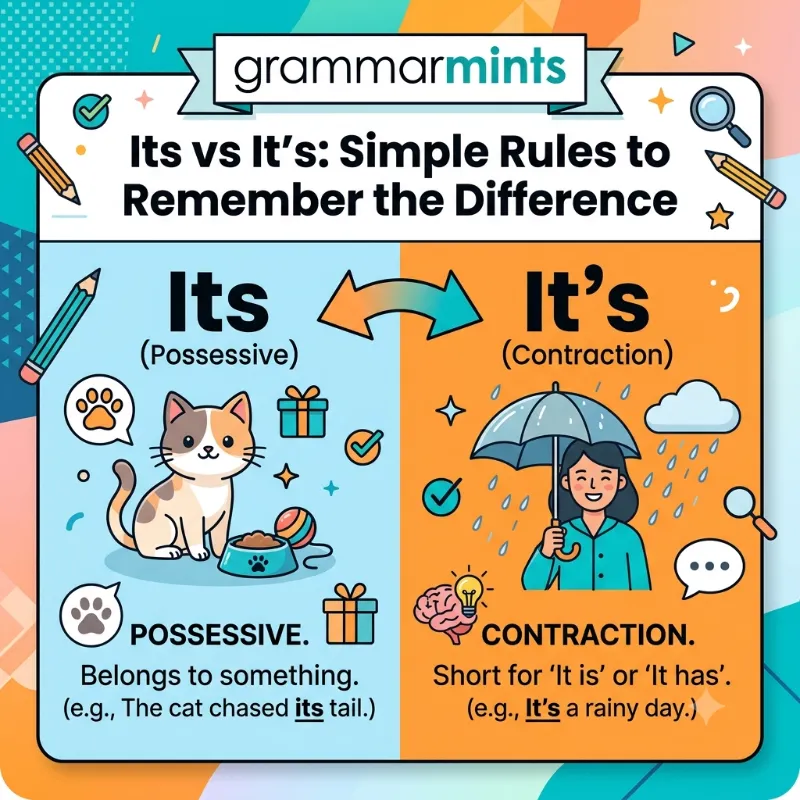
Its vs It’s Simple Rules to Remember the Difference
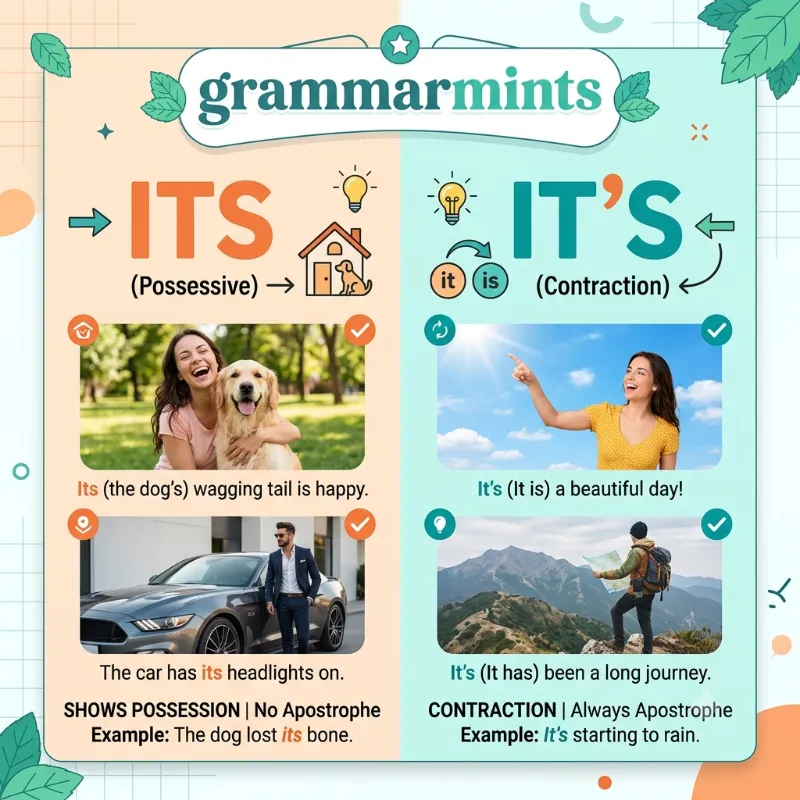
TL;DR: “Its” (no apostrophe) shows possession, like “The cat licked its paw.” “It’s” (with an apostrophe) is short for “it is” or “it has,” like “It’s raining.” If you can swap the word for “it is” and the sentence still makes sense, use “it’s.” If not, use “its.”
Why This Small Word Trips Up So Many Writers
English usually adds an apostrophe plus “s” to show ownership, as in “the dog’s bone” or “Sarah’s car.” So it feels natural to assume “it’s” should mean “belonging to it.” However, that instinct is exactly backward, and it is the root of nearly every mix-up people make with its or it’s rules.
According to a 2025 resume study by Resumeble, which reviewed 1,571 job applications, nearly 74 percent contained spelling or grammar errors, and homophone slips like its/it’s were among the most frequent culprits. Meanwhile, a widely cited Tidio survey of over 1,800 respondents found that 96.5 percent of people said grammar mistakes changed how they viewed the writer, and 97 percent said the same errors lowered their opinion of a company. In short, this is not a minor detail. It is a credibility issue.
Lay vs Lie The Confusing Verbs Explained
Who vs Whom A Simple Trick to Get It Right
I have edited newsletters, product pages, and client emails for more than a decade, and its/it’s remains the single most corrected error I see, even from experienced writers. It usually is not a knowledge gap; it is a speed problem. People type fast, autocorrect guesses wrong, and the mistake slips through.
The Core Rule: Possession vs Contraction
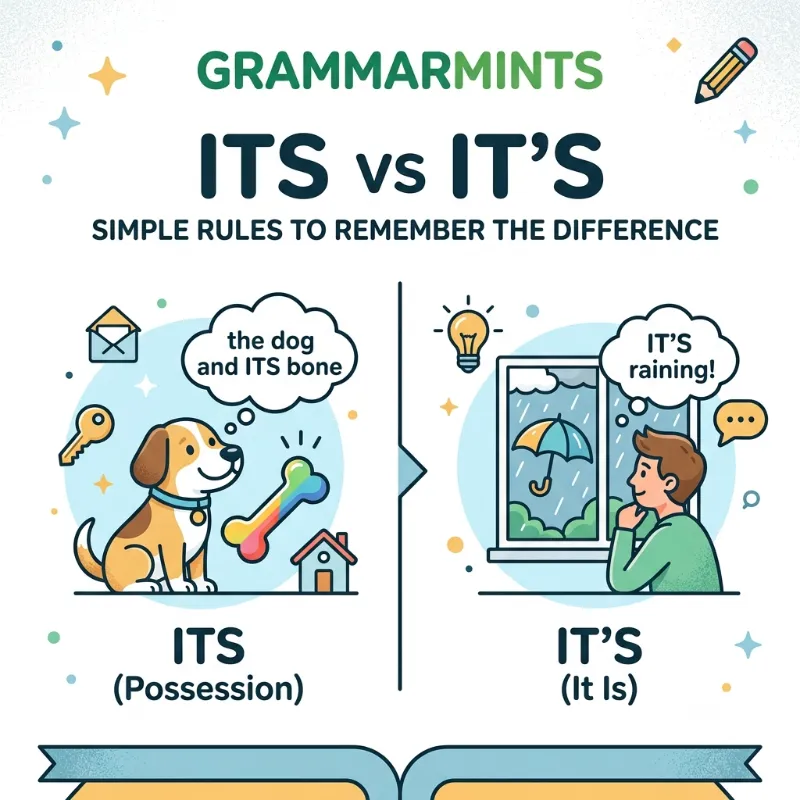
Here is the entire rule in one sentence: “its” shows ownership, and “it’s” is a shortcut for two words. Everything else in this guide simply builds on that one idea.
When to Use “Its” (Possessive)
Use “its” when you want to show that something belongs to “it,” meaning an object, animal, or idea already mentioned. There is no apostrophe here, which trips up many writers because it breaks the usual possessive pattern.
- The company updated its logo in March 2024.
- The bird returned to its nest before sunset.
- Every business has its own way of handling customer complaints.
Notice that none of these need an apostrophe. Just like “his,” “her,” and “their,” the word “its” is already possessive on its own.
When to Use “It’s” (Contraction)
Use “it’s” only when you can replace it with “it is” or “it has” and the sentence still reads correctly. This is the fastest of all the possessive its rules to check, because it takes one quick mental swap.
- It’s been raining since 6 a.m. (It has been raining…)
- It’s a great day for a walk. (It is a great day…)
- I think it’s time to leave. (It is time to leave.)
If replacing the word with “it is” sounds strange or wrong, you almost certainly need “its” instead.
A Simple Two-Step Test You Can Use Anywhere
Instead of memorizing grammar terms, try this quick test whenever you are unsure:
- Read the sentence and swap “its” or “it’s” with “it is.”
- If the sentence still makes sense, keep the apostrophe. If it sounds broken, remove the apostrophe.
For example, take the sentence “The team celebrated it’s win.” Swap it: “The team celebrated it is win.” That sentence falls apart instantly, so the correct version is “The team celebrated its win.” This test works almost every time, and it takes less effort than trying to recall a rule from a textbook, as this writing center guide from the University of Nevada, Reno also recommends.
Its vs It’s Simple Rules to Remember the Difference
Affect vs Effect How to Use Each Word Correctly
Its vs It’s Examples in Real Sentences
Seeing the words side by side often helps more than any rule. Below is a quick comparison table you can save or screenshot for later.
| Sentence | Correct Word | Why |
|---|---|---|
| The car lost value quickly. | its | Shows possession (the car’s value) |
| getting late, so we should go. | It’s | Short for “It is getting late” |
| The company changed pricing in June 2025. | its | Shows possession (the company’s pricing) |
| been a long week. | It’s | Short for “It has been a long week” |
| The app updated privacy policy last month. | its | Shows possession |
| I heard going to snow tonight. | it’s | Short for “it is going to snow” |
This kind of side-by-side comparison is exactly what makes its vs its examples click for visual learners. Once you see the pattern a few times, your brain starts to catch the error before you even finish typing.
Common Mistakes People Still Make in 2026
Even with spellcheck and grammar apps everywhere, this mix-up has not disappeared. A recent workplace survey published in mid-2026 found that 82 percent of workers admitted to making at least one document mistake in the past year, and 70 percent said they now lean on AI tools just to catch small errors before hitting send. Here are the mistakes that show up most often.
- Writing “the dog wagged it’s tail” instead of “its tail.”
- Writing “its going to rain” instead of “it’s going to rain.”
- Adding an apostrophe out of habit because most possessives use one.
- Trusting autocorrect blindly, since phone keyboards often insert the wrong version.
- Skipping a final proofread pass before sending an email or publishing a post.
If any of these feel familiar, do not worry. This is one of the most common errors even among native English speakers, and fixing it is mostly about building a quick double-check habit.
Then vs Than Understanding the Difference
Quick Reference Chart
Here is a simple breakdown of how each version functions, so you can scan it in a few seconds next time you are stuck.
| Word | Function | Apostrophe? | Example |
|---|---|---|---|
| Its | Possessive pronoun | No | The plant dropped its leaves. |
| It’s | Contraction of “it is” | Yes | It’s a beautiful morning. |
| It’s | Contraction of “it has” | Yes | It’s rained all week. |
| Its’ | Not a real word | N/A | Never use this form. |
That last row matters more than people think. Some writers, trying to be extra careful, add an apostrophe after the “s” in “its.” This form does not exist in English, so it is worth remembering that the only two correct versions are “its” and “it’s,” nothing else.
A Quick Case Study From Everyday Writing
A small e-commerce brand I worked with in early 2025 ran a product description that read, “This blender is known for it’s powerful motor.” The page had been live for nearly eight months before a customer pointed out the error in a review. After the team fixed it and ran a short grammar audit across 40 product pages, they found the same its/it’s mistake on six other listings. It is a small fix, but on a public-facing page, small errors add up to a bigger trust problem, especially for shoppers comparing brands.
This lines up with what larger studies have shown too. A resource from ICAL TEFL’s guide on its vs it’s notes that this mistake is common even among native speakers, not just English learners, which matches what I have seen across dozens of client projects.
Memory Tricks That Actually Work
If the swap test ever feels slow, try one of these shortcuts instead. Pick whichever one sticks in your head best.
- Think of “his” and “hers.” Neither uses an apostrophe, and “its” follows the same family of possessive pronouns.
- Say the sentence out loud with “it is” inserted. Your ear will usually catch the mistake before your eyes do.
- Remember that an apostrophe almost always means letters are missing, not that something is owned.
For more on tricky word pairs like this one, our guide to common grammar mistakes covers several other homophones that trip up even confident writers, including a close cousin of this problem in our your vs you’re breakdown.
Why Getting This Right Still Matters
You might wonder if a single apostrophe really makes a difference. Based on the data above, it clearly does. Nearly all readers notice grammar slips, and a large share of them silently judge the writer or the brand behind the words. Therefore, spending thirty seconds on a final proofread is a small price for a much stronger first impression.
If you write emails, product pages, or social posts for work, it is worth building small habits around this. For example, reading your sentence backward, using a grammar checker before publishing, or simply pausing before hitting send can catch most its/it’s slips before anyone else sees them. A helpful breakdown from Busuu’s its vs it’s lesson also recommends this kind of quick self-check for language learners and native speakers alike.
Frequently Asked Questions
Is it “its” or “it’s” when talking about a company? Use “its” when the company owns something, such as “the company raised its prices.” Use “it’s” only when you mean “it is” or “it has,” such as “it’s a growing company.”
Why does “its” not have an apostrophe if it shows possession? Because “its” belongs to the same group as “his,” “her,” and “their.” None of these possessive pronouns use an apostrophe, even though regular nouns do.
Is “its'” ever correct? No. This form does not exist in standard English. If you see it, it is always a typo for either “its” or “it’s.”
What is the fastest way to check which one to use? Replace the word with “it is” in your sentence. If it still makes sense, use “it’s.” If it sounds wrong, use “its.”
Do native English speakers make this mistake too? Yes, often. Multiple grammar guides and workplace surveys confirm that this is one of the most common errors among native speakers, not just English learners.
Conclusion
The difference between its and it’s comes down to one simple test: if “it is” fits, add the apostrophe; if it does not, leave it out. This small rule solves a mistake that shows up in resumes, emails, and product pages every single day. Once you practice the swap test a few times, it becomes automatic, and you will likely start catching this error in other people’s writing too. For more grammar guides like this one, visit our homepage or browse our full common grammar mistakes hub for related word pairs worth mastering.
References
- University of Nevada, Reno Writing & Speaking Center. “It’s vs. Its.” unr.edu.
- ICAL TEFL. “Its vs It’s in English.”
- Busuu. “Its vs It’s Explained: Examples and Tips to Avoid Mistakes.”
- Resumeble. “Spelling Errors, Poor Layouts, and Vague Wins Still Cost Job Seekers in 2025.” PRWeb, July 2025.
- Tidio. “Grammar Drama: Common Grammar Mistakes Survey.”
- Allwork.Space. “82% of Workers Made a Document Mistake Last Year, Survey Finds.” June 2026.