If you have ever frozen mid-sentence wondering whether to say “I go” or “I went,” you already know why tenses in English grammar matter so much. Tenses tell your listener when something happens, and getting them right is often the difference between sounding confident and sounding confused. In this guide, we will break tenses in English grammar into simple, bite sized pieces so that past, present, and future finally start to feel natural.
If you want to learn more gerunds and infinitives rules tips and expert advice.
Whether you are a student in the United States preparing for an exam, a professional in Europe polishing your business English, or simply someone who wants to speak with more confidence, this guide was written with you in mind. We will move step by step, use real examples, and skip the confusing textbook language.
If you want to learn more conditional sentences rules tips and expert advice.
What Are Tenses in English Grammar?
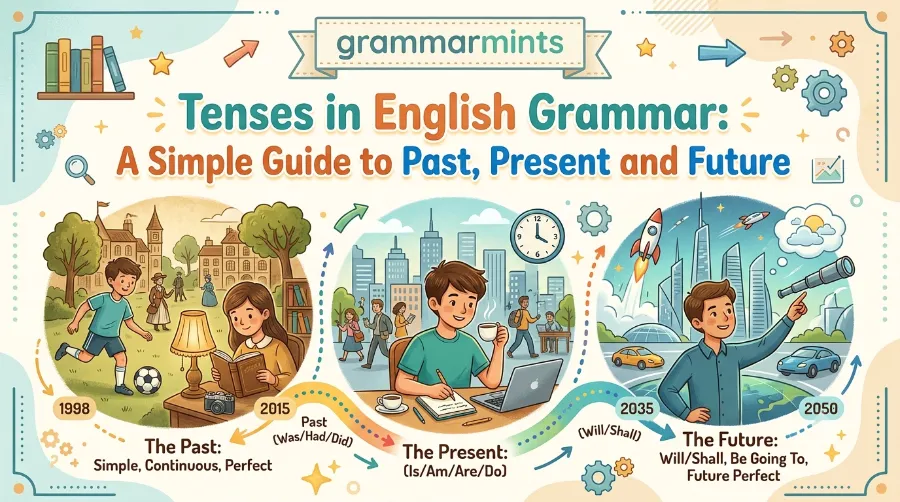
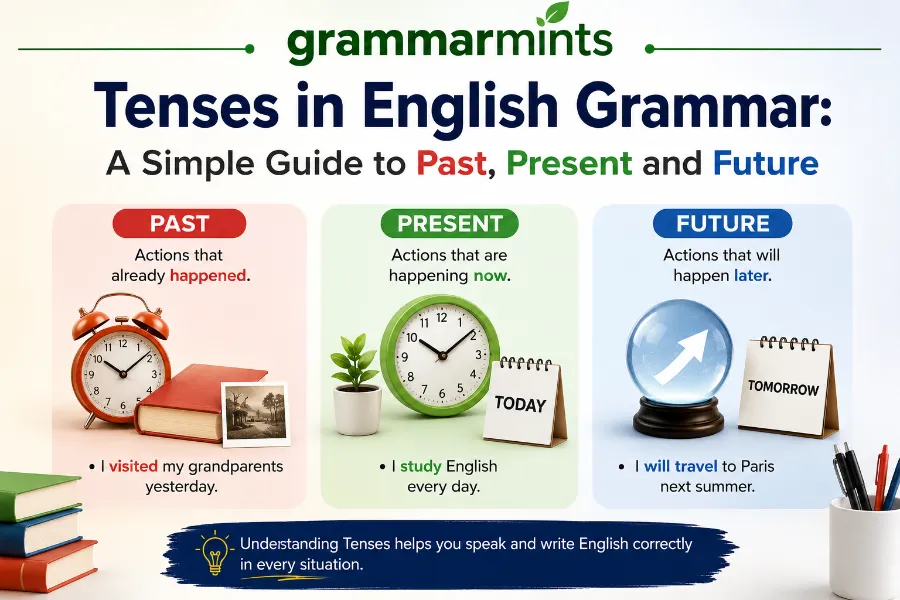
Put simply, tenses in English grammar are the verb forms we use to show time. English has three main time periods past, present, and future and each one splits into four aspects: simple, continuous, progressive, and perfect. That gives us twelve tense forms in total, although in everyday conversation you will lean on a handful of these far more than the rest.
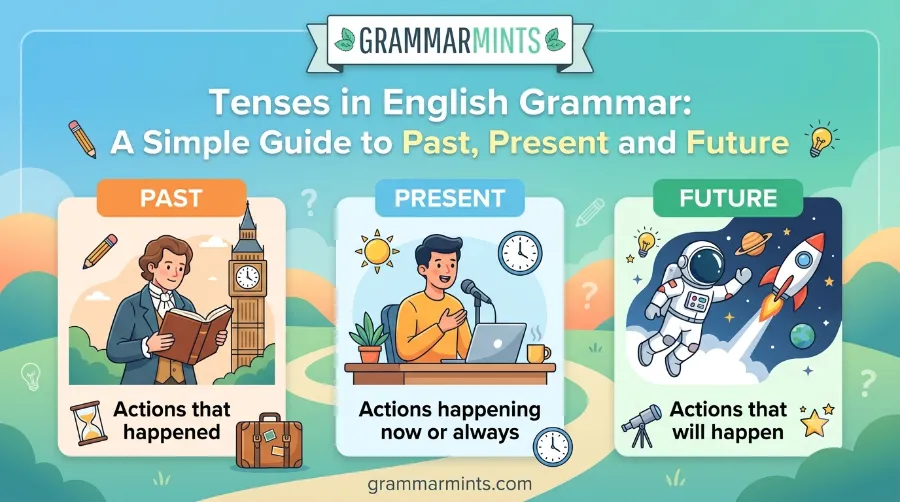
Here is why this matters. According to Grammar Mints’ pillar guide on English grammar rules, tenses form the backbone of almost every other grammar rule you will learn, from subject-verb agreement to reported speech. Once tenses click, everything else becomes easier to absorb.
Before we go further, it helps to remember that tenses always attach to verbs. If you are still shaky on what a verb actually is, this breakdown of parts of speech is a great place to start, since it explains how verbs work alongside nouns, adjectives, and the rest of the sentence.
Table 1: The Three Time Periods at a Glance
| Time Period | Basic Question It Answers | Example |
|---|---|---|
| Present | What happens now, generally, or regularly? | She works in Berlin. |
| Past | What already happened? | She worked in Berlin last year. |
| Future | What will happen? | She will work in Berlin next year. |
Present Tense in English Grammar
The present tense is where most beginners start, and for good reason: it covers habits, facts, and things happening right now. There are four forms, and each one carries a slightly different meaning.
Simple Present
Use the simple present for routines, schedules, and general truths. For example, “The sun rises in the east” or “I check my emails at 9 a.m. every day.” Because it does not change with time, it is one of the easiest tenses in English grammar to learn first.
Present Continuous
The present continuous (also called present progressive) describes an action happening right now or around now. For instance, “I am writing this guide today” or “They are traveling through Spain this month.” You form it with am/is/are + verb-ing.
Present Perfect
This tense links the past to the present, and it trips up many learners. Consider the sentence, “I have lived in Paris since 2019.” Notice that the action started in the past but continues into the present. This is a subtle but important part of tenses in English grammar, and it is one of the most common differences between American and British usage.
Present Perfect Continuous
Finally, the present perfect continuous emphasizes duration. “She has been studying for three hours” tells you the action is ongoing and has lasted a while.
Past Tense in English Grammar
Past tenses describe anything that already happened. They matter for storytelling, history, and everyday updates about your day.
Simple Past
The simple past states a completed action at a specific time, such as “I graduated in 2018” or “We visited London in July 2023.” Regular verbs add -ed (walked, played), while irregular verbs change form entirely (went, ate, saw).
Past Continuous
Use the past continuous for an action that was in progress when something else happened. For example, “I was cooking dinner when the phone rang.” This structure sets the scene before an interruption.
Past Perfect
The past perfect shows that one past action happened before another past action. “By the time she arrived, the meeting had already started” makes the sequence crystal clear.
Past Perfect Continuous
This form highlights how long something had been happening before another past event. “He had been working there for ten years before the company closed” is a classic example.
Future Tense in English Grammar
The future tense predicts, promises, or plans what has not happened yet.
Simple Future
The most common structure uses will, as in “I will call you tomorrow.” You can also use going to for plans already decided, such as “We are going to launch the new product in September 2026.”
Future Continuous
This describes an action that will be in progress at a specific future time. “This time next week, I will be presenting at the conference in Chicago” paints a vivid picture of a future moment.
Future Perfect
Use the future perfect for an action that will be completed before a certain point in the future. “By 2027, she will have finished her degree” is a common structure in academic and career planning.
Future Perfect Continuous
Less common but still useful, this form emphasizes duration up to a future point. “By next month, I will have been working here for five years.”
Table 2: Tense Signal Words Cheat Sheet
| Tense | Common Signal Words | Quick Example |
|---|---|---|
| Simple Present | always, usually, every day | She walks to work. |
| Present Continuous | now, right now, at the moment | She is walking now. |
| Simple Past | yesterday, last week, in 2020 | She walked yesterday. |
| Past Continuous | while, when, at that moment | She was walking when it rained. |
| Simple Future | tomorrow, next year, soon | She will walk tomorrow. |
| Future Continuous | at this time next week | She will be walking then. |
Common Mistakes Learners Make With English Tenses
Even advanced speakers slip up occasionally. Here are the mistakes that show up most often in classrooms and workplaces across the United States and Europe:
- Mixing simple past and present perfect. Saying “I have seen him yesterday” instead of “I saw him yesterday” is a frequent error, since present perfect never pairs with a specific past time word.
- Forgetting irregular verbs. Many learners regularize verbs that should not be regularized, writing “goed” instead of “went.”
- Overusing continuous forms. Stative verbs like know, believe, and own rarely take the continuous form, so “I am knowing the answer” should simply be “I know the answer.”
- Confusing will and going to. Will often expresses a spontaneous decision, while going to signals a plan already made.
According to EnglishClass101’s breakdown of English tenses, these mixed-up forms are among the top reasons learners struggle to sound natural even after years of study, which is exactly why steady, structured practice pays off.
Quick Tips to Master Tenses in English Grammar
Learning tenses in English grammar is less about memorizing rules and more about building instinct through repetition. Try these approaches:
- Read a paragraph aloud and label every verb with its tense. This trains your eye to notice patterns quickly.
- Keep a daily journal using only the tense you are practicing that week.
- Listen actively to podcasts or shows and pause whenever you hear an unfamiliar tense structure.
- Practice timelines on paper. Drawing a simple line with past, present, and future helps visual learners see how tenses connect.
As Wall Street English notes in its verb tense guide, consistent daily exposure, rather than occasional cramming, tends to produce the most lasting improvement, since your brain needs repeated contact with a pattern before it becomes automatic.
Table 3: English Learning at a Glance (2026 Data)
| Data Point | Figure | Source |
|---|---|---|
| Global English learners | Approximately 1.75 billion people | British Council, Future of English report |
| Top-ranked country for proficiency | Netherlands, scoring 647/800 (6 years running) | EF English Proficiency Index, 2025 |
| Time to reach intermediate (B1) fluency | 600 to 1,000 hours of focused study | Cambridge Assessment English |
| Global English learning market value | Around $43.5 billion in 2025, growing 22% a year | Preply Global Language Learning Report |
These numbers matter because they show something encouraging: reaching a comfortable level with tenses in English grammar, and English overall, is not an overnight event for anyone, including native-language peers around you. It is a gradual process, and every learner is moving through roughly the same curve.
Real-Life Example: A Week in Three Tenses
To bring this all together, imagine a professional named Maria describing her week to a colleague in a video call on a Friday afternoon.
- Past: “On Monday, I finished the quarterly report and sent it to the finance team.”
- Present: “Right now, I am reviewing feedback from my manager.”
- Future: “By next Friday, I will have completed the revised version and scheduled it for release.”
Notice how naturally Maria moves between tenses in English grammar without pausing to think about grammar rules. That fluency is the goal, and it comes from practice, not perfection.
Frequently Asked Questions
How many tenses are there in English grammar? English has three time periods — past, present, and future — each with four aspects, giving twelve tenses in total.
What is the easiest tense to learn first? Most learners find the simple present easiest, since it follows the most predictable pattern and appears constantly in everyday speech.
Why is the present perfect so confusing? It links the past to the present without stating an exact time, which feels unfamiliar to speakers of languages that separate past and present more strictly.
Can I become fluent without memorizing every tense rule? Yes. Fluency usually comes from repeated exposure and practice rather than memorizing charts, though understanding the basic structure still helps you self-correct.
How long does it typically take to master English tenses? Based on Cambridge Assessment English research, most learners need roughly 600 to 1,000 hours of consistent study to feel comfortable with core tense structures at an intermediate level.
Conclusion
Tenses in English grammar might feel overwhelming at first glance, but once you break them down into past, present, and future, with their four aspects each, the pattern becomes far easier to see. Start with the forms you use most, practice with real sentences from your own life, and let the rest build gradually. For more grammar breakdowns like this one, explore the full library at Grammar Mints, where you will find guides covering everything from sentence structure to advanced writing tips.
References
- British Council, Future of English Report
- EF English Proficiency Index, 2025
- Cambridge Assessment English, Research on Learning Outcomes
- Preply, Global Language Learning Report
- EnglishClass101, English Tenses Blog
- Wall Street English, English Verb Tenses Guide