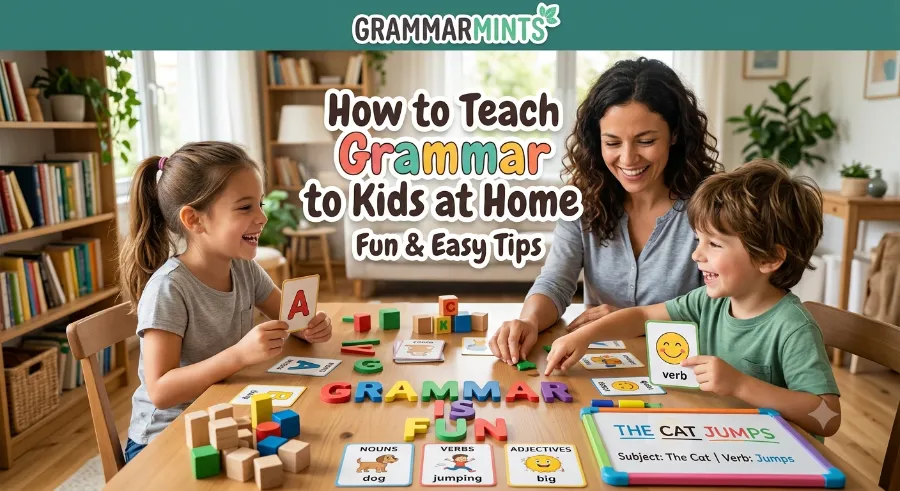
Grammar time does not have to end in groans and gritted teeth. If you have ever wondered how to teach grammar to kids at home, you are in good company. Millions of parents in the United States and across Europe now handle at least part of their child’s language learning outside a classroom. Grammar is usually the subject that feels trickiest to explain in plain, friendly words.
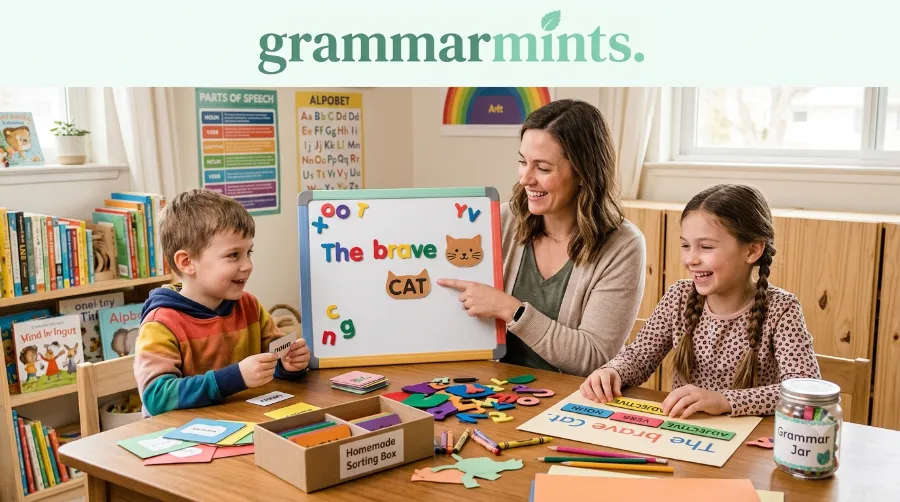
The good news is that grammar sticks best when it is taught the way kids actually learn. Stories, games, and short daily habits work far better than long worksheets. Whether you are homeschooling full time in Texas or helping with homework in Berlin, the same core principles apply everywhere. Children pick up grammar fastest when it feels like play, not a test. The same short routine, repeated often, becomes second nature over time.
In this guide, you will find a simple, step-by-step method. You will also get real numbers from recent research, ready-to-use activities, and sample weekly schedules. By the end, you should have a clear, low-stress plan you can start using today, without buying an expensive curriculum.
Why Grammar Skills Matter More Than Ever
Reading and writing scores have been slipping for a while now, and that trend is worth watching. According to the 2024 National Assessment of Educational Progress, only 31 percent of fourth-grade students performed at or above the NAEP Proficient level in reading. That is 2 percentage points lower than 2022 and 4 percentage points lower than 2019. In other words, fewer kids are leaving school with strong reading and language foundations than five years ago.
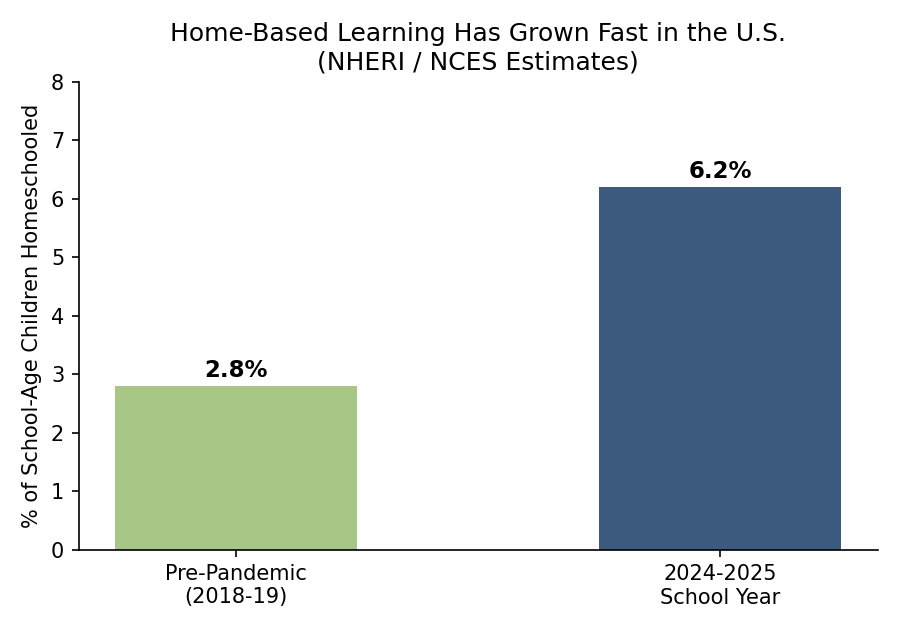
At the same time, more families are stepping in to fill that gap themselves. There were an estimated 3.408 million homeschool students, ages 5 through 17, in the United States during the 2024-2025 school year. That figure keeps climbing every year. Grammar, spelling, and sentence structure are usually the first subjects parents want extra help with, since they form the base for everything else a child writes or says.
The chart below puts both trends side by side. As classroom reading scores dip, home-based language support keeps growing. This is exactly why a simple, low-pressure grammar routine at home makes such a big difference.
Show Image
Beyond test scores, grammar shapes how clearly a child can express an idea or write a simple email years down the line. A child who understands sentence structure tends to write more confidently and speak more clearly in class discussions. That matters a great deal for families in Europe, where many children grow up learning English alongside a home language.
So, before diving into worksheets or apps, remember the real goal. It is not perfect grammar overnight, but steady, confident progress your child can feel proud of. Perfectionism tends to backfire with young learners; consistency almost always wins in the long run.
Signs Your Child Might Need Extra Grammar Support
Not every child needs a formal grammar routine right away. A few warning signs are worth watching for, though, since catching them early makes correction much easier:
- Frequent mixing of past, present, and future tense in the same conversation
- Difficulty forming complete sentences when speaking or writing
- Confusion between similar-sounding words, such as “their,” “there,” and “they’re”
- Avoiding writing tasks altogether, even short ones like a birthday card
- A noticeable gap between how well your child speaks and how well they write
If two or more of these sound familiar, that is a good signal. Start the routine below sooner rather than later.
How to Teach Grammar to Kids at Home in 7 Simple Steps
You do not need a teaching degree to help a child understand grammar. You just need a plan that fits into everyday life. Here is a step-by-step approach that many parents and tutors rely on.
- Start with spoken grammar, not written rules. Talk with your child and gently repeat back a corrected sentence instead of pointing out the mistake directly. For example, if your seven-year-old says “I goed to the park,” you can reply, “Oh, you went to the park? That sounds fun.” This models the correct form without shame or lectures. It works especially well for younger children who are not yet reading fluently.
- Teach one concept at a time. Nouns this week, verbs the next, then simple punctuation. Cramming several rules together usually backfires and makes kids anxious rather than curious. A slow, steady pace almost always beats a rushed one.
- Use real books and shows as examples. Pause during a bedtime story and ask, “Which word in that sentence is the action word?” Familiar stories make grammar feel like a game rather than homework. Children remember rules better when they are tied to a character they already love.
- Practice for 10 to 15 minutes a day, not an hour once a week. Short, consistent sessions build stronger memory than long cramming sessions. They are also far easier to fit into a busy household schedule. Daily micro-sessions tend to outlast weekend “grammar marathons” by a wide margin.
- Turn corrections into a mini-challenge. Instead of saying “that’s wrong,” ask, “Can you say that a different way?” This keeps kids in problem-solving mode instead of feeling criticized. It also builds independent editing skills that pay off later in school essays.
- Mix in writing practice. Have your child write a two-line diary entry, a text to grandma, or a caption for a photo. Writing reveals grammar gaps that speaking often hides. Spoken sentences are usually shorter and more forgiving than written ones.
- Celebrate small wins out loud. A simple “You used past tense perfectly there!” builds confidence. Confident kids ask more questions and take more risks with language. Over time, this small habit does more for motivation than any workbook ever could.
Notice that none of these steps require a formal lesson plan. They fit naturally into breakfast, car rides, and bedtime. That is exactly why they work so well for busy parents. Here is what a typical week might look like once the routine is up and running.
Sample Weekly Grammar Schedule
| Day | Focus | Time Needed |
|---|---|---|
| Monday | Spoken correction during breakfast chat | 10 minutes |
| Tuesday | Sentence scramble game | 15 minutes |
| Wednesday | Read-aloud with grammar spotting | 10 minutes |
| Thursday | Short writing task (diary or text) | 15 minutes |
| Friday | Grammar game or app session | 15 minutes |
| Weekend | Free reading, no formal correction | Optional |
A schedule like this rarely feels like extra work once it becomes routine. Most of it fits inside activities families are already doing anyway.
Setting Up a Grammar-Friendly Space at Home
Environment matters more than most parents expect. A cluttered corner of the kitchen table sends a very different signal than a small, dedicated space for reading and writing. You do not need an elaborate homeschool room to make this work. A shelf, a notebook, and a consistent spot at the table are usually enough.
A few small touches make a noticeable difference over time:
- Keep a “word wall.” A sheet of paper on the fridge or wall where tricky words go once your child learns them. Seeing progress visually reinforces the habit far better than a grade ever could.
- Store a grammar notebook somewhere visible. When the notebook lives in a drawer, it gets forgotten. When it sits on the table, it becomes part of the daily rhythm.
- Set a consistent time, not just a consistent length. Right after breakfast or right before bedtime tends to work better than “whenever we get to it.” Routines anchored to an existing habit stick far more reliably.
- Remove pressure from the space itself. Avoid using the grammar corner as a punishment spot. Keep it linked to curiosity and small wins instead.
Once this environment feels natural, grammar practice starts to feel like a normal part of the day. It stops being a separate subject forced into an already packed schedule.
Fun Tools and Techniques That Make Grammar Stick
Once the basics are in place, the right tools can turn grammar practice from a chore into something kids look forward to. Consistency matters here as well, so pairing grammar work with strong overall study habits tends to produce the best results. If you would like a broader framework for building those habits, our guide to best study techniques for students is a helpful next stop.
Here are a few approaches worth trying at home:
- Grammar games and apps. Short, game-like drills keep attention spans engaged far longer than static worksheets, especially for kids under age ten.
- Sentence scrambles. Write a sentence on strips of paper, mix up the words, and let your child rebuild it correctly. This teaches sentence structure without a single rule being recited out loud.
- Color-coded grammar. Assign a color to each part of speech, such as blue for nouns and red for verbs. Visual learners especially benefit from this trick.
- AI writing helpers, used carefully. Tools built on modern language models can generate quick practice sentences or explain a rule in a new way. Our breakdown of Grammarly vs. ChatGPT for grammar practice walks through the pros and cons of each.
- Guided prompts for older kids. Once children reach upper elementary or middle school, a well-written prompt can help them practice independently. Our list of ChatGPT prompts for studying includes several designed for language review.
Beyond the tools above, several DIY games require no purchase at all. They also work well for siblings of different ages practicing together:
- Grammar bingo. Fill a bingo card with parts of speech instead of numbers, then call out words during reading time.
- The mistake hunt. Write a short paragraph with three or four deliberate errors and challenge your child to find them all.
- Story chain. Take turns adding one sentence to a growing story, each using a different part of speech correctly.
- Grammar charades. Act out a verb, and have your child guess it and use it correctly in a full sentence.
These games cost nothing beyond a little planning time. Because they involve movement and conversation, many kids retain the lessons faster than they would from a printed page.
As your child’s writing improves, encourage them to keep track of what they learn. Good note-taking is not just for older students; even a simple grammar notebook helps young learners see their progress. Our guide on best note-taking methods for students offers age-appropriate ideas that pair well with a grammar routine.
Teaching Grammar in Bilingual and ESL Households
Many families across Europe are raising children who speak English alongside a home language. Grammar mistakes in these households often look a little different. A child who speaks German or French at home might carry over sentence order or article rules that do not quite match English. This is completely normal, and it usually resolves faster than parents expect with steady exposure.
A few adjustments help bilingual and ESL households in particular:
- Keep languages separate during practice time, rather than mixing corrections from both languages in the same sentence.
- Read aloud in English daily, even for just ten minutes, since listening comprehension often develops faster than speaking accuracy.
- Be patient with article and preposition mistakes, such as “a,” “an,” and “the.” These are notoriously tricky, even for advanced learners.
- Use visual grammar aids rather than relying only on verbal explanations, since translated rules do not always map neatly between languages.
With this approach, most bilingual children catch up to monolingual peers within a year or two of steady practice. They rarely feel singled out or behind along the way.
Common Grammar Mistakes and How to Fix Them at Home
Most grammar struggles fall into a handful of predictable patterns. Recognizing them early saves a lot of frustration for both parent and child. It also means you can focus your limited practice time on the mistakes that matter most.
Interestingly, most of these patterns are developmental rather than a sign of a deeper problem. Nearly every child mixes up verb tenses or homophones at some point. The mistake usually fades on its own once enough correct examples have been modeled. The table below breaks down the five most common issues parents report, along with a simple fix for each one.
| Common Mistake | Example | Simple Home Fix |
|---|---|---|
| Mixing up verb tenses | “Yesterday I go to school” | Ask “when did it happen?” before every sentence to anchor the tense |
| Subject-verb disagreement | “The dogs is barking” | Practice with plural nouns first, since these trip kids up most |
| Confusing homophones | “Their going to the park” | Use flashcards with pictures, not just definitions |
| Run-on sentences | “I woke up I ate breakfast I went to school” | Teach the “one idea, one sentence” rule with clapping pauses |
| Missing capitalization | “my dog is named max” | Turn it into a spotting game during reading time |
Working through even one row of this table per week tends to produce steadier, longer-lasting improvement. Trying to fix all five patterns at once usually overwhelms both parent and child.
Age-Wise Grammar Teaching Tips
Grammar instruction should look different depending on your child’s age. A five-year-old and a twelve-year-old need very different approaches, even when the underlying skill is the same.
| Age Group | Main Focus | Suggested Activity |
|---|---|---|
| Ages 4-6 | Spoken sentences, basic nouns and verbs | Picture books with repeated sentence patterns |
| Ages 7-9 | Simple tenses, plurals, punctuation | Sentence scrambles and short daily journaling |
| Ages 10-12 | Complex sentences, clauses, homophones | Editing short paragraphs together, peer review with siblings |
| Ages 13+ | Style, tone, and advanced punctuation | Real-world writing like emails, blog comments, or essays |
Every child develops at a slightly different pace, so treat these age ranges as a guide rather than a strict rule. A confident nine-year-old might already be ready for tasks in the next group, and that is perfectly normal.
Using Technology and Trusted Websites to Support Grammar Practice
Free, well-designed resources can take a lot of pressure off parents, especially on busy weeknights. The British Council’s Learn English Kids site offers structured grammar and vocabulary practice designed for young learners. It works well as a five-minute add-on after homework. You can explore it directly through the British Council’s grammar practice hub.
Public libraries are another underused resource. The New York Public Library has put together a roundup of free websites for practicing English. Many of the tools it lists remain active today, well beyond the post’s original publish date. You can find that full roundup on the NYPL’s guide to free English practice websites.
When it comes to AI tools specifically, treat them as a tutor’s assistant rather than a replacement for your own explanations. Ask the tool to generate three example sentences, then have your child spot the pattern themselves. This keeps the thinking work with your child, which is where the real learning happens.
It also helps to set a few ground rules before introducing any app or website. Keep sessions short, around ten minutes, so screen time does not crowd out spoken practice. Sit with younger children during the first few sessions instead of handing over a device and walking away. Guided screen time consistently outperforms unsupervised screen time for language learning. Treat any single tool as one piece of a broader routine, not the whole plan.
A Real Parent Example: What Progress Actually Looks Like
Consider a typical case. In September 2025, a parent in Ohio began a 15-minutes-a-day grammar routine with her eight-year-old son. He had been struggling with verb tenses at the start of the school year. Using short sentence-scramble games and daily read-aloud corrections, she noticed a clear shift by December 2025. His classroom teacher reported far fewer tense errors in his writing samples, and his confidence during read-aloud time improved noticeably.
This kind of result is common, not exceptional. Homeschooling researchers have long noted that homeschooled students often perform above the average of institutionally schooled peers on standardized testing measures. Consistent, low-pressure grammar practice at home is one of the simplest reasons why. Small, steady habits beat occasional long sessions almost every time.
A similar pattern shows up outside the United States as well. In early 2026, a bilingual family in Manchester began using the color-coded grammar method with their ten-year-old daughter. She was fluent in spoken English but struggled with written punctuation. After roughly eight weeks of ten-minute daily sessions, her teacher noted a visible drop in run-on sentences during a March 2026 progress review. Neither family used an expensive program. Both relied on short, repeatable habits built around everyday moments.
Frequently Asked Questions
1. What age should I start teaching grammar at home? Most children are ready for simple spoken grammar concepts by age four or five. Formal written grammar rules usually work better from around age seven onward.
2. How long should a grammar session last? Ten to fifteen minutes a day is generally more effective than one long weekly session. Short bursts help young children retain information better.
3. Do I need a curriculum to teach grammar at home? Not necessarily. Many parents succeed using books, conversation, and free online resources. A light curriculum can help if you prefer more structure.
4. Is it okay to use AI tools like ChatGPT to help with grammar lessons? Yes, as a supplement. AI tools work well for generating extra practice sentences or explaining a rule differently. They should not replace hands-on conversation with a parent.
5. My child hates grammar worksheets. What else can I try? Try games, sentence scrambles, and color-coding instead of worksheets. Most kids respond far better to activities that feel playful rather than academic.
6. How do I teach grammar to a bilingual child without confusing them? Keep practice time focused on one language at a time. Lean on visual aids rather than direct translation, since rules rarely map perfectly between languages.
7. What if my child is behind grade level in grammar? Slow down rather than speed up. Focus on one concept until it feels natural, then move forward. Comparing your child’s pace to a school benchmark usually adds pressure without adding progress.
8. Should grammar be taught separately from reading and writing? No. Grammar sticks best when it is woven into reading and writing activities your child already enjoys, rather than treated as a standalone subject.
Final Thoughts
Teaching grammar at home does not require perfection, a teaching certificate, or hours of your evening. It simply requires a little consistency and the right small activities. Mistakes should be treated as part of the learning process, not something to fear. Start with one of the seven steps above, pick a single tool from this guide, and build from there.
Over a few months, you will likely see the same quiet, steady progress that thousands of homeschooling families are already seeing across the United States and Europe. Progress will not always be visible day to day. It adds up faster than most parents expect once the routine becomes a habit rather than a task on a to-do list. That shift from “grammar lesson” to “grammar habit” is what makes the whole process feel far less overwhelming for everyone.
References
- National Center for Education Statistics, NAEP 2024 Reading Assessment Results, nationsreportcard.gov
- National Home Education Research Institute (NHERI), “How Many Homeschool Students Are There in the United States?” 2024-2025 report
- Pew Research Center, “A Look at Homeschooling in the U.S.,” 2025
- British Council, Learn English Kids, Grammar and Vocabulary Practice
- New York Public Library Blog, “11 Great Free Websites to Practice English”