A single line can cost you a job, a client, or a deal. That is the blunt truth behind most formal letter mistakes. They rarely look dramatic on the page. Yet they change how a reader judges your competence within seconds. Whether you are drafting a cover letter or a complaint, small slips in tone or grammar tell the reader something you never meant to say. This guide walks through the errors that show up most often in 2026. It also explains why they happen and exactly how to fix each one.
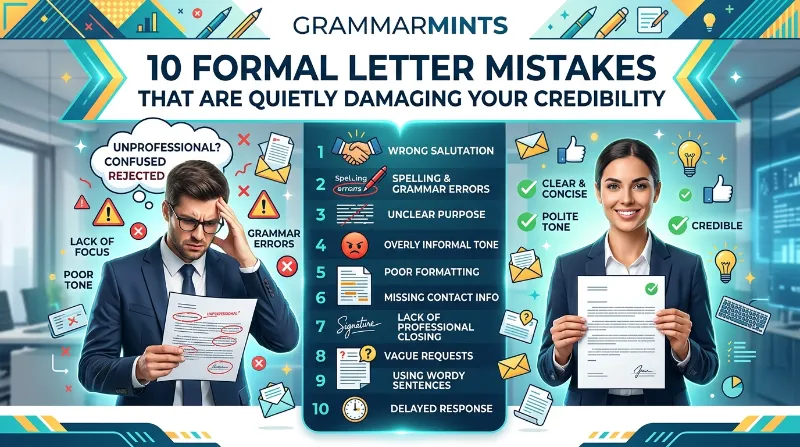
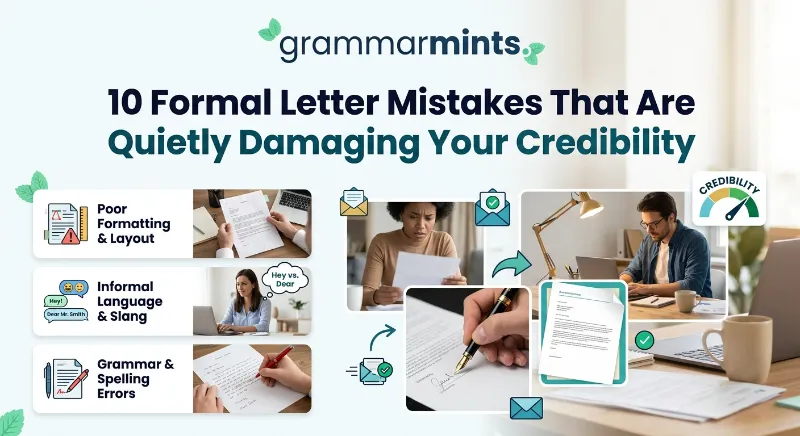
10 Formal Letter Mistakes That Are Quietly Damaging Your Credibility
TL;DR: Most letter writing errors come down to five habits: the wrong salutation, an overly casual tone, weak grammar, a messy structure, and skipping the final proofread. Fix those five, and your letters instantly read as more professional, no matter who receives them.
Why These Errors Still Matter in an AI Writing World
You might assume that spellcheckers and AI assistants have already solved this problem. However, research says otherwise. The gap between “written” and “well written” is still wide open. A widely cited MarketingProfs survey polled nearly 1,840 readers. 97% said grammar mistakes influence their perception of a company. Just over half said grammar usage shapes how professional that company appears.
ESL Exam Grammar Mistakes Why Smart Students Still Lose Points
That effect is not just a feeling; it shows up in company-wide numbers too. Grammarly and The Harris Poll put the cost of unclear workplace writing at roughly $1.2 trillion a year. That figure covers US companies alone. The same report found that one in five business leaders lost business over poor communication. More than twice as many gained new business from writing that was clear and effective.
So, even though tools now catch typos automatically, they cannot catch a stiff tone or a wrong salutation. They also miss a rambling structure. Consequently, the human judgment behind a formal letter still matters more than any spellchecker.
Figure 1: How Writing Mistakes Shape Reader Perception
| Reader reaction to writing errors | Share who agree |
|---|---|
| Say mistakes shape their overall view of a company | 97% |
| Say mistakes hurt perceived professionalism | 52% |
| Say mistakes hurt perceived credibility | 35% |
Source: MarketingProfs / Grammarly research, 2021 survey data.
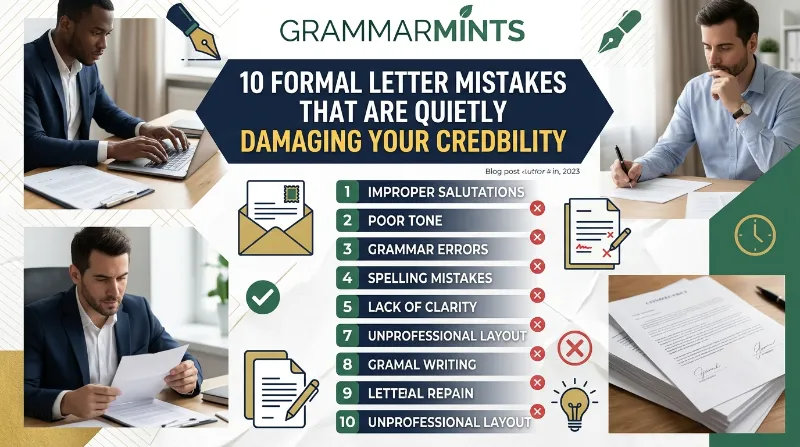
The Most Common Formal Letter Mistakes (And How to Fix Each One)
Below is a breakdown of the ten mistakes that show up most often in cover letters and business correspondence. Each one includes a quick fix you can apply the next time you sit down to write.
1. Opening With the Wrong Salutation
Many writers still default to “Dear Sir or Madam,” even though it reads as outdated to most modern readers. One widely used style guide notes that this greeting is often seen as lazy. A little research usually reveals the actual name of the recipient. If you truly cannot find a name, “Dear Hiring Manager” works far better than a vague, generic phrase.
Fix it fast:
- Search the company website, LinkedIn, or make a quick phone call before defaulting to a generic greeting.
- Use a full name with a title only when you are certain of gender and spelling.
- Avoid “To Whom It May Concern” unless the letter is genuinely addressed to no one in particular.
2. Slipping Into a Casual Tone
This is one of the most common letter writing mistakes, and it usually happens by accident. A writer starts formal, then relaxes halfway through. Contractions, slang, or emoji-style enthusiasm creep in. A formal letter represents your professional voice. That shift instantly weakens the message, even when the content itself is solid.
Most Common Punctuation Mistakes in Professional Writing (and How to Fix Them Fast)
A 2024 Grammarly-published guide flags phrases like “I’m running late, I’ll be there soon” as too informal. The formal version, “I regret that I am unable to arrive at the scheduled time,” suits business correspondence far better. Tone consistency, from greeting to sign-off, is what separates a professional letter from a rushed email.
3. Overusing Passive Voice and Vague Language
Passive constructions, such as “Mistakes were made” instead of “I made a mistake,” often creep into formal writing. Writers assume passive voice sounds more polished. In reality, it usually adds words without adding clarity. Readers have to work harder to figure out who did what. Business letter grammar rules generally favor active voice because it is shorter and more direct.
Quick test: If you can add “by zombies” after the verb and the sentence still makes sense (“The report was written by zombies”), it is passive. Rewrite it so the subject performs the action instead.
4. Ignoring Proper Letter Structure
A formal letter follows a predictable shape for a reason. Readers scan for the same information in the same place every time. Skipping the sender’s address, the date, or a subject line makes the letter look rushed. This holds true even when the content inside is strong.
A well-structured formal letter typically includes:
- Sender’s address and the date, aligned at the top.
- Recipient’s name, title, and address.
- A clear subject line or reference, for business letters.
- A greeting, followed by an opening paragraph that states the purpose.
- Body paragraphs organized by topic.
- A closing paragraph with a clear next step or request.
- A formal sign-off and signature block.
5. Grammar, Spelling, and Punctuation Slips
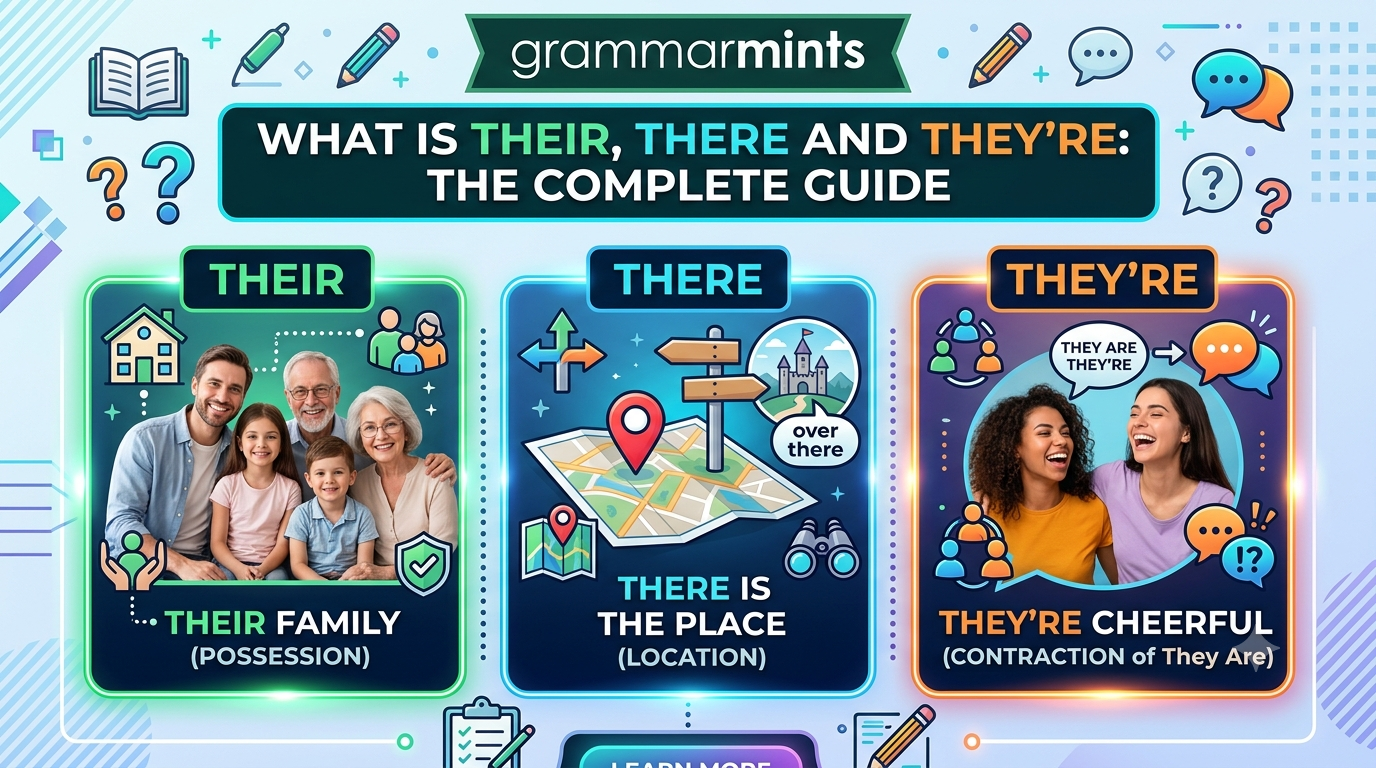
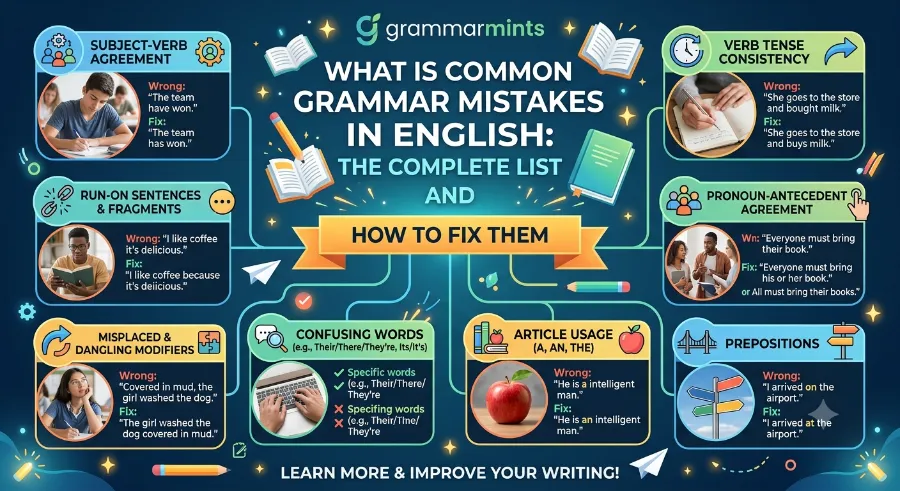
This is the category most people picture when they hear about sloppy business correspondence, and it remains one of the most damaging. Misplaced commas and subject-verb disagreement are small on the page but loud in the reader’s mind. So are confused homophones like their, there, and they’re. One related study found that irregular verb forms remain some of the most persistent errors, even among fluent, experienced writers.
A dedicated grammar checker, such as LanguageTool, catches many of these slips before they reach the recipient. Tools like Ginger’s grammar checker and Scribens are also worth keeping in your browser bar. Each one flags slightly different issues, from punctuation to sentence structure. None of them replace a careful human read-through. Together, though, they cut down on the errors that slip past a tired eye late at night.
6. Using Overly Complex Words to “Sound Formal”
Ironically, one of the more common business letter grammar mistakes is trying too hard. Writers reach for “utilize” instead of “use,” or “pursuant to” instead of “regarding.” They assume complexity signals professionalism. Plain, precise words almost always read as more confident and more competent than inflated ones.
If you would not say a word out loud in a meeting, it probably does not belong in your letter either. Formal does not mean complicated. It means clear, respectful, and direct.
7. Weak or Missing Closing Statements
Many formal letters trail off with a vague “Thank you for your time” and nothing else. While polite, this leaves the reader unsure of what happens next. A strong closing restates the purpose and gives a clear next step, such as a reply date or a specific action.
Compare these two endings:
- Weak: “Thank you for considering my request.”
- Strong: “I would appreciate a response by Friday, March 6, and I am happy to provide any further documents you may need.”
8. Overlooking Regional and Cultural Differences
For readers across the US, UK, and wider Europe, this mistake is easy to miss but genuinely damaging. American English favors “Sincerely” as a closing and MM/DD/YYYY date formats. British and European English typically use “Yours faithfully” for unnamed recipients. When the name is known, “Yours sincerely” is standard, along with DD/MM/YYYY dates. Mixing the two conventions in one letter can look inconsistent, especially to a detail-focused reader like a hiring manager.
A quick regional checklist:
- United States: MM/DD/YYYY dates, “Sincerely” as a default closing, single spacing after periods.
- United Kingdom: DD/MM/YYYY dates, “Yours faithfully” or “Yours sincerely” depending on the name, and British spelling such as colour and organise.
- Continental Europe: Often follows UK conventions. Some readers, especially in finance and law, still expect the more formal DIN 5008-style layout common in German business correspondence.
9. Skipping the Final Proofread
It sounds obvious, yet it remains one of the most frequent mistakes writers make under deadline pressure. A letter written in one sitting and sent immediately almost always has something the writer would catch on a second read. That could be a repeated word, a missing “not,” or a name spelled two different ways in the same document.
Reading the letter out loud forces your brain to slow down. So does reading it backward, from the last sentence to the first. Both tricks help you actually see the words instead of skimming past what you expect to be there.
10. Forgetting Contact Details or a Clear Signature Block
A letter that never states how to reach you defeats its own purpose. Missing phone numbers or an unsigned closing line force the reader to hunt for a way to respond. Busy recipients often will not bother.
Formal Letter Writing Tips That Separate Professionals From Amateurs
Beyond fixing individual mistakes, a few habits consistently separate polished writers from everyone else. These formal letter writing tips apply whether you are writing a cover letter, a client proposal, or a formal complaint to a landlord.
Habits That Sharpen Every Letter
- Write the purpose sentence first. State exactly what you want the reader to do. Build the rest of the letter around that one sentence.
- Keep paragraphs short. Three to four sentences per paragraph is plenty. Dense blocks of text discourage readers before they even start.
- Match tone to relationship, not to formality alone. A letter to a long-term client can be warm and formal at once. It does not need to sound like a legal contract.
- Read the letter as the recipient, not the writer. Ask what a stranger would understand from the first two sentences alone.
- Cut the first paragraph in half. Most writers over-explain their reason for writing before getting to the point. Trimming that opening usually sharpens the whole letter.
- Save a personal template library. Keep two or three tested openings and closings on hand. This saves time and keeps tone consistent across every letter you send.
These tips work because they target the parts of a letter a reader notices first: the opening line, the request, and the closing action. Everything in between simply needs to stay clear and well organized.
Why This Matters at the Business Level
This is also where broader research becomes genuinely useful, not just interesting. The Grammarly Business and Harris Poll study found that poor workplace communication is linked to lower productivity. It is also linked to weaker performance across knowledge workers and business leaders alike.
More recent figures back this up. 82% of knowledge workers say poor communication has increased their overall stress. Meanwhile, 81% report a drop in productivity because of it. A formal letter is a small artifact. But it carries the same stakes as any other piece of business writing.
Figure 2: The Real Cost of Weak Business Writing
| Business impact | Share reporting it |
|---|---|
| Lost business due to poor writing | ~20% of business leaders |
| Gained new business from effective writing | 43% of business leaders |
| Increased stress from poor communication | 82% of knowledge workers |
| Decreased productivity from poor communication | 81% of knowledge workers |
Source: Grammarly Business & Harris Poll, State of Business Communication research.
Business Letter Grammar Rules Worth Memorizing
A handful of grammar rules cause more trouble than the rest combined. Learning these five well solves a large share of common letter writing mistakes on their own.
- Subject-verb agreement. “The team is meeting,” not “The team are meeting,” in American English business writing.
- Consistent tense. Do not slide from past to present mid-paragraph. Readers notice the shift even if they cannot name it.
- Apostrophes for possession, not plurals. “The client’s request” is correct. “The clients request,” without the apostrophe, changes the meaning entirely.
- One space after a period. Modern style guides on both sides of the Atlantic have moved away from the old two-space rule.
- Comma before a coordinating conjunction. “I reviewed the contract, and I have three questions” needs that comma to read cleanly.
Our guide to grammar mistakes at work breaks down these same slips in more detail. Much of your formal correspondence may happen over email rather than paper letters. If so, check our breakdown of common email grammar mistakes too, since many of the same habits carry over.
A Real Example: Before and After
The Ohio Complaint Letter
Here is a short excerpt from an actual complaint letter draft, lightly edited to remove identifying details. It was written by a small business owner in Ohio in early 2025.
Before: “Hi there, I’m writing bc my order from last month never showed up and its been like 3 weeks now which is honestly pretty frustrating and I was wondering what your going to do about it.”
After: “Dear Customer Service Team, I am writing regarding order #4821, placed on January 6, 2025, which has not yet arrived after three weeks. I would appreciate an update on its status, along with a revised delivery date or a refund if the item cannot be located.”
The second version keeps the same core complaint. It removes contractions, fixes “your” to “you’re,” and clarifies the actual request. It also adds a reference number and a date, giving the recipient exactly what they need to act quickly. Customer service teams consistently report the same pattern. Adding specific dates and order numbers is often the difference between a letter resolved in one reply and one that drags on for three rounds.
The UK Cover Letter
A second example comes from a UK-based job application reviewed in late 2025. The original draft opened with “Hiya, I saw the job post and thought I’d apply.” That reads more like a text message than a cover letter. After editing, the opening became: “Dear Ms. Harding, I am writing to apply for the Marketing Coordinator role advertised on 12 November 2025, having followed your team’s campaign work for the past two years.” The revised version keeps the same enthusiasm. But it also signals, from the first sentence, that the applicant understands professional tone and has done their homework.
Both examples share a pattern worth noticing. Neither fix required rewriting the entire letter. Each one needed a handful of targeted changes to tone, specificity, and structure. That is genuinely good news, since most writers are only a short edit away from a noticeably stronger letter.
What Most Advice on This Topic Leaves Out
Plenty of grammar blogs cover formal letters in isolation. They offer a generic template and a short list of dos and don’ts. Far fewer connect the format to the outcome it is meant to produce, like a faster reply or an interview callback. The table below summarizes where the gap tends to sit.
| Topic | Commonly covered elsewhere | Often missing |
|---|---|---|
| Salutations and greetings | Yes, in most style guides | Regional variation between US and UK readers |
| Grammar and punctuation rules | Yes, extensively | How specific errors change perceived credibility |
| Letter formatting and layout | Yes, with templates | Why structure affects response speed |
| Closing lines | Briefly mentioned | Concrete before-and-after examples |
| Tone consistency | Rarely covered in depth | How AI-assisted drafts drift in tone |
Understanding this gap matters, since it shows where writers should focus their editing time. Grammar checkers already handle spelling and basic structure reasonably well. The higher-value work left is tone, structure, and specific details, like dates and reference numbers, that make a letter easy to act on.
Where the Bigger Picture Gets Missed
Most existing guides on this topic focus heavily on grammar rules or a single generic template. They rarely address the surrounding context that determines whether a letter lands well. Few discuss regional formatting differences between US and UK readers in real depth. Even fewer connect letter quality back to measurable business outcomes, like response rates or client retention.
That gap matters more now than it did five years ago. More first drafts are AI-assisted today. The letters that stand out are edited with a genuine feel for tone and audience, not just technical accuracy. A letter can pass every grammar check and still fail to sound like a real, thoughtful person wrote it. That is often the actual reason a reader disengages.
You may be polishing a resume alongside your cover letter. If so, it is worth applying the same standard to both documents. Our guide on resume grammar mistakes covers the errors that show up most often in that specific format. For formal writing conventions, the Purdue Online Writing Lab remains one of the most trusted free academic resources. It is worth bookmarking alongside your grammar checker of choice.
A Note From Reviewing Thousands of Letters
After years of reviewing formal letters for corporate clients, one pattern stands out above every grammar rule. Writers underestimate how quickly a reader decides to trust or dismiss a letter. That decision often happens within the first two sentences, long before the reader reaches the actual request.
This is also why editing for tone tends to produce better results than editing for grammar alone. A letter with one small grammar slip but a confident tone almost always outperforms a technically perfect letter that reads as stiff or robotic. Readers forgive small errors far more easily than they forgive a letter that feels impersonal or confusing.
One more practical habit worth adopting: keep a short “mistakes I make often” list based on your own past letters. Most writers repeat the same two or three errors across every piece of correspondence. That might be a specific comma habit, or a tendency to bury the main request in paragraph three. Once you know your own pattern, proofreading gets noticeably faster.
A Simple Pre-Send Checklist
Before you send any formal letter, run through this short list. It takes under two minutes and catches most of the common letter writing mistakes covered above.
- Does the greeting use a real name, or a reasonable alternative to “Dear Sir or Madam”?
- Is the tone consistent from the first line to the last?
- Have you checked subject-verb agreement and tense consistency throughout?
- Does the closing state a clear next step, with a date if relevant?
- Have you run the letter through a grammar checker and read it once more yourself?
- Are your contact details, signature, and any reference numbers included?
FAQ: Fixing Common Letter Writing Mistakes
What is the most common formal letter mistake? Slipping into a casual tone partway through the letter is one of the most frequent issues. Grammar and punctuation errors that a spellchecker alone will not catch come in a close second.
Is “Dear Sir or Madam” still acceptable? It is understood, but most modern style guides see it as outdated. A quick search for the recipient’s name, or a department-based greeting, usually reads as more professional.
How long should a formal letter be? Most formal letters work best at three to five short paragraphs, roughly 300 to 400 words. Longer letters risk losing the reader’s attention before the main request appears.
Do UK and US formal letters follow different rules? Yes, particularly around date formats, spelling, and closing phrases. UK letters commonly use “Yours faithfully” for unnamed recipients. US letters typically default to “Sincerely” regardless of whether the name is known.
Can grammar checkers catch every mistake? No. Tools such as LanguageTool, Ginger, and Scribens catch spelling and many grammar issues. Tone, structure, and clarity still need a careful human read-through before sending.
Should a formal letter ever use contractions? Generally, no. Contractions such as “don’t” or “we’ll” read as conversational. Most style guides recommend spelling them out in full, even when the overall tone is warm.
What is the biggest difference between a formal letter and a formal email? Structure and pacing, mostly. A printed letter typically includes a full address block and a formal signature. A formal email relies on a clear subject line and a signature block instead. The tone and grammar rules stay largely the same across both formats.
Conclusion
None of the mistakes covered here require advanced training to fix. They mostly require attention and a second read. A formal letter succeeds when the tone stays consistent and the structure guides the reader naturally. Good grammar simply gets out of the way of the message. Small details, like a correct salutation or a specific date, carry more weight than most writers realize. Fixing them takes only a few extra minutes before you hit send. The next formal letter you write is a good place to start. Run it through the checklist above, and notice how much sharper it already sounds.
References
- MarketingProfs, “How Grammar Mistakes Influence People’s Perceptions of Companies” (survey of 1,839 respondents)
- Grammarly Business and The Harris Poll, “State of Business Communication” report and related research on workplace communication costs
- Pumble, “Workplace Communication Statistics for 2026”
- Grammarly, “How to Write a Formal Letter: Format, Examples, and Tips”
- Purdue Online Writing Lab (OWL), business and formal writing guidelines
- LanguageTool, Ginger Software, and Scribens grammar-checking tools