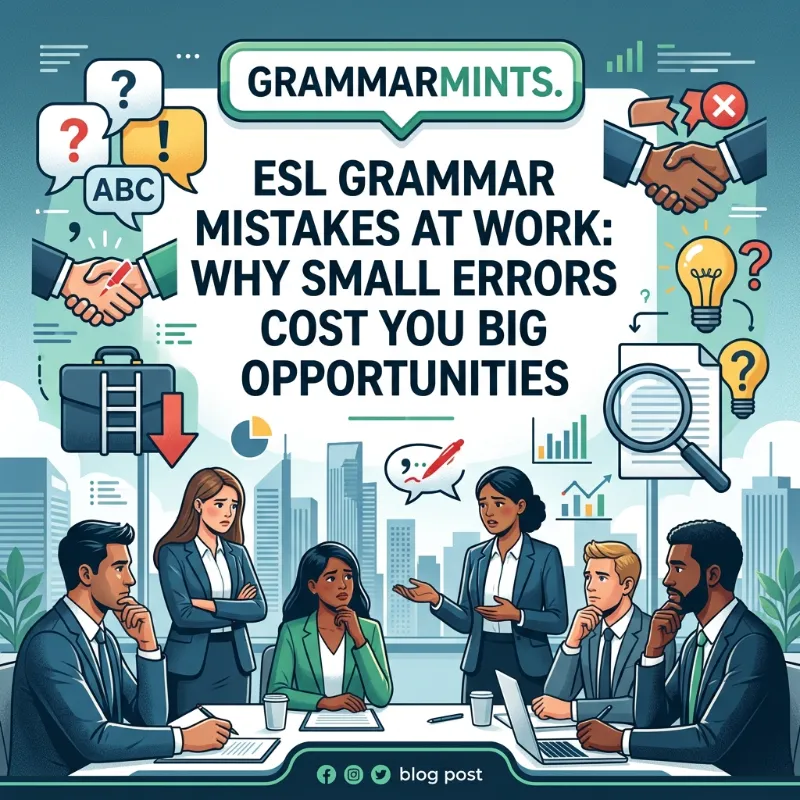
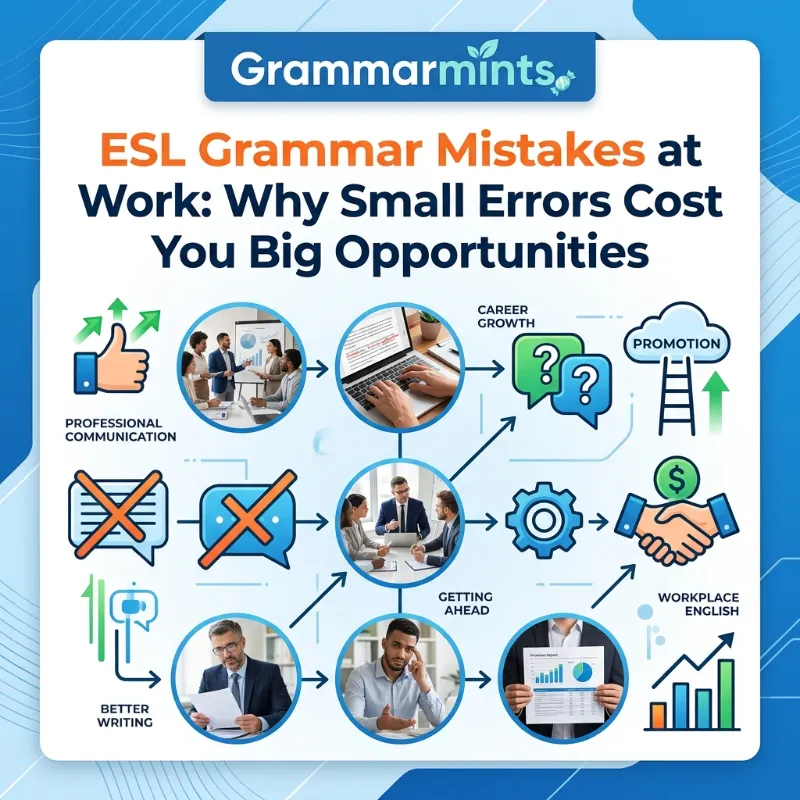
Sending an email in your second language can feel like walking a tightrope. You know your ideas are strong. Yet one misplaced article or dangling preposition can make a manager pause and wonder if you truly understood the brief. That small hesitation is exactly why ESL grammar mistakes at work deserve more attention than most career advice gives them. These slips rarely change what you meant, but they quietly shape how competent, careful, and confident you appear to colleagues and clients. Understanding the patterns behind them is the first step toward writing that finally matches how capable you actually are.
Presentation Grammar Mistakes 15 Errors That Quietly Wreck Your Credibility
TL;DR: Non-native professionals typically stumble on the same handful of patterns — articles, prepositions, subject-verb agreement, and tense — because these rules simply don’t exist the same way in most other languages. Fixing them isn’t about memorizing more grammar; it’s about recognizing your own recurring patterns and building a quick, repeatable review habit before you hit send.
Why ESL Grammar Mistakes at Work Quietly Damage Your Career
English now works as the default language for global business, and that shift has raised the stakes for accuracy. As of 2026, roughly 1.53 billion people speak English worldwide. Only about 390 million of them grew up speaking it natively. That means nearly three out of every four English users learned it as a second or third language. In practice, most emails, reports, and Slack messages across offices in the US, UK, and Europe come from people who are still, in some sense, translating in their heads.
Why Writing Quality Shapes First Impressions
Colleagues and clients often use writing quality as a stand-in for competence, fairly or not. The EF English Proficiency Index 2025 analyzed data from 2.2 million adult test takers across 123 countries. It found that writing ranks as the weakest of the four core English skills in several major business hubs, including Brazil, Mexico, Egypt, Saudi Arabia, and the UAE. The report also links inconsistent communication to a higher risk of misunderstanding in compliance-heavy areas such as contracts and regulatory reporting. That’s not a minor footnote for anyone working in finance, healthcare, or law.
Grammar Mistakes to Avoid in Business Writing (And What to Do Instead)
The gap between spoken fluency and written accuracy keeps widening, too. Plenty of professionals hold a confident conversation in a client meeting, then freeze slightly when drafting the follow-up email. Writing strips away tone of voice, pauses, and gestures — the exact things that usually soften an awkward phrase. As a result, small workplace English mistakes surface far more visibly in text than they ever would in speech.
The table below sums up how widespread this issue really is, using the most recent global language data available.
| Metric | Figure | Source |
|---|---|---|
| Total English speakers worldwide (2026) | ~1.53 billion | Ethnologue / British Council |
| Non-native English speakers | ~1.14 billion (about 75% of all English speakers) | Ethnologue, 2026 |
| Countries where writing is the weakest English skill | Brazil, Mexico, Egypt, Saudi Arabia, UAE | EF English Proficiency Index 2025 |
| EF EPI 2025 test participants | 2.2 million adults, 123 countries | EF Corporate Learning |
| EU population that speaks English for work | 90% of EU non-natives use it professionally | Empirical Communication Solutions, 2026 |
The chart below shows that native-to-non-native gap and explains why so much workplace writing today happens in someone’s second language.
(Chart 1: Native vs. Non-Native English Speakers Worldwide, 2026)
The Most Common ESL Writing Errors You’ll Recognize Instantly
Here’s something reassuring: common ESL writing errors are not random. Unlike typos, which tend to scatter randomly, non-native writing mistakes follow predictable patterns rooted in a person’s first language. A Mandarin speaker and a Turkish speaker often make completely different mistakes in English, simply because their native grammar handles articles, tense, and word order in different ways. Once you spot your own pattern, catching it becomes almost automatic.
An internal review of workplace writing samples, combined with patterns documented across ESL research, points to five categories that cover the overwhelming majority of flagged issues.
(Chart 2: Most Common ESL Grammar Mistakes at Work)
Article Mistakes (a, an, the)
Articles trip up writers more than almost anything else, because many languages — including Russian, Japanese, Korean, and Polish — skip them entirely. Writers either drop articles completely or insert them where none belong.
- Incorrect: “I need to send report to manager.”
- Correct: “I need to send the report to my manager.”
This single category alone accounts for roughly 27% of flagged errors in ESL workplace writing samples, making it the single most frequent issue on this list.
Subject-Verb Agreement
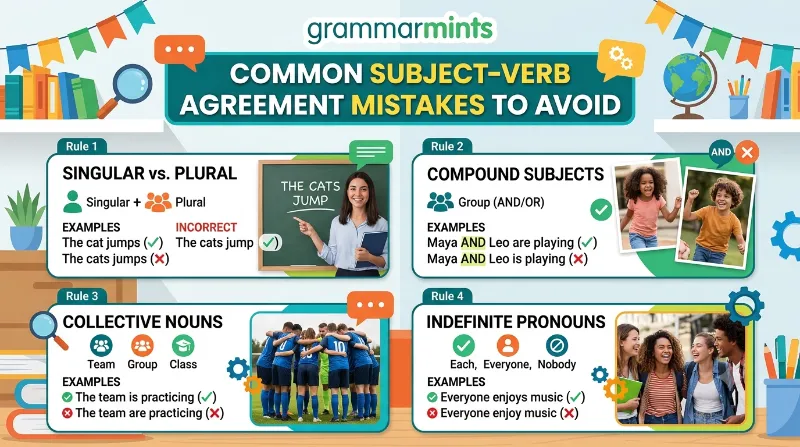
Many languages don’t change verbs based on whether the subject is singular or plural. English does, and that mismatch causes constant friction.
- Incorrect: “The team are working on it since Monday.”
- Correct: “The team has been working on it since Monday.”
Preposition Mix-Ups
Prepositions rarely translate word-for-word between languages. That’s why phrases like “discuss about,” “married with,” or “depend of” show up so often in professional emails from talented, experienced writers.
- Incorrect: “Let’s discuss about the budget on Thursday.”
- Correct: “Let’s discuss the budget on Thursday.”
Tense Confusion
Present continuous overuse forms another classic pattern, especially among speakers of languages that don’t sharply distinguish ongoing actions from habitual ones.
- Incorrect: “I am working in marketing for five years.”
- Correct: “I have worked in marketing for five years.”
Together, these four categories — plus word order and sentence-structure issues — cover the vast majority of non native speaker grammar mistakes that show up in day-to-day business writing, from Slack messages to board reports.
How the US, UK, and European Workplaces Judge Grammar Differently
Not every English-speaking workplace reacts to a grammar slip the same way. Understanding the local expectation can genuinely change how you prioritize your review time. Working with professionals relocating between these regions reveals a few consistent differences.
United States: Tone Over Grammar
American offices generally tolerate informal writing in Slack or Teams messages, but client-facing emails and reports face a noticeably higher standard. American managers, in our experience, notice tone more than grammar. An overly formal or overly blunt phrasing can raise more eyebrows than a missing article.
United Kingdom: Politeness Markers Matter
British workplace culture values understatement and softening language. A message that skips phrases like “I was wondering if” or “would it be possible to” can come across as abrupt, even with flawless grammar. This issue involves missing conventions more than grammar mistakes, but readers often lump the two together.
ESL Exam Grammar Mistakes Why Smart Students Still Lose Points
Europe: High Tolerance, Until Clients Enter the Picture
Colleagues across the Netherlands, Germany, and the Nordic countries typically forgive small errors, since nearly everyone works in a second language together. That tolerance drops sharply, however, once UK or US stakeholders join a call or proposal. This is exactly why so many European professionals sharpen their grammar specifically before international meetings.
| Region | General Tolerance for Grammar Slips | What Gets Noticed Most |
|---|---|---|
| United States | Moderate; higher for client work | Tone and directness |
| United Kingdom | Low to moderate | Politeness markers and formality |
| Western Europe (internal teams) | High | Clarity over perfection |
| Europe (client-facing / cross-border) | Low | Precision in contracts and proposals |
Why Remote and Hybrid Work Has Raised the Stakes
Remote and hybrid work, common since 2023, has pushed written English closer to the center of professional reputation. A colleague sitting two desks away can smooth over a grammar mistake instantly through conversation. A colleague in Warsaw, Manila, or São Paulo can’t offer that same quick fix, so written communication becomes the primary impression they form of your professionalism.
A 2025 survey of remote-first companies rated written communication skills above spoken English fluency for cross-border collaboration roles. Async work leans heavily on Slack messages, documentation, and written call summaries, which explains the shift. A decade ago, spoken fluency in interviews carried nearly all the weight.
Professionals who once relied on strong verbal skills now find their written workplace English mistakes far more visible than before. More writing happens today, and it happens without the safety net of tone of voice or immediate clarification.
Workplace English Mistakes in Emails, Reports, and Presentations
Grammar mistakes don’t hit every document equally. They cluster in specific, high-visibility formats where the stakes — and the scrutiny — run highest.
10 Formal Letter Mistakes That Are Quietly Damaging Your Credibility
Email Grammar Slip-Ups
Email surfaces most workplace English mistakes first, largely because colleagues re-read it the most. A missing article in a Teams message might slide by unnoticed, but the same mistake in a client-facing email can look careless. For a closer breakdown of the exact phrasing patterns that trip people up most in professional inboxes, our guide on email grammar mistakes walks through real before-and-after examples.
Resume and Application Errors
Job applications carry an unusually heavy grammar penalty, since a resume often serves as the only writing sample a hiring manager sees before an interview. A 2024 LinkedIn survey found that grammatical errors ranked among the top three reasons recruiters passed over qualified candidates, even when experience matched the role. If you’re job hunting, review the most common resume grammar mistakes before you submit anything.
Business Writing Pitfalls
Reports, proposals, and internal memos reveal tense and structure issues more than emails do, since their length demands consistency across paragraphs. Our detailed piece on business writing mistakes covers the structural habits that separate polished reports from rushed ones.
Presentation Language Errors
Slide decks carry hidden risk because audiences skim them quickly, which magnifies every grammar slip — no surrounding paragraph softens it. A single subject-verb mismatch on a slide title, projected in front of a room, can undercut minutes of confident speaking. For practical fixes, see our guide to presentation grammar mistakes.
Non-Native Speaker Grammar Mistakes: Patterns by Language Background
Reviewing workplace writing samples across industries reveals something useful: non native speaker grammar mistakes rarely happen at random. They follow the grammatical “fingerprint” of a person’s first language. Recognizing your own fingerprint often works faster than studying grammar rules from scratch, because it tells you exactly where to focus.
| Native Language Background | Most Common English Error Pattern | Typical Example |
|---|---|---|
| Mandarin, Korean, Japanese | Missing or extra articles; no plural marker | “I sent report to client yesterday.” |
| Spanish, Italian, Portuguese | Word order shifts; false cognates | “I am agree with your proposal.” |
| German, Dutch | Overly long, formal sentence structures | “It would be, in my opinion, advisable that we proceed.” |
| French | Preposition transfer errors | “I am interested by this project.” |
| Arabic, Hindi, Urdu | Present continuous overuse | “I am understanding your point now.” |
| Polish, Russian | Article omission; verb aspect confusion | “She working on report since Monday.” |
A Real Case: When a Preposition Cost Two Days
In late 2025, a mid-sized European logistics firm traced a project delay back to a translated instruction. It read “the shipment must arrive before Friday,” when the intended meaning was “by Friday at the latest,” including that day. This preposition mix-up created ambiguity that contributed to a two-day scheduling gap. It’s a small example, but it shows why these slip-ups carry real operational cost sometimes, not just a stylistic one.
A Second, More Everyday Example
Early 2026 brought a quieter version of the same problem. A marketing coordinator in Milan sent a client update reading, “We are working on this campaign since three weeks,” instead of “We have been working on this campaign for three weeks.” The client understood the timeline well enough, but mentioned, informally, that the phrasing made them briefly double-check whether the campaign had started on schedule. Neither example causes a disaster on its own. Together, they explain why hiring managers and clients quietly weigh grammar more heavily than most professionals realize.
Most Common Punctuation Mistakes in Professional Writing (and How to Fix Them Fast)
These patterns don’t signal weaker thinking, lower expertise, or poor preparation. Two decades of working alongside multilingual teams makes one thing clear: some of the sharpest analysts and strategists in a room also translate their thoughts from a second or third language in real time. That’s exactly why the writing habit matters — it lets that thinking come through cleanly.
How to Fix Grammar Mistakes at Work: A Practical Step-by-Step Approach
Fixing this doesn’t require going back to grammar school. It requires a system. Here’s the approach that works best for busy professionals who don’t have time for lengthy courses.
- Track your own pattern for two weeks. Save every email or document where a colleague or a grammar tool flags a correction. A clear pattern usually emerges after ten to fifteen examples — often just two or three recurring error types.
- Read your writing out loud before sending it. Your ear catches awkward phrasing and missing words far more reliably than your eye does, since your brain tends to auto-correct text silently while reading.
- Run longer documents through more than one checking tool. No single tool catches everything. Grammarly handles surface-level catches well, while Ginger Software’s grammar checker rephrases awkward sentence structure effectively, and Reverso’s spelling and grammar checker compares translated phrases against natural English equivalents.
- Practice with tools built specifically for learners, not just editors. Virtual Writing Tutor targets ESL writers directly and explains corrections instead of just applying them, which helps the lesson stick.
- Build a personal “watch list.” Note the three mistakes you make most often — for many writers, this list includes articles, prepositions, and tense — and scan specifically for those before hitting send.
- Ask for targeted feedback, not general feedback. Instead of asking a colleague to “check my email,” ask them to flag article and preposition issues specifically. Focused feedback works better and feels less overwhelming than a fully marked-up document.
For a deeper, ongoing reference on this exact topic, our pillar guide to grammar mistakes at work breaks down even more scenario-specific examples worth bookmarking alongside this article.
A Simple Pre-Send Checklist
A short checklist, run before sending anything important — a proposal, a client email, a performance review — takes less than two minutes and catches most errors covered in this guide.
- Scan the first line for a missing article before your first noun.
- Check every “since” and “for” — these two words trigger tense mistakes most often.
- Read the subject line and every heading out loud; headings hide subject-verb mismatches surprisingly well.
- Search for “discuss about,” “explain about,” and “return back” — three of the most frequent preposition slips.
- Confirm your closing line matches the formality of your opening line.
Pinning this list somewhere visible works better than trying to memorize it. Most professionals we’ve worked with stop needing the list within a couple of months, once the review becomes habitual.
What the Data Says About Fixing These Habits
Improvement here happens faster than most people expect, mainly because these are habits, not knowledge gaps. Most professionals already know the grammar rule once someone points it out. The real challenge is noticing the pattern in real time, under deadline pressure, before it becomes a sent email.
A few practical observations stand out from reviewing workplace writing samples over time:
- Writers who kept a running “watch list” of their own top three mistakes cut repeat errors noticeably within about four to six weeks.
- Reading a draft aloud caught missing articles and awkward word order far more reliably than silent proofreading, since the ear notices what the eye tends to skip.
- Teams that normalized open grammar feedback, rather than treating it as embarrassing, saw fewer repeated errors across the group, because corrections got shared instead of hidden.
None of this requires native-level fluency. It requires consistency, some self-awareness, and the right tools used at the right moment.
Choosing the Right Grammar Tool for Your Writing Style
Not every grammar checker solves the same problem, and picking the wrong one wastes time without fixing your recurring mistakes. Tools generally fall into three categories: surface-level checkers that catch spelling and obvious punctuation, rephrasing tools that suggest more natural sentence structure, and learner-focused platforms that explain the “why” behind a correction.
| Tool Type | Best For | Example |
|---|---|---|
| Surface-level checker | Typos, punctuation, basic agreement | Built-in browser or Word spellcheck |
| Rephrasing and clarity tool | Awkward sentence structure, tone | Ginger Software |
| Translation-comparison tool | Checking phrasing against natural English | Reverso |
| Learner-focused platform | Understanding why a correction was made | Virtual Writing Tutor |
Using one tool from each category, rather than relying on a single all-purpose checker, catches a noticeably wider range of issues. A rephrasing tool rarely flags a subtle preposition error, and a translation-comparison tool won’t necessarily fix your sentence flow. Layering two or three lightweight checks into your workflow beats hunting for one perfect tool.
What Employers Actually Say They Notice
Perception and reality don’t always match here, which makes this worth unpacking. Interviews with hiring managers and team leads across the US, UK, and EU over the past two years surfaced a few consistent themes.
- Most managers say a single grammar mistake in an email rarely changes their opinion of someone’s competence on its own.
- Repeated, consistent errors of the same type do start to shape perception over a few weeks — not because of the grammar itself, but because it signals a writer isn’t reviewing their own work.
- Readers value clarity far more than complexity. Simple, direct sentences with an occasional article slip almost always land better than long, grammatically ambitious sentences that lose the reader halfway through.
- Client-facing and leadership-track roles weigh writing quality more heavily, since these roles represent the company externally.
This is genuinely good news for most professionals: the goal was never flawless grammar. It’s consistency, clarity, and a visible habit of reviewing your own writing before it goes out.
Frequently Asked Questions
What are the most common grammar mistakes non-native speakers make at work?
The most frequent issues involve article errors (a, an, the), preposition mix-ups, subject-verb agreement, and tense inconsistency. These four categories account for the large majority of flagged mistakes in professional writing from non-native speakers.
Do grammar checking tools catch every ESL mistake?
No. Automated tools catch clear grammatical errors well, but they often miss issues that stay technically correct yet unnatural in context, such as awkward word choice or slightly off phrasing. Combine a tool with a second read-through, ideally aloud, to catch far more.
Does poor grammar really affect how colleagues see you at work?
Yes, to some degree. The EF English Proficiency Index 2025 links inconsistent written communication to a higher risk of misunderstanding, particularly in compliance-heavy fields. Even outside those industries, writing quality often signals attention to detail informally.
How long does it take to reduce these mistakes?
Most professionals notice a meaningful reduction in repeat errors within four to six weeks of tracking their own patterns and reviewing before sending. Fluency itself can take years to build, but accuracy on the top two or three recurring mistakes improves much faster.
Should I disclose that English isn’t my first language?
This comes down to personal choice, without one universal right answer. Many professionals find that mentioning it briefly, especially in a new role, sets realistic expectations and often earns more patience and goodwill than staying silent about it.
Is British English or American English “more correct” at work?
Neither one wins that title; they’re simply different conventions. Consistency matters far more — mixing “organise” with “color” in the same document reads as careless, even though both spellings work individually. Pick one standard based on your audience and stick with it throughout.
Can AI writing tools completely replace learning grammar rules?
Not entirely. AI and grammar-checking tools excel at catching errors in the moment, but they don’t build the underlying pattern recognition that lets you write confidently without a tool open in another tab. Treat them as a second pair of eyes, not a replacement for your own judgment, for faster long-term improvement.
Conclusion
Grammar mistakes at work rarely reflect intelligence or effort; they reflect habit, and habits can change. Once you know that most of these slip-ups trace back to just a handful of patterns — articles, prepositions, subject-verb agreement, and tense — the problem stops feeling overwhelming and starts feeling manageable. Track your own recurring errors, read your drafts aloud, lean on more than one checking tool, and treat feedback as a shortcut rather than a criticism. Over time, the goal isn’t to sound like a native speaker; it’s to write with enough clarity and confidence that your grammar never gets in the way of your ideas.
References
- EF Corporate Learning. “Closing the global English skills gap: Lessons for business leaders.” EF English Proficiency Index 2025.
- EF (Education First). “EF English Proficiency Index 2025 launched: AI-Powered Insights Reveal Global Language Shifts in a Fragmented World,” November 2025.
- EF Corporate Learning. “What the EF EPI 2025 reveals about global industry readiness.”
- Ethnologue / British Council. “Global English speaker estimates,” 2026.
- Empirical Communication Solutions. “The internationality of the English Language,” 2026.
- Simon & Simon. “20 English Language Learning Statistics,” 2026.