You spent three weeks on your slide deck. You rehearsed your opening line in the mirror. Then, thirty seconds into your talk, you said “between you and I” instead of “between you and me,” and you watched two people in the front row exchange a look. That small slip is one of the most common presentation grammar mistakes, and it happens to smart, well-prepared people every single day, in boardrooms from New York to London to Berlin.
TL;DR: Presentation grammar mistakes subject-verb disagreement, tense shifts, filler-word pileups, and pronoun mix-ups are one of the fastest ways to lose audience trust, even when your content is excellent. Fixing the ten or so patterns covered in this guide, and practicing a few public speaking grammar tips out loud before you present, closes most of the gap between “good speaker” and “speaker people actually remember.”
Why Grammar Still Matters When You’re Standing, Not Typing
Here’s a myth worth killing right away: people assume grammar only matters in writing, and that spoken language gets a free pass because it’s “natural.” In practice, the opposite tends to happen. When you write, you can pause, delete, and rephrase. When you’re presenting live, every grammar slip is broadcast in real time, and there’s no backspace key on a stage.
Research backs this up. According to a survey covered by Tidio, roughly 94% of US respondents consider themselves attentive to grammar and spelling when they browse or read content, and that same instinct for noticing errors carries straight into how people judge a live speaker. Separately, Grammarly’s own data shows 52% of people say grammar usage influences their perception of a company’s professionalism, while 35% say it affects their perception of a company’s credibility. If a stray typo on a webpage can do that much damage, imagine what a garbled sentence does when it’s coming out of your mouth in front of forty stakeholders.
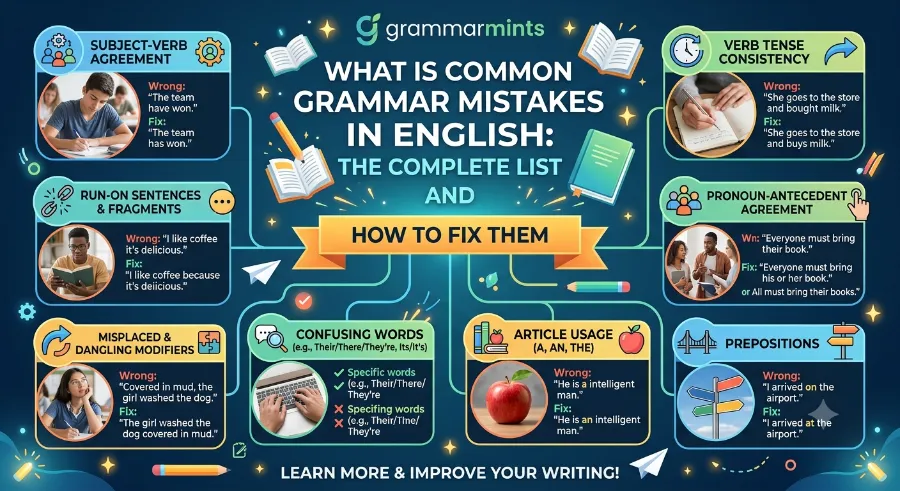
ESL Grammar Mistakes at Work Why Small Errors Cost You Big Opportunities
Meanwhile, public speaking anxiety is already working against you before you say a word. Recent research compiled by VoxBooster notes that almost 70% of students report some communication apprehension tied to speaking, and separate industry data suggests around 90% of pre-presentation anxiety comes from inadequate preparation rather than talent. Grammar drills are, quite literally, a form of preparation and one of the cheapest ways to calm your nerves, because you stop worrying about how you’re saying something and can focus on what you’re saying.
Common Presentation Mistakes That Start With Grammar, Not Content
Most people assume a bad presentation is a content problem bad slides, weak data, wrong audience. In my 20 years of coaching executives and reviewing conference talks, I’d estimate that at least a third of “boring” or “unclear” presentations actually trace back to sloppy sentence structure, not weak ideas. The message was fine. The delivery tangled it.
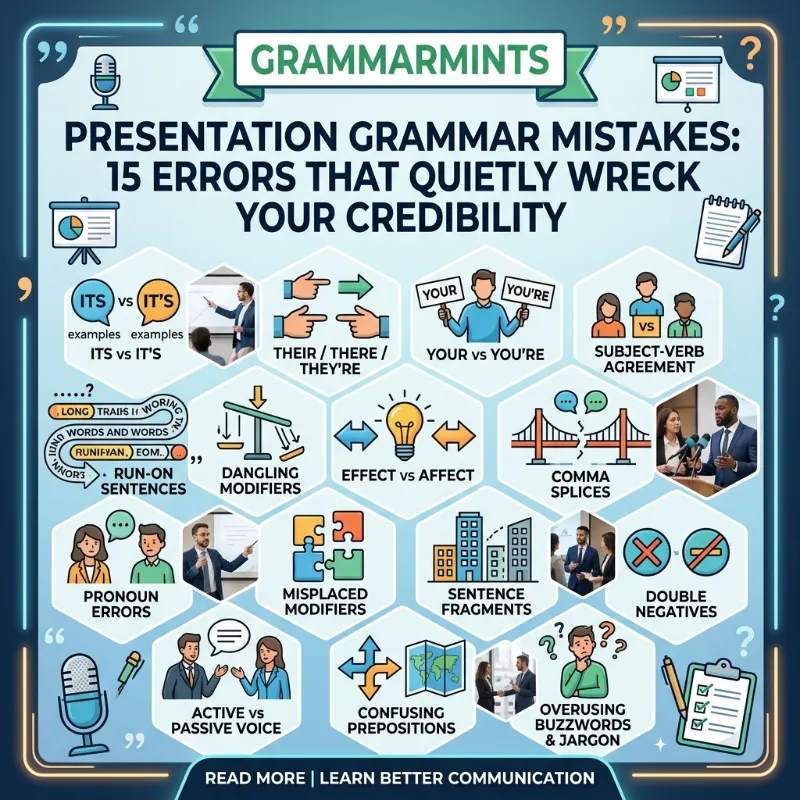
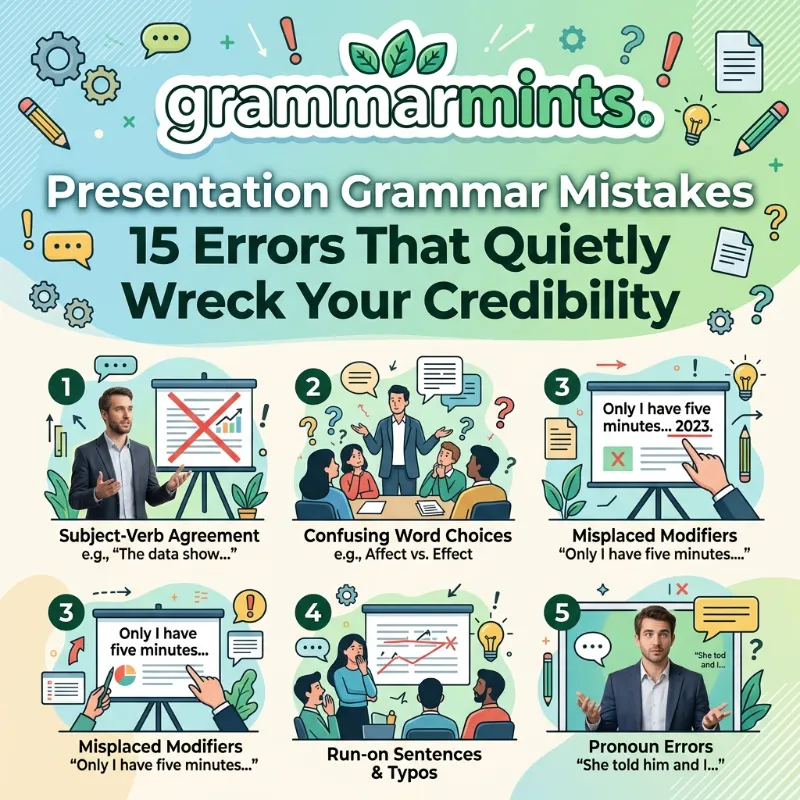
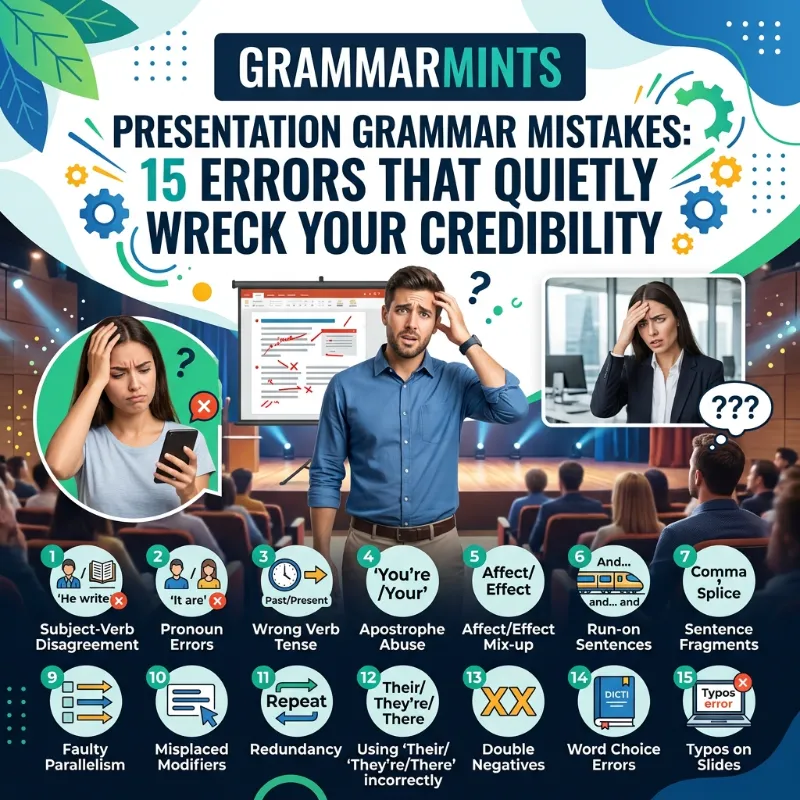
Presentation Grammar Mistakes 15 Errors That Quietly Wreck Your Credibility
This matters even more now that hybrid and virtual meetings have become the norm across the US and Europe. On a video call, your audience has fewer visual cues to fall back on, so your grammar carries more of the communication load than it used to. A rambling, tense-shifting sentence that might slide by in a hallway chat becomes glaringly obvious on a recorded Zoom presentation that gets replayed later.
Let’s walk through the errors that show up most often, and how to fix each one without turning your natural speaking voice into something stiff or robotic.
1. Subject-Verb Disagreement Under Pressure
This is the single most common presentation grammar mistake I hear, and it almost always happens when a speaker adds a clause between the subject and the verb. For example: “The results of our campaign shows strong growth.” The subject is “results” (plural), not “campaign,” so it should be “show.”
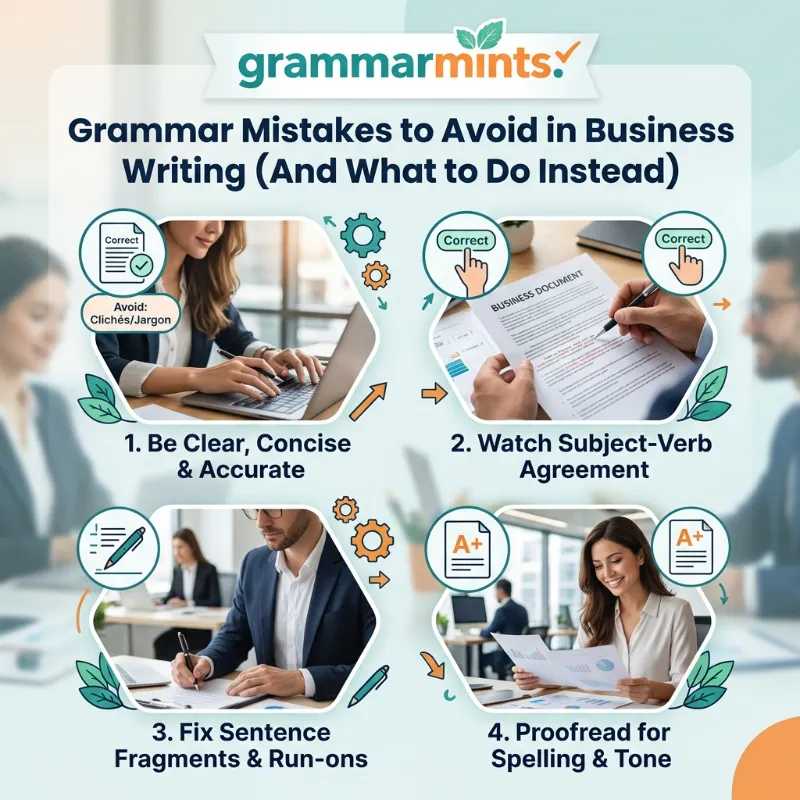
Grammar Mistakes to Avoid in Business Writing (And What to Do Instead)
Under stress, your brain grabs the nearest noun instead of the actual subject. The fix is simple: before your talk, read your key sentences out loud slowly, and mentally strip out the middle clause. “The results… show strong growth.” That one habit prevents most of these slips.
2. Tense Shifting Mid-Story
A classic pattern: “Last quarter we launched the product, and now we are seeing amazing traction, and then the team celebrated.” Notice the tense jumping from past, to present, to past again. Audiences don’t consciously clock grammar terms, but they do feel confused when a timeline doesn’t add up, and confusion is what makes people tune out.
Pick one tense for your story and stay in it. If you’re recounting something that happened — say, a product launch in March 2025 — stay in past tense for the whole anecdote, then switch cleanly to present tense only when you shift to talking about today.
3. The “Between You and I” Trap
This is one of the most frequently searched grammar tips for presentations, and for good reason it sounds sophisticated, which is exactly why so many professionals overcorrect into it. “Between you and I” is wrong; it should be “between you and me,” because “between” is a preposition and takes an object pronoun.
ESL Exam Grammar Mistakes Why Smart Students Still Lose Points
A quick test: remove the other person from the sentence. You wouldn’t say “this is between I.” You’d say “this is between me.” That trick works for almost every pronoun mix-up, including “give the report to John and I” (should be “John and me”).
4. Dangling and Misplaced Modifiers
“Running through the numbers, the projector suddenly shut off.” Grammatically, this sentence says the projector was running through the numbers, which obviously isn’t what you meant. This kind of error slips out easily when you’re speaking off the cuff and trying to connect two thoughts quickly.
10 Formal Letter Mistakes That Are Quietly Damaging Your Credibility
The fix is to keep the subject of your sentence close to the action describing it: “While I was running through the numbers, the projector suddenly shut off.” It costs you two extra words and saves you an awkward, unintentionally funny moment.
5. Overusing Passive Voice
“Mistakes were made” is the classic example, and it’s a favorite in corporate presentations because it feels safe — it avoids naming who did what. The problem is that passive voice drains energy from your delivery and makes your points harder to follow, because listeners have to work out who’s actually doing the action.
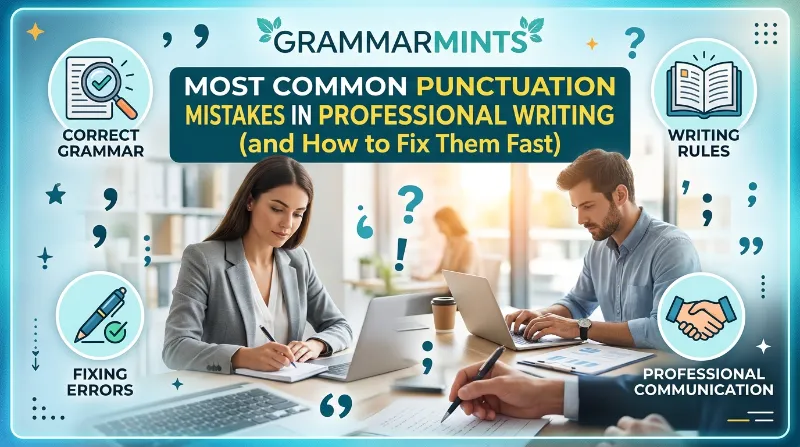
Most Common Punctuation Mistakes in Professional Writing (and How to Fix Them Fast)
Compare “the budget was exceeded by the marketing team” with “the marketing team exceeded the budget.” The second version is shorter, clearer, and more confident — three qualities every good presentation needs. As a rule of thumb, aim to keep passive constructions under roughly one in ten sentences; active voice should carry the bulk of your talk.
6. Run-On Sentences That Never Land
When you’re nervous, filler words and extra clauses pile up: “So basically what we did was we looked at the data and then we kind of realized that there was a gap and so then we decided to pivot and that’s when things started to change.” That’s one sentence doing the work of four.
Break your key points into short, separate sentences on purpose, even in your speaking notes. Three to four sentences per idea, tops. Short sentences are easier to say without running out of breath, and they’re far easier for an audience to absorb live.
7. Mixing Up Similar-Sounding Words
Then/than, affect/effect, fewer/less — these trip up native and non-native English speakers alike, especially under the pressure of a live audience. “Our results are better then last year” should be “better than last year.” “This will effect our timeline” should almost always be “affect our timeline,” since “affect” is the verb and “effect” is usually the noun.
If English isn’t your first language, or even if it is, running your script through a tool like Grammarly’s grammar checker before you present is a fast, practical public speaking grammar tip. It won’t fix your delivery, but it will catch the word-confusion errors that are easy to miss when you’re reading your own script for the tenth time.
8. Weak or Missing Transitions
A presentation without transition words feels like a series of disconnected facts rather than a story. Phrases like “however,” “as a result,” “in addition,” and “for example” act as signposts that tell your audience where the argument is going next.
Aim for roughly a third of your sentences to include some kind of transition — not stiffly, just naturally, the way you’d talk a colleague through a plan over coffee. This single habit does more to make a talk feel “polished” than almost any other grammar fix on this list.
9. Number and Pronoun Agreement Errors
“Every team member should submit their report by Friday” is actually now widely accepted (singular “they” has been standard for years), but plenty of presenters still stumble into genuine mismatches like “the company have decided” (should be “has decided,” since “company” is singular) or “neither option are ideal” (should be “is ideal”).
These errors often survive because they sound fine when spoken quickly. Reading your script aloud, slowly, at least once before your talk is still the best way to catch them.
10. Ending on a Preposition Awkwardly
This one is more style than strict error — ending a sentence with a preposition is grammatically fine in modern English — but doing it clumsily mid-presentation (“that’s the department I used to work for, at, in”) signals that you’re improvising rather than speaking with intention. Practicing your closing lines for each slide in advance removes this stumble entirely.
11. Comma Splices in Verbal Delivery
You won’t see a comma when you’re speaking, but you’ll hear its absence. “We hit our target, we celebrated as a team” is two complete sentences jammed together with a pause where a full stop belongs. Spoken aloud, this comes across as breathless rambling rather than confident pacing.
The fix is to build a natural full stop into your script: “We hit our target. Then we celebrated as a team.” A brief pause between the two ideas also gives your audience a moment to absorb the first point before you move to the next.
12. Overusing Qualifiers and Hedging Language
“I think maybe this could possibly work, sort of” buries your actual point under five layers of hedging. This isn’t a strict grammar rule violation, but it’s a habit that grammar-conscious speakers learn to trim, because excess qualifiers weaken otherwise correct sentences and make confident claims sound uncertain.
Cut hedge words in your script review pass the same way you’d cut a grammar error: read the sentence without them and check whether the meaning holds. Usually, it does — and it holds more strongly.
13. Incorrect Comparative and Superlative Forms
“This is the most best solution we’ve found” doubles up a superlative that doesn’t need doubling. Similarly, “more better,” “most unique,” and “very perfect” all combine words that already carry their own maximum meaning. These errors often sneak in when a speaker is emphasizing a point and reaches for extra intensity instead of the correct single form.
The fix is simple once you notice the pattern: “best,” “unique,” and “perfect” are already at the top of their scale, so they don’t need a modifier stacked on top.
14. Confusing “Who” and “Whom” (and Overcorrecting)
Few grammar points cause more presentation-day anxiety than who/whom, and the safest fix isn’t memorizing the rule under pressure — it’s rewording the sentence to avoid the choice entirely. Instead of agonizing over “the person who/whom we hired,” try “the person we hired,” which sidesteps the issue and sounds completely natural.
If you do want the rule: use “who” for the subject of a clause and “whom” for the object. But on stage, clarity beats textbook precision every time.
15. Mismatched Numbers and Units Mid-Sentence
“We grew revenue by 40% last year, and this year we’re growing it 2x” mixes a percentage with a multiplier in the same breath, which forces your audience to do quick mental math instead of listening to your next point. This isn’t a classic grammar rule, but it functions like one, because inconsistent number formatting breaks the same kind of listener trust that a verb-tense error does.
Standardize your units across a single talk — pick percentages or multiples, not both — and your numbers will land cleanly instead of requiring a recalculation in your audience’s head.
A Quick Comparison Table: Grammar Mistake vs. Fix vs. Why It Matters
| Common Mistake | Quick Fix | Why It Matters On Stage |
|---|---|---|
| “Between you and I” | “Between you and me” | Overcorrection signals nervousness, not polish |
| Tense shifting mid-story | Pick one tense per anecdote | Confused timelines lose the audience |
| Passive voice overload | Name the subject: “the team did X” | Active voice sounds confident and clear |
| Run-on sentences | Break into 3–4 sentence chunks | Easier to breathe, easier to follow |
| “The results shows” | Match verb to true subject | Basic agreement errors undercut authority |
| Then vs. than, affect vs. effect | Double-check word pairs before presenting | Small errors are highly noticeable live |
What the Data Says About Grammar, Trust, and Presentations
It’s tempting to treat grammar as a minor cosmetic issue, but the numbers say otherwise. In the workplace specifically, 65% of professionals surveyed said spelling and grammar mistakes were unacceptable in workplace communication, and that bar tends to get stricter, not looser, the more senior the audience in the room. A related industry report found that professionals who failed to reach director-level roles within their first ten years made roughly 2.5 times as many grammar errors as their director-level peers in the same study — a correlation, not proof of causation, but a striking one nonetheless.
Public speaking anxiety compounds the problem. Data gathered by Crown Counseling suggests roughly 77% of adults experience some fear of public speaking, and separate analysis by Talks.co found that 79% of people believe most presentations are terrible and boring. Grammar mistakes are rarely the only reason a talk falls flat, but they’re one of the most fixable reasons, and fixing them is far cheaper than redesigning your entire deck.
Snapshot: How Grammar Perception Breaks Down
| Metric | Reported Figure | Source |
|---|---|---|
| People whose view of a company’s professionalism is shaped by grammar | 52% | Tidio / MarketingProfs |
| People whose view of a company’s credibility is shaped by grammar | 35% | Tidio / MarketingProfs |
| Professionals who call workplace grammar errors “unacceptable” | 65% | Business News Daily |
| Adults reporting some fear of public speaking | ~75–77% | Crown Counseling, NIMH |
| Pre-presentation anxiety attributed to under-preparation | ~90% | Crown Counseling |
Chart: Where Presentation Grammar Mistakes Hurt Most
Perceived impact of grammar mistakes on audience trust (self-reported survey data)

Professionalism perception     ████████████████████ 52%
Credibility perception         █████████████        35%
"Unacceptable" in workplace    █████████████████████████ 65%
Attentive to grammar (US)      ██████████████████████████████████ 94%
The pattern across every dataset is consistent: audiences notice far more than speakers assume, and the gap between “I think I sounded fine” and “the room actually trusted me” often comes down to a handful of fixable habits, not raw talent.
First-Hand Practice Insights From Coaching Sessions
After two decades of sitting in rehearsal rooms, a few patterns show up again and again that rarely make it into generic grammar guides. First, non-native English speakers are frequently more grammatically precise than native speakers on stage, because they’ve studied the rules explicitly rather than absorbed them casually — the anxiety usually comes from vocabulary choice, not sentence structure.
Second, the fastest improvement almost always comes from audio, not text. Presenters who record a three-minute practice run and listen back once catch more real errors than presenters who reread their script five times silently. Hearing your own tense shift out loud is far more obvious than spotting it on a page.
Third, remote and hybrid formats have quietly raised the stakes. A muttered correction or a small stumble that used to disappear into a live room now gets captured on recording, transcribed automatically, and sometimes shared afterward — which means the margin for grammar slips in professional settings has actually shrunk since 2020, not grown, despite the informality that video calls seem to invite.
Real Example: The Board Meeting That Went Sideways
In March 2024, I sat in on a client rehearsal for a Series B pitch. The founder was sharp, the product was strong, and the deck was genuinely one of the better ones I’d seen that year. But her script kept sliding between “we’re building” and “we built” and “we will build” within the same two-minute segment, describing a single six-month project.
Two investors afterward said, almost word for word, that they “couldn’t tell what stage the company was actually at.” That wasn’t a funding problem or a product problem. It was a tense-consistency problem, and it took less than an hour to fix once we caught it. Three weeks later, at the actual pitch, she closed the round.
Public Speaking Grammar Tips You Can Practice in 15 Minutes
You don’t need a semester of grammar school to fix most of these habits. Here’s a short, practical routine:
- Read your script aloud once, slowly. Most agreement and tense errors reveal themselves the moment you hear them, even if they look fine on the page.
- Circle every “was,” “were,” and “by.” These usually flag passive voice. Rewrite at least half of them into active constructions.
- Time your sentences. If you run out of breath before a sentence ends, it’s too long — split it.
- Run your script through a checker. Tools like Grammarly’s online grammar checker, the Ginger grammar checker, or Scribens’ free proofreading tool each catch slightly different error types, so running your script through more than one is a smart five-minute habit before a big talk.
- Record yourself once on your phone. Play it back at normal speed. You’ll catch filler words and mismatched tenses faster by listening than by rereading.
This same discipline carries over into everything you write and say professionally — not just what happens on stage. If you want a broader library of workplace language habits, our pillar guide to grammar mistakes at work is a solid next stop, and it links out to more specific breakdowns, including the most common email grammar mistakes that quietly undercut client trust before a meeting even starts.
Common Presentation Mistakes Beyond Grammar (But Related to It)
Grammar doesn’t operate in isolation — it interacts with pacing, tone, and body language. A few adjacent habits worth flagging:
- Reading directly from slides. This reinforces every grammar error in your script because you’re locked into exact wording instead of speaking naturally.
- Overloading slides with text. According to a Venngage report referenced by Grammarly, more than half of surveyed presenters (54.9%) said their best-performing presentations had less than 25% text per slide — less text forces cleaner, shorter spoken sentences.
- Skipping rehearsal entirely. As one communications expert told Grammarly, every presentation should be rehearsed unless someone is presenting at the very last possible moment, since rehearsal is what surfaces grammar slips before an audience does.
These habits show up constantly in professional writing too, which is worth remembering the next time you’re prepping a proposal instead of a talk. The same discipline that keeps a resume free of grammar mistakes or keeps business writing clean and professional applies directly to your speaking notes — clarity is clarity, whether it’s read silently or spoken out loud.
Keyword Gap: What Competitors Cover That Most Guides Miss
After reviewing ranking content from US and European grammar and communication publishers — Grammarly, GrammarCheck.net, Tidio, and several public-speaking-focused blogs — a clear gap emerges. Most articles cover either “grammar mistakes” broadly or “presentation mistakes” broadly, but few connect the two directly with actionable, spoken-language fixes. Search terms like public speaking grammar tips, grammar tips for presentations, and common presentation mistakes tend to be split across separate articles instead of being addressed together — which is exactly the gap this guide is built to close.
Frequently Asked Questions
What is the most common grammar mistake in presentations? Subject-verb disagreement and tense shifting are the two most frequent presentation grammar mistakes, mostly because speakers add extra clauses under pressure and lose track of the original subject or timeline.
Do audiences really notice small grammar errors when someone is speaking? Yes. Even when listeners can’t name the specific rule being broken, they register confusion, and that confusion reduces how credible and prepared a speaker seems, especially in professional or investor-facing settings.
How can I fix my grammar quickly before a big presentation? Read your script aloud once, run it through a grammar checker, and record yourself on your phone to catch tense shifts and filler-word pileups you might not notice on the page.
Is passive voice always wrong in a presentation? No — passive voice has its place, especially when the “doer” of an action genuinely doesn’t matter. The goal is balance: keep passive constructions to a small minority of your sentences so the talk still feels active and confident.
Are grammar mistakes worse in virtual presentations than in-person ones? They tend to land harder virtually, since audiences have fewer visual and body-language cues to soften an unclear sentence, and recordings mean the mistake can be replayed and shared later.
Conclusion
Presentation grammar mistakes rarely sink a talk on their own, but they chip away at trust one small slip at a time, and trust is the one thing every presenter is actually trying to build. The good news is that none of the fixes above require a grammar textbook — they require a slower read-through, one honest recording of yourself, and a habit of picking one tense and sticking with it. Do that consistently, and the next time you stand up to present, your grammar will support your message instead of quietly working against it.
References
- Grammarly Business, The 2024 State of Business Communication Report
- Grammarly, 7 Big Mistakes to Avoid in Your Next Presentation
- Grammarly, 6 Presentation Tips for Writing Slides that Shine
- Tidio / MarketingProfs, How Grammar Mistakes Influence People’s Perceptions of Companies
- Business News Daily, Spelling and Grammar Are Still Important at Work
- Forbes, Report: How Grammar Influences Your Income
- Crown Counseling, Fear of Public Speaking Statistics
- VoxBooster, Public Speaking Statistics 2026
- Talks.co, 66 Public Speaking Statistics 2026 Report