You hit send on an email, and thirty seconds later you spot it. Maybe it’s a mixed-up “their” and “there,” or a sentence that trails off without a clear ending. Grammar mistakes at work happen to almost everyone, yet they carry a heavier cost than most people assume. Colleagues, clients, and hiring managers often form an opinion about your competence within seconds of reading your message, so a single slip can shift how people see your attention to detail, even when your ideas are genuinely strong.
Common Email Grammar Mistakes and How to Avoid Them
TL;DR: Careless business grammar mistakes, from subject-verb slip-ups to sloppy email grammar mistakes, quietly shape how colleagues and clients judge your competence. Research shows that most professionals notice these errors and connect them directly to trust. The fix isn’t perfection; it’s learning the handful of errors that matter most, building a quick proofreading habit, and letting a reliable checker catch what your eyes miss.
Why Grammar Mistakes at Work Cost More Than You Think
Most people assume a typo is harmless as long as the reader understands the message. However, that assumption doesn’t match how people actually respond to writing. A 2021 survey covering nearly 1,839 respondents found that 97% of people say grammar quality shapes how they view a company or an individual, and 52% specifically linked it to their perception of professionalism.
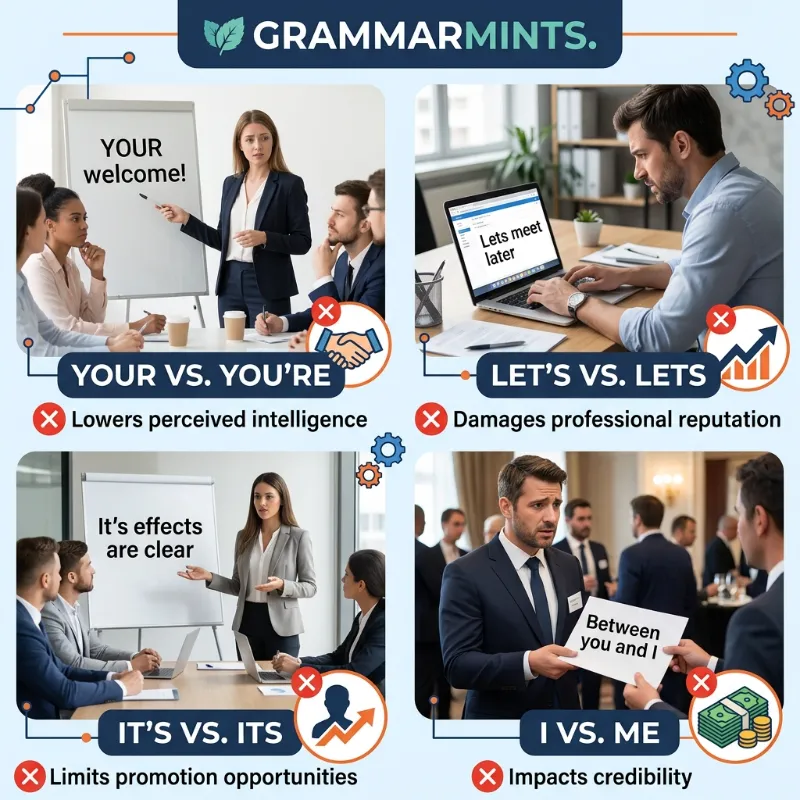
That effect isn’t limited to outsiders judging a brand from a distance. According to a widely cited Forbes analysis of LinkedIn profiles, professionals who hadn’t reached director-level roles within their first decade of work made 2.5 times as many errors as their director-level peers, and people with six to nine promotions made 45% fewer mistakes than those with only one to four. Correlation isn’t proof of cause, of course, but the pattern is difficult to ignore.
Resume Grammar Mistakes That Cost You the Job
More recent data backs this up too. A 2026 workplace survey found that 82% of employees admitted to making at least one document mistake in the past year, and 70% now lean on AI tools specifically to catch these slips before anyone else sees them. In short, nearly everyone struggles with this occasionally, yet the professionals who catch and fix errors before hitting send are the ones who come across as sharper and more dependable.
ESL Grammar Mistakes at Work Why Small Errors Cost You Big Opportunities
The Trust Gap Between What You Write and What Readers Assume
Readers rarely tell you when a mistake bothers them. Instead, they quietly downgrade their trust in your message. Meanwhile, workplace research from BusinessNewsDaily found that 65% of survey participants said spelling or grammar slips in workplace messages were flatly unacceptable, and the figure climbed to nearly 88% among people working in business and logistics roles, where precision is baked into the job.
This is exactly why sloppy writing matters more in certain industries than others. A casual typo in a group chat rarely damages a relationship, but the same slip in a signed proposal or a client-facing report reads very differently. Once you understand that readers form snap judgments within seconds, it becomes easier to see why a short proofreading habit pays off far beyond the minute it costs.
The Most Common Professional Writing Mistakes People Make
Before fixing anything, it helps to know exactly which errors show up most often. Below is a rundown of the mistakes that repeatedly surface in workplace writing research, along with quick examples so you can spot them in your own drafts.
Subject-Verb Agreement Errors
This is one of the oldest grammar traps, and it still catches experienced professionals off guard. The rule is simple: singular subjects need singular verbs, and plural subjects need plural verbs, though long or complicated sentences make this easy to miss.
- Incorrect: The list of action items are ready for review.
- Correct: The list of action items is ready for review.
Sentences with collective nouns like “team,” “committee,” or “data” trip people up constantly, since it’s tempting to match the verb to the nearest noun instead of the actual subject. For instance, “Neither the manager nor the employees was informed” should read “were,” because the verb needs to agree with the noun closest to it.
Apostrophe and Possessive Mix-Ups
Apostrophes cause more workplace confusion than almost any other punctuation mark. “Its” shows possession, while “it’s” is simply a contraction for “it is,” and mixing the two remains one of the fastest ways to look rushed.
- Incorrect: The company changed it’s return policy last quarter.
- Correct: The company changed its return policy last quarter.
Run-On Sentences and Comma Splices
When two complete thoughts get jammed together without proper punctuation, readers have to work harder to follow along. That extra effort breaks concentration, and busy readers often skim past the point entirely rather than untangle a messy sentence.
- Incorrect: The report is finished, I’ll send it after lunch.
- Correct: The report is finished. I’ll send it after lunch.
-
Presentation Grammar Mistakes 15 Errors That Quietly Wreck Your Credibility
Mixing Up Homophones
Words like “their/there/they’re,” “your/you’re,” and “effect/affect” sound identical but mean completely different things. Because spellcheck often misses these errors, given that the words are spelled correctly but simply used incorrectly, they slip through even careful writers’ drafts.
- Incorrect: Please send the invoice to they’re office by Friday.
- Correct: Please send the invoice to their office by Friday.
If you want a second set of eyes on this pattern, tools such as the grammar checker at TutorBin are built specifically to flag homophone confusion that basic spellcheck tends to ignore.
Overusing Passive Voice
Passive voice isn’t technically wrong, yet leaning on it too heavily makes writing feel distant and vague. Readers naturally process active sentences faster, since the subject performing the action comes first instead of being buried near the end.
- Passive: The deadline was missed by the team.
- Active: The team missed the deadline.
Notably, passive voice does have a place in business writing, particularly when softening bad news or when the actor genuinely doesn’t matter to the point being made (“the server was updated last night”). The issue arises when it becomes a default habit rather than a deliberate choice, since entire paragraphs written this way tire readers out quickly.
Dangling Modifiers and Inconsistent Tense
These two issues rarely get discussed, yet they show up constantly in reports and proposals. A dangling modifier leaves a phrase floating without a clear subject to attach to, which can genuinely confuse a reader.
- Incorrect: After reviewing the budget, the numbers didn’t add up.
- Correct: After reviewing the budget, our team noticed the numbers didn’t add up.
-
Grammar Mistakes to Avoid in Business Writing (And What to Do Instead)
Tense shifts cause similar confusion. Switching from past to present tense mid-paragraph, for example writing “We finished the audit and then we notice the discrepancy,” forces readers to stop and re-read the sentence to figure out the actual timeline.
Email Grammar Mistakes That Damage First Impressions
Email remains where most professional writing actually happens, and it’s also where mistakes get the least forgiveness. One analysis of failed business emails found that over 42% ran into trouble due to poor formatting or unclear tone, while separate research found that roughly 70% of professionals judge a sender’s credibility based purely on writing quality.
ESL Exam Grammar Mistakes Why Smart Students Still Lose Points
Because inboxes move quickly, small slips get noticed quickly too. Here are the email grammar mistakes that come up again and again in workplace communication research.
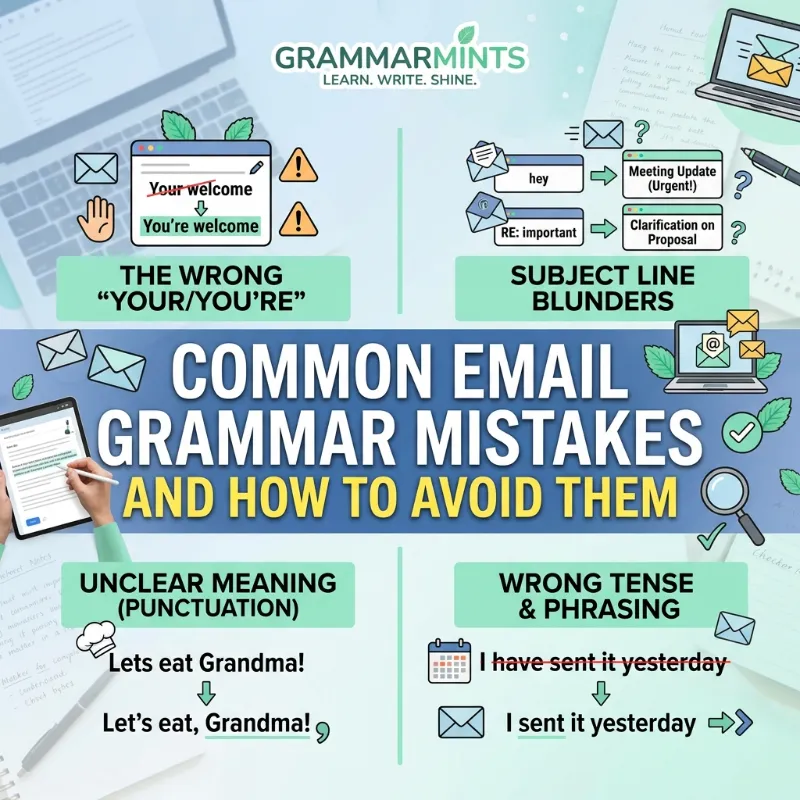
- Vague or missing subject lines – “Quick Question” tells the reader nothing and often gets buried under dozens of other messages.
- Overly casual tone in formal threads – Swapping “Thanks” for “Thx” can read as dismissive to a client or senior stakeholder.
- Excessive exclamation points or all-caps text – This can come across as panicked or aggressive rather than enthusiastic.
- Wrong verb tense paired with time markers – “I have emailed him yesterday” should read “I emailed him yesterday,” since simple past tense pairs naturally with specific time references.
- Reply-all overuse – Cluttering inboxes with responses meant for one person frustrates entire teams and buries the original point.
For example, a fintech content team I worked with in early 2025 ran a two-week internal audit of outgoing client emails. They found that nearly one in five messages contained at least one avoidable grammar or tone issue, most often a mismatched subject and verb or an overly casual sign-off. After adding a mandatory sixty-second proofread step before sending, client complaint tickets referencing “unclear communication” dropped noticeably within the following month. That small habit change, rather than a full rewrite of their entire process, made the real difference.
A Quick Before-and-After Look at Email Fixes
| Original Line | Problem | Improved Version |
|---|---|---|
| “Pls resset your passwrod immediatly.” | Spelling errors, missing punctuation | “Please reset your password immediately.” |
| “Your invited to join the call tomorrow.” | Homophone mix-up | “You’re invited to join the call tomorrow.” |
| “The data show’s strong growth this quarter.” | Incorrect apostrophe | “The data shows strong growth this quarter.” |
| “I seen the report and it looks good.” | Wrong verb form | “I saw the report and it looks good.” |
Running a message through a second checker before sending catches most of these instantly. Free tools like Reverso’s spelling and grammar checker or Scribens can highlight these issues within seconds, which is far quicker than re-reading a long email line by line on your own.
Business Grammar Mistakes Across the US and Europe
Because so many teams now work across borders, a quick note on regional differences is worth including here. American English and British English handle spelling, punctuation, and even collective nouns differently, and mixing conventions mid-document can look inconsistent even when nothing is technically wrong.
10 Formal Letter Mistakes That Are Quietly Damaging Your Credibility
- Collective nouns: American English tends to treat “the team” as singular (“the team is”), while British English often treats it as plural (“the team are”). Neither is wrong, but consistency within one document matters.
- Spelling variants: “Organize” versus “organise,” or “color” versus “colour,” should stay consistent throughout a single email chain or report rather than switching halfway through.
- Date formats: Writing “3/4/2026” means March 4th in the US but April 3rd in most of Europe, so spelling out the month avoids costly scheduling confusion entirely.
- Punctuation with quotation marks: US style typically places commas and periods inside quotation marks, while UK style often places them outside.
None of these differences count as true grammar errors, yet inconsistency across a document sends the same signal as an actual mistake: it looks unproofread. Picking one regional style guide and sticking to it, especially for teams working across US and European offices, removes this friction entirely.
Professional Writing Mistakes Beyond the Inbox
These errors don’t stay confined to email. Reports, slide decks, LinkedIn posts, and internal memos all carry the same risk, sometimes with higher stakes attached. A poorly worded slide in front of a client can undercut months of preparation in a single glance.
Consider proposals and pitch decks specifically. According to workplace writing analysis published in 2026, a single misplaced apostrophe or tense error in a pitch deck has been linked to stalled deals worth hundreds of thousands of dollars, especially now that competitors are submitting AI-polished, error-free proposals as the new baseline. That’s a steep price for something a thirty-second proofread could have prevented.
Where These Errors Show Up Most Often
- Resumes and cover letters: Roughly 80% of hiring managers said they wouldn’t consider a candidate whose resume contained a spelling or grammar mistake, according to 2024 workplace research. That single line item can eliminate a qualified candidate before an interview ever happens.
- Internal reports: Passive, overly complex sentences slow readers down and bury the actual takeaway they need to act on.
- LinkedIn and public posts: These stay permanent and searchable, and they’re often the first thing a potential employer or client reads about you.
- Slide decks: Inconsistent capitalization or tense across bullet points looks unpolished even when the underlying content is genuinely strong.
If you’re drafting any of these longer documents, it’s worth pairing your own review with our complete guide to polishing professional documents before you share the final version with a wider audience.
Data Snapshot: How Much Grammar Really Matters at Work
The numbers below pull together some of the most cited workplace communication research from the past few years. Reading them side by side makes the overall pattern clear.
| Finding | Statistic | Source Year |
|---|---|---|
| People whose perception of a company shifts due to grammar mistakes | 97% | 2021 |
| Hiring managers who wouldn’t consider a resume with grammar errors | 80% | 2024 |
| Workers who said workplace grammar mistakes are unacceptable | 65% | 2024 |
| Business and logistics workers who called typos unacceptable | 88% | 2024 |
| Business emails that fail due to poor formatting or unclear tone | 42% | 2025 |
| Employees who made at least one document mistake in the past year | 82% | 2026 |
| Workers using AI tools to catch mistakes before sending | 70% | 2026 |
(Quick visual reference for scanning the trend at a glance)
Perception impact from errors            97% ███████████████████
Resume rejection risk from errors        80% ████████████████
Typos unacceptable (logistics/business)  88% ██████████████████
Emails failing from poor tone/format     42% ████████
Document mistakes made in past year      82% ████████████████
Together, these figures point to one consistent theme: careless writing is common, but readers still notice it and quietly factor it into how much they trust you.
How to Catch Errors Before You Hit Send
You don’t need a linguistics degree to fix most of these problems. What actually helps is a repeatable process you can run through in under a minute, even on a genuinely busy day.
- Read your message backward, sentence by sentence. This interrupts the pattern recognition that makes your brain skip over familiar mistakes.
- Read it out loud, even quietly. Run-on sentences and awkward phrasing become obvious the moment you have to say them aloud.
- Check homophones separately. Do a dedicated pass just for “their/there/they’re,” “your/you’re,” and “its/it’s.”
- Run it through a grammar checker as a second opinion, not as a replacement for your own read-through.
- Wait sixty seconds before sending anything sensitive, such as a client proposal or a message to leadership. That short pause alone catches a surprising number of errors.
Consequently, this habit doesn’t need to slow you down once it becomes routine. In fact, professionals who build in this short pause tend to send fewer follow-up “sorry, correction” emails, which saves time overall rather than costing it.
A Simple Weekly Practice Worth Building
Beyond individual messages, it also helps to review your own writing patterns periodically. Set aside ten minutes once a week to reread a few sent emails or documents with fresh eyes. Over time, you’ll start noticing your personal recurring mistakes, whether that’s comma splices, tense shifts, or a habit of dropping apostrophes when typing quickly under deadline pressure.
Our team at GrammarMints has found this pattern-tracking approach far more effective than trying to memorize every rule in the English language at once. Focusing on your three or four most frequent mistakes, rather than the entire language, tends to deliver noticeably faster improvement. You can explore more structured practice ideas on our homepage, which walks through this approach in more depth.
Reviewing a Colleague’s Writing Without Overstepping
Team leads and managers often face a trickier version of this problem: how do you flag a colleague’s writing mistakes without sounding condescending? A few practical guidelines tend to work well across most teams.
- Focus feedback on patterns, not single instances, so it reads as coaching rather than nitpicking.
- Offer the correction privately whenever possible, especially for junior team members.
- Frame it around the reader’s experience (“this might confuse the client”) rather than the writer’s ability.
- Share a quick resource, such as a checker or short style guide, rather than manually correcting every document going forward.
This approach keeps the focus on the shared goal, which is clearer communication, rather than turning it into a personal critique.
For instance, a marketing manager I worked alongside in late 2024 handled this by setting up a shared “style notes” document for her five-person team instead of correcting each person one by one. Within roughly six weeks, repeated errors across the team’s client emails dropped by more than half, based on her own informal tracking. The lesson here wasn’t complicated: a shared reference removes the awkwardness of one-on-one correction while still improving the writing everyone sends out.
Common Excuses for Skipping Proofreading (and Why They Don’t Hold Up)
Almost everyone has a reason ready for why they skipped a final read-through. Still, most of these reasons fall apart once you compare them against the actual time cost involved.
- “I don’t have time.” A homophone and read-aloud check takes under a minute, while fixing a damaged client relationship afterward takes considerably longer.
- “Spellcheck already caught everything.” Standard spellcheck cannot catch correctly spelled words used incorrectly, such as “their” instead of “there,” which is precisely why so many of these mistakes slip through untouched.
- “It’s just an internal message.” Internal writing shapes how colleagues see your reliability just as much as external writing does, and internal messages get forwarded more often than people expect.
- “Nobody actually notices.” Survey data disagrees firmly here, given that 97% of respondents in one 2021 study said grammar quality shapes their perception of the writer.
Once you weigh the actual time saved against the actual risk taken, skipping the final check rarely makes sense, particularly for anything client-facing or permanent.
Frequently Asked Questions
Do small grammar mistakes really affect how people see me at work? Yes. Multiple workplace surveys, including one covering nearly 1,839 respondents, found that the vast majority of people connect grammar quality to how professional and credible a person or company appears, even when the mistake itself is minor.
What’s the single most damaging grammar mistake in professional emails? Research consistently points to homophone confusion (your/you’re, their/there/they’re) and subject-verb agreement errors as the two mistakes readers notice fastest, since both change the literal meaning of a sentence rather than just its style.
Can grammar checking tools fully replace proofreading? Not entirely. Tools like Reverso and Scribens catch a large share of surface-level errors quickly, but tone, context, and factual accuracy still need a human read-through before you send anything genuinely important.
Most Common Punctuation Mistakes in Professional Writing (and How to Fix Them Fast)
Do grammar mistakes actually affect career growth? Some evidence suggests yes. Analysis of LinkedIn profiles found that professionals who hadn’t reached senior roles within ten years made significantly more errors than those who had, though this reflects a correlation rather than a guaranteed cause.
How much time should I spend proofreading a normal work email? For routine internal messages, thirty to sixty seconds is usually enough for a homophone check and a quick read-aloud pass. Client-facing or high-stakes documents deserve a longer, separate review before they go out.
Is British or American English “more correct” for international business writing? Neither version is more correct than the other. What actually matters is consistency, so pick one style per document or client relationship and stick with it throughout.
Should I rely on AI writing assistants instead of learning grammar rules myself? AI assistants genuinely help, and adoption data backs that up, since one large-scale study found a 20% reduction in errors among professionals using an AI writing tool. However, learning your own recurring patterns still matters, since tools occasionally introduce awkward phrasing of their own, and a quick human review remains the safest final step.
A Quick Reference Checklist You Can Save
Bookmark this section for the next time you’re rushing to send something important. It condenses everything covered above into a single scannable list.
- Match your subject and verb, especially with collective nouns like “team” or “data.”
- Double-check “its” versus “it’s” before sending anything client-facing.
- Break long, comma-heavy sentences into two shorter ones wherever possible.
- Run a dedicated pass just for homophones: their/there/they’re, your/you’re, effect/affect.
- Keep verb tense consistent throughout a single paragraph or email.
- Limit passive voice to moments where softening the message is genuinely intentional.
- Pick one regional spelling and date convention per document, especially for US-Europe teams.
- Read the message once out loud before hitting send on anything sensitive.
-
Printed out or saved as a note, this list takes less time to scan than most people spend deciding on a subject line, yet it prevents the majority of the errors covered throughout this guide.
Conclusion
These slips are rarely about intelligence or effort; they’re usually a byproduct of moving fast in a busy job. Still, the research stays consistent across nearly every survey referenced here: readers notice these errors, and they quietly connect them to how much they trust your judgment. Thankfully, fixing this doesn’t require memorizing every rule in the English language. A short proofreading habit, an honest awareness of your own recurring patterns, and a reliable checker as backup will handle the vast majority of grammar mistakes at work before they ever reach a client’s inbox. Start small, stay consistent, and your writing will begin working for you instead of quietly working against you.
References
- MarketingProfs, “How Grammar Mistakes Influence People’s Perceptions of Companies” (2021)
- Forbes, “Report: How Grammar Influences Your Income” (2013, cited in ongoing workplace writing research)
- BusinessNewsDaily, “Spelling and Grammar Are Still Important at Work” (2024)
- Alore, “6 Bad Email Examples That Kill Deals” (2025)
- Allwork.Space, “82% of Workers Made a Document Mistake Last Year, Survey Finds” (2026)
- Frontiers in Education, “Students’ Awareness of the Importance of Using Proper English Grammar in the Job Market” (2026)