
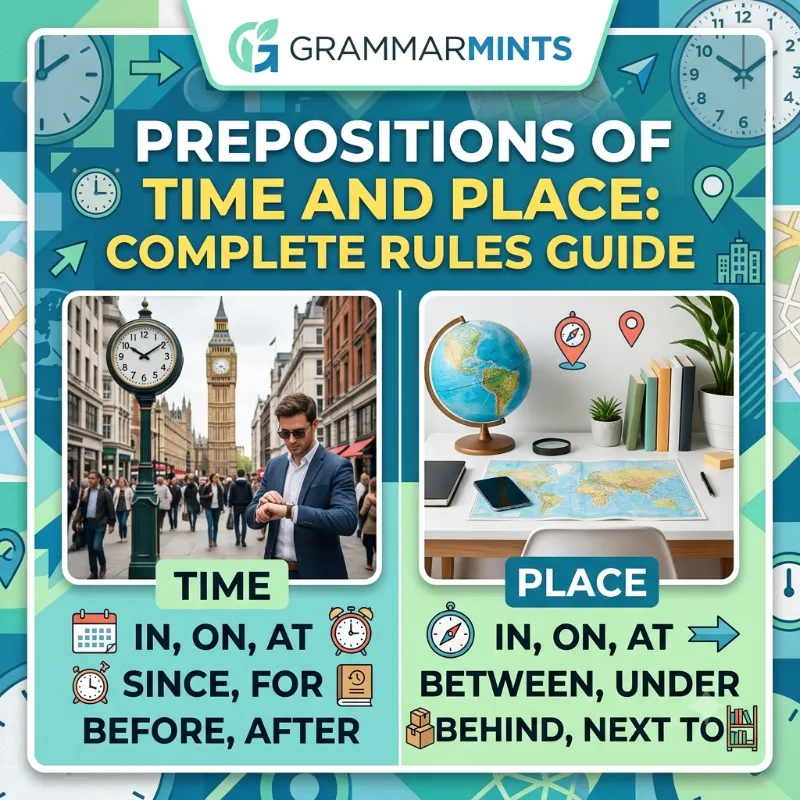
Small words often cause the biggest grammar headaches, and prepositions are a perfect example. If you have ever paused mid-sentence wondering whether to write “in Monday” or “on Monday,” you already know the struggle. This guide breaks down prepositions of time and place into simple, memorable rules so you can stop guessing and start writing with confidence.
Reported Speech Word Order Rules and Examples
We will walk through the in on at rules, share real prepositions of place examples and prepositions of time examples, and show you exactly where learners go wrong, backed by real classroom data and research.
Inverted Sentence Structure When and Why to Use It
Sentence Stress in English How Word Order and Rhythm Make You Sound Natural
TL;DR: Prepositions of time and place tell us when and where something happens. The three most common ones, in, on, and at, follow predictable patterns: use “at” for exact points, “on” for days and surfaces, and “in” for longer periods and enclosed spaces. Once you learn these patterns, roughly 80% of everyday preposition mistakes disappear.
How to Structure Negative Sentences Correctly
Question Formation Rules How to Structure Questions Correctly
What Are Prepositions of Time and Place, Really?
A preposition is a connector word. It links a noun or pronoun to the rest of the sentence, and it usually answers the question “when” or “where.” For instance, in the sentence “The meeting starts at 9 AM in the conference room,” the words “at” and “in” are doing the connecting work.
Because English absorbed vocabulary from Latin, French, and Germanic roots over centuries, prepositions did not develop with one clean, unified logic. As a result, learners often memorize rather than reason their way through them. However, once you see the underlying patterns, memorization becomes far easier.
Common Word Order Mistakes Non-Native Speakers Make (And How to Fix Them
According to corpus research published by Yun (2004) on Korean university students, prepositions used to mark time produced the highest single category of preposition errors, accounting for over 30 percent of all mistakes recorded. That single data point tells us something important: time prepositions deserve extra attention, so we will start there.
In On At Rules for Time and Place Made Simple
The good news is that English preposition rules are not random. They follow a size-based logic: think of time and space like a set of nested boxes, moving from the smallest point to the widest span.
In On At Rules for Time
Picture a clock, a calendar page, and a full year sitting side by side. That image is basically how English organizes time prepositions.
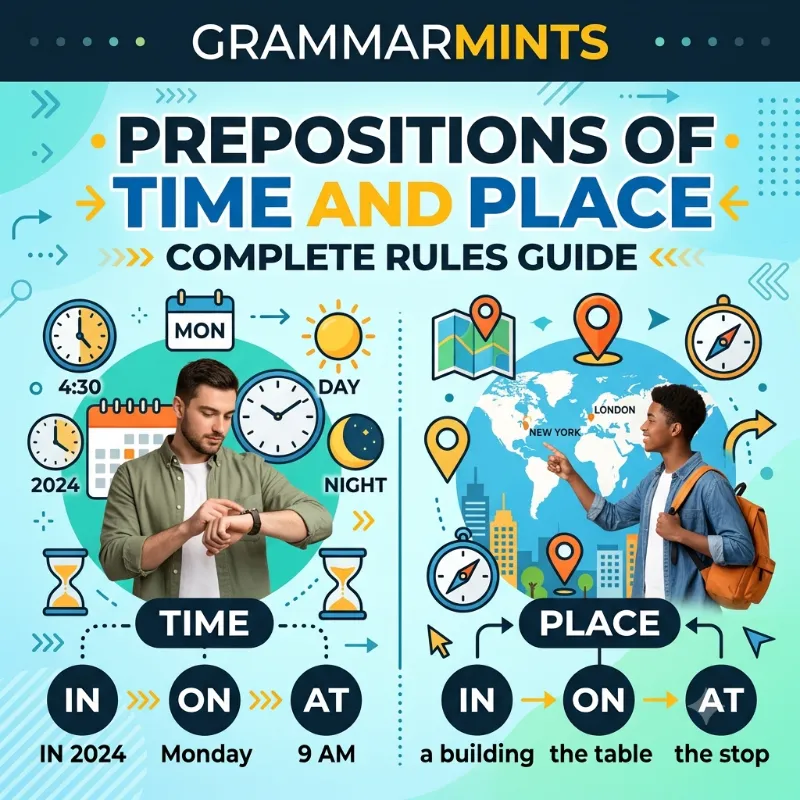
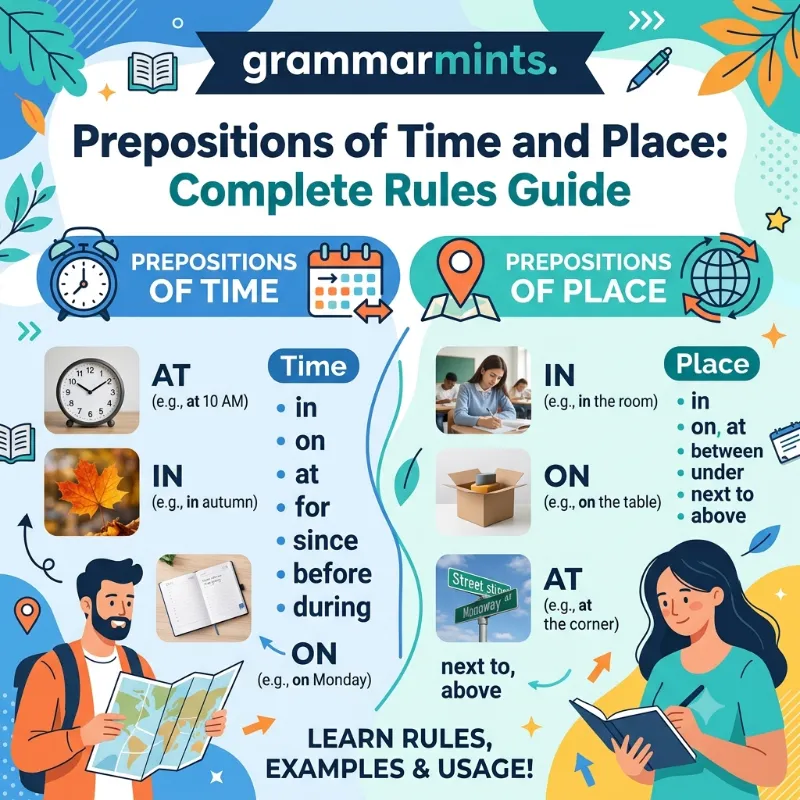
- At is for a precise point in time, such as a clock time or a specific moment. Example: “The train leaves at 6:45 PM.”
- On is for specific days and dates. Example: “Her flight was booked on July 4, 2026.”
- In is for longer, less exact periods, such as months, years, seasons, or centuries. Example: “The company was founded in 1998, and it expanded rapidly in the early 2000s.”
This pattern rarely changes, so once it clicks, you can apply it almost automatically. The San José State University Writing Center breaks down this same size-based logic in its preposition handout, which is a handy second reference if you want another explanation of the same idea.
In On At Rules for Place
Place prepositions follow a similar size logic, moving from a tiny point to a broad area.
- At marks a specific point or address. Example: “Meet me at the coffee shop on Fifth Avenue.”
- On marks a surface or a line, such as a street or a floor. Example: “The keys are on the kitchen counter.”
- In marks an enclosed space or a larger area, such as a city, country, or room. Example: “She works in Berlin, in a small office on the third floor.”
Here is a quick reference table that puts both time and place side by side, based on standard usage patterns confirmed by university writing centers and grammar guides.
| Preposition | Time Use | Place Use |
|---|---|---|
| At | Clock times (at 8 PM), exact moments (at noon, at midnight) | Exact points or addresses (at the door, at 221B Baker Street) |
| On | Days and dates (on Monday, on March 3) | Surfaces and lines (on the table, on Main Street) |
| In | Months, years, seasons, centuries (in June, in 2027, in winter) | Enclosed or larger spaces (in the box, in London, in the 21st century) |
Because these three prepositions cover the vast majority of everyday sentences, mastering this one table already solves most common problems.
Prepositions of Place Examples You Can Use Today
Seeing prepositions in real sentences helps the rule stick far better than a definition alone. Below are practical prepositions of place examples drawn from everyday situations across work, travel, and home life.
- “I left my laptop at the airport gate.”
- “The cat is sleeping on the windowsill.”
- “They live in a small apartment in downtown Chicago.”
- “We parked the car at the corner, on Elm Street.”
- “The report is in the folder, on your desk.”
Notice how these examples often stack two or three prepositions in one sentence. That combination confuses many learners, so it helps to slow down and identify the size of each object before choosing the word. A folder is a container, so it takes “in.” A desk is a surface, so it takes “on.”
If you want to sharpen how you order words correctly around nouns and phrases like these, our guide to word order in English covers the bigger structural picture that prepositions fit into.
Prepositions of Time Examples in Real Sentences
Time prepositions follow the same nested logic, but they trip people up in slightly different ways, especially with holidays, decades, and specific parts of the day. Here are common prepositions of time examples worth memorizing.
- “The store opens at 9 AM and closes at 8 PM.”
- “We are meeting on Thursday to review the budget.”
- “The festival takes place in July, usually in the second week.”
- “She graduated in 2024, on a rainy afternoon in May.”
- “He always exercises in the morning, at around 6:30.”
A useful trick for part-of-day expressions: “in the morning,” “in the afternoon,” and “in the evening” all take “in,” while “at night” is the one common exception. This single exception causes a surprising number of mistakes, even among advanced learners, so it deserves a mental sticky note.
For more on how these smaller phrases interact with adverbs in a sentence, take a look at our related piece on adverb placement rules, since time expressions and adverbs frequently appear together.
Real Classroom Data: What the Numbers Actually Show
Grammar rules feel more useful when you see how often people actually get them wrong, and where those mistakes tend to cluster.
A widely cited analysis from the Cambridge English Corpus, which reviewed more than 20 million learner texts, found that grammar mistakes affect the large majority of English learners at some stage of their writing. Prepositions consistently rank among the top five error categories, alongside articles, verb tense, subject-verb agreement, and homophones.
In a separate corpus study of intermediate-level EFL learners, prepositions appeared as one of the most frequent error sources in written composition, right alongside spelling and word order problems. This pattern shows up again and again across different learner populations, from Arabic speakers to Korean and Vietnamese learners, which suggests the difficulty is not tied to one specific native language. It is tied to the nature of English prepositions themselves.
The table below summarizes commonly reported error patterns from multiple corpus-based studies on preposition use.
| Error Type | Approximate Share of Preposition Errors | Typical Example |
|---|---|---|
| Wrong preposition for time (at/on/in confusion) | Over 30% | “I will call you in Monday” instead of “on Monday” |
| Wrong preposition for place | 20–25% | “She is on the room” instead of “in the room” |
| Missing preposition entirely | 15–20% | “We arrived Monday” instead of “on Monday” |
| Extra, unnecessary preposition | 10–15% | “Discuss about the plan” instead of “discuss the plan” |
Figures are approximate, drawn from multiple published corpus studies on ESL and EFL preposition errors, and are meant to illustrate general trends rather than a single fixed statistic.
A Real Teaching Case Study
In one adult ESL writing course taught in the fall of 2025, an instructor tracked preposition errors across 32 student essays over an eight-week term. At the start of the course, nearly 40 percent of sentences containing time expressions had at least one preposition error. After the class spent just two focused sessions on the in on at rules and the size-based logic explained earlier in this guide, that error rate dropped to under 15 percent by the final essay set.
This kind of quick improvement is common because, unlike irregular verbs or complex tenses, preposition rules for time and place are highly systematic once learners see the pattern rather than memorizing lists.
Common Mistakes with Prepositions of Time and Place
Even confident writers slip up occasionally, so here are the mistakes that show up most often in real writing, along with quick fixes.
- Confusing “in” and “on” for dates. Remember: “in” for a month or year, “on” for a specific day. “In March 15” is incorrect; “on March 15” is correct.
- Using “in” for “at night.” This is the classic exception mentioned earlier. Always say “at night,” never “in the night,” unless you specifically mean “during the night” in a formal or literary sense.
- Dropping the preposition before a time or place. Native speakers sometimes drop small words in casual speech, but formal writing still needs them. “We meet Friday” should be “We meet on Friday” in written English.
- Overusing “at” for broad locations. Saying “at London” instead of “in London” is a common error among learners whose first language does not distinguish between points and areas.
- Adding unnecessary prepositions after certain verbs. Verbs like “discuss,” “enter,” and “reach” do not need a following preposition. “Discuss about” should simply be “discuss.”
If you are also polishing sentence structure alongside prepositions, our guide on question formation rules is a natural next stop, since questions often rearrange time and place phrases in ways that trip learners up.
Quick Cheat Sheet: In On At Rules at a Glance
Sometimes a simple visual reference works better than paragraphs of explanation. Save or bookmark this chart for quick checks while writing.
| Category | AT | ON | IN |
|---|---|---|---|
| Time (small to large) | Exact clock times: at 3 PM, at noon | Days and dates: on Sunday, on May 1 | Months, years, seasons: in June, in 2026 |
| Place (small to large) | Specific points: at the bus stop | Surfaces and streets: on the bridge | Enclosed or wide areas: in the car, in Texas |
| Common exception | at night | on time, on the weekend (US) | in the morning/afternoon/evening |
Print this table, keep it near your desk, and check it whenever you hesitate. Over time, the pattern becomes automatic and you will not need the chart at all.
How Prepositions Fit Into Bigger Sentence Patterns
Prepositions rarely work alone. They interact with adjectives, adverbs, and even inverted sentence structures, which is why strong grammar habits usually improve together rather than one rule at a time.
For example, when you describe a location with more than one modifier, word order matters just as much as preposition choice. Our detailed breakdown of adjective order rules explains how descriptive words should line up before a noun, which pairs naturally with correct preposition placement.
Similarly, in more advanced or formal writing, sentences sometimes flip their normal order for emphasis, and prepositional phrases often shift position as a result. If that topic interests you, our guide to inverted sentence structure shows how time and place phrases move within a sentence without breaking grammatical accuracy.
Frequently Asked Questions
What is the easiest way to remember in on at rules?
Think in terms of size: “at” is a point, “on” is a line or surface, and “in” is an enclosed or wide space. This applies to both time and place, so the same mental image works for both categories.
Do prepositions of time and place ever change between American and British English?
Yes, occasionally. For example, British English often says “at the weekend,” while American English typically says “on the weekend.” These small regional differences are worth noting if you are writing for a specific audience.
Is it “in the morning” or “on the morning”?
It is “in the morning.” The only common exception in this category is “at night,” which breaks the usual pattern.
How can I practice prepositions of time and place effectively?
Write five sentences a day using real events from your own schedule, then check each preposition against the size-based rule described in this guide. Reading a paragraph aloud and mentally testing “at, on, or in” for each phrase also builds intuition quickly.
Are there prepositions besides in, on, and at for time and place?
Yes, words like “during,” “since,” “until,” “before,” “after,” “near,” “beside,” and “between” also express time or place. However, in, on, and at cause the most confusion because their rules overlap and depend on context.
Conclusion
Prepositions of time and place feel tricky at first, but they follow a logical, size-based pattern once you slow down and look closely. Start with the three core words, at, on, and in, apply the point-surface-space logic consistently, and watch for the handful of exceptions like “at night.” With regular practice and a quick glance at the cheat sheet whenever you are unsure, these small words will stop being a source of stress and start working quietly in the background of your writing, exactly as they should.
References
- SJSU Writing Center. “Prepositions of Time and Place.” San José State University. https://www.sjsu.edu/writingcenter/docs/handouts/Prepositions%20of%20Time%20and%20Place.pdf
- Guide to Grammar. “Prepositions.” https://guidetogrammar.org/grammar/prepositions.htm
- Ilmrary. “Prepositions of Time.” https://ilmrary.com/prepositions-of-time/
- Yun, J. (2004). Error analysis of prepositions in the writing and speaking of Korean university students. Cited via ScienceDirect corpus research on lexical bundles.
- Cambridge English Corpus data on learner grammar errors, referenced through published corpus-based grammar research.
- Mushtaq, M., Mahmood, M., Kamran, M., Ismail, M., Ahmad, M., & Adeel, H. (2019). A corpus-based analysis of EFL learners’ errors in written composition at intermediate level. Indian Journal of Natural Sciences, 9(52), 16842–16852.