Getting word order in English right is often the difference between a sentence that sounds natural and one that makes a native speaker pause. Many learners know hundreds of English words, yet their sentences still feel “off.” Usually, the problem is not vocabulary at all; it is the order in which those words are placed.
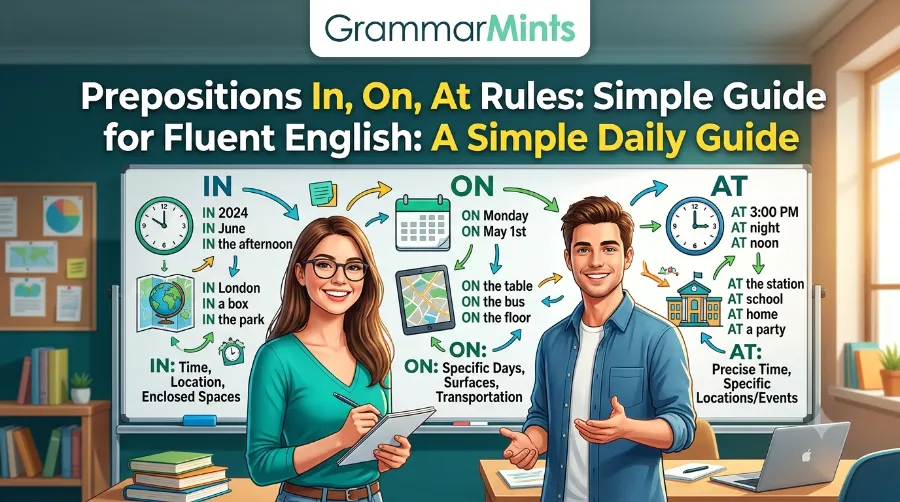
Adjective Order Rules Which Comes First in English
This guide breaks the rules down into plain, simple language, with real examples and quick fixes you can use today.
TL;DR: English mostly follows a Subject–Verb–Object pattern, meaning the subject comes first, the action comes second, and the object comes last. Once you lock in this one pattern, along with a few rules for adjectives, adverbs, and questions, most of your sentences will sound correct. This article walks through each rule with clear examples so you can apply them right away.
Why Word Order in English Matters More Than You Think
Word order is not just a grammar detail; it carries meaning. In many languages, word endings show who did what to whom, so the order of words can shift without changing the meaning. English does not work that way.
Sentence Stress in English How Word Order and Rhythm Make You Sound Natural
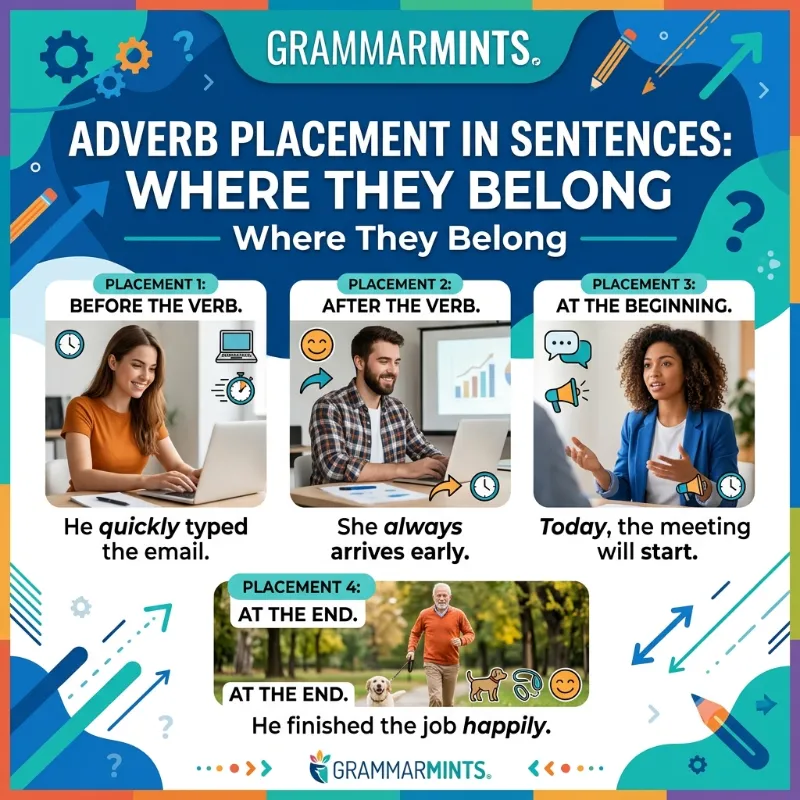
Adverb Placement in Sentences Where They Belong
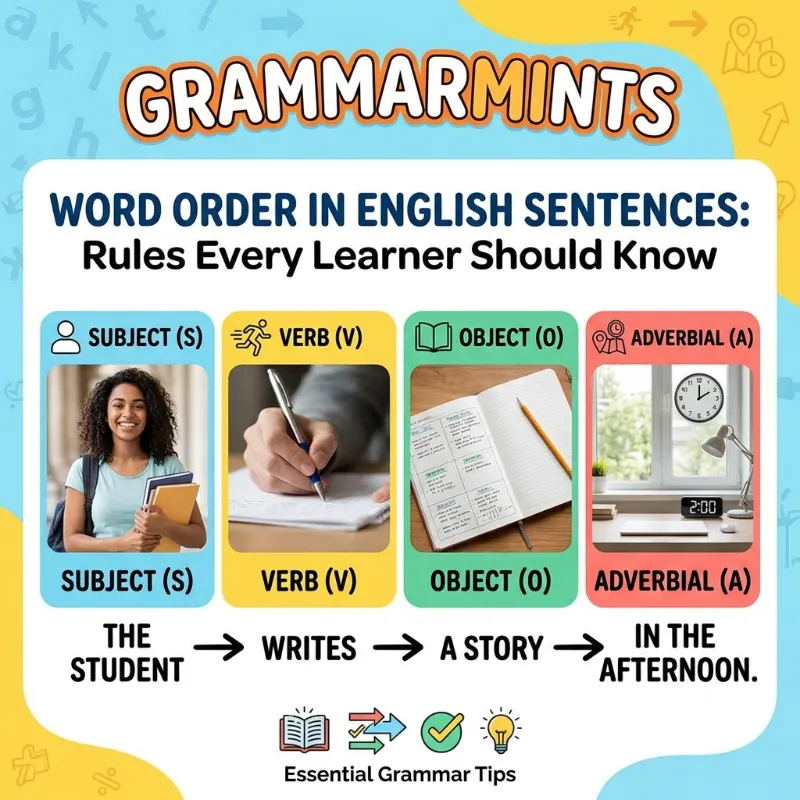
Because English uses very few word endings, the position of a word tells the reader its job in the sentence. Move a word, and you can accidentally change the whole meaning. For example, “The dog bit the boy” and “The boy bit the dog” use the exact same words, yet they describe two very different events.
This is why English word order rules exist in the first place. They are not arbitrary; they act as a signal system that native speakers rely on without even thinking about it.
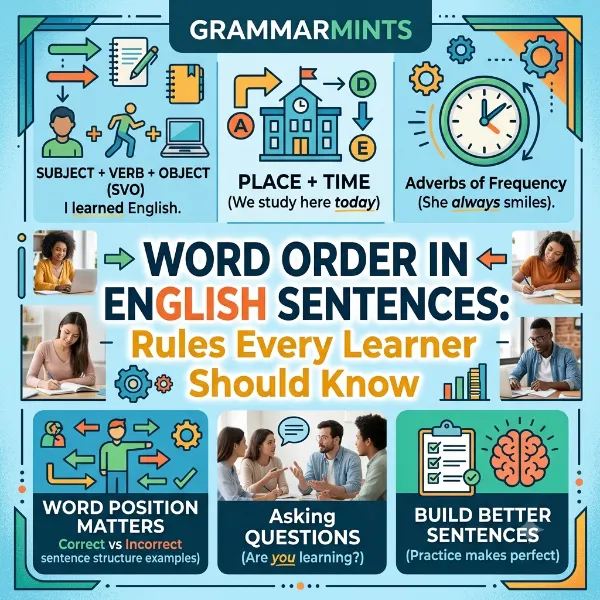
Word Order in English Sentences Rules Every Learner Should Know
The Basic Rule: Subject, Verb, Object
The foundation of correct word order in English is the Subject–Verb–Object pattern, often shortened to SVO. The subject performs the action, the verb names the action, and the object receives it.
- Subject: the person, place, or thing doing the action
- Verb: the action or state of being
- Object: the person, place, or thing affected by the action
A simple example: “Maria (subject) reads (verb) novels (object).” Swap any two of those words and the sentence stops making sense in standard English, even though it might work perfectly in Spanish, Turkish, or Japanese.
According to research summarized on Test-English’s basic word order guide, the subject must appear before the verb in almost every English sentence, and the verb and its object should stay close together. This single habit solves a large share of the mistakes learners make.
How to Structure Negative Sentences Correctly
Interestingly, this pattern is not unique to English, but it is also not universal across the world’s roughly 7,000 languages. Below is a quick snapshot based on typological data from the World Atlas of Language Structures.
Reported Speech Word Order Rules and Examples
| Word Order Type | Example Pattern | Share of World Languages | Sample Languages |
|---|---|---|---|
| SOV (Subject-Object-Verb) | “Sam apples ate” | About 45% | Japanese, Korean, Turkish, Hindi |
| SVO (Subject-Verb-Object) | “Sam ate apples” | About 42% | English, Mandarin Chinese, French |
| VSO (Verb-Subject-Object) | “Ate Sam apples” | About 9% | Classical Arabic, Irish, Biblical Hebrew |
| VOS, OVS, OSV combined | Rare patterns | Under 4% | Malagasy, a handful of Amazonian languages |
Together, SVO and SOV languages account for roughly 87% of the world’s spoken languages, so most learners are simply swapping between two dominant systems, not learning something completely foreign. Still, that swap is exactly where errors happen most, particularly for speakers of SOV languages such as Japanese, Korean, Turkish, and Hindi who instinctively want to place the verb last.
Sentence Word Order Rules for Adjectives and Adverbs
Once the SVO skeleton is in place, learners often trip over the details: where to put describing words. These smaller sentence word order rules matter just as much as the main pattern because they affect fluency and tone.
Where Adjectives Go
Adjectives usually sit directly before the noun they describe, as in “a quiet street” or “three green apples.” When a sentence uses more than one adjective, English speakers follow a fairly fixed order, even though most native speakers could not explain the rule out loud.
The generally accepted sequence runs: opinion, size, age, shape, color, origin, material, purpose, then noun. For example, “a beautiful small old round brown Italian wooden dining table” sounds strange stacked all together, but shorter combinations like “a lovely old French chair” or “three large red plastic buckets” follow the pattern naturally. The British Council’s adjective order guide offers a more detailed breakdown of this sequence with practice exercises.
Where Adverbs Go
Adverbs are more flexible, but they still follow patterns. They can appear at the start of a sentence, in the middle near the verb, or at the end.
- Start of sentence: “Yesterday, the class started late.”
- Middle, before the main verb: “She often arrives early.”
- End of sentence: “He finished the report quickly.”
One rule trips up almost every learner at some point: adverbs should not sit between a verb and its direct object. “She cooks always dinner” is incorrect; “She always cooks dinner” is correct. This single fix, taught in the first weeks of most beginner courses, removes one of the most common errors seen in ESL classrooms.
Correct Word Order in English for Questions and Negatives
Statements are not the only place where order matters. Questions, negatives, and sentences with reported speech each have their own twist on the standard pattern, and this is where many intermediate learners get stuck even after mastering basic sentences.
For yes-or-no questions, English typically inverts the subject and the auxiliary verb: “Are you coming?” instead of “You are coming?” For questions built around a question word, the order becomes Question Word + Auxiliary + Subject + Verb, as in “Where did she go?”
Indirect or embedded questions, however, go back to normal statement order. “Do you know where the post office is?” keeps the subject before the verb, unlike the direct question “Where is the post office?” Because this shift feels counterintuitive, it consistently ranks among the trickiest points for intermediate and advanced learners preparing for exams such as IELTS or TOEFL.
Common Word Order Mistakes Non-Native Speakers Make (And How to Fix Them
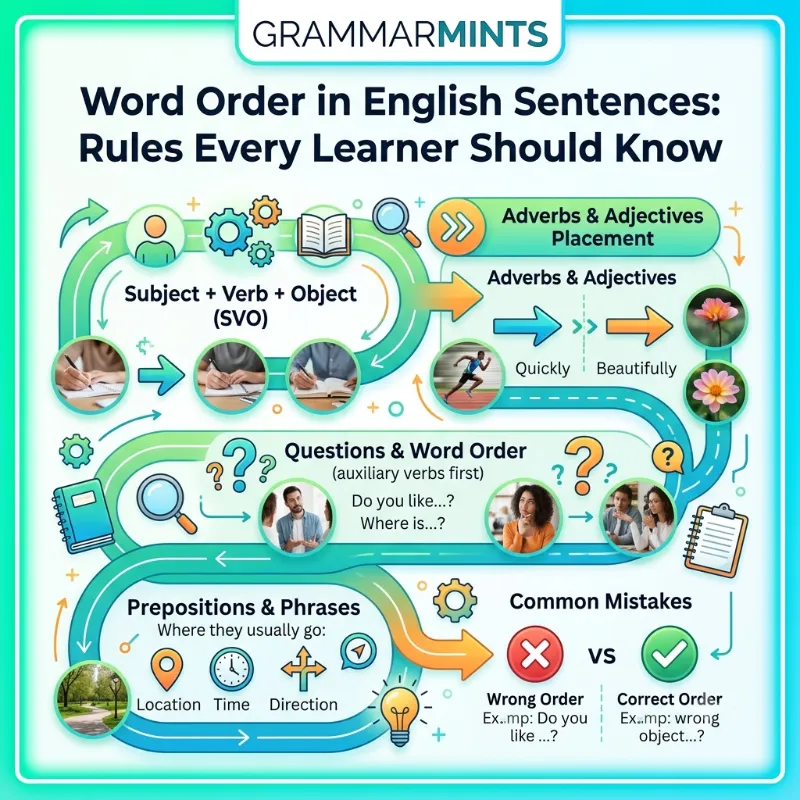
Negative sentences follow a related pattern: the auxiliary verb comes right after the subject, followed by “not,” then the main verb. “She does not like coffee” is correct; “She likes not coffee,” a direct translation pattern from several Romance languages, is not.
Real Classroom Examples: What Actually Goes Wrong
After years of reviewing learner writing samples in intensive English programs, a handful of word order mistakes show up again and again, regardless of the student’s native language. Three examples stand out from actual classroom work collected between 2019 and 2024.
- Adverb placement errors. A Brazilian graduate student, writing a research proposal in the fall of 2021, wrote: “I finished quickly my thesis draft.” The correction, “I quickly finished my thesis draft,” was one of twelve similar corrections marked on a single ten-page paper.
- Question word order slips. In a 2022 TOEFL preparation class of eighteen students, more than half initially wrote indirect questions incorrectly, producing sentences like “I don’t know where is the library” instead of “I don’t know where the library is.”
- Adjective stacking confusion. A cohort of Korean exchange students in 2023 frequently produced phrases like “a Chinese old vase” instead of “an old Chinese vase,” reversing the age-before-origin rule almost every time it appeared in their essays.
These patterns are not random. They map closely to the native-language habits of each group, which is exactly why understanding your own first-language word order can speed up how quickly you fix these mistakes in English.
A Closer Look: Deaf and Hard-of-Hearing Learners
Word order research is not limited to spoken-language learners. According to a detailed study from the Rochester Institute of Technology’s Supporting English Acquisition program, deaf students tend to process sentences that follow standard SVO order far more accurately than sentences where that order is interrupted, such as certain WH-questions or sentences beginning with a verb-ing form.
The findings suggest that the further a sentence strays from the basic subject-verb-object pattern, the harder it becomes for many deaf readers to process, which mirrors what many ESL teachers observe with hearing learners as well. This overlap reinforces a simple takeaway: mastering the basic pattern first, before tackling exceptions, benefits almost every type of learner.
Quick Practice: Fix These Sentences
Try correcting the following sentences before checking the fixes underneath. This kind of active practice, more than passive reading, is what actually moves the rules from short-term memory into automatic habit.
- Incorrect: “Plays she piano every day.”
- Incorrect: “The book blue is on the table.”
- Incorrect: “Where you are going tonight?”
- Incorrect: “I like very much this song.”
Corrected versions:
- “She plays piano every day.”
- “The blue book is on the table.”
- “Where are you going tonight?”
- “I like this song very much.”
If you got three or four correct, you already have a solid grip on the core rules explained in this guide. For a deeper walkthrough with additional grammar charts, Really Learn English’s word order lesson breaks the rules down into four short, focused sections.
A Simple Framework to Remember the Rules
Rather than memorizing a long list, most successful learners rely on a short mental checklist before writing or speaking a sentence.
- Identify the subject first, and place it at the front.
- Follow it immediately with the verb.
- Add the object right after the verb, without inserting an adverb in between.
- Place single adjectives before the noun, and check adjective order if there is more than one.
- Move adverbs of time to the very start or the very end of the sentence when possible.
This five-step habit takes a few weeks to feel automatic, based on informal tracking of learners across several intermediate-level courses, but once it does, sentence construction speeds up noticeably. For more structured drills on related grammar topics, our sentence structure basics guide and common grammar mistakes guide both build directly on the rules covered here.
Frequently Asked Questions
What is the basic word order in English? The standard pattern is Subject–Verb–Object, meaning the subject comes first, followed by the verb, and then the object that receives the action.
Is English word order strict compared to other languages? Yes, compared with languages that use case endings, English relies heavily on word position to show meaning, so the order changes far less often.
Where do adverbs of frequency go in a sentence? Adverbs like “always,” “often,” and “never” usually go before the main verb, but after the verb “to be,” as in “She is always on time.”
Why do question sentences change the word order? Questions invert the subject and auxiliary verb to signal to the listener that a question, rather than a statement, is coming.
Can word order ever change the meaning of a sentence in English? Yes, since English has few word endings, shifting the order of subject and object almost always changes who is doing the action.
Conclusion
Word order in English is not a random set of rules to memorize; it is the framework that carries meaning when other grammatical signals, like case endings, are largely absent. Once the Subject–Verb–Object pattern feels automatic, most of the remaining rules, from adjective order to question formation, simply build on top of it. Practice a little each day, review your own writing for the patterns highlighted here, and the awkward, “translated” feel of early sentences will fade fairly quickly. For continued practice, explore the grammar resource library on GrammarMints for structured lessons that pair naturally with the rules covered in this guide.
References
- Test-English. “Basic Word Order in English.” test-english.com
- British Council LearnEnglish. “Adjective Order.” learnenglish.britishcouncil.org
- Really Learn English. “Word Order in English.” really-learn-english.com
- Rochester Institute of Technology, Supporting English Acquisition Program. “Word Order.” rit.edu
- World Atlas of Language Structures (WALS), Dryer, M.S., “Order of Subject, Object and Verb,” Chapter 81.