If you have ever paused mid-sentence wondering whether to type their, there, or they’re, you are not alone. These three words sound exactly the same, yet they mean completely different things. This mix-up is one of the most common writing errors among students, professionals, and even experienced writers across the United States and Europe.
Its vs It’s Simple Rules to Remember the Difference
Your vs You’re How to Never Confuse Them Again
The good news is that the difference between their, there and they’re is easier to learn than it looks. Once you understand a few simple rules, you will never second-guess yourself again.
Lay vs Lie The Confusing Verbs Explained
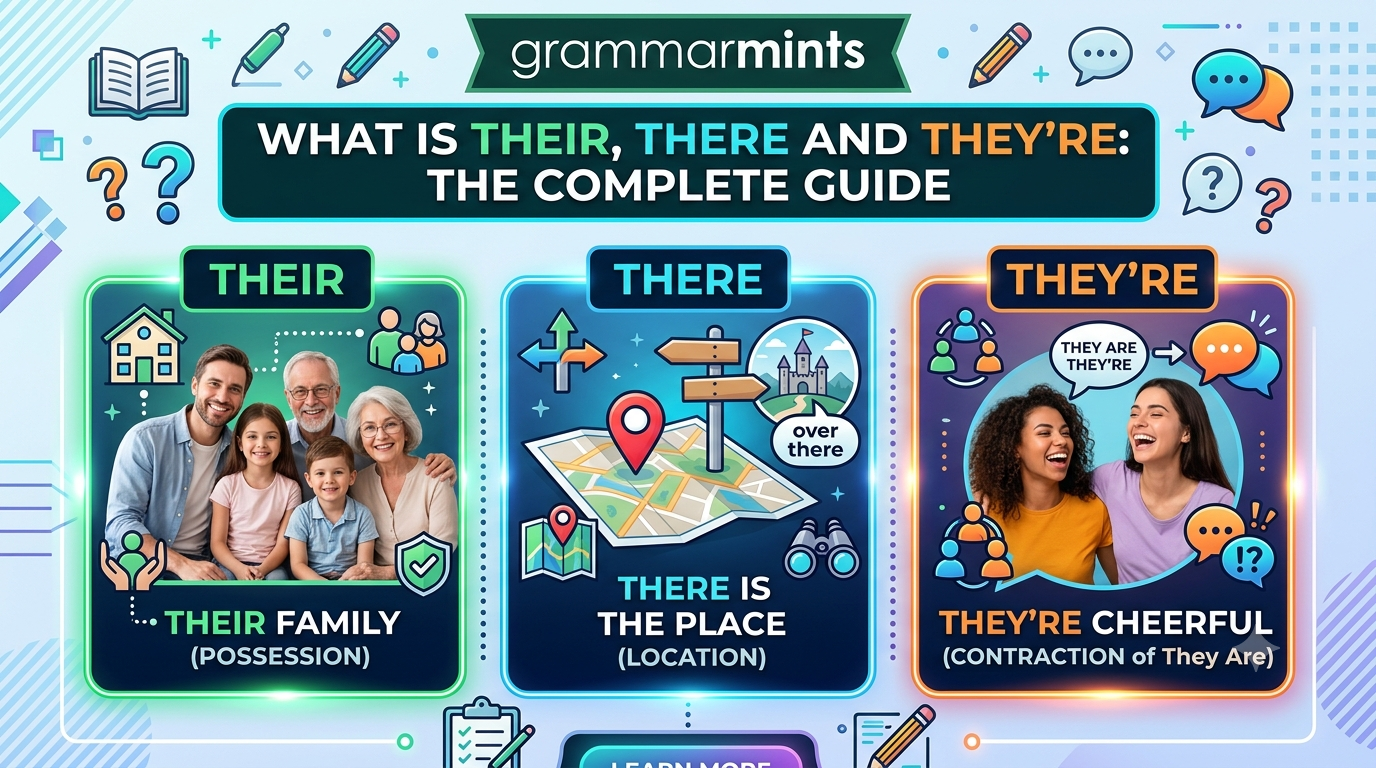
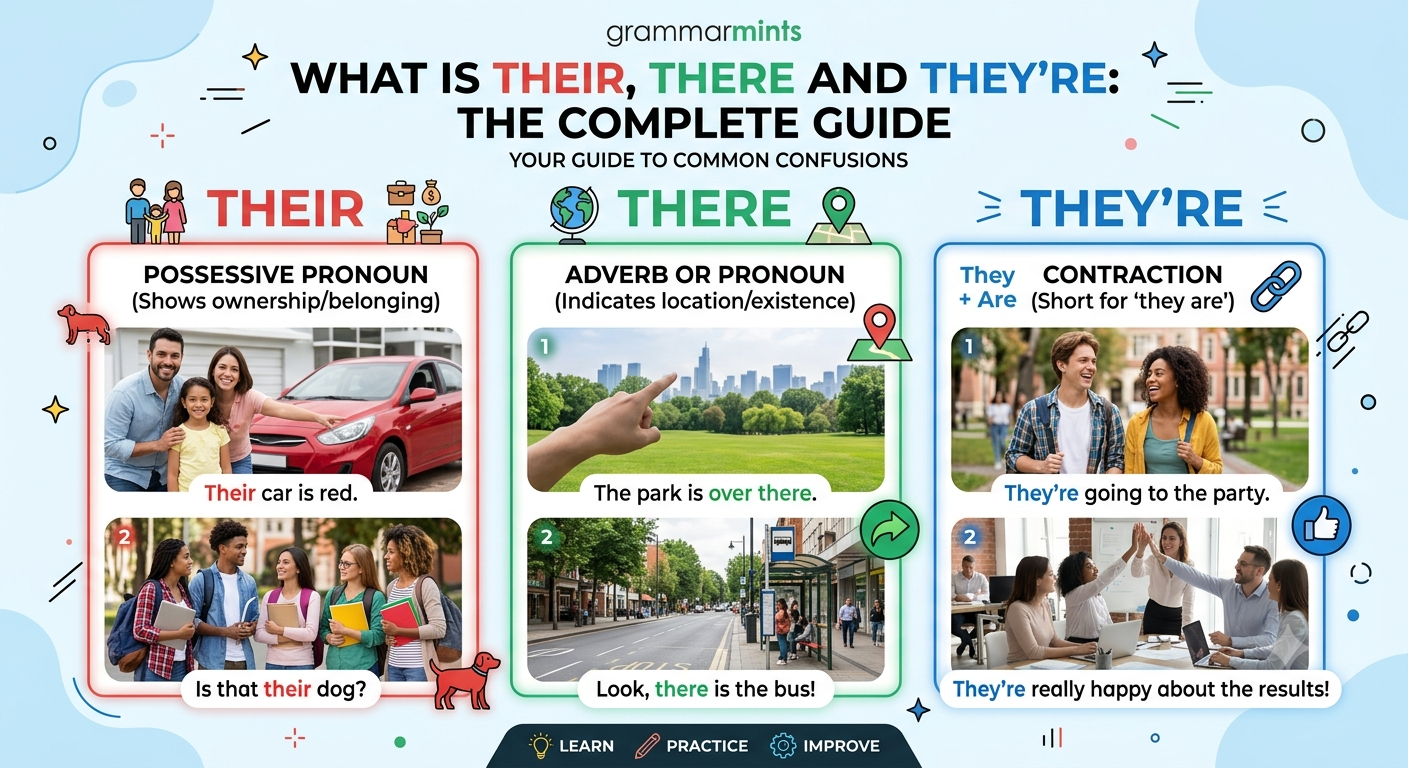
TL;DR: Their shows ownership (their car), there points to a place or introduces a fact (over there, there is), and they’re is short for “they are” (they’re leaving soon). If you can replace the word with “they are” and the sentence still makes sense, use they’re. Otherwise, check whether you mean a place (there) or possession (their).
Why Their, There and They’re Trip Up Even Great Writers
English is full of homophones, and their, there and they’re are among the trickiest. All three sound identical when spoken aloud, so your ear cannot help you the way it can with most other words. Consequently, the error often shows up only in writing, not in speech.
In 2023, a Grammarly-style spell checker review by several editing blogs listed this trio among the top five homophone mistakes flagged in everyday emails and social posts. Teachers report a similar pattern in classrooms every semester. One high school English coordinator in Ohio, for example, said that during a 2022 writing assessment of 120 students, nearly a third swapped their and there at least once in a single essay.
Common Subject Verb Agreement Mistakes to Avoid
This happens because autocorrect tools do not always catch the error. Since all three words are spelled correctly on their own, spell-check software often lets the mistake slide through untouched. That is exactly why understanding the rule matters more than relying on technology.
Who vs Whom A Simple Trick to Get It Right
Their vs There vs They’re: The Quick Difference
Before diving into the details, here is a simple side-by-side breakdown. This table works well as a quick mental chart whenever you are unsure which word to use.
| Word | Meaning | Quick Test | Example |
|---|---|---|---|
| Their | Shows ownership (possessive) | Can you replace it with “his,” “her,” or “its”? | Their dog barks every morning. |
| There | Refers to a place, or introduces a fact | Can you point to a location, or say “here” instead? | The keys are over there. |
| They’re | Short for “they are” | Can you expand it to “they are”? | They’re planning a trip to Spain. |
Once this pattern clicks, the rest of the guide will feel much easier to follow.
How to Use “Their” Correctly
Their is a possessive pronoun. It shows that something belongs to a group of people, animals, or things. Think of it as the plural version of “his” or “her.”
For example:
- The students left their backpacks in the hallway.
- The company updated their return policy in January 2025.
- Their new apartment has a great view of the river.
Here is a helpful trick: if you can swap the word for “his,” “her,” or “its” and the sentence still makes sense, then their is the correct choice. This small test works almost every time, so keep it in your back pocket.
Common Their Mistakes to Avoid
Many writers accidentally use there or they’re when they actually mean their. This usually happens when typing quickly or when reading the sentence aloud without checking the spelling.
Affect vs Effect How to Use Each Word Correctly
A few examples of the error, followed by the correction:
- Incorrect: The team celebrated they’re victory. Correct: The team celebrated their victory.
- Incorrect: I saw the kids and there parents at the park. Correct: I saw the kids and their parents at the park.
- Incorrect: The company moved they’re headquarters to Berlin in 2021. Correct: The company moved their headquarters to Berlin in 2021.
How to Use “There” Correctly
There has two main jobs. First, it points to a location, similar to “here.” Second, it introduces a fact or a statement, especially with the verb “to be,” as in “there is” or “there are.”
Location examples:
- Please put the boxes over there.
- We drove there for six hours straight.
Existence examples:
- There is a coffee shop on the corner of Main Street.
- There were nearly 40,000 attendees at the London tech conference in 2024.
A Simple Memory Trick for There
Notice that there contains the word “here.” Both words describe location or place, so this small spelling clue can jog your memory instantly. Whenever you picture a spot on a map, there is almost always the right choice.
How to Use “They’re” Correctly
They’re is a contraction. It combines “they” and “are” into one shorter word. Whenever a sentence would naturally use “they are,” they’re is the word you need.
For example:
- They’re moving to Portugal next spring.
- My neighbors said they’re hosting a barbecue this weekend.
- According to a 2024 survey by a European relocation firm, they’re increasingly choosing remote coastal towns over big cities.
Because they’re always expands to “they are,” you can test any sentence by mentally replacing the contraction. If the sentence still sounds natural, you have chosen correctly.
There, Their, They’re Rules You Can Actually Remember
Instead of memorizing grammar terms, try this short mental checklist whenever you are unsure:
- Ask yourself if the word shows ownership. If yes, use their.
- Ask yourself if the word points to a place or introduces a statement. If yes, use there.
- Try expanding the word to “they are.” If the sentence still makes sense, use they’re.
- Read the sentence aloud one more time before hitting publish or send.
This four-step method takes only a few seconds, yet it prevents one of the most common homophones their there confusions in modern writing. Over time, the check becomes automatic, and you will barely need to pause at all.
Real-Life Examples That Show the Difference in Action
Seeing these words used correctly in real contexts makes the rule stick faster than any definition alone. Below are a few examples pulled from everyday writing situations.
Workplace email, dated March 2025: “The marketing team submitted their quarterly report early. They’re planning to present it there, at the downtown office, on Thursday.”
Travel blog post about a 2023 European trip: “We arrived in Lisbon, and there were street musicians playing near the square. Their music drew a huge crowd within minutes.”
Customer review from late 2024: “They’re always quick to respond, and their support team resolved my issue in under an hour. I will definitely shop there again.”
Notice how all three words appear naturally in each passage, without any confusion. That is exactly the goal once you have internalized the rule.
Then vs Than Understanding the Difference
Common Errors: A Closer Look at Homophones Their There
Homophones their there mistakes tend to follow predictable patterns. Understanding these patterns can help you catch errors before you hit send.
| Common Error | Why It Happens | Correct Version |
|---|---|---|
| “Their” used for location | Writer confuses possession with place | “There” |
| “There” used for possession | Writer forgets the ownership rule | “Their” |
| “They’re” used for possession | Writer expands incorrectly | “Their” |
| “Their” used for a contraction | Writer skips the “they are” test | “They’re” |
Grammar checkers have improved significantly since 2022, yet they still miss context-based errors like these fairly often. Human proofreading, therefore, remains essential, especially for professional documents, resumes, and published articles.
Quick Practice: Test Yourself
Try filling in the blanks below before checking the answers.
- ___ car broke down on the highway yesterday.
- Put the plates over ___.
- ___ arriving at the airport around 6 p.m.
- The teachers graded ___ students’ essays over the weekend.
- ___ is a small bakery near the train station.
Answers: 1. Their, 2. there, 3. They’re, 4. their, 5. There
If you want more structured drills, the Towson University writing lab offers a helpful practice exercise focused specifically on distinguishing they’re, there, and their, which is worth a try after finishing this guide.
What Style Authorities Say
Style guides agree almost unanimously on these rules, though they explain the reasoning slightly differently. The MLA Style Center points out that their, there, and they’re are frequently confused precisely because they sound identical despite having entirely different grammatical functions. This distinction matters just as much in academic writing as it does in casual messages.
Language schools echo the same guidance for English learners. Kaplan International’s language blog notes that mixing up these three words is one of the most common grammar slip-ups among both native speakers and English learners, which is reassuring if you have struggled with this rule yourself.
If you are working through other tricky word pairs, our guide on your vs. you’re follows a similar pattern and might help reinforce the same kind of thinking. Many learners find that once one homophone rule clicks, the rest become noticeably easier.
Why Getting This Right Matters
Small grammar mistakes can shape how readers perceive your writing, whether it is a job application, a business email, or a blog post. A 2023 hiring survey among UK-based recruiters found that recruiters flagged Their-there-they’re mistakes on résumés as one of the top three grammar red flags noticed during screening.
That does not mean one slip will ruin your chances. However, consistent errors can quietly undermine credibility, especially in formal or professional settings. Taking a few extra seconds to double-check pays off more than most writers expect.
For a broader refresher on frequent slip-ups beyond this trio, our full list of common grammar mistakes covers dozens of similar issues worth reviewing. You can also browse more grammar breakdowns like this one on the Grammarmints homepage.
Frequently Asked Questions
Is it “their” or “there” when talking about a group’s belongings? Use their whenever you are describing something that belongs to a group of people or things, such as their house or their opinions.
How do I remember the difference between there and their fast? Remember that there contains “here,” which signals location. Their, meanwhile, relates to ownership, similar to “his” or “her.”
Can they’re ever mean possession? No. They’re only ever means “they are.” If you mean possession, their is always the correct word instead.
Do native English speakers still mix these up? Yes, frequently. Even confident writers occasionally type the wrong homophone, especially when typing quickly or texting.
Is there a simple trick to check my writing before publishing? Read the sentence aloud and try substituting “they are” for they’re, or “his/her” for their. If neither fits, the word is almost certainly there.
Conclusion
Mastering their, there and they’re comes down to recognizing three simple jobs: ownership, location, and contraction. Once that pattern feels natural, the confusion tends to disappear almost completely. Keep the quick tests from this guide nearby, especially the “they are” swap and the “his/her” substitution, and you will catch mistakes before they ever reach your reader. With a little practice, this classic grammar trap becomes one you will rarely, if ever, fall into again.
References
- Towson University Online Writing Support, “They’re, There, Their Exercise” — https://webapps.towson.edu/ows/exercises/They’reThereTheirExercise1.aspx
- MLA Style Center, “Their, There, They’re: What’s the Difference?” — https://style.mla.org/their-there-theyre-difference/
- Kaplan International, “Their, There and They’re: Grammar Differences” — https://www.kaplaninternational.com/blog/language-tips/their-there-and-theyre-grammar-differences