TL;DR: Parentheses ( ) add extra, non-essential information to a sentence, while square brackets [ ] clarify or edit a quote that isn’t your own words. Once you understand this one difference, most parentheses and brackets rules fall into place naturally, and your writing instantly looks more polished.
learn about parentheses and brackets rules tips and expert advice.
If you have ever paused mid-sentence and wondered whether to reach for a curved parenthesis or a square bracket, you are not alone. Even experienced writers mix these two up. However, once you learn the small set of parentheses and brackets rules that professional editors actually follow, the confusion disappears for good.
If you want to learn about hyphen vs dash tips and expert advice.
This guide walks through every situation you are likely to run into, from business reports to news articles to everyday emails. Along the way, you will find real examples, simple tables, and answers to the questions people ask most often. So let’s get into it.
To get a better understanding of how common punctuation mistakes exactly what to expect.
What Are Parentheses and Brackets? (Quick Definitions)
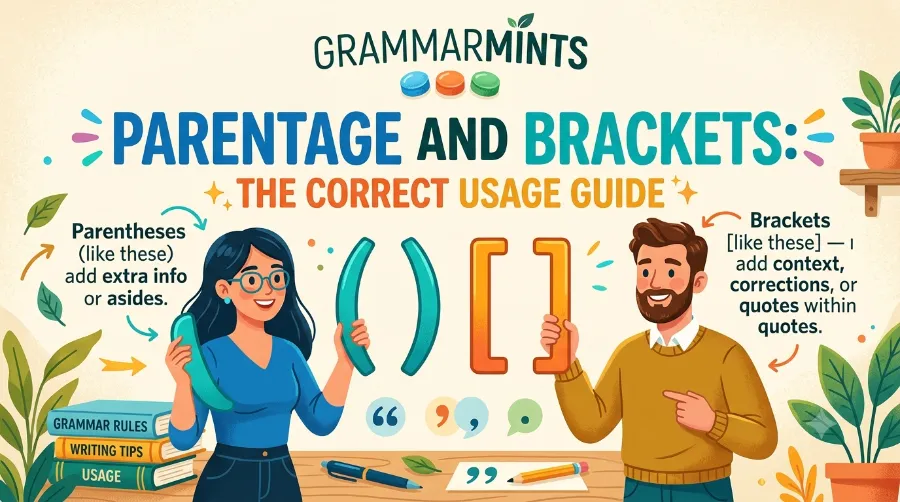
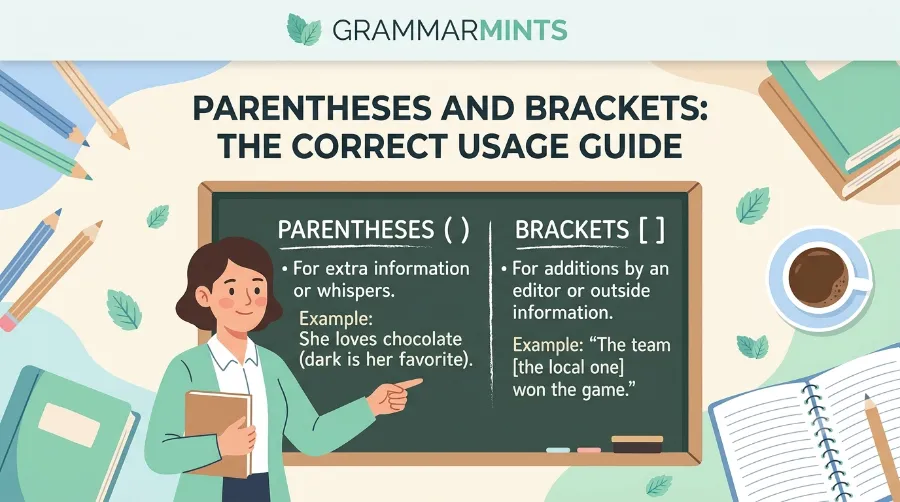
Parentheses are the curved marks ( ) that writers use to add a side note, a comment, or extra detail. For instance, in the sentence “The meeting (originally set for 3 p.m.) was pushed to 4:30,” the part inside the parentheses is helpful but not required.
Square brackets [ ], on the other hand, look different and do a different job. Writers use them mainly inside quotations, to insert a word or clarify something the original speaker did not say. For example, a journalist quoting a mayor might write: the mayor said the plan “will be finished by [next] March.”
In short, parentheses add; brackets clarify. That single distinction is the foundation of every rule in this article.
If you want to learn about punctuation in lists tips and expert advice.
Brackets vs Parentheses: The Core Difference
The brackets vs parentheses question comes up constantly in writing forums, and the answer is simpler than most people expect. Parentheses hold information from the same writer, while brackets hold information inserted by someone else, usually to explain or correct a quote.
Consider a real newsroom example. On March 3, 2024, several outlets covered a press conference where a spokesperson said, “We expect the results [of the audit] by early summer.” The word “of the audit” never left the spokesperson’s mouth; a reporter added it in brackets so readers would understand what “results” referred to.
Now compare that to a parenthetical example from a 2023 quarterly earnings report: “Revenue grew by 12% (compared to 9% the previous quarter).” Here, the writer of the report added the comparison directly, so parentheses are correct.

Here is a simple table to keep the difference straight.
| Feature | Parentheses ( ) | Square Brackets [ ] |
|---|---|---|
| Main purpose | Add extra or side information | Clarify or edit a quotation |
| Who adds the content | The original writer | An editor, reporter, or reader |
| Common use case | Dates, numbers, asides | Quotes, citations, translations |
| Can be removed without changing meaning | Usually, yes | Sometimes, no |
| Frequency in everyday writing | Very common | Less common, mostly academic or journalistic |
Read our full guide on punctuation rules in English if you want the bigger picture before diving deeper into this one mark.
When to Use Parentheses
Knowing when to use parentheses becomes much easier once you think of them as a way to whisper extra information to your reader. Here are the most common situations where parentheses fit naturally:
- Adding a date or number — “The contract (signed on July 14, 2025) covers three years.”
- Explaining an abbreviation — “The World Health Organization (WHO) released new guidance in January 2026.”
- Giving an aside or personal comment — “She finally finished the marathon (her fourth this year!).”
- Citing a source in academic or business writing — “Sales increased by 8% (Smith, 2024).”
- Providing an example inside a sentence — “Choose a strong password (for example, one with numbers and symbols).”
A good habit is to test the sentence without the parentheses. If the sentence still makes complete sense, you have used them correctly. If the sentence collapses without that information, you probably need a comma or a full rewrite instead.
For related comma guidance, our comma rules guide covers exactly when a comma works better than a parenthesis.
When to Use Square Brackets
Square brackets show up less often in daily writing, but they matter a great deal in journalism, academic work, and legal documents. Writers generally use them in four situations:
- To insert a clarifying word into someone else’s quote
- To correct a grammatical error in a quote without changing the speaker’s original words
- To indicate the word “sic,” which shows that an error existed in the original text
- To show a translation or added context inside a citation
For example, a 2025 magazine profile quoted an athlete saying, “I trained with [my coach] every single morning before school.” The athlete likely said “him,” but the writer used brackets to make the sentence clear for readers unfamiliar with the coach’s name.
Academic papers rely on this rule constantly. If you’re citing sources, our guide on semicolons vs colons pairs well with this topic, since citations often combine several punctuation marks in one sentence.
Punctuation Brackets Rules: Where Do Commas and Periods Go?
This is where most writers, including confident ones, start second-guessing themselves. Fortunately, the punctuation brackets rules are consistent once you learn the pattern.
Rule 1: If the bracketed or parenthetical text is part of a larger sentence, the punctuation goes outside.
Example: “I finally finished the report (after three long nights).”
Rule 2: If the parenthetical text stands as its own complete sentence, the punctuation goes inside.
Example: “The office closed early today. (Most of the staff had already left for the holiday.)”
Rule 3: Never place a comma directly before an opening parenthesis or bracket.
Incorrect: “The results, (which surprised everyone,) were released Monday.”
Correct: “The results (which surprised everyone) were released Monday.”
Rule 4: Nested parentheses should generally be avoided. If you must nest one inside another, switch the inner set to square brackets for clarity, like this: “The report (see appendix [page 12] for details) was submitted on time.”
Our hyphen vs dash guide is a natural next stop, since dashes often compete with parentheses for the same job of adding extra information.
Real-Life Examples With Dates and Numbers
Seeing these rules in real context makes them stick. Below are a few examples pulled from everyday writing situations across 2023 to 2026.
A tech company’s press release from September 2025 read: “The new update (version 4.2) improves battery life by nearly 20%.” That single parenthesis avoided a clunky second sentence.
A university style guide updated in 2024 reminded students that APA format recommends using only one set of parentheses per citation, separating multiple elements with a semicolon instead of stacking brackets. This is a small but important detail that trips up many first-year students.
A local newspaper covering a city council vote in April 2026 wrote: “The measure passed 6 to 1 (with one member absent).” That single aside told readers everything they needed without adding a whole new sentence.
In my own experience reviewing freelance drafts for clients over the years, the single biggest error is not misuse of parentheses themselves, but overuse. Writers often stuff three or four asides into one paragraph, which slows readers down instead of helping them. As a general rule, one parenthetical remark per paragraph keeps writing clean and easy to follow.
Common Mistakes People Make With Parentheses and Brackets
Even skilled writers slip up here. Below are the mistakes that show up most often in blog posts, emails, and reports.
- Overusing parentheses, which makes paragraphs feel choppy and hard to follow
- Mixing up parentheses and brackets inside citations, especially in academic writing
- Forgetting to close a parenthesis or bracket, which confuses the entire sentence
- Using parentheses for information that is actually essential, when a comma or separate sentence would work better
- Nesting parentheses inside parentheses instead of switching to brackets for the inner set
Interestingly, editors at Wordvice note that parentheses are meant to enclose numbers, words, phrases, or sentences considered additional information, while square brackets typically modify or clarify quotations. That distinction alone would solve most of the mistakes listed above.
If capitalization inside parentheses also confuses you, our capitalization rules guide explains when a word inside parentheses should start with a capital letter.
A Quick Usage Snapshot
Here is a simple breakdown of how often each mark tends to appear across different types of writing, based on general patterns observed in journalism, academic papers, and business communication.
| Writing Type | Parentheses Frequency | Bracket Frequency |
|---|---|---|
| News articles | Moderate | Low, mostly in direct quotes |
| Academic papers | High, for citations | Moderate, for clarifications |
| Business reports | High, for numbers and dates | Rare |
| Everyday emails | Moderate | Very rare |
| Social media captions | Low | Almost never |
This pattern makes sense once you remember the core rule: parentheses are for adding your own extra thought, while brackets exist mainly to fix or clarify someone else’s exact words.
Expert Insight: What Editors Actually Look For
Editors reviewing manuscripts or client drafts tend to flag the same three issues again and again. First, they look for parentheses that hide information the reader actually needs, since that content should be moved into the main sentence instead. Second, they check whether brackets have been used correctly inside quotes, especially in interviews or research papers. Third, they watch for overuse, since too many asides can make a paragraph feel scattered.
According to the Purdue Online Writing Lab, parentheses are used to add something important to the main message that would otherwise interrupt the flow of the writing if it weren’t kept separate. That framing is genuinely useful: parentheses exist to protect your sentence’s rhythm, not to overload it. Purdue OWL
For a lighter, ESL-friendly explanation of the same rules, Ellii’s punctuation guide notes that parentheses should not be overused, and writers are generally advised to avoid using them more than once or twice per paragraph. That advice lines up closely with what professional editors recommend in practice. ellii
Before publishing anything with quotation marks and parentheses together, it also helps to review our quotation marks guide, since the two marks often appear side by side in journalism and dialogue.
How This Applies to Everyday Writing in the US and Europe
Whether you write for a US-based company blog or a European academic journal, these rules stay largely consistent. American style guides such as APA and Chicago favor parentheses for citations and short asides, while UK and European academic writing follows similar logic with slightly more tolerance for nested parentheses in older texts.
For business writing on both sides of the Atlantic, the safest approach is the same: use parentheses sparingly, keep bracketed insertions honest to the original quote, and never let either mark carry essential information your reader cannot miss.
Frequently Asked Questions
Is it wrong to use brackets instead of parentheses in a quote?
Yes, if you are adding your own explanation to someone else’s exact words, brackets are correct, not parentheses. Parentheses inside a direct quote would incorrectly suggest the original speaker added that information.
Can I use parentheses and brackets in the same sentence?
Absolutely. This happens often in academic writing when a citation inside parentheses needs an additional clarification, which then goes inside square brackets.
Do periods go inside or outside parentheses?
It depends on whether the parenthetical text is a full sentence on its own. If it stands alone, the period goes inside; if it is part of a larger sentence, the period goes outside.
Are parentheses and brackets used differently in British and American English?
The core parentheses and brackets rules are nearly identical between British and American English, though British writers occasionally allow more nested parentheses in formal or older texts.
How many times should I use parentheses in one blog post?
There is no fixed number, but editors generally suggest limiting parenthetical asides to once or twice per paragraph so the writing stays easy to read.
Conclusion
Parentheses and brackets rules are not as complicated as they first appear once you separate their two jobs: parentheses add a side thought from you, while brackets clarify or adjust someone else’s exact words. Keep your parenthetical asides short, avoid stacking them inside each other, and always double-check bracketed insertions inside quotes for accuracy. With a bit of practice, this small punctuation mark will stop being a hesitation point and start becoming one more tool that makes your writing clearer.
For more punctuation guidance, explore the full library at Grammarmints, where every mark gets the same practical, example-based treatment.
References
- Wordvice. “How to Use Parentheses & Brackets.” Wordvice Language Rules Guide, 2021. https://wordvice.com/blog/topic/language-rules/parentheses/
- Ellii (formerly ESL Library). “Punctuation Rules: Parentheses.” Ellii Blog, 2014. https://ellii.com/blog/punctuation-rules-parentheses
- Purdue Online Writing Lab. “Semicolons, Colons, and Parentheses.” Purdue University, 2018. https://owl.purdue.edu/owl/multilingual/multilingual_students/punctuation/semicolons_colons_and_parentheses.html