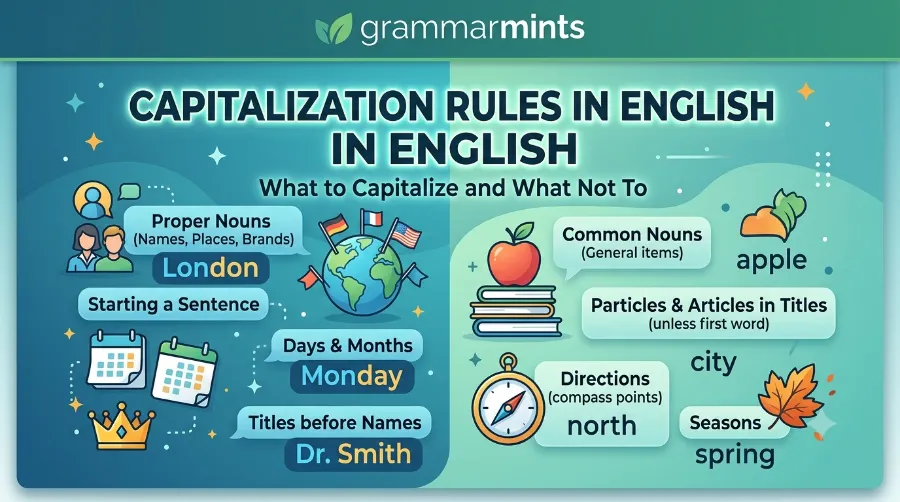
TL;DR: The capitalization rules in English come down to three groups: sentence starters, proper nouns, and the pronoun “I.” Everything else, including seasons, generic job titles, and most words after a colon, usually stays lowercase. Once you know these three groups, nearly every capital-letter decision becomes automatic.
To get a better understanding of how common punctuation mistakes exactly what to expect.
learn semicolon vs colon tips and expert advice
Capital letters look small, but they carry a lot of weight. A single misplaced uppercase letter can make a resume look careless or a marketing email look unpolished. Because of this, learning the capitalization rules in english is one of the fastest ways to sharpen your everyday writing, whether you’re drafting a report in Chicago or finishing a university essay in Manchester.
If you want to learn quotation marks rules tips and expert advice.
This guide walks through the standard rules, the exceptions that trip people up, and the specific patterns used in headlines and titles. Along the way, you’ll find real examples, a few tables comparing style guides, and a short cheat sheet you can save for later. Nothing here is complicated; it’s simply organized so it finally makes sense.
learn about capitalization rules in english tips and expert advice.
Why Capitalization Rules in English Still Matter in 2026
Grammar might feel like a small detail, but readers notice it more than you’d expect. According to Grammarly’s Business Communication research, workplace miscommunication costs U.S. companies close to $1.2 trillion every year, and small errors like inconsistent capitalization are part of that pattern. In addition, a Linguix-backed survey found that 68% of consumers say they’re less likely to buy from a brand whose writing contains grammar or spelling mistakes.
If you want to learn about hyphen vs dash tips and expert advice.
That’s not just a marketing problem. A 2024 BusinessNewsDaily survey reported that nearly 80% of hiring managers would skip a candidate whose resume had a spelling or capitalization slip. Meanwhile, 93% of professionals admit they’ve sent a work email with an error in it. So although capitalization feels minor in the moment, it quietly shapes how people judge your writing, your brand, and even your job application.
If you want to learn about punctuation in lists tips and expert advice.
For a fuller picture of how these small choices connect to the bigger picture of English mechanics, our punctuation rules in English guide is a useful companion piece to this one.
The Core Capitalization Rules List
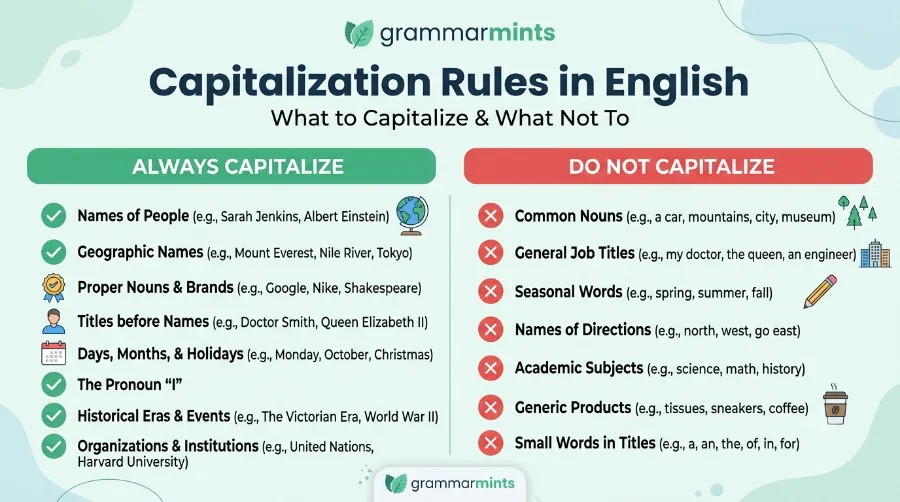
Before getting into exceptions, it helps to see the whole picture at once. Below is a simple capitalization rules list that covers roughly 90% of everyday writing situations.
- First word of every sentence: “The meeting starts at 9 a.m.”
- The pronoun “I”: always capitalized, no matter where it sits in a sentence.
- Proper nouns: specific people, places, and things, such as “Sarah,” “Paris,” or “Microsoft.”
- Days, months, and holidays: “Monday,” “October,” “Thanksgiving.” Seasons, however, stay lowercase.
- Nationalities and languages: “French,” “Japanese,” “American.”
- Titles used directly before a name: “President Biden,” but “the president spoke.”
- The first word of a direct quotation: “She said, ‘Turn left at the corner.'”
- Titles of books, films, and articles: following title case rules, which we’ll cover shortly.
Once these eight patterns feel automatic, capitalization stops being a guessing game. Still, a few tricky situations deserve closer attention, since they’re where most writers slip up.
Proper Nouns vs. Common Nouns
This is where confusion usually starts. A proper noun names something specific, such as “the Mississippi River,” while a common noun names a category, such as “a river.” For example, “I study biology at Boston University” capitalizes the university’s full name but leaves “biology” lowercase, because it’s a general subject, not a specific course title.
learn about parentheses and brackets rules tips and expert advice.
Job titles follow the same logic. “The marketing director approved the budget” stays lowercase because it’s describing a role in general. However, “Marketing Director Elena Cruz approved the budget” capitalizes it, since the title sits directly before the name and functions like part of it.
Punctuation and What to Capitalize After It
People often wonder what to capitalize after a colon or semicolon, and the honest answer is that it depends on the sentence. If a colon introduces a single word or a phrase, the next word usually stays lowercase. But if it introduces a complete, independent sentence, most American style guides recommend capitalizing the first word.
For a closer look at how colons and semicolons behave differently in a sentence, our semicolon vs. colon guide breaks this down step by step. Commas, meanwhile, almost never trigger a capital letter unless they’re followed by a proper noun, a topic our comma rules in English guide covers in more detail.
When to Capitalize: Everyday Situations People Get Wrong
Knowing when to capitalize a word gets easier once you separate it from habit. Many writers over-capitalize out of instinct, especially in business emails, because bold-sounding words feel like they deserve extra emphasis. They don’t.
Here are common situations, sorted by what actually happens in professional and academic writing:
- Family titles: capitalize only when used as a name substitute, as in “I called Mom” versus “I called my mom.”
- Compass directions: lowercase for direction, as in “drive west,” but capitalized for a region, as in “the West Coast.”
- Seasons: always lowercase unless part of a formal event name, such as “Spring Festival.”
- Internal company terms: product features, department nicknames, and internal program names generally stay lowercase unless they’re trademarked.
- Academic subjects: lowercase unless it’s a specific course name or a language, as in “I’m studying history,” but “I’m taking History 201.”
A real-world example makes this concrete. In late 2024, several style guides updated their references after the Associated Press announced it was adopting Merriam-Webster as its official dictionary for the first time in decades. That single decision affected how thousands of newsrooms and PR teams across the United States handled capitalization edge cases going forward, showing just how much these small rules ripple outward.
Title Case Rules for Headlines and Blog Titles
If sentence capitalization is the everyday layer, title case rules are the specialized layer used for headlines, book titles, and blog posts. Title case means capitalizing the important words in a title while keeping small connecting words lowercase.
Generally, you capitalize:
- Nouns, pronouns, verbs, adjectives, and adverbs
- The first and last word of the title, no matter what part of speech they are
- Words with four or more letters, in most style guides
You typically lowercase:
- Articles (a, an, the)
- Coordinating conjunctions (and, but, or)
- Short prepositions (in, on, at, of, to)
For instance, “How to Improve Your Writing Skills” follows title case correctly, while “How To Improve your Writing Skills” mixes the rules and looks inconsistent to a trained eye. This distinction matters even more in technical writing, where headings are often scanned quickly rather than read word for word, a point that ClickHelp’s guide to capitalization for user guide titles explains well for documentation teams.
Comparing Major Style Guides
Because style guides don’t always agree, here’s how four of the most common ones handle title case:
| Style Guide | Capitalize Prepositions? | Capitalize “To” in Infinitives? | Common Use Case |
|---|---|---|---|
| AP Style | Only if 4+ letters | No | News, PR, marketing |
| Chicago Manual of Style | Only if used adverbially | No | Publishing, books |
| APA Style | Words of 4+ letters | Yes | Academic papers |
| MLA Style | Rarely | No | Humanities essays |
Interestingly, at the 2024 ACES conference, editors from the Chicago Manual of Style confirmed that the term long known as “headline style” was being renamed “title case” in the upcoming edition, aligning its terminology with how most digital tools already describe it. If you’re formatting a title and want a quick way to check it against multiple guides at once, a tool like headline capitalization checkers or Capitalize My Title can save time, since manually cross-checking four different guides for every headline isn’t realistic for most writers.
A Quick Look at the Data
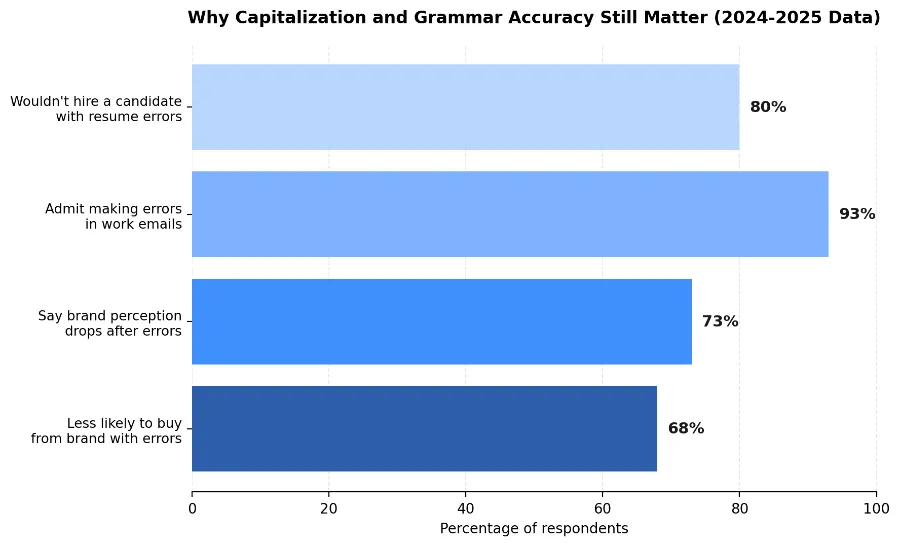
Because so much of this comes down to reader perception, it helps to see the numbers side by side rather than take it on faith.
Chart summary: 68% of consumers say they’re less likely to buy from a brand with errors, 73% say brand perception drops after errors, 93% admit making errors in work emails, and 80% wouldn’t hire a candidate with resume errors.
As the chart shows, the cost of inconsistency isn’t hypothetical. It shows up in hiring decisions, purchase decisions, and everyday brand trust, which is exactly why editorial teams keep investing in style consistency even as writing volume increases across every industry.
Real Examples From Everyday Writing
Sometimes the rule makes more sense with a concrete case attached to it. Here are a few situations pulled from real writing patterns seen in newsrooms, offices, and classrooms over the past two years.
- In March 2024, a press release template circulated by several PR firms reminded writers that dateline cities, like “AUSTIN, Texas,” are written in full caps, while the phrase “press release” itself stays lowercase in running text.
- A 2025 style memo from a mid-sized publishing house noted that “internet” and “web” no longer need capital letters, a shift that most major style guides completed years earlier but some in-house teams were still catching up on.
- A university writing center flagged that students frequently capitalize “professor” even when it’s not directly before a name, such as writing “I emailed my Professor” instead of the correct “I emailed my professor.”
These aren’t rare mistakes. They’re the same three or four patterns repeating across different writers, which is exactly why a short reference list saves so much editing time later.
A Simple Capitalization Rules in English Cheat Sheet
To bring everything together, here’s a condensed version you can glance at while writing:
- Capitalize the first word of every sentence and every direct quotation.
- Always capitalize “I,” regardless of position.
- Capitalize specific names of people, places, brands, and organizations.
- Capitalize days, months, and holidays, but not seasons.
- Capitalize titles only when they sit directly before a name.
- Use title case for headlines, keeping short connecting words lowercase.
- When unsure, check a dictionary or a trusted style guide rather than guessing.
This is essentially the full set of capitalization rules in english that most professional writers rely on daily, whether they’re writing for a U.S. audience or a UK one, since the core logic barely changes across English dialects.
Frequently Asked Questions
Do British and American English follow different capitalization rules?
Mostly no. The core rules, like capitalizing proper nouns and sentence starters, are identical. The small differences usually involve formatting choices in titles, not the underlying grammar.
Should job titles always be capitalized?
No. Capitalize them only when they appear directly before someone’s name, such as “Director Smith.” In general references, like “the director,” keep it lowercase.
Is it correct to capitalize words after a colon?
It depends on what follows. If a full, independent sentence follows the colon, capitalize it. If it’s just a phrase or list, lowercase is usually correct.
What about capitalizing words for emphasis, like in emails?
Style guides generally discourage this. Using capital letters for emphasis, instead of italics or bold, tends to read as shouting rather than emphasis.
Are there tools that check capitalization automatically?
Yes. Several online title-case converters can check a headline against AP, APA, MLA, or Chicago rules within seconds, which is especially handy for teams publishing frequent content.
Conclusion
Capitalization rules aren’t as intimidating as they first appear once they’re broken into small, repeatable patterns. Sentence starters, proper nouns, and the word “I” cover most situations, while title case rules handle the rest for headlines and titles. With a bit of practice and a reliable reference nearby, these small decisions stop feeling like guesswork and start feeling automatic, which is exactly what confident, professional writing depends on. For more grammar fundamentals that pair naturally with this topic, feel free to explore additional guides on GrammarMints.
References
- Grammarly Business. The 2024 State of Business Communication Report. (2024)
- Embryo. The Power of Grammarly + Usage Stats. (2025)
- BusinessNewsDaily. Spelling and Grammar Are Still Important at Work. (2024)
- PBJ Stories. Should a Press Release Be Capitalized? AP Style Guide. (2026)
- Erin Brenner’s Editing Blog. Making Sense of Title Style Rules. (2024)
- ClickHelp. Capitalization Rules for User Guide Titles.
- Headline Capitalization. Blog Post Title Capitalization Guide.
- Capitalize My Title. AP Style Title Capitalization Tool.