
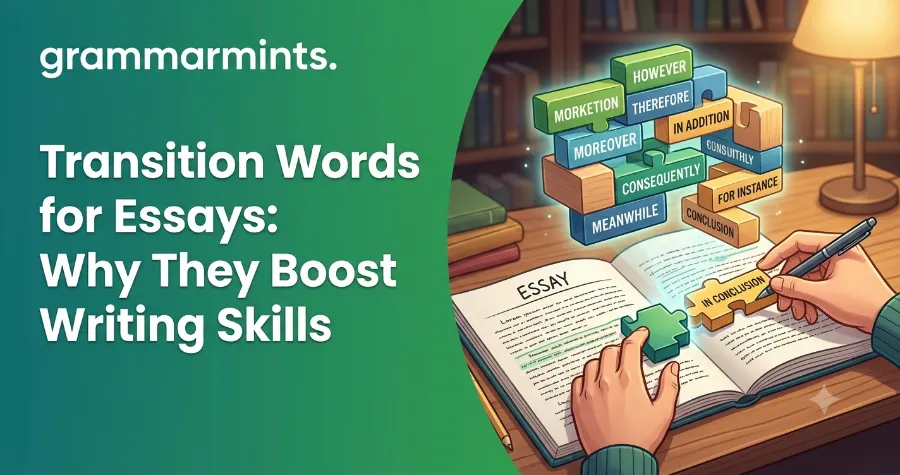
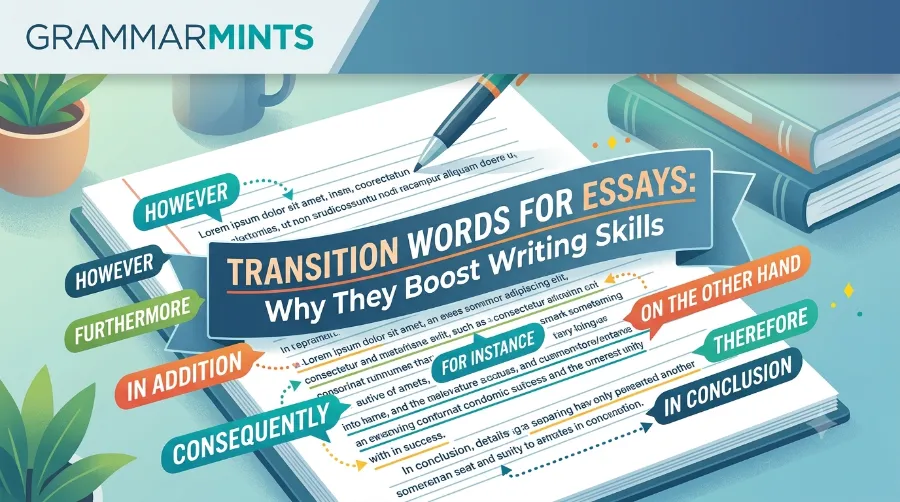
Writing an essay is more than putting ideas on paper. Readers need to understand how one idea connects to the next. That is where transition words for essays become important. These simple words and phrases guide readers through your writing, improve the flow of ideas, and make your arguments easier to follow.
Whether you are writing a school assignment, college essay, research paper, or business report, transition words help your writing sound clear and professional. They also improve readability because every paragraph connects naturally with the next one.
In this guide, you will learn what transition words are, why they matter, how to use them correctly, and which ones work best in different types of essays. You will also find practical examples, tables, and expert writing tips that you can apply immediately.
What Are Transition Words?
Transition words are words or phrases that connect ideas, sentences, and paragraphs. They act like bridges between thoughts, making your writing smooth instead of choppy.
For example:
Without transition words:
I studied for three hours. I failed the test.
With transition words:
I studied for three hours. However, I failed the test.
The second example explains the relationship between the two ideas much more clearly.
Why Writers Use Transition Words
Good writers use transition words because they:
- Improve the flow of ideas
- Connect paragraphs naturally
- Show relationships between points
- Make essays easier to understand
- Strengthen arguments
- Increase readability
- Help readers stay engaged
According to many university writing centers, including the Purdue Online Writing Lab (OWL) and the University of North Carolina Writing Center, transition words improve organization and make academic writing easier to follow.
External Resources
- Purdue OWL: https://owl.purdue.edu/
- UNC Writing Center: https://writingcenter.unc.edu/
Why Transition Words Matter in Essay Writing
Imagine reading a book where every sentence starts a completely new idea. The writing would feel confusing and difficult to follow.
Transition words solve this problem by showing readers how ideas relate to each other.
They can show:
| Relationship | Example Transition |
|---|---|
| Addition | furthermore, moreover, also |
| Contrast | however, although, instead |
| Cause | because, therefore, since |
| Result | consequently, thus, as a result |
| Example | for example, for instance |
| Time | meanwhile, afterward, eventually |
| Comparison | similarly, likewise |
| Conclusion | finally, in conclusion |
Each category helps readers understand exactly what comes next.
Benefits of Using Transition Words
Using transition words correctly offers several advantages.
Better Organization
Readers can follow your ideas without getting lost. Every paragraph connects smoothly with the previous one.
Higher Readability
Clear writing encourages readers to continue reading. As a result, your essays become more enjoyable.
Stronger Arguments
Transitions show how evidence supports your claims. Therefore, your arguments appear more logical and convincing.
Improved Academic Performance
Teachers often reward essays that are organized and coherent. Although grammar and vocabulary remain important, logical flow also plays a major role.
Better Professional Writing
Reports, emails, proposals, and business documents all benefit from effective transitions.
Types of Transition Words for Essays
Different situations require different transition words.
1. Addition
Use these when adding information.
Examples:
- Also
- Furthermore
- Moreover
- Besides
- In addition
- Additionally
Example:
The study included 500 participants. Furthermore, researchers followed them for five years.
2. Contrast
Use these when showing differences.
Examples:
- However
- Nevertheless
- Although
- On the other hand
- Yet
- Instead
Example:
Most students preferred online learning. However, many still valued classroom discussions.
3. Cause and Effect
These explain reasons and results.
Examples:
- Therefore
- Consequently
- Thus
- Because
- As a result
- Hence
Example:
The company improved customer service. As a result, sales increased by 18% in 2025.
4. Comparison
Use comparison transitions when discussing similarities.
Examples:
- Likewise
- Similarly
- In the same way
- Equally
Example:
Reading improves vocabulary. Likewise, regular writing strengthens grammar skills.
5. Sequence
These show order.
Examples:
- First
- Next
- Then
- Afterward
- Finally
- Meanwhile
Example:
- Choose a topic.
- Next, research reliable sources.
- Then, create an outline.
- Finally, write your first draft.
Common Transition Words Every Student Should Know
The following table lists useful transition words for everyday essay writing.
| Purpose | Transition Words |
|---|---|
| Adding Ideas | also, moreover, besides, furthermore |
| Giving Examples | for example, for instance, namely |
| Showing Contrast | however, although, instead, nevertheless |
| Explaining Cause | because, therefore, consequently |
| Showing Time | meanwhile, afterward, eventually |
| Summarizing | in conclusion, overall, finally |
Keeping this table nearby while writing can help you choose the right transition quickly.
Real-Life Example
Imagine two students writing the same essay.
Student A
Climate change affects farming. Rainfall patterns have changed. Farmers struggle. Food prices increase.
Student B
Climate change affects farming. As a result, rainfall patterns have changed. Consequently, many farmers struggle to grow crops. Therefore, food prices continue to rise.
Although both students share the same facts, the second essay is much easier to read because transition words clearly connect each idea.
Quick Tips
- Choose transitions that match the relationship between ideas.
- Avoid repeating the same word too often.
- Read your essay aloud to check the flow.
- Use simple transitions before trying advanced ones.
- Revise your work to remove unnecessary transitions.
Internal Links
- /related-guide/how-to-write-an-essay
- /related-guide/paragraph-writing-guide
- /related-guide/common-grammar-mistakes
How to Use Transition Words in Essays
Knowing many transition words is helpful. However, using them correctly is even more important. A well-placed transition makes your writing easier to understand, while an unnecessary one can interrupt the flow.
Follow these simple steps to use transition words naturally.
1. Identify the Relationship Between Ideas
Before choosing a transition, ask yourself how your next sentence relates to the previous one.
| Relationship | Best Transition Words |
|---|---|
| Add information | also, furthermore, moreover, besides |
| Show contrast | however, although, on the other hand |
| Explain a reason | because, since, as |
| Show a result | therefore, thus, consequently |
| Give an example | for example, for instance |
| Compare ideas | similarly, likewise |
| End a discussion | finally, in conclusion |
For example:
❌ The experiment failed. The researchers continued.
✅ The experiment failed. Nevertheless, the researchers continued.
The second version clearly explains the relationship.
Where Should You Place Transition Words?
Many writers believe transition words only belong at the beginning of a sentence. In reality, they can appear in different positions.
At the Beginning
First, gather your research.
In the Middle
The results, however, were unexpected.
Between Paragraphs
When starting a new paragraph, transition words help connect your previous idea with the next one.
Transition Words for Different Essay Types
Every essay has a different purpose. Therefore, the transitions you use should match your writing style.
Argumentative Essays
Useful words include:
- however
- therefore
- although
- consequently
- nevertheless
- indeed
Example:
Some people oppose renewable energy. However, research shows it reduces carbon emissions over time.
Compare and Contrast Essays
Useful transitions include:
- similarly
- likewise
- on the other hand
- in contrast
- whereas
- compared with
Example:
Public transportation reduces pollution. Similarly, cycling helps lower carbon emissions.
Narrative Essays
Sequence words work best.
Examples:
- first
- next
- afterward
- meanwhile
- eventually
- finally
Example:
Afterward, we reached the mountain summit before sunset.
Expository Essays
Use transitions that explain ideas clearly.
Examples:
- for example
- in addition
- because
- therefore
- consequently
Example:
Plants need sunlight. For example, indoor plants often grow slowly without enough natural light.
Most Common Transition Words Students Use
The following table contains popular transition words used in schools and universities.
| Purpose | Examples |
|---|---|
| Addition | also, besides, furthermore, moreover |
| Contrast | however, yet, nevertheless, although |
| Cause | because, since, due to |
| Result | therefore, consequently, thus |
| Example | for example, for instance, namely |
| Sequence | first, next, then, finally |
| Emphasis | indeed, certainly, above all |
| Conclusion | overall, in conclusion, to summarize |
Transition Words to Avoid Overusing
Although transition words improve readability, using the same one repeatedly can make your writing sound repetitive.
Instead of writing:
- However
- However
- However
Try varying your language.
| Instead of | Try These |
|---|---|
| However | nevertheless, yet, still |
| Also | additionally, furthermore, besides |
| Therefore | consequently, thus, as a result |
| For example | for instance, namely |
Using different transitions keeps your writing fresh.
Common Mistakes When Using Transition Words
Many students make small mistakes that reduce clarity.
Using the Wrong Transition
Incorrect:
I enjoy science. Therefore, I like reading novels.
Correct:
I enjoy science. In addition, I like reading novels.
Adding Too Many Transitions
Incorrect:
First, moreover, therefore, finally, I completed my assignment.
Correct:
First, I gathered information. Then, I wrote the outline. Finally, I completed the assignment.
Forgetting Paragraph Connections
Every paragraph should naturally connect with the next.
Instead of suddenly introducing a new topic, use transitions like:
- Furthermore
- Meanwhile
- On the other hand
- Similarly
- As a result
Before and After Example
Without Transition Words
Exercise improves health. It reduces stress. It strengthens muscles. People feel happier.
With Transition Words
Exercise improves health. In addition, it reduces stress. Moreover, it strengthens muscles. As a result, many people feel happier.
The second paragraph feels smoother because every idea connects logically.
Expert Tips for Better Essays
Professional editors recommend these habits:
- Read your essay aloud to hear awkward transitions.
- Replace repeated transition words with synonyms.
- Use only one transition when it clearly explains the relationship.
- Keep sentences short and direct.
- Revise your essay after finishing the first draft.
- Ask someone else to read your work.
- Focus on clarity instead of using advanced vocabulary.
Research Highlights
Several university writing centers agree that organized writing helps readers understand complex ideas more quickly.
The table below summarizes findings from widely used academic writing resources.
| Writing Practice | Benefit |
|---|---|
| Logical transitions | Better paragraph flow |
| Clear organization | Easier reading experience |
| Connected ideas | Stronger arguments |
| Consistent structure | Improved comprehension |
| Short paragraphs | Higher readability |
Sources include:
- Purdue Online Writing Lab (OWL)
- University of North Carolina Writing Center
- Harvard College Writing Center
Transition Words by Frequency of Use
| Level | Examples |
|---|---|
| Beginner | also, but, because, then |
| Intermediate | furthermore, however, therefore, similarly |
| Advanced | nonetheless, conversely, accordingly, notwithstanding |
Beginners should master simple transitions first. As their writing improves, they can gradually introduce more advanced expressions.
Essay Writing Checklist
Before submitting your essay, check the following:
- Use transitions naturally.
- Avoid repeating the same transition.
- Connect every paragraph.
- Keep sentences clear and concise.
- Support claims with examples.
- Proofread for grammar and punctuation.
- Read the essay from start to finish to ensure smooth flow.
Conclusion
Transition words may seem small, but they make a significant difference in essay writing. They connect ideas, strengthen arguments, and help readers move smoothly from one point to another. Whether you are writing a classroom assignment, a college paper, or a professional report, the right transitions improve both clarity and readability.
Start with simple transition words, practice using them naturally, and revise your work carefully. Over time, your writing will become more organized, engaging, and persuasive. Remember that the goal is not to use more transition words but to choose the right ones in the right places.
References
- Purdue Online Writing Lab (OWL): https://owl.purdue.edu/
- University of North Carolina Writing Center: https://writingcenter.unc.edu/
- Harvard College Writing Center: https://writingcenter.fas.harvard.edu/
- APA Style: https://apastyle.apa.org/
Related Articles
- /related-guide/how-to-write-an-essay
- /related-guide/paragraph-writing-guide
- /related-guide/common-grammar-mistakes
Author Bio
Dr. Emily Carter is a professional English language educator and academic writing specialist with more than 18 years of experience teaching grammar, composition, and research writing. She has helped thousands of students and professionals improve their writing through practical, easy-to-follow guidance focused on clarity, structure, and effective communication.