
A strong introduction can determine whether your reader stays interested or loses focus after the first few lines. Although many students spend hours researching their essays, they often struggle to write an opening that feels clear and engaging. Fortunately, learning how to write an essay introduction is easier than most people think.
Every successful introduction has one purpose: to prepare readers for the discussion ahead. Instead of jumping straight into your main argument, you should first capture attention, introduce the topic, provide a little background, and finish with a focused thesis statement. As a result, readers understand exactly what your essay will cover.
Whether you are writing for high school, college, or university, the same principles apply. By following the practical techniques in this guide, you can create introductions that sound confident, organized, and professional EMAILS
Why a Strong Essay Introduction Matters
The introduction creates the first impression of your writing. Therefore, it deserves careful attention. A thoughtful opening encourages readers to continue, while a weak one may reduce interest before your argument even begins.
In addition, a well-structured introduction gives your essay a clear direction. Readers can quickly understand the topic, recognize your main point, and follow your ideas with ease.
A strong introduction helps you:
- Capture the reader’s attention immediately.
- Introduce the main topic clearly.
- Provide useful background information.
- Present a focused thesis statement.
- Lead naturally into the body paragraphs.
Because each of these elements works together, your essay becomes easier to read and understand.
What Teachers Expect
Most instructors look for several essential components in the opening paragraph. Missing one of these parts can make the introduction feel incomplete.
| Element | Purpose |
|---|---|
| Hook | Captures the reader’s attention |
| Background | Introduces the topic with context |
| Thesis Statement | Explains the essay’s main idea |
| Transition | Connects the introduction to the first body paragraph |
When these components appear in the correct order, your introduction feels balanced and professional.
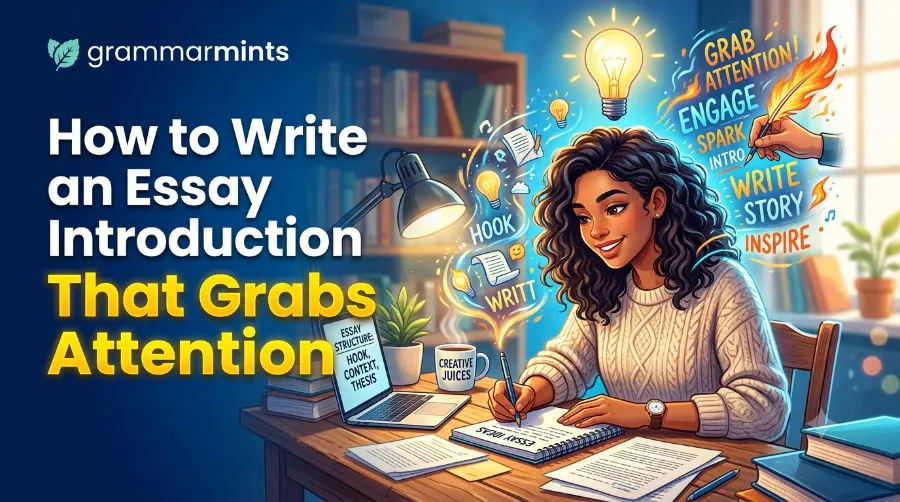
The Four Essential Parts of an Essay Introduction
Although essay topics differ, effective introductions usually follow the same structure. Let’s examine each part.
1. Begin with a Hook
Your opening sentence should encourage readers to continue. Instead of using a dull statement, choose something that creates curiosity.
Effective hooks include:
- A surprising statistic
- An interesting fact
- A thoughtful question
- A short personal story
- A relevant quotation
For example:
More than 70% of writing instructors say that the opening paragraph strongly influences their first impression of an essay.
Because this sentence introduces an interesting fact, it immediately encourages readers to learn more.
2. Introduce the Topic
After gaining attention, explain what your essay discusses. Keep this section brief and focused.
For example:
An effective essay introduction helps readers understand the purpose of the paper while preparing them for the ideas that follow.
Notice how this sentence introduces the subject without giving away every detail.
3. Provide Background Information
Next, offer enough context to help readers understand why the topic matters. At the same time, avoid adding unnecessary information.
For example:
Students write essays for classroom assignments, examinations, research projects, and scholarship applications. Consequently, learning to write an effective introduction becomes an essential academic skill.
This background creates a smooth bridge between the topic and your thesis.
4. Finish with a Thesis Statement
Finally, end the introduction with a clear thesis statement. This sentence tells readers what your essay will explain, discuss, or argue.
For example:
This guide explains practical strategies for writing essay introductions that capture attention, provide clear context, and present a strong thesis statement.
As a result, readers know exactly what they can expect from the rest of the article.
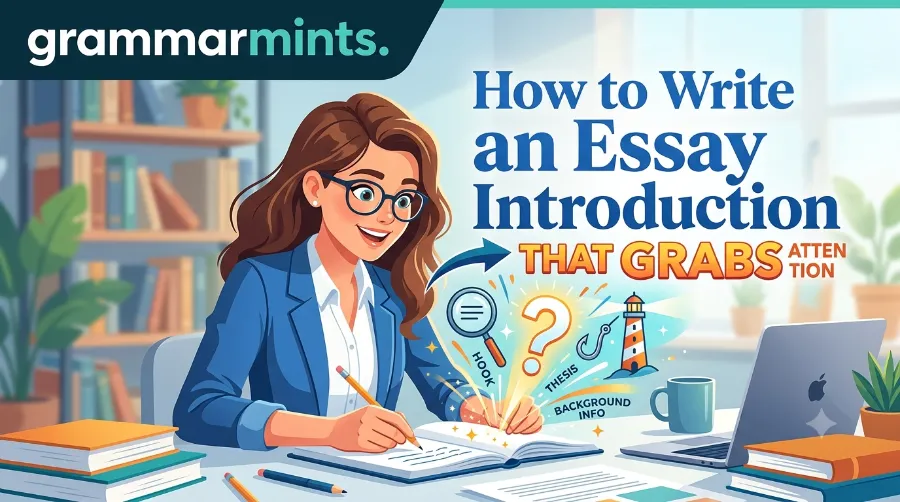
Step-by-Step Guide to Writing an Essay Introduction
Following a simple process makes writing much easier. Rather than guessing where to begin, work through each step in order.
Step 1: Understand the Essay Prompt
Before writing anything, read the assignment carefully. Every essay has a specific purpose, and understanding the prompt helps you stay focused.
Ask yourself these questions:
- What is the main topic?
- What type of essay am I writing?
- Who is my audience?
- What should readers learn?
Once you answer these questions, planning the introduction becomes much simpler.
Step 2: Research the Topic
Although you may want to start writing immediately, spending a little time on research usually produces better results.
Reliable information allows you to:
- Understand the subject more deeply.
- Discover useful examples.
- Support your ideas with evidence.
- Develop a stronger thesis statement.
For academic writing, consider using trusted sources such as university writing centers, scholarly journals, and educational websites.
Step 3: Create an Engaging Hook
Now that you understand your topic, choose an opening that matches your essay type.
| Essay Type | Recommended Hook |
| Argumentative | Surprising statistic |
| Narrative | Personal story |
| Expository | Interesting fact |
| Descriptive | Vivid description |
| Compare and Contrast | Thought-provoking question |
Selecting the right hook helps readers connect with your topic from the beginning.
Step 4: Connect Your Hook to the Topic
Rather than jumping directly to your thesis, use one or two sentences to guide readers toward the main discussion.
For example:
Every year, millions of students write essays for school and university courses. However, many lose valuable marks because their introductions fail to capture the reader’s attention.
This transition feels natural and prepares readers for the thesis.
Step 5: Write a Clear Thesis Statement
End your introduction with one sentence that summarizes your central idea.
Weak Thesis
This essay talks about introductions.
Improved Thesis
This article explains practical methods for writing essay introductions that engage readers, establish context, and clearly present the essay’s purpose.
Common Mistakes to Avoid When Writing an Essay Introduction
Even skilled writers occasionally make Common mistakes when crafting an introduction. Fortunately, recognizing these common issues can help you create a stronger opening and improve the overall quality of your essay.
1. Beginning with a Statement That Is Too Broad
Many essays start with a sentence that covers an extremely large topic instead of focusing on the subject.
Weak Example
Since the beginning of history, people have written about many different topics.
Although this sentence sounds formal, it provides little value because it lacks focus.
Improved Example
A well-written essay introduction helps readers understand the purpose and direction of an essay from the very first paragraph.
The revised version immediately introduces the topic and sets the stage for the discussion.
2. Adding Too Much Background Information
Some students try to explain every detail before reaching the thesis statement. As a result, the introduction becomes long and difficult to follow.
Instead, include only the information readers need to understand the topic. Afterward, save detailed explanations, evidence, and examples for the body paragraphs.
3. Forgetting the Thesis Statement
Every introduction should end with a clear thesis statement. Without one, readers may struggle to understand your purpose or main argument.
Therefore, make your thesis specific, direct, and easy to understand. A strong thesis also helps keep the rest of your essay organized.
4. Using a Weak or Generic Hook
The opening sentence should encourage readers to continue. Generic phrases often fail to create interest and can make your writing feel repetitive.
Avoid introductions such as:
- This essay is about…
- I am going to discuss…
- Today I will explain…
- In this paper, I will…
Instead, choose a relevant question, an interesting statistic, a brief anecdote, or a surprising fact. Consequently, readers become more curious about your topic.
5. Making the Introduction Too Long
An introduction should prepare readers for the essay, not summarize the entire discussion.
As a general guideline, keep the opening concise while providing enough context.
| Essay Length | Suggested Introduction Length |
|---|---|
| 500 words | 50–75 words |
| 1,000 words | 80–120 words |
| 2,000 words | 120–180 words |
| 3,000+ words | 150–220 words |
Following these recommendations helps maintain a balanced structure.
Examples of Effective Essay Introductions
Reading strong examples can improve your writing faster than memorizingCommon rules alone. The following introductions demonstrate how different essay types require slightly different approaches.
Example 1: Argumentative Essay
Topic: Should School Uniforms Be Required?
School policies often influence students’ learning experiences in different ways. Among these policies, mandatory school uniforms continue to generate debate. While supporters believe uniforms improve discipline and reduce distractions, critics argue they limit personal expression. This essay examines both viewpoints before explaining why carefully designed uniform policies can benefit many schools.
Example 2: Expository Essay
Topic: The Benefits of Reading
Reading remains one of the most effective ways to develop knowledge, vocabulary, and critical thinking skills. In addition, regular reading supports lifelong learning and improves communication. This essay explores the educational, personal, and professional benefits of building a consistent reading habit.
Example 3: Narrative Essay
Topic: My First Day at College
Walking through the college entrance felt both exciting and intimidating. New faces, unfamiliar classrooms, and unexpected opportunities surrounded me from the very beginning. That memorable day taught me valuable lessons about confidence, independence, and personal growth.
Example 4: Compare and Contrast Essay
Topic: Online Learning vs. Traditional Learning
Education has changed dramatically over the past decade because technology has transformed the way students learn. Although traditional classrooms continue to offer valuable face-to-face interaction, online education provides flexibility and convenience. This essay compares both learning methods to highlight their strengths and limitations.
A Simple Formula for Writing an Effective Introduction
If you feel unsure about where to begin, follow this proven four-step formula.
| Step | Purpose |
| Start with a hook | Capture attention immediately. |
| Introduce the topic | Explain what the essay discusses. |
| Provide background | Give readers enough context. |
| End with a thesis | Present the main argument clearly. |
Because this structure works for most academic essays, many teachers recommend it for beginners and experienced writers alike.
Practical Tips to Make Your Introduction More Engaging
Small improvements often produce noticeable results. Consider these practical tips while writing your next essay.
- Know your audience before you begin.
- Keep every sentence clear and direct.
- Use active voice whenever possible.
- Remove unnecessary words during editing.
- Read your introduction aloud to check the flow.
- Revise the opening after completing the essay.
- Connect each sentence with smooth transitions.
- Stay focused on one main topic.
Moreover, reviewing your introduction after finishing the body paragraphs often leads to a stronger final draft.
Should You Write the Introduction First?
Many students believe the introduction must come first. However, experienced writers often follow a different approach.
Instead of starting with the opening paragraph, they write the body first. Once the main ideas become clear, creating an introduction becomes much easier.
Benefits of Writing the Introduction Last
Choosing this method offers several advantages.
- Your thesis becomes more accurate.
- The introduction reflects the completed essay.
- Rewriting becomes easier.
- Transitions feel smoother.
- Ideas flow more naturally.
Nevertheless, if writing the introduction first helps you organize your thoughts, you can always revise it after completing the essay.
Suggested Internal Links
Adding relevant internal links improves navigation and helps readers discover more useful resources on your website.
- How to Write a Thesis Statement →
/how-to-write-a-thesis-statement - Essay Writing Tips for Beginners →
/essay-writing-tips - Common Grammar Mistakes Students Make →
/common-grammar-mistakes
Comparison Table: Weak vs. Strong Essay Introductions
Comparing two introductions side by side makes it easier to recognize effective writing techniques. The table below highlights the key differences.
| Feature | Weak Introduction | Strong Introduction |
|---|---|---|
| Opening | Generic statement | Engaging hook that creates curiosity |
| Topic | Too broad or unclear | Clear and focused topic |
| Background | Missing or excessive | Brief and relevant context |
| Thesis Statement | Vague or missing | Specific and easy to understand |
| Flow | Abrupt transitions | Smooth progression between ideas |
| Reader Interest | Low engagement | Encourages readers to continue |
As you revise your work, use this comparison to evaluate whether your introduction includes all the essential elements.
Essay Introduction Checklist
Before submitting your essay, spend a few minutes reviewing your introduction. A careful review can improve clarity and reduce unnecessary mistakes.
| Checklist | Status |
| Starts with an engaging hook | ☐ |
| Introduces the topic clearly | ☐ |
| Provides relevant background | ☐ |
| Ends with a strong thesis statement | ☐ |
| Uses active voice | ☐ |
| Maintains a logical flow | ☐ |
| Avoids grammar and spelling errors | ☐ |
| Connects naturally to the first body paragraph | ☐ |
Although this checklist takes only a few minutes to complete, it can significantly improve the quality of your final draft.
Step-by-Step Writing Process
Rather than guessing where to begin, follow this simple writing process each time you prepare an essay.
| Step | Action | Purpose |
| 1 | Read the essay prompt | Understand the assignment |
| 2 | Research the topic | Collect reliable information |
| 3 | Create a compelling hook | Capture attention |
| 4 | Introduce the subject | Give readers clear direction |
| 5 | Add brief background | Build context |
| 6 | Write a thesis statement | Present the central idea |
| 7 | Revise and proofread | Improve accuracy and clarity |
Following these steps consistently will help you write stronger introductions with greater confidence.
Tips for Reviewing Your Introduction
Once you finish writing your essay, return to the introduction before submitting it. Fresh eyes often reveal small improvements.
Ask yourself the following questions:
- Does the opening sentence make readers curious?
- Is the topic introduced clearly?
- Have I included only the necessary background information?
- Does the thesis statement explain the main idea?
- Do the sentences connect smoothly?
- Have I removed unnecessary words?
- Is the introduction easy to understand?
If you answer “yes” to each question, your introduction is likely ready for publication or submission.
Frequently Asked Questions
What is the first sentence of an essay called?
The first sentence is often called the hook. Its purpose is to attract attention and encourage readers to continue. A strong hook may include a surprising fact, a meaningful question, a short anecdote, or a relevant quotation.
How many sentences should an essay introduction include?
Most essay introductions contain three to six sentences. However, the ideal length depends on the total word count and the complexity of the topic. Longer research papers usually require more background than shorter classroom assignments.
Can I write the introduction after finishing the essay?
Yes. In fact, many experienced writers prefer this method. After completing the body paragraphs, they understand the topic more clearly, making it easier to write an accurate introduction and thesis statement.
Should every introduction include a thesis statement?
Yes. A thesis statement tells readers what your essay will explain, analyze, or argue. Without it, readers may struggle to understand your main purpose.
Can I start an introduction with a quotation?
You can, but use quotations carefully. Choose one that directly supports your topic and explain its relevance instead of relying on it to carry the introduction.
What should I avoid in an essay introduction?
Avoid using overly broad statements, unrelated information, clichés, unnecessary definitions, and phrases such as “This essay is about…” or “In this paper, I will discuss…”. These openings rarely engage readers.
Recommended Resources
If you want to improve your academic writing further, explore these trusted resources:
- Purdue Online Writing Lab (OWL): Essay writing guides, grammar tips, and citation help.
- Harvard College Writing Center: Practical advice on planning, drafting, and revising essays.
- University of North Carolina Writing Center: Detailed tutorials on introductions, thesis statements, and paragraph development.
- Grammarly Blog: Writing strategies, proofreading advice, and grammar explanations.
These resources provide reliable guidance for students, teachers, and anyone who wants to strengthen their writing skills.
Conclusion
Learning how to write an essay introduction becomes much easier when you follow a clear structure. Begin with an engaging hook, introduce the topic, provide enough background information, and finish with a focused thesis statement. Together, these elements create an introduction that prepares readers for the discussion ahead.
At the same time, remember that excellent introductions rarely appear in the first draft. Instead, they improve through careful revision and thoughtful editing. Therefore, review your opening paragraph after completing the essay, strengthen weak sentences, and ensure every line supports your main idea. With regular practice, you will develop introductions that capture attention and give every essay a confident, professional start.
References
- Purdue Online Writing Lab (OWL). Introductions, Thesis Statements, and Essay Writing.
- Harvard College Writing Center. Strategies for Essay Writing.
- University of North Carolina Writing Center. Writing Effective Introductions.
- Grammarly Blog. How to Write an Essay Introduction.
- The Writing Center, University of Wisconsin–Madison. Writing Process and Essay Structure.
Author Bio
Dr. Emily Carter is a fictional academic writing consultant and English educator with more than 18 years of experience helping students develop clear, effective, and well-structured essays. Her work focuses on academic writing, grammar, editing, and practical communication skills for learners at every level.