Writing clearly is one of the most valuable skills in school, business, blogging, and professional communication. One of the biggest factors that affects clarity is understanding active vs passive voice. Although both sentence structures are grammatically correct, they create different reading experiences.
Today, readers expect simple and direct content. Search engines also reward articles that are easy to understand. Therefore, knowing when to use active voice and when passive voice is appropriate can instantly improve your writing.
In this complete guide, you’ll learn the difference between active and passive voice, discover practical examples, explore common mistakes, and understand how professional writers use both styles effectively.
What Is Active Voice?
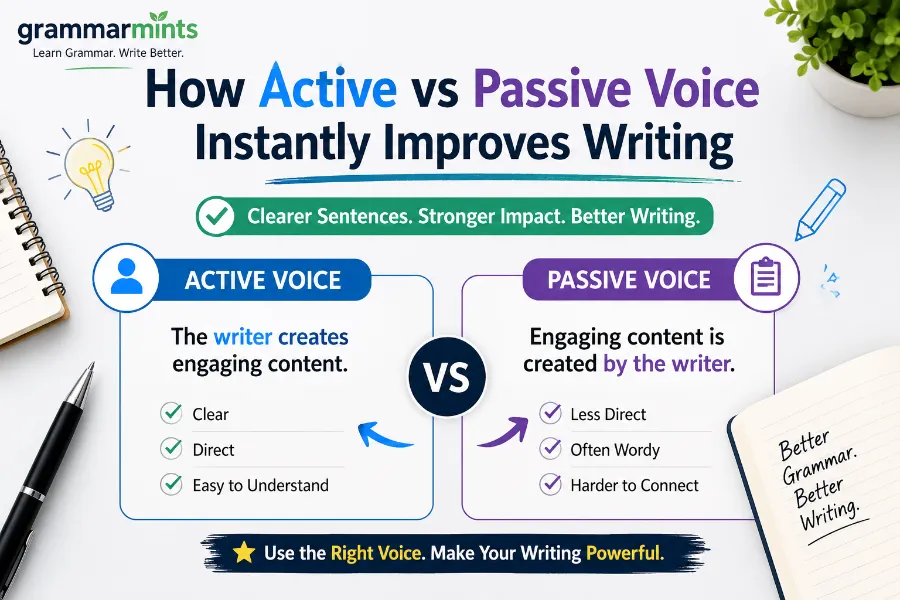
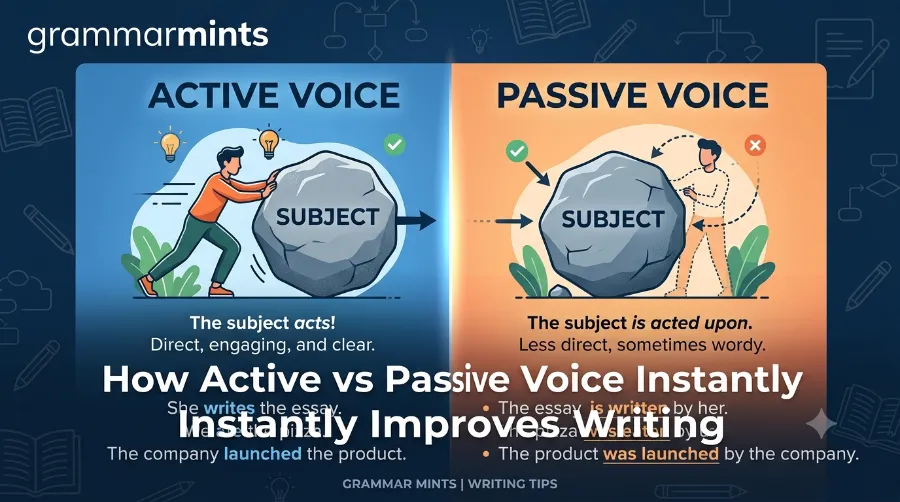
Active voice means the subject performs the action.
Formula
Subject + Verb + Object
Examples
- Sarah wrote the report.
- The teacher explained the lesson.
- Google updated its search algorithm.
- The company launched a new product.
Notice how every sentence clearly identifies who performs the action.
This structure makes writing:
- Easier to understand
- Faster to read
- More engaging
- More persuasive
Because of these advantages, active voice is recommended for most online writing.

What Is Passive Voice?
Passive voice changes the sentence structure. Instead of showing who performs the action first, it focuses on the object receiving the action.
Formula
Object + Be Verb + Past Participle + By + Subject
Examples
- The report was written by Sarah.
- The lesson was explained by the teacher.
- A new product was launched by the company.
Sometimes the person performing the action is omitted.
Example:
The building was completed in 2025.
Here, the builder isn’t mentioned.
Passive voice isn’t wrong. It simply serves a different purpose.
Active vs Passive Voice: Side-by-Side Comparison
| Feature | Active Voice | Passive Voice |
|---|---|---|
| Sentence focus | Subject | Object |
| Readability | Excellent | Moderate |
| Word count | Shorter | Longer |
| Clarity | High | Lower |
| SEO writing | Recommended | Limited |
| Business writing | Preferred | Sometimes useful |
| Academic writing | Frequently used | Often accepted |
Why Active Voice Improves Writing
Most successful blogs, newspapers, and websites rely heavily on active voice.
Here are the biggest reasons.
1. It Makes Sentences Clear
Readers instantly know who performed the action.
Example
Active:
Apple released a software update.
Passive:
A software update was released.
The active sentence answers more questions immediately.
2. It Improves Readability
Research consistently shows that shorter and more direct sentences reduce reading effort.
Example
Instead of
The decision was made by management.
Write
Management made the decision.
3. It Increases Reader Engagement
Active voice creates movement.
Readers stay interested because every sentence feels energetic.
Compare these:
Passive
The ball was kicked by John.
Active
John kicked the ball.
The second sentence feels stronger.
4. It Supports Better SEO
Although search engines do not rank pages simply because they use active voice, readable content generally provides a better user experience. Easy-to-read articles often improve engagement metrics such as time on page and readability scores.
Professional SEO writers usually aim to keep passive voice to a minimum.
When Passive Voice Is the Better Choice
Passive voice still has important uses.
Unknown Subject
Example
The painting was stolen last night.
Nobody knows who stole it.
Scientific Writing
Researchers often focus on the experiment rather than the researcher.
Example
The samples were collected during spring.
Formal Reports
Government and legal documents frequently use passive voice.
Example
The application was approved.
Diplomatic Communication
Passive voice softens criticism.
Instead of
You made a mistake.
Writers sometimes use
A mistake was made.
Real-Life Examples
News Headlines
Active
Scientists discover new deep-sea species.
Passive
New deep-sea species discovered.
Marketing
Active
Our software saves you hours every week.
Passive
Hours are saved every week.
The first sentence feels much stronger.
Business Emails
Active
I attached the invoice.
Passive
The invoice has been attached.
Both are correct.
However, active voice sounds warmer and more personal.
Common Mistakes
Mistake 1
Using passive voice too often.
Poor
The meeting was attended by several employees.
Better
Several employees attended the meeting.
Mistake 2
Adding unnecessary words.
Passive voice often increases sentence length.
Example
Passive
The report was completed by the manager yesterday.
Active
The manager completed the report yesterday.
Mistake 3
Hiding responsibility.
Instead of
Errors were made.
Write
We made mistakes.
Readers appreciate honesty.
How to Change Passive Voice into Active Voice
Follow these simple steps.
- Find the main verb.
- Identify who performs the action.
- Move that person to the beginning.
- Rewrite the sentence.
Example
Passive
The email was sent by Lisa.
Step 1
Action = sent
Step 2
Person = Lisa
Active
Lisa sent the email.
Practice Examples
| Passive Sentence | Active Sentence |
| The cake was baked by Emma. | Emma baked the cake. |
| The website was updated by the developer. | The developer updated the website. |
| The package was delivered yesterday. | The courier delivered the package yesterday. |
| The lesson was completed by students. | Students completed the lesson. |
Active Voice vs Passive Voice in Different Types of Writing
| Writing Type | Best Choice |
| Blogging | Active |
| Copywriting | Active |
| Journalism | Mostly Active |
| Academic Papers | Mixed |
| Scientific Research | Mixed |
| Legal Documents | Passive Often Used |
| Technical Manuals | Mixed |
Quick Checklist
Before publishing, ask yourself:
- Is every sentence easy to understand?
- Does the subject perform the action?
- Can any passive sentence become active?
- Does the writing sound natural?
- Is the meaning clear?
Simple Flow Chart
Start

↓

Who performs the action?

↓

YES

↓

Use Active Voice

↓

Need to emphasize the object?

↓

YES

↓

Use Passive Voice

↓

Finish
Usage Comparison Chart
| Situation | Active Voice | Passive Voice |
| Blog posts | ⭐⭐⭐⭐⭐ | ⭐⭐ |
| Product descriptions | ⭐⭐⭐⭐⭐ | ⭐ |
| News articles | ⭐⭐⭐⭐ | ⭐⭐⭐ |
| Research papers | ⭐⭐⭐ | ⭐⭐⭐⭐ |
| Government documents | ⭐⭐ | ⭐⭐⭐⭐⭐ |
Frequently Asked Questions
What is the difference between active and passive voice?
Active voice places the subject before the verb and shows who performs the action. Passive voice focuses on the object receiving the action.
Which voice is better for SEO?
Active voice is generally better because it improves readability and user experience.
Is passive voice grammatically wrong?
No. Passive voice is grammatically correct when used appropriately.
Can professional writers use passive voice?
Yes. Journalists, researchers, and legal professionals use passive voice whenever it improves clarity or shifts emphasis.
How much passive voice should I use?
Most readability tools recommend keeping passive voice low. For blog content, active voice should be the dominant style.
Conclusion
Understanding active vs passive voice is one of the easiest ways to improve your writing instantly. Active voice creates clear, engaging, and concise sentences that readers enjoy. Meanwhile, passive voice remains useful in scientific, legal, and formal situations where the action matters more than the actor.
The best writers do not avoid passive voice completely. Instead, they know when each style serves the reader. By practicing both forms, you’ll write with greater confidence, improve readability, and create content that connects with your audience.
References
- Purdue Online Writing Lab (OWL)
- Grammarly Handbook
- Plain Language Guidelines (U.S. Government)
- Microsoft Writing Style Guide
Author Bio
Dr. Emily Carter is a professional English language specialist with over 20 years of experience in grammar education and technical writing. She has helped thousands of students, educators, and businesses improve their writing through practical, research-based language guidance.