
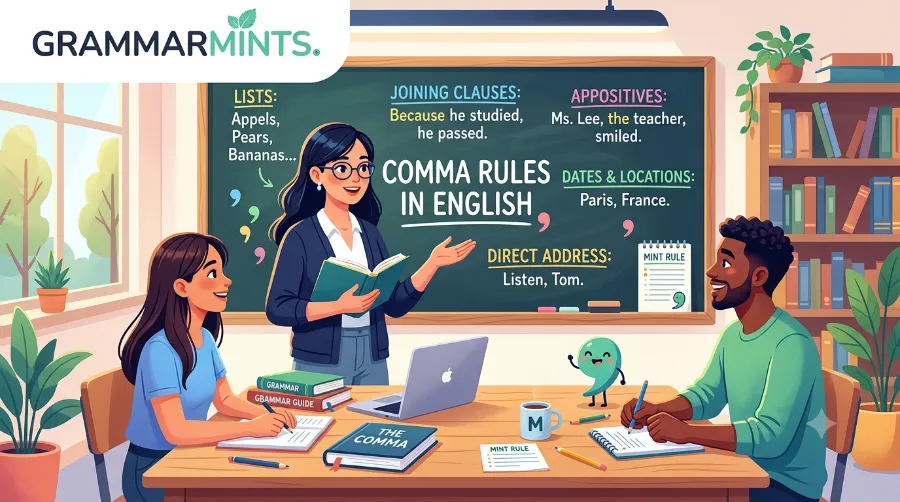
You see them in textbooks, emails, and social media posts every day. Commas are tiny shapes that hold huge power over your writing structure. Consequently, confusing these tiny markings can alter your entire message or leave your reader totally lost.
Mastering these guidelines helps you express your thoughts smoothly and professionally. Therefore, this comprehensive article will break down exactly how to use them safely. We will explore clear definitions, everyday scenarios, and the foundational syntax you need to write with true confidence.
Quick Answer: What Are Comma Rules in English?
Comma rules in English are structural guidelines that dictate exactly where to place a comma inside a sentence. Ultimately, these standards help separate distinct thoughts, clarify itemized lists, and provide logical pauses for readers. Following them prevents confusing sentences and keeps your writing highly professional.
TL;DR: The Core Comma Rules At a Glance
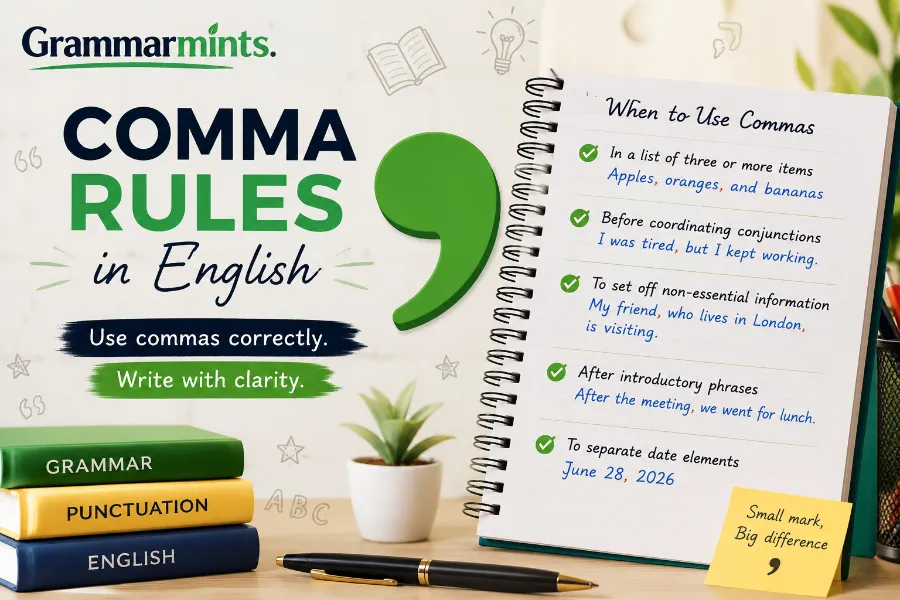
• Use commas to separate three or more items in a list.
• Place one before coordinating conjunctions when joining independent thoughts.
• Put a comma after introductory words or introductory phrases.
• Set off extra, non-essential information within your text.
• Use them between descriptive words that modify nouns equally.
• Avoid putting them between simple subjects and their main verbs.
What is a Comma and What is Its Part of Speech?
To begin, we must define the term clearly. A comma is a punctuation mark depicted by a small curved line (,). In grammatical terms, it is classified strictly as a punctuation mark, rather than a standard part of speech like a noun or a verb.
Furthermore, this symbol serves as an internal organizer for human language. Its primary function is to establish structural boundaries within written expressions. It signals a small separation without stopping the entire idea.
How It Works: The Purpose of Punctuation Pacing
Commas work by changing how a reader paths through your text. Think of them as soft yields on an open highway. Specifically, they tell the human mind to take a tiny breath before moving forward.
Without Comma: Let's eat Grandma! (Sounds dangerous!)
With Comma:    Let's eat, Grandma! (A friendly invitation to dinner.)
As demonstrated, missing punctuation can alter your literal meaning entirely. Accordingly, proper placement keeps your intent safe and perfectly transparent.
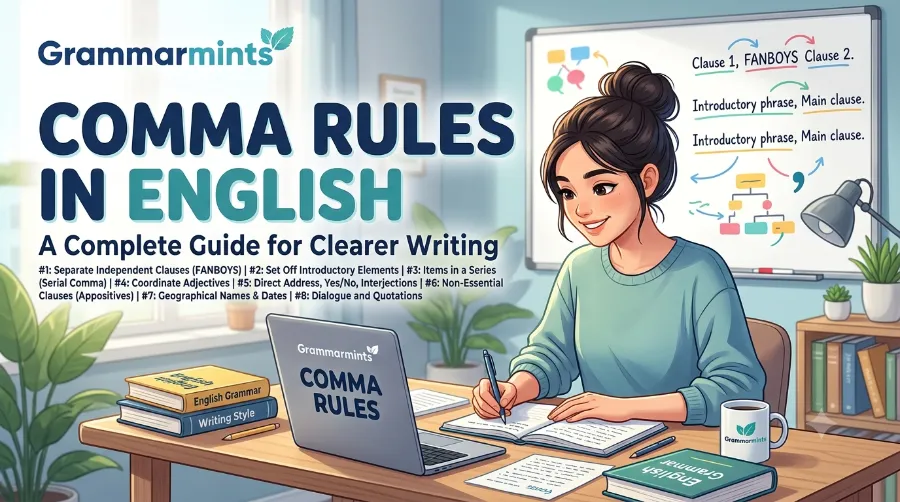
The 8 Main Comma Rules in English
1. Separating Items in a List (The Oxford Comma)
When you list three or more things, you must separate them. For example, you might buy apples, bananas, and oranges. The final marking before the word “and” is famously known as the Oxford comma. It removes all doubt about where items start and finish.
2. Joining Two Independent Clauses with Conjunctions
An independent clause is simply a complete thought that can stand alone. If you link two complete thoughts with words like but, or, or and, add a comma first. For instance: “She wanted to walk, but the rain started falling heavily.”
3. After an Introductory Phrase or Dependent Clause
If you start a sentence with a transition or an uncompleted thought, follow it with a pause. For example: “Suddenly, the lights flickered off.” Similarly: “Because it was late, we went straight to sleep.”
4. Setting Off Non-Essential Information
Sometimes you add extra details that your sentence does not actually need to make basic sense. You should cradle these extra details inside matching commas. For example: “My math teacher, who loves chess, gave us a bonus puzzle.”
5. Between Coordinate Adjectives
If two descriptive words modify a noun equally, separate them cleanly. You can test this by trying to swap their placement. If the phrase still sounds natural, like “a cold, rainy afternoon,” you need that pause.
6. Introducing Direct Quotes
When you write down exact spoken words, you must introduce them correctly. Usually, you place a comma right before the opening quotation mark. For instance: He turned around and yelled, “Wait for me!”
7. Punctuating Direct Address
When speaking directly to a specific person, isolate their name from the rest of the statement. For example, write: “Thank you for the help, David.” This indicates exactly who is receiving the message.
8. Separating Dates, Addresses, and Titles
Standard formatting requires punctuation when listing formal data. You must separate the day from the year, such as July 4, 1776. Also, use them to separate cities from states, like Austin, Texas.
When Not to Use a Comma: Common Misplacement
Using too many markings can ruin your pacing just as quickly as using too few. Therefore, you must learn where to avoid them.
| Context | Best Choice | Why |
| Subject and Verb | No Comma | Never separate the main actor from their action. |
| Compound Predicates | No Comma | Do not add pauses between two actions done by one subject. |
| Restrictive Clauses | No Comma | Essential information cannot be cut out with punctuation. |
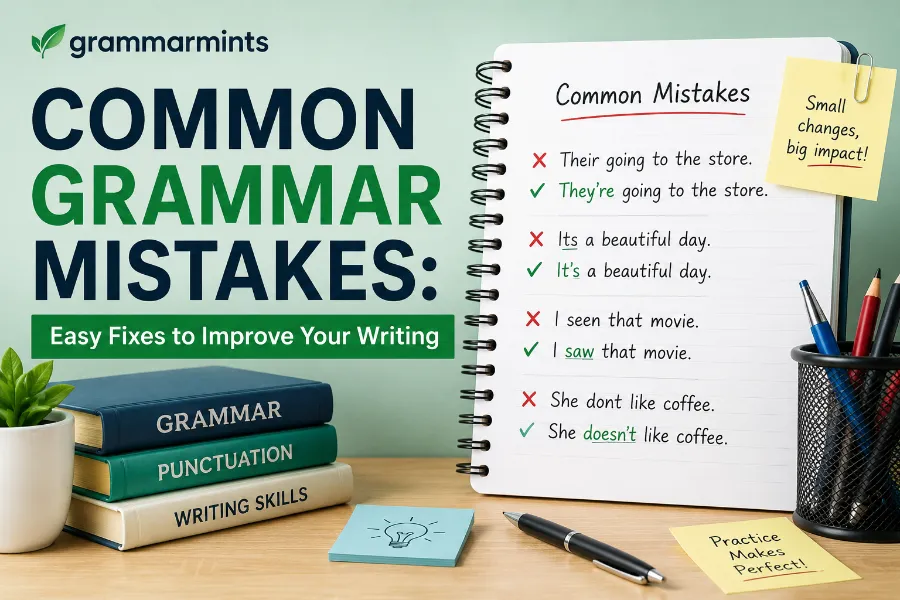
Common Mistakes: The Dreaded Comma Splice
A comma splice happens when you glue two complete thoughts together without a proper coordinating conjunction. This creates a confusing run-on sentence that disrupts natural reading.
- Incorrect: “I love baking cookies, they taste absolutely amazing.”
- Correct: “I love baking cookies, and they taste absolutely amazing.”
- Alternative: “I love baking cookies; they taste absolutely amazing.”
Real-World Practice: Quick Scenario Guide
Let us look at some everyday modern examples to see these rules in action.
- Emailing a boss: “As requested, I sent over the updated financial reports.”
- Texting a friend: “Hey Sarah, are we still meeting up for lunch today?”
- Writing an essay: “The experiment was successful, yet the team required more data.”
Comma Rules Mini Quiz
Test your understanding with these quick practice questions.
- Which sentence uses correct list punctuation?
- A=I need paper pens and tape.
- B= I need paper, pens, and tape.
- Fix this sentence: “After we finished lunch we walked to the park.”
- True or False: You should always place a comma between a subject and its verb.
Answer Key
- B (It correctly utilizes commas to separate listed items cleanly.)
- Correction: “After we finished lunch, we walked to the park.” (Requires a pause after the introductory clause.)
- False (This separates the main actor from the action, which is grammatically incorrect.)
Frequently Asked Questions
What are the 8 main comma rules?
The core rules include separating list items, joining independent thoughts, setting off introductory clauses, and enclosing non-essential data. Additionally, they involve separating coordinate adjectives, setting off direct quotes, indicating direct address, and formatting dates or addresses.
Where do you put commas in a sentence?
You place them where structural grammar boundaries occur, such as after introductory phrases or before coordinating conjunctions. They also go between multiple items in a series and around extra descriptive details.
Is a comma necessary before “and”?
Yes, it is highly recommended in lists of three or more items to avoid confusion. This specific placement is widely known as the Oxford comma.
When should you not use a comma?
You should never place one directly between a subject and its main verb. Furthermore, avoid using them to join two complete thoughts without a coordinating conjunction word.
What is a comma splice?
A comma splice is an error that occurs when two independent thoughts are joined by only a comma. You must fix this by adding a conjunction, a semicolon, or a period.
Conclusion
Understanding comma rules in english is an essential step toward clearer, more professional communication. By using these pauses correctly, you guide your readers safely through your ideas. Take a moment to review your next written draft for these basic placements to see an immediate improvement.