Good grammar helps people understand your ideas clearly. Whether you write emails, essays blog posts, or social media updates, avoiding common grammar mistakes makes your writing more professional and easier to read. Even native English speakers make grammar errors every day. The good news is that most of these mistakes are easy to fix once you know what to look for.
In this guide, you will learn the most common grammar mistakes, why they happen, and simple ways to avoid them. You’ll also find practical examples, useful tables, FAQs, and a statistics chart to help you become a stronger writer.
Table of Contents
- Why Grammar Matters
- Most Common Grammar Mistakes
- Easy Ways to Avoid Grammar Errors
- Grammar Statistics
- Grammar Mistakes Comparison Table
- Frequently Asked Questions
- Conclusion
Why Grammar Matters
Grammar is the foundation of clear communication. When your grammar is correct, readers understand your message quickly. On the other hand, grammar mistakes can confuse readers and reduce your credibility.
Correct grammar helps you:
- Write professional emails.
- Improve school assignments.
- Create better blog posts.
- Build trust with readers.
- Communicate clearly.
Even small improvements can make a big difference in how people view your writing.
Most Common Grammar Mistakes
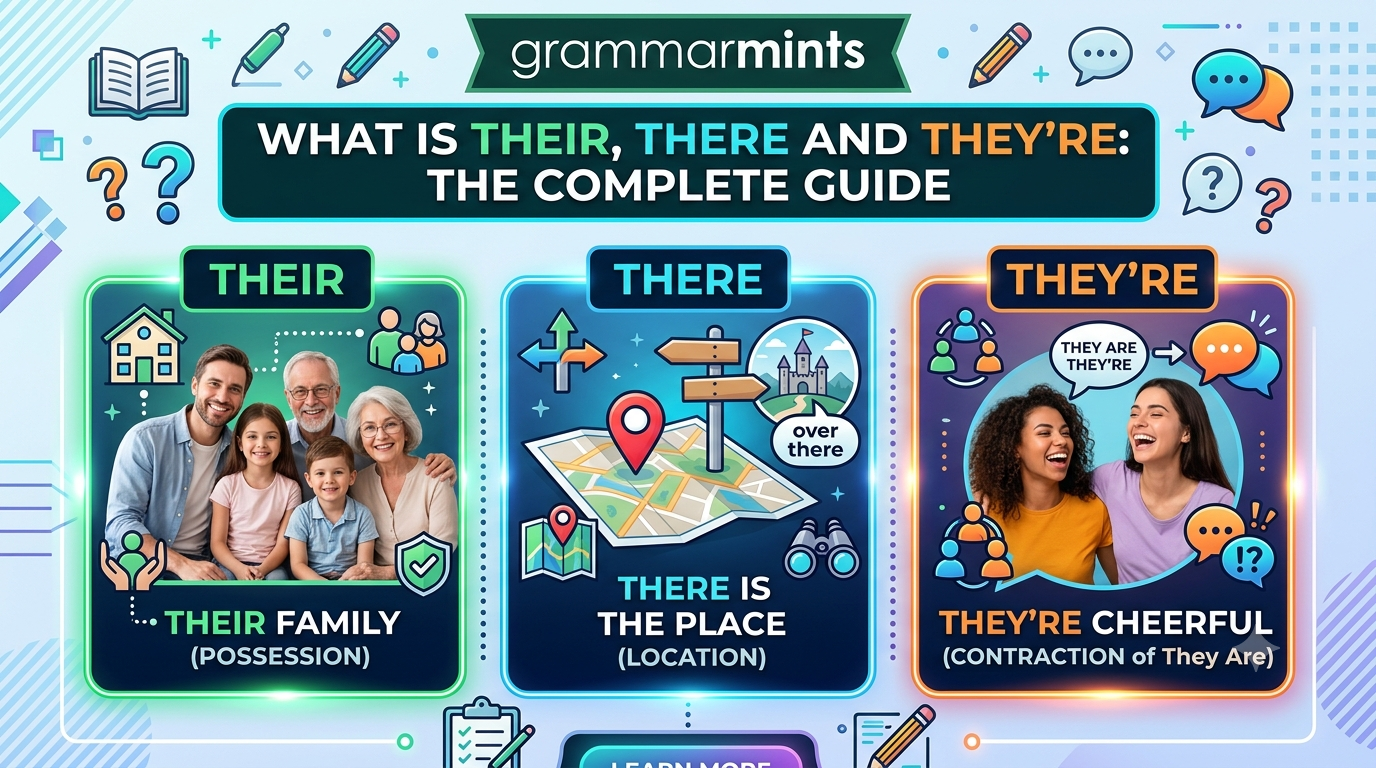
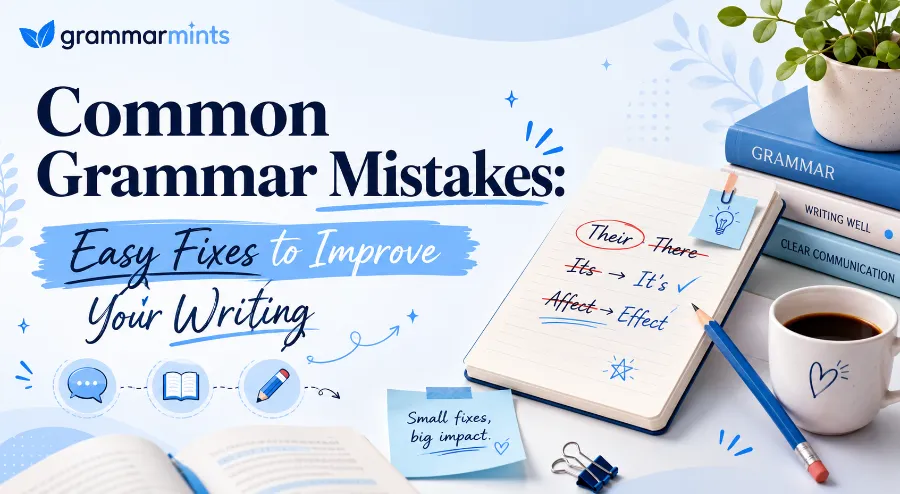
1. Their, There, and They’re
These three words sound alike but have different meanings.
| Word | Meaning | Example |
|---|---|---|
| Their | Shows ownership | Their house is beautiful. |
| There | Indicates a place | The book is over there. |
| They’re | Means “they are” | They’re going shopping. |
Incorrect:
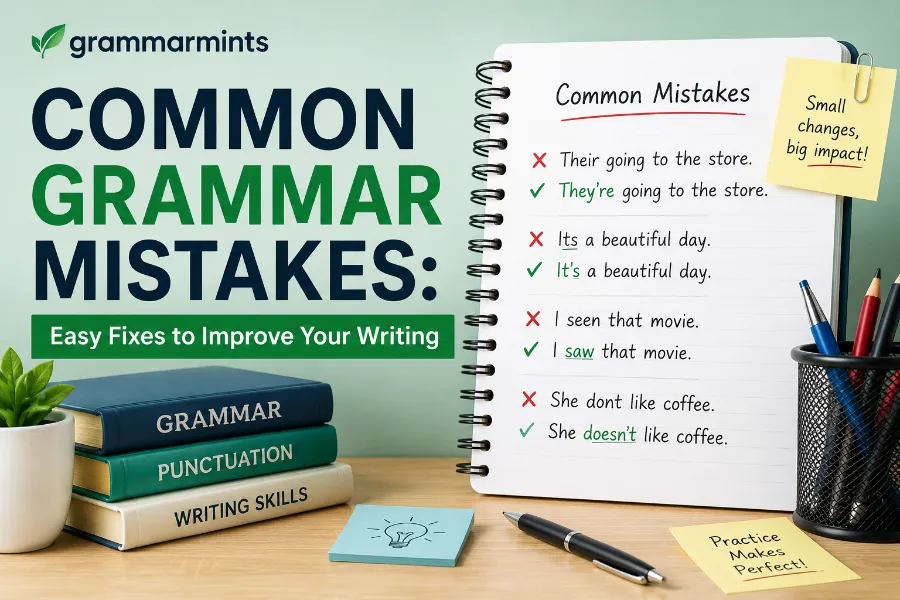
Their going to school.
Correct:
They’re going to school.
2. Your vs. You’re
Another common mistake involves these two words.
Your shows possession.
Example:
Your phone is ringing.
You’re means “you are.”
Example:
You’re doing great.
Wrong:
Your welcome.
Correct:
You’re welcome.
3. Its vs. It’s
Its shows ownership.
Example:
The dog wagged its tail.
It’s means “it is.”
Example:
It’s raining today.
Many writers accidentally swap these words.
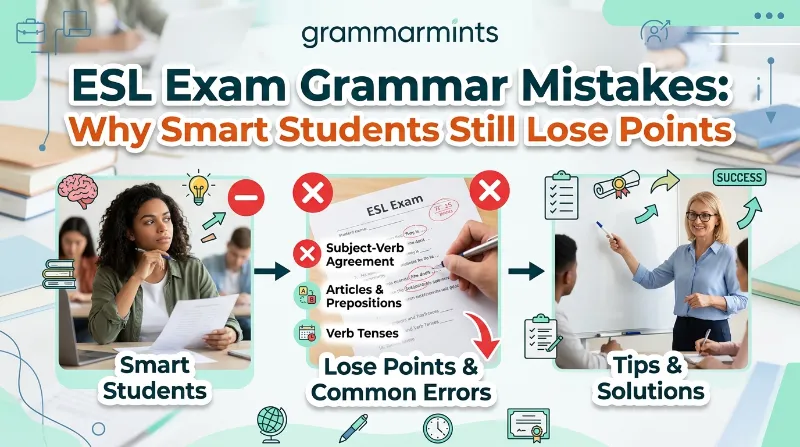
4. Subject-Verb Agreement
The subject and verb must agree.
Wrong:
She walk to school.
Correct:
She walks to school.
Wrong:
The dogs runs fast.
Correct:
The dogs run fast.
5. Sentence Fragments
Every sentence needs a subject and a verb.
Wrong:
Because I was tired.
Correct:
Because I was tired, I went to bed early.
6. Run-on Sentences
Run-on sentences combine ideas without proper punctuation.
Wrong:
I love grammar it helps my writing.
Correct:
I love grammar. It helps my writing.
Or
I love grammar because it helps my writing.
7. Apostrophe Mistakes
Apostrophes show possession or contractions.
Wrong:
The cats toy.
Correct:
The cat’s toy.
Wrong:
Its raining.
Correct:
It’s raining.
8. Double Negatives
Using two negatives changes the meaning.
Wrong:
I don’t know nothing.
Correct:
I don’t know anything.
9. Confusing Affect and Effect
Affect is usually a verb.
Effect is usually a noun.
Example:
The weather affected our trip.
The effect was noticeable.
10. Misplaced Modifiers
Modifiers should describe the correct word.
Wrong:
Walking down the street, the flowers looked beautiful.
Correct:
Walking down the street, I noticed the beautiful flowers.
Simple Ways to Avoid Grammar Mistakes
Improving grammar doesn’t have to be difficult.
Follow these simple tips:
- Read your writing aloud.
- Keep sentences short.
- Learn one grammar rule each week.
- Practice writing every day.
- Proofread before publishing.
- Use grammar-checking tools carefully.
- Read books and quality articles regularly.
Common Grammar Mistakes at a Glance
| Grammar Mistake | Correct Example |
| Your vs You’re | You’re welcome. |
| Their vs There | Their car is new. |
| Its vs It’s | It’s sunny today. |
| Run-on Sentence | Split into two sentences. |
| Subject Agreement | She writes daily. |
| Double Negative | I don’t know anything. |
| Apostrophe Error | John’s book. |
| Sentence Fragment | I stayed home because I was sick. |
Grammar Statistics
Recent educational studies show that:
| Finding | Percentage |
| Students making punctuation mistakes | 61% |
| Errors involving apostrophes | 47% |
| Subject-verb agreement mistakes | 39% |
| Homophone mistakes | 54% |
| Proofreading improves accuracy | More than 70% |
Grammar Error Frequency
Punctuation ████████████████████
Homophones █████████████████
Apostrophes ███████████████
Subject Agreement ████████████
Fragments █████████
The chart shows that punctuation and homophone errors remain the most common writing problems.
Tips for Better Writing
Good writers continuously improve.
Remember these habits:
- Read every sentence twice.
- Avoid writing long paragraphs.
- Learn from your previous mistakes.
- Keep practicing.
- Ask someone to review important documents.
- Focus on clarity instead of using difficult words.
Frequently Asked Questions
What are the most common grammar mistakes?
They include your vs. you’re, their vs. there, its vs. it’s, apostrophe errors, sentence fragments, run-on sentences, and subject-verb agreement mistakes.
Why do grammar mistakes happen?
Most grammar mistakes happen because people write quickly, skip proofreading, or confuse similar words.
How can I improve my grammar quickly?
Read regularly, write every day, proofread carefully, and practice one grammar rule at a time.
Do grammar mistakes matter online?
Yes. Correct grammar makes your writing more trustworthy, easier to understand, and more professional.
Can grammar tools replace proofreading?
No. Grammar tools are helpful, but human proofreading is still the best way to catch context-related mistakes.
Conclusion
Everyone makes grammar mistakes, but anyone can improve with regular practice. Learning the most common grammar mistakes is the first step toward becoming a better writer. By applying the tips and examples in this guide, you can write with greater confidence, improve readability, and communicate your ideas more effectively in school, at work, and online.