
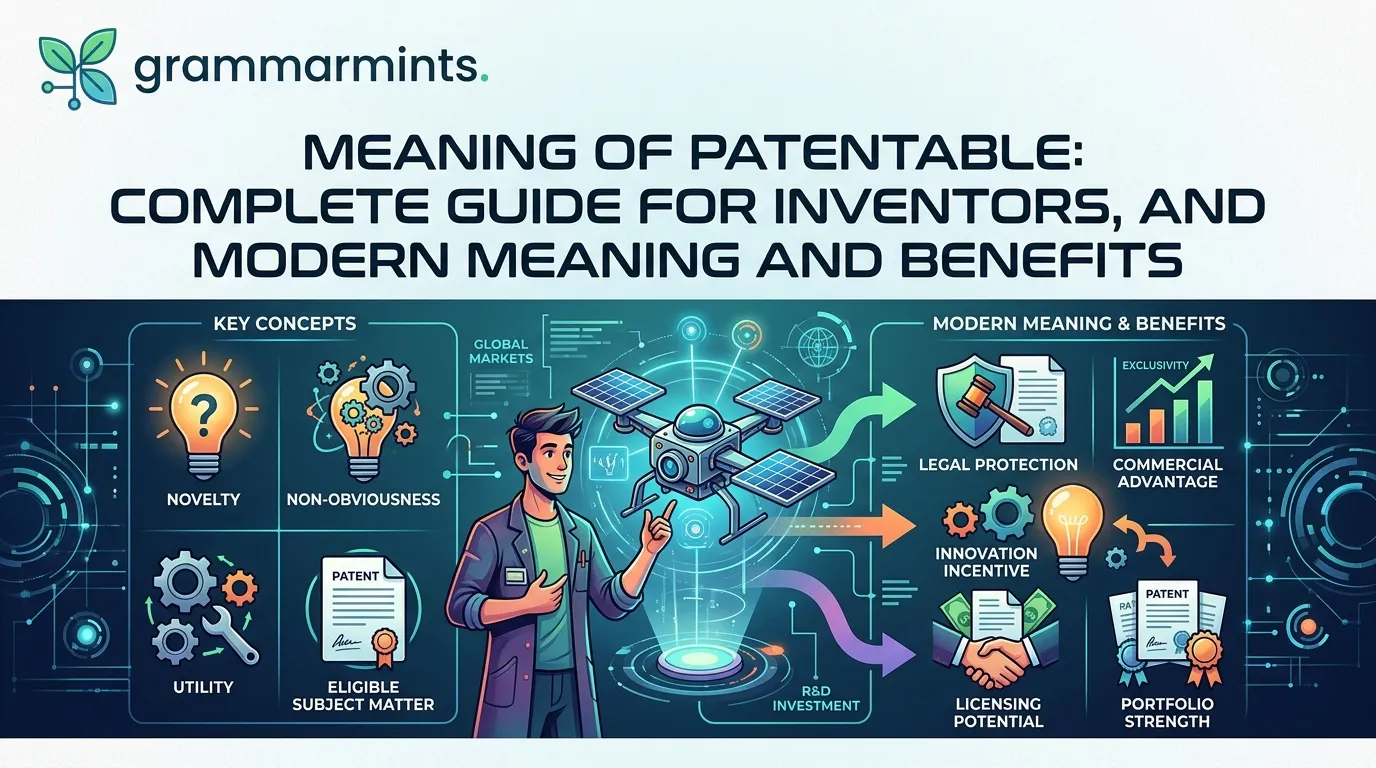
Understanding the meaning of patentable is important for inventors, entrepreneurs, researchers, and business owners. Every year, thousands of people create new products, software solutions, medical devices, and manufacturing processes. However, not every idea qualifies for patent protection.
If you have developed a unique invention, you may wonder whether it can receive a patent. This guide explains what patentable means, the requirements for patent eligibility, real-world examples, common mistakes, and the latest patent trends.
What Is the Meaning of Patentable?
The term patentable refers to an invention that meets the legal requirements necessary to receive a patent from a government patent office.
A patent gives an inventor exclusive rights to make, use, sell, or license an invention for a specific period. In the United States, utility patents generally last 20 years from the filing date.
Simply having a good idea does not make it patentable. The invention must satisfy several legal standards before authorities approve it.
Simple Definition
Patentable means:
Eligible to receive patent protection because it meets legal requirements such as novelty, usefulness, and non-obviousness.
Why Patentability Matters
Patent protection offers several benefits:
- Prevents competitors from copying your invention
- Creates licensing opportunities
- Increases business value
- Attracts investors
- Provides market advantages
- Builds intellectual property assets
Consequently, many startups and large companies invest heavily in patent development.
Main Requirements for Patentability
To qualify for patent protection, an invention generally must meet the following requirements.
1. Novelty
Novelty means the invention must be new.
If someone already disclosed, sold, published, or patented the same invention, it may lose patent eligibility.
Example
Suppose a company invented a foldable smartphone in 2026. If a similar design already appeared in patent databases before the filing date, the invention may fail the novelty test.
2. Non-Obviousness
The invention must not be obvious to a person skilled in the relevant field.
This requirement prevents simple modifications from receiving patent protection.
Example
Adding a slightly larger battery to an existing smartphone may appear obvious. Therefore, the patent office could reject the application.
3. Utility
The invention must provide a useful purpose.
A patent office typically requires evidence that the invention works as described.
Examples
Useful inventions include:
- Medical devices
- Manufacturing equipment
- Software systems
- Renewable energy technologies
- Consumer electronics
4. Patent-Eligible Subject Matter
Some categories qualify for patents while others do not.
Generally Patentable
| Category | Example |
|---|---|
| Machines | Industrial robots |
| Processes | Manufacturing methods |
| Articles of manufacture | Electronic devices |
| Compositions of matter | Pharmaceuticals |
Generally Not Patentable
| Category | Example |
| Abstract ideas | Pure mathematical formulas |
| Natural phenomena | Gravity |
| Laws of nature | Natural biological processes |
| Human concepts | Mental processes |
Patentable vs Non-Patentable Inventions
The table below highlights the difference.
| Feature | Patentable | Non-Patentable |
| New | Yes | No |
| Useful | Yes | No |
| Non-obvious | Yes | No |
| Eligible subject matter | Yes | No |
| Can receive patent | Yes | No |
Real-Life Patent Examples
Many famous inventions received patent protection because they met patentability requirements.
Apple’s Smartphone Innovations
Apple obtained numerous patents covering touchscreen technology, user interfaces, and device design.
Pharmaceutical Breakthroughs
Drug manufacturers regularly patent new medicines. These patents often protect billions of dollars in research investments.
Electric Vehicle Technologies
Companies such as Tesla, Inc. file patents for battery systems, charging technologies, and manufacturing processes.
How Patent Offices Evaluate Patentability
Patent examiners follow a detailed review process.
Step 1: Application Submission
The inventor files:
- Specifications
- Claims
- Drawings
- Supporting documents
Step 2: Prior Art Search
Examiners search existing:
- Patents
- Research papers
- Publications
- Technical documents
Step 3: Examination
The examiner compares the invention against prior art.
Step 4: Approval or Rejection
The patent office may:
- Approve the application
- Request amendments
- Issue a rejection
Patentability Checklist
Before filing, ask these questions:
Quick Evaluation Guide
| Question | Yes | No |
| Is it new? | ✓ | |
| Does it solve a problem? | ✓ | |
| Is it useful? | ✓ | |
| Is it non-obvious? | ✓ | |
| Can you explain how it works? | ✓ |
More “Yes” answers generally indicate stronger patent potential.
Common Reasons Patent Applications Fail
Many applications face rejection.
Lack of Novelty
The invention already exists.
Obvious Modifications
The improvement is too predictable.
Poor Documentation
Inventors sometimes fail to explain their invention clearly.
Ineligible Subject Matter
The invention falls into excluded categories.
Patent Statistics and Trends
The patent landscape continues to grow worldwide.
Global Patent Activity
| Year | Estimated Patent Applications Worldwide |
| 2021 | 3.4 Million |
| 2022 | 3.46 Million |
| 2023 | 3.55 Million |
| 2024 | 3.6+ Million |
Source data compiled from international intellectual property reports.
Patent Application Growth Chart
2021 ▓▓▓▓▓▓▓▓▓▓▓▓▓▓▓▓
2022 ▓▓▓▓▓▓▓▓▓▓▓▓▓▓▓▓▓
2023 ▓▓▓▓▓▓▓▓▓▓▓▓▓▓▓▓▓▓
2024 ▓▓▓▓▓▓▓▓▓▓▓▓▓▓▓▓▓▓▓
The chart illustrates continued growth in global innovation and intellectual property filings.
How to Determine If Your Invention Is Patentable
Follow these steps.
Step 1: Document Everything
Record:
- Development dates
- Design changes
- Testing results
Step : Evaluate Novelty
Compare your invention against existing solutions.
Step 4: Consult a Patent Professional
Professional guidance can significantly improve application quality.
Benefits of Obtaining a Patent
Patents provide several business advantages.
Competitive Protection
Competitors cannot legally copy patented inventions.
Licensing Revenue
Companies can earn royalties from licensing agreements.
Investor Confidence
Strong intellectual property often attracts investors.
Increased Company Value
Patent portfolios can become valuable business assets.
Patentable Ideas in Emerging Industries
Several industries continue generating strong patent activity.
Artificial Intelligence
AI inventions involve:
- Machine learning systems
- Data processing methods
- Automation technologies
Renewable Energy
Examples include:
- Solar technologies
- Battery storage systems
- Green hydrogen solutions
Biotechnology
Researchers frequently patent:
- Medical therapies
- Diagnostic tools
- Pharmaceutical compounds
Frequently Asked Questions
What does patentable mean in simple words?
Patentable means an invention qualifies for patent protection because it meets legal requirements such as novelty, usefulness, and non-obviousness.
Can an idea alone be patented?
Generally, no. Patent offices require a detailed invention rather than a simple idea.
How long does a patent last?
Most utility patents in the United States last 20 years from the filing date.
Is software patentable?
Some software-related inventions may qualify if they meet patent eligibility requirements.
Who decides whether something is patentable?
Patent examiners at government patent offices evaluate applications and determine eligibility.
Conclusion
The meaning of patentable goes beyond simply having a creative idea. An invention must be new, useful, non-obvious, and legally eligible for patent protection. Understanding these requirements can help inventors save time, reduce filing mistakes, and improve their chances of obtaining valuable intellectual property rights. As innovation continues to accelerate across technology, healthcare, energy, and manufacturing industries, knowing whether an invention is patentable remains a critical step toward long-term success.