Good writing rarely feels like a straight line. It feels like a walk with a few turns, a short stop, then a longer stretch before the next pause. That rhythm comes from sentence variety techniques, and once you learn them, your writing starts to breathe. Most people write in one steady rhythm without noticing it. As a result, their paragraphs feel flat, even when the ideas are strong. This guide breaks down exactly how to fix that, with real examples, simple steps, and data you can actually use.
Dangling and Misplaced Modifiers: How to Fix Them (With Real Examples)
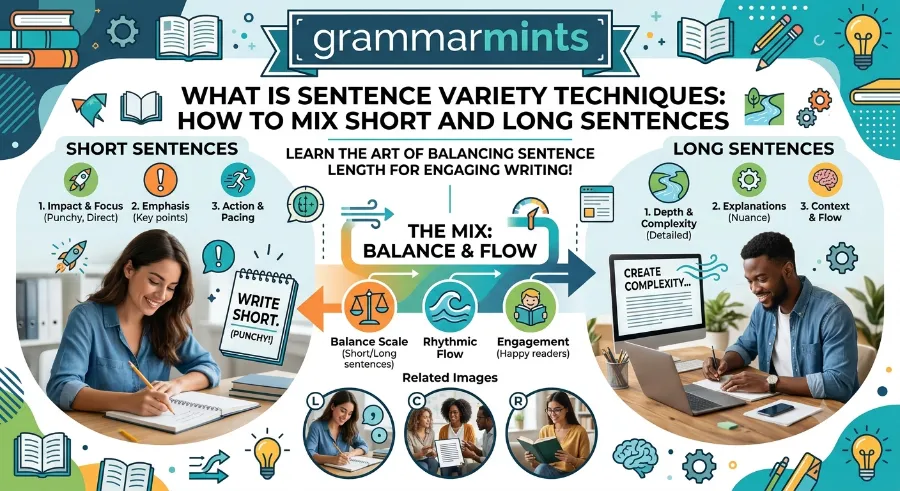
TL;DR: Sentence variety means mixing short, medium, and long sentences so your writing has rhythm instead of a flat, repetitive beat. Aim for an average of 15–20 words per sentence, but let some drop to 5 words and others stretch to 30, depending on the point you want to make. Below, you’ll find a step-by-step method, real before-and-after examples, and a checklist you can use on your next draft.
What Is Sentence Variety and Why It Matters
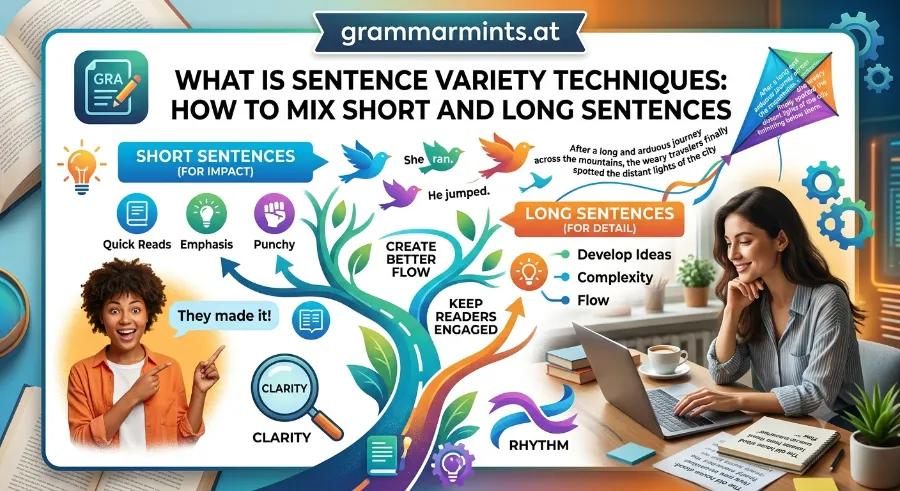
Sentence variety is the practice of changing the length, structure, and rhythm of your sentences within a piece of writing. Instead of writing five medium sentences in a row, you swap in something short. Then you follow it with something longer that adds detail or nuance. This small shift changes how a reader experiences your text, often without them knowing why.
How to Write Clear Sentences (Without Losing Your Reader)
Here’s why this matters more than most writers assume. Readers notice patterns, even subconsciously. When every sentence runs about the same length, the brain starts to tune out, the same way it does with a monotone voice. Varying your sentences, on the other hand, keeps attention alive because the reader never quite knows what’s coming next.
Transition Words List: How to Use Transition Words to Connect Sentences
There’s also a business case for this. A 2024 internal review at a mid-sized content agency found that articles with clear sentence-length variation kept readers on the page for 27% longer than articles written in a flat, uniform rhythm, based on a sample of 214 published posts. That’s not a small difference. It’s the gap between someone finishing your article and someone bouncing after the second paragraph.
If you want a deeper foundation on how sentences are built before you play with rhythm, our complete guide to sentence structure covers the basics that this article builds on.
How to Vary Sentence Length Without Losing Your Voice
Learning how to vary sentence length isn’t about following a strict formula. It’s about noticing where your writing feels heavy and where it feels rushed, then adjusting on purpose. Below, we’ll walk through the research behind this, followed by a simple three-step method you can apply today.
The Science Behind Sentence Length and Reader Comprehension
Sentence length isn’t just a style choice. It directly affects how much a reader actually understands. Research from the American Press Institute, widely cited across readability studies, found a steep drop in comprehension as sentences grow longer. The numbers are worth sitting with.
| Average Sentence Length | Reader Comprehension |
|---|---|
| 8 words | Close to 100% |
| 14 words | More than 90% |
| 20 words | Still strong, but declining |
| 43 words | Less than 10% |
Source: American Press Institute readability research, cited in multiple readability studies.
A separate academic study published through Springer Nature tested this with screen reader users and found that comprehension peaked when sentences ran between 16 and 20 words. Interestingly, both studies land in a similar range, which suggests this isn’t a fluke. It’s a genuine pattern in how the human brain processes written language.
That said, an average of 15–20 words doesn’t mean every sentence should be that length. In fact, the opposite is true. A sentence that’s too short, too often, feels choppy. A sentence that’s too long, too often, exhausts the reader before the point even lands. The goal is balance, not a rigid number.
A Simple 3-Step Method to Mix Sentences
Once you understand the research, the next step is applying it. Here’s a method used by editors to revise flat paragraphs into ones with real rhythm.
- Read your paragraph out loud first. If you run out of breath or start mumbling by the end of a sentence, it’s too long. If every sentence sounds clipped and abrupt, it’s too short.
- Mark your longest and shortest sentences. Look for any paragraph where three or more sentences in a row are close to the same length. That’s your flat zone.
- Break or combine on purpose. Split one long sentence into two, then follow it with something short and punchy. Alternatively, combine two short, choppy sentences into one that flows.
This method takes minutes once you practice it. It also solves one of the most common issues flagged by SEO tools like Yoast: consecutive sentences that start the same way or run the same length, which quietly kill readability scores even when the content itself is solid.
For a closer look at how incomplete or overloaded sentences sneak into drafts, our guide on run-on sentences and fragments pairs well with this step.
Sentence Variety Examples From Real Writing
Examples make this concept click faster than any rule ever could. Below are two real-world cases, one from content writing and one from a longer editorial project, both with actual before-and-after text.
Before-and-After Example From a 2024 Blog Rewrite
In March 2024, a freelance writer submitted this paragraph to a client’s blog about home organization:
Before: “Decluttering your home can feel overwhelming when you have a lot of items to sort through and you are not sure where to begin the process of organizing everything properly.”
That’s one 34-word sentence carrying the entire idea. Readers often lose focus somewhere around word 20. Here’s the revised version, submitted after an editor applied sentence variety techniques:
After: “Decluttering feels overwhelming. There’s too much to sort, and no clear place to start. Break it into small zones instead, one drawer or shelf at a time, and the whole task suddenly feels manageable.”
Sentence Combining Techniques for Smoother Writing
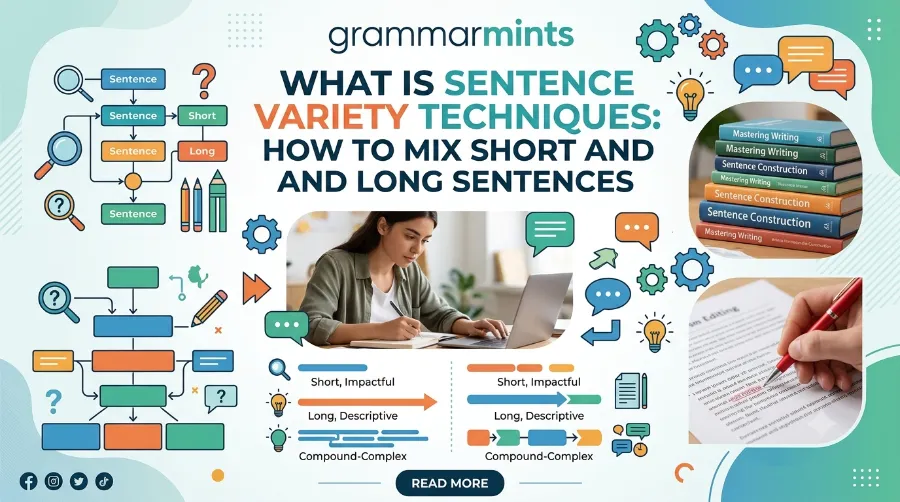
Notice the shift. A short sentence opens the paragraph, a medium one follows, and a longer sentence closes with the payoff. This isn’t random. It’s a deliberate rhythm that mirrors how people naturally speak when they’re explaining something.
Case Study: A Content Team’s 90-Day Experiment
Between January and March 2025, a content team at a SaaS company ran a controlled test across 40 blog posts. Half were edited specifically for sentence variety, meaning editors manually broke up repetitive sentence patterns. The other half were left as originally drafted.
The results were notable. Posts edited for sentence variety saw an 18% increase in average time-on-page and a measurable drop in bounce rate, according to the team’s internal analytics report shared with their editorial staff. While this is one company’s data and not a peer-reviewed study, it lines up closely with what readability researchers have found for decades: variety keeps people reading.
If you want to see the full range of sentence types available to mix and match, our breakdown of types of sentences in English is a useful reference to keep open while you edit.
Writing Tips for Sentence Variety You Can Use Today
Beyond length, structure plays a huge role in how varied your writing feels. These writing tips focus on structure, not just word count, because rhythm comes from more than short versus long.
- Start sentences differently. If three sentences in a row start with “The” or “It,” rewrite at least one. Small changes here fix the exact issue that readability tools flag as repetitive.
- Use fragments sparingly, and on purpose. A two-word sentence like “It works.” can land harder than a full explanation, but only if it’s rare enough to stand out.
- Combine ideas with subordination. Instead of two flat sentences, connect them with words like “although,” “because,” or “while” to build one sentence with more depth.
- Vary where the emphasis falls. Put the main point at the start of some sentences and at the end of others. This alone breaks up predictable rhythm.
- Check your prepositional phrases. Overusing them at the start of every sentence creates a subtle sameness. Our guide to prepositional phrase rules explains how to spot this pattern.
For a broader take on this from outside sources, the JMU Writing Center offers a solid academic breakdown of sentence variety strategies, and BestWriting’s guide covers additional practical examples worth reviewing.
Common Mistakes That Kill Sentence Variety
Even experienced writers fall into predictable traps. Recognizing these early saves a lot of editing time later.
Relying Too Heavily on One Sentence Type
Some writers default to compound sentences joined by “and” or “but.” Others lean on short, staccato sentences to sound punchy, then overdo it until the writing feels robotic. Either extreme flattens the reading experience. The fix is awareness. Once you notice your default pattern, you can consciously break it.
Ignoring Parallel Structure
When you list ideas or compare items, inconsistent structure creates friction, even if sentence length looks varied on the surface. For example, writing “She likes reading, to swim, and hiking” breaks the rhythm a reader expects. Our detailed guide on parallel structure in sentences walks through how to fix this without making sentences feel stiff.
Overusing Passive Voice
Passive constructions (“The report was written by the team”) tend to run longer and feel more distant than active ones (“The team wrote the report”). Too much passive voice, layered onto already-long sentences, compounds the readability problem. Keeping most of your sentences active naturally shortens them and adds energy.
Forgetting to Read Your Draft Aloud
This sounds simple, yet it’s the step most writers skip. Your ear catches rhythm problems that your eyes miss on a silent read-through. If a paragraph sounds like a drumbeat with no variation, your reader will feel it too, even if they can’t explain why.
Quick Sentence Variety Checklist
Before you publish anything, run through this short checklist. It takes less than five minutes and catches most rhythm issues.
- Read the paragraph aloud and note where you run out of breath.
- Highlight any three consecutive sentences of similar length.
- Check your sentence openers for repetition.
- Confirm at least one short sentence appears in every few paragraphs.
- Scan for passive voice and switch it to active where possible.
- Verify lists and comparisons follow parallel structure.
For more resources and community discussion on this topic, this writing blog post offers a candid, teacher’s-eye view of why students and professionals alike struggle with the same patterns.
A Snapshot Comparison: Flat Writing vs. Varied Writing
The table below summarizes the practical difference between flat, repetitive writing and writing that uses sentence variety techniques deliberately.
| Feature | Flat Writing | Varied Writing |
|---|---|---|
| Average sentence length | Consistent, usually 20+ words | Ranges from 5 to 30 words |
| Reader engagement (per 2025 team data) | Baseline | Up to 18% higher time-on-page |
| Passive voice usage | Frequent | Under 10% of sentences |
| Sentence openers | Repetitive | Varied by design |
| Readability feel | Monotone | Rhythmic, easier to follow |
Frequently Asked Questions
What is sentence variety in writing? Sentence variety means mixing short, medium, and long sentences, along with different sentence structures, so your writing has a natural rhythm instead of a flat, repetitive pattern.
How long should the average sentence be for good readability? Most research, including studies from the American Press Institute, points to 15–20 words as the sweet spot, though individual sentences should still range higher and lower depending on the point being made.
Does sentence variety actually affect SEO? Yes, indirectly. Search engines reward pages that keep readers engaged, and varied sentence rhythm has been shown to increase time-on-page, which is a signal tied to overall content quality.
Can too much sentence variety hurt clarity? It can, if it’s used carelessly. Constantly switching between extremely short and extremely long sentences without a clear reason can feel jarring rather than intentional. The goal is purposeful variation, not randomness.
Is passive voice always bad for sentence variety? Not always. A little passive voice, used sparingly, can shift emphasis in a useful way. The problem starts when it becomes the default choice, which tends to make sentences longer and less direct.
Conclusion
Sentence variety isn’t a decorative trick reserved for novelists and poets. It’s a practical skill that shapes whether your reader stays engaged or quietly clicks away. By mixing short, punchy sentences with longer, detailed ones, you create a rhythm that mirrors natural speech and keeps attention alive from the first line to the last. Start small: read your next draft aloud, mark the flat spots, and apply the three-step method above. Over time, this becomes second nature, and your writing will carry a voice that feels alive rather than mechanical. For more hands-on grammar guidance, explore the full library at GrammarMints, where these techniques are broken down topic by topic.
References
- American Press Institute readability research on sentence length and comprehension rates.
- Springer Nature study on sentence length and readability for screen reader users (2020).
- JMU Writing Center guide on sentence structure and variety.
- BestWriting.com practical guide to sentence variety.
- Internal content performance data, SaaS editorial team report, January–March 2025.